- CATin
- CAT past papers
- CAT 2024 Slot 3
- QA
CAT 2024 Slot 3 — QA questions with answers
All 22 questions of the Quantitative Ability section (14 MCQs, 8 TITA). Try each one, then open its answer and solution.
CAT 2024 Slot 3, timed like the real exam (120 minutes, 40 a section) and scored the CAT way: +3 right, −1 for a wrong MCQ, 0 for a wrong TITA, with the full post-mock analysis. Free — sign in and you come straight back to this paper.
Sit this paper as a timed mock in CATin — freeQuantitative Ability
CAT 2024 Slot 3 · 40 minutes · +3 for a right answer, −1 for a wrong MCQ, 0 for a wrong TITA
Q47MCQSet Theory
In a group of 250 students, the percentage of girls was at least 44% and at most 60%. The rest of the students were boys. Each student opted for either swimming or running or both. If 50% of the boys and 80% of the girls opted for swimming while 70% of the boys and 60% of the girls opted for running, then the minimum and maximum possible number of students who opted for both swimming and running, are
- A72 and 88, respectively
- B75 and 96, respectively
- C72 and 80, respectively
- D75 and 90, respectively
Answer and solution
Answer: (C) 72 and 80, respectively
Girls
satisfy
(44% and 60% of 250), and boys
.
Swimming:
. Running:
. Every student chose at least one, so
both
swimming
running
.
Substituting
: both
.
This rises with
, so the minimum is at
:
, and the maximum is at
:
. Both give whole numbers of students (
and
).
Option A (72 and 88) has the right minimum, but 88 would need
, above the 60% cap of 150.
Hence, option C (72 and 80, respectively).
Q48MCQIndices & Surds
If
, where a and b are natural numbers, then
equals
- A7
- B8
- C9
- D10
Answer and solution
Answer: (B) 8
.
As
and
are natural numbers, match the parts with and without
in
:
and
, i.e.
.
With
,
is one of
,
,
,
. Only
gives
.
Check:
.
So
.
The other options are impossible: every pair with
has
or
, so
,
and
cannot occur. The pair
also sums to
but gives
, not
.
Hence, option B (8).
Q49TITAAverages, Mixtures & Alligations
The average of three distinct real numbers is 28. If the smallest number is increased by 7 and the largest number is reduced by 10, the order of the numbers remains unchanged, and the new arithmetic mean becomes 2 more than the middle number, while the difference between the largest and the smallest numbers becomes 64. Then, the largest number in the original set of three numbers is
Type in your answer (TITA). No negative mark for a wrong answer.
Answer and solution
Answer: 70
Let the numbers be
, so
.
After the changes the numbers are
,
and
, in the same order. Their sum is
, so the new mean is 27.
The new mean is 2 more than the middle number, so
and
.
The new difference between the largest and smallest is
, so
.
Adding the two equations:
, so
and
. Check: the new numbers
, 25 and 60 keep the same order.
The answer is 70.
Q50MCQRemainders
If
is divided by 13, the remainder is
- A5
- B8
- C9
- D4
Answer and solution
Answer: (C) 9
Work modulo 13. Since
, we have
, and so
.
, so
.
, so the remainder is
.
Q51MCQTime & Work
Sam can complete a job in 20 days when working alone. Mohit is twice as fast as Sam and thrice as fast as Ayna in the same job. They undertake a job with an arrangement where Sam and Mohit work together on the first day, Sam and Ayna on the second day, Mohit and Ayna on the third day, and this three-day pattern is repeated till the work gets completed. Then, the fraction of total work done by Sam is
- A1/20
- B3/10
- C1/5
- D3/20
Answer and solution
Answer: (B) 3/10
Take the job as 60 units. Sam does
units a day. Mohit is twice as fast, 6 units a day. Mohit is thrice as fast as Ayna, so Ayna does 2 units a day.
Day 1 (Sam + Mohit): 9. Day 2 (Sam + Ayna): 5. Day 3 (Mohit + Ayna): 8. One 3-day cycle does 22 units.
Two cycles (6 days) do 44 units, leaving 16. Day 7 does 9, leaving 7; day 8 does 5, leaving 2; Mohit and Ayna finish the last 2 units on day 9.
Sam worked on days 1, 2, 4, 5, 7 and 8:
units, which is
of the job.
Option D (3/20) is half of this; it would count only one of Sam's two working days in each cycle.
Hence, option B (3/10).
Q52MCQPolygons & Circles
A circular plot of land is divided into two regions by a chord of length
meters such that the chord subtends an angle of
at the center. Then, the area, in square meters, of the smaller region is
- A
- B
- C
- D
Answer and solution
Answer: (D)
The chord subtends
at the centre, so its length is
.
, so
m.
The smaller region is the minor segment: the sector minus the triangle formed by the two radii and the chord.
Sector:
.
Triangle:
.
Segment:
square metres.
Option B adds the triangle instead of subtracting it, giving the sector plus the triangle rather than the segment. Options A and C use 20 in place of 25.
Hence, option D (
).
Q53MCQSequences & Series
Consider the sequence
and
for
. Then, the value of the sum
, is
- A-1024144
- B-1022121
- C-1023132
- D-1026169
Answer and solution
Answer: (A) -1024144
Only even-numbered terms are needed. With
, the rule gives
.
,
,
, and in general
. Each step keeps this form, since
.
So
, and the sum is
.
The last term, 2023, is
with
, so there are 1012 odd numbers. The sum of the first
odd numbers is
, so the total is
.
Options B, C and D are
,
and
; they come from miscounting the terms.
Hence, option A (-1024144).
Q54TITAInequalities & Modulus
The number of distinct real values of x, satisfying the equation max(x, 2) - min(x, 2) = |x + 2| - |x - 2|, is
Type in your answer (TITA). No negative mark for a wrong answer.
Answer and solution
Answer: 2
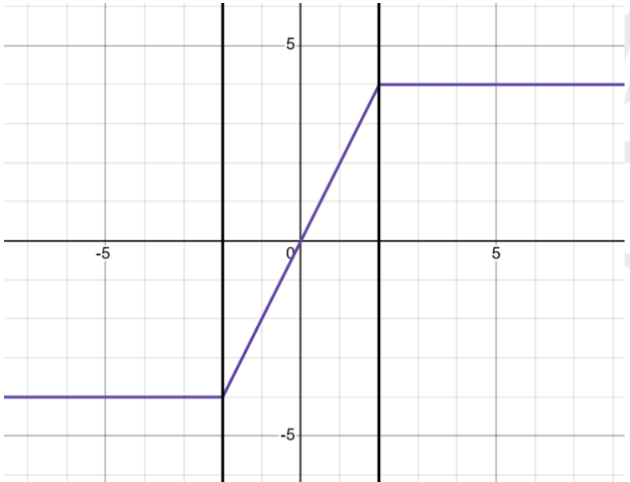
Note that .
So the equation becomes: , which gives .
Case 1: : .
Case 2: : .
Case 3: : , which contradicts .
So there are exactly 2 distinct real values of that satisfy the equation.
Q55TITASimple & Compound Interest
Aman invests Rs 4000 in a bank at a certain rate of interest, compounded annually. If the ratio of the value of the investment after 3 years to the value of the investment after 5 years is 25 : 36, then the minimum number of years required for the value of the investment to exceed Rs 20000 is
Type in your answer (TITA). No negative mark for a wrong answer.
Answer and solution
Answer: 9
The value after
years is
. The ratio of the values after 3 and 5 years is
, so
and
.
We need
, that is,
.
Powers of 1.2:
,
,
, and
.
So 8 years is not enough (
), and 9 years is (
).
The answer is 9.
Q56MCQQuadratic & Polynomial Equations
The sum of all distinct real values of x that satisfy the equation
, is
- A
- B
- C
- D
Answer and solution
Answer: (A)
Let
, which is positive for every real
. The equation becomes
, i.e.
.
Its discriminant
is positive, and the roots have sum
and product
. So both roots are positive and distinct, and each gives one real
; the two
values are distinct.
Sum of the
values
.
Option D (
) comes from taking the product of the roots as
without dividing by the leading coefficient
.
Hence, option A (
).
Q57MCQTime, Speed & Distance
A train travelled a certain distance at a uniform speed. Had the speed been 6 km per hour more, it would have needed 4 hours less. Had the speed been 6 km per hour less, it would have needed 6 hours more. The distance, in km, travelled by the train is
- A720
- B800
- C780
- D640
Answer and solution
Answer: (A) 720
Let the speed be
km/h and the time
hours, so the distance is
.
Faster:
gives
.
Slower:
gives
.
Adding the two equations:
, so
. Then
, so
.
Distance
km. Check: at 36 km/h it takes 20 hours (4 fewer), and at 24 km/h it takes 30 hours (6 more).
The two equations fix
and
, so no other option can satisfy both conditions.
Hence, option A (720).
Q58TITALogarithms
If
and
, then the value of the product abcdef is
Type in your answer (TITA). No negative mark for a wrong answer.
Answer and solution
Answer: 2
Substitute each equation into the next.
.
Raise both sides to the power
:
.
Raise to the power
:
.
Continuing the same way:
, then
, then
.
So
, which gives
.
The same result follows from logarithms:
,
, and so on, and by the change-of-base rule the product
telescopes to
.
The answer is 2.
Q59MCQProfit, Loss & Discount
Gopi marks a price on a product in order to make 20% profit. Ravi gets 10% discount on this marked price, and thus saves Rs 15. Then, the profit, in rupees, made by Gopi by selling the product to Ravi, is
- A10
- B25
- C15
- D20
Answer and solution
Answer: (A) 10
Ravi saves Rs 15 through a 10% discount, so 10% of the marked price is 15 and the marked price is Rs 150.
The marked price gives a 20% profit, so
and the cost price is Rs 125.
Ravi pays
, so Gopi's profit is
rupees.
Option C (15) is the discount, not the profit, and option B (25) is the profit Gopi would make at the full marked price.
Hence, option A (10).
Q60TITAAverages, Mixtures & Alligations
A certain amount of water was poured into a 300 litre container and the remaining portion of the container was filled with milk. Then an amount of this solution was taken out from the container which was twice the volume of water that was earlier poured into it, and water was poured to refill the container again. If the resulting solution contains 72% milk, then the amount of water, in litres, that was initially poured into the container was
Type in your answer (TITA). No negative mark for a wrong answer.
Answer and solution
Answer: 30
Let
litres of water be poured in first, so the milk is
litres and the milk fraction is
.
Taking out
litres leaves
litres in the same ratio. Refilling with water adds no milk, so the milk left is
.
So
, that is,
, or
.
This factors as
. Since
litres were taken from a 300-litre container,
, so
.
Check: 270 litres of milk; removing 60 litres leaves
litres of milk, which is 72% of 300.
The answer is 30.
Q61MCQPolygons & Circles
A regular octagon ABCDEFGH has sides of length 6 cm each. Then the area, in sq. cm, of the square ACEG is
- A72(2 + √2)
- B36(1 + √2)
- C72(1 + √2)
- D36(2 + √2)
Answer and solution
Answer: (D) 36(2 + √2)
A regular octagon has interior angles of
. The square's side AC skips one vertex, so it is the third side of triangle ABC, with
and
.
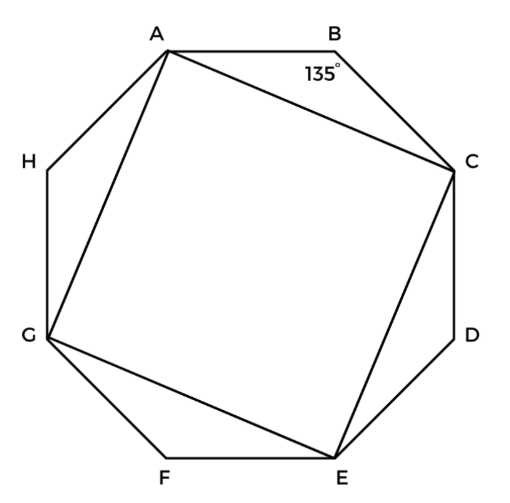
By the cosine rule,
.
The area of square ACEG is
sq cm.
Option A,
, is twice this. Option C,
, is the area of the whole octagon,
with
.
Hence, option D (36(2 + √2)).
Q62TITAInequalities & Modulus
The number of distinct integer solutions (x, y) of the equation |x + y| + |x - y| = 2, is
Type in your answer (TITA). No negative mark for a wrong answer.
Answer and solution
Answer: 8
For any real
and
,
. If
, then
and
both have the sign of
(or are 0), so their absolute values add to
. The case
is the same with the roles swapped.
So the equation says
.
Integer pairs with
and
form a
grid of 9 points. Removing
, where the maximum is 0, leaves 8:
,
,
,
,
,
.
Check one:
gives
.
The answer is 8.
Q63MCQFunctions & Graphs
For any non-zero real number x, let f(x) + 2f(1/x) = 3x. Then, the sum of all possible values of x for which f(x) = 3, is
- A3
- B-2
- C-3
- D2
Answer and solution
Answer: (C) -3
Replacing
by
in
gives
.
Double this second equation,
, and subtract the first:
, so
.
Setting
:
, so
, that is,
.
Its discriminant is
, so it has two real roots, and neither is 0 because the constant term is
. Their sum is
.
Option A (3) has the wrong sign; it comes from writing the quadratic as
.
Hence, option C (-3).
Q64MCQLinear Equations
For some constant real numbers p, k and a, consider the following system of linear equations in x and y:
px - 4y = 2
3x + ky = a
A necessary condition for the system to have no solution for (x, y), is
- Aap + 6 = 0
- B2a + k ≠ 0
- Cap - 6 = 0
- Dkp + 12 ≠ 0
Answer and solution
Answer: (B) 2a + k ≠ 0
The system has no solution when the two lines are parallel but distinct: the
and
coefficients are in proportion, but the constants are not. So we need
, that is,
, and
.
The second condition is
, that is,
. If
as well, the second equation is a multiple of the first and there are infinitely many solutions. So
holds whenever there is no solution: it is a necessary condition.
Option D is the strongest distractor, but
is the condition for a unique solution; no solution needs
. With
, option C (
) is the same as
, which gives infinitely many solutions, and option A (
) is only one of many no-solution cases, so it is not necessary.
Hence, option B (2a + k ≠ 0).
Q65MCQRatios, Proportions & Partnership
Rajesh and Vimal own 20 hectares and 30 hectares of agricultural land, respectively, which are entirely covered by wheat and mustard crops. The cultivation area of wheat and mustard in the land owned by Vimal are in the ratio of 5 : 3. If the total cultivation area of wheat and mustard are in the ratio 11 : 9, then the ratio of cultivation area of wheat and mustard in the land owned by Rajesh is
- A4 : 3
- B7 : 9
- C3 : 7
- D1 : 1
Answer and solution
Answer: (B) 7 : 9
Total land
hectares. Wheat : mustard is
overall, so wheat
ha and mustard
ha.
Vimal's 30 ha are in the ratio
: wheat
ha and mustard
ha.
Rajesh's wheat
ha and mustard
ha, which add to his 20 ha.
Ratio
.
Option A (4 : 3) would give Rajesh more wheat than mustard, but overall wheat is 55% of the land while Vimal's is 62.5%, so Rajesh's wheat share must be below 55%.
Hence, option B (7 : 9).
Q66TITATriangles & Lines
The midpoints of sides AB, BC, and AC in ΔABC are M, N, and P, respectively. The medians drawn from A, B, and C intersect the line segments MP, MN and NP at X, Y, and Z, respectively. If the area of ΔABC is 1440 sq cm, then the area, in sq cm, of ΔXYZ is
Type in your answer (TITA). No negative mark for a wrong answer.
Answer and solution
Answer: 90
M, N and P are the midpoints of AB, BC and CA, so triangle MNP joins the midpoints of triangle ABC. Its area is
sq cm.
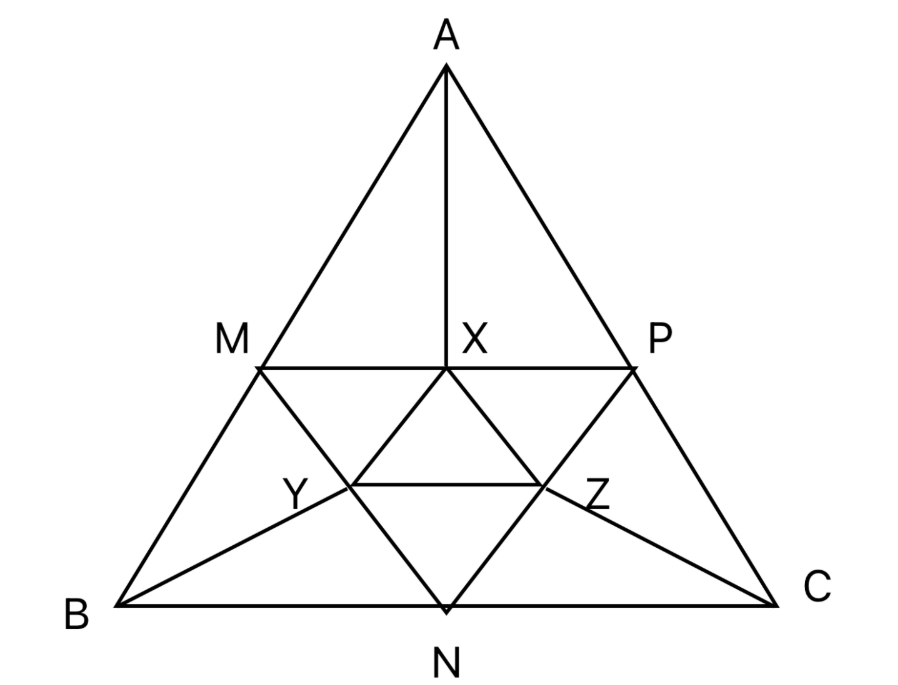
Now locate X. MP joins the midpoints of AB and AC, so MP is parallel to BC. The median AN runs from A to the midpoint of BC, and a line from A cuts every segment parallel to BC in the same ratio, so AN meets MP at its midpoint. So X is the midpoint of MP.
In the same way, the median BP meets MN (parallel to AC) at its midpoint Y, and the median CM meets NP (parallel to AB) at its midpoint Z.
So triangle XYZ joins the midpoints of the sides of triangle MNP, and its area is
sq cm.
The answer is 90.
Q67TITAPermutations & Combinations
The number of all positive integers up to 500 with non-repeating digits is
Type in your answer (TITA). No negative mark for a wrong answer.
Answer and solution
Answer: 378
Count the numbers from 1 to 500 whose digits are all different.
One-digit numbers (1 to 9): 9.
Two-digit numbers: the first digit is 1 to 9 (9 ways), and the second is any of the other 9 digits, including 0:
.
Three-digit numbers from 100 to 499: the first digit is 1, 2, 3 or 4 (4 ways), the second is any of the 9 remaining digits, and the third any of the 8 left:
.
500 repeats the digit 0, so it is not counted.
Total
.
The answer is 378.
Q68MCQPercentages
After two successive increments, Gopal's salary became 187.5% of his initial salary. If the percentage of salary increase in the second increment was twice of that in the first increment, then the percentage of salary increase in the first increment was
- A30
- B27.5
- C25
- D20
Answer and solution
Answer: (C) 25
Let the first increase be
, so the second is
. Writing
:
.
Expanding:
, so
, which factors as
.
The positive root is
, so
. Check:
.
Option A (30) would give
, which is too large, and option D (20) gives
, which is too small.
Hence, option C (25).