- CATin
- CAT past papers
- CAT 2024 Slot 3
- DILR
CAT 2024 Slot 3 — DILR questions with answers
All 22 questions of the Data Interpretation & Logical Reasoning section (12 MCQs, 10 TITA, 5 sets). Try each one, then open its answer and solution.
CAT 2024 Slot 3, timed like the real exam (120 minutes, 40 a section) and scored the CAT way: +3 right, −1 for a wrong MCQ, 0 for a wrong TITA, with the full post-mock analysis. Free — sign in and you come straight back to this paper.
Sit this paper as a timed mock in CATin — freeData Interpretation & Logical Reasoning
CAT 2024 Slot 3 · 40 minutes · +3 for a right answer, −1 for a wrong MCQ, 0 for a wrong TITA
Data set
Set for questions 25–29
The figure below shows a network with three parallel roads represented by horizontal lines R-A, R-B, and R-C and another three parallel roads represented by vertical lines V1, V2, and V3. The figure also shows the distance (in km) between two adjacent intersections.
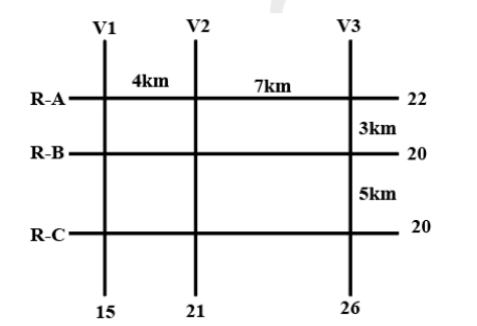
Six ATMs are placed at six of the nine road intersections. Each ATM has a distinct integer cash requirement (in Rs. Lakhs), and the numbers at the end of each line in the figure indicate the total cash requirements of all ATMs placed on the corresponding road. For example, the total cash requirement of the ATM(s) placed on road R-A is Rs. 22 Lakhs.
The following additional information is known.
1. The ATMs with the minimum and maximum cash requirements of Rs. 7 Lakhs and Rs. 15 Lakhs are placed on the same road.
2. The road distance between the ATM with the second highest cash requirement and the ATM located at the intersection of R-C and V3 is 12 km.
Q25MCQLogical Puzzles
Which of the following statements is correct?
- AThere is no ATM placed at the (R-C, V2) intersection.
- BThe ATM placed at the (R-C, V2) intersection has a cash requirement of Rs. 9 Lakhs.
- CThe ATM placed at the (R-C, V2) intersection has a cash requirement of Rs. 8 Lakhs.
- DThe cash requirement of the ATM placed at the (R-C, V2) intersection cannot be uniquely determined.
Answer and solution
Answer: (B) The ATM placed at the (R-C, V2) intersection has a cash requirement of Rs. 9 Lakhs.
Call the intersection (R-B, V2) B2, and so on. Totals: R-A 22, R-B 20, R-C 20, V1 15, V2 21, V3 26. Amounts are distinct, 7 to 15.
C3 has an ATM; only B2 is 12 km from it by road (
), so the second-highest,
, is at B2.
The road with 7 and 15 totals at least 22. V3 would also need a 4, so R-A holds just 7 and 15. Neither is at A2: 15 leaves 6 for V2; 7 forces
, leaving 6 for R-B.
Case 1: 15 at A3, 7 at A1. V3 leaves 11, at C3. V1 needs 8; at C1, R-C would need 1 more, so 8 is at B1,
and C2 is 9.
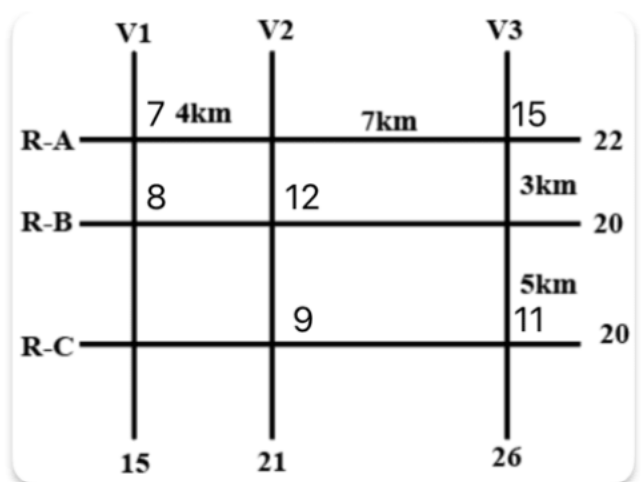
Case 2: 15 at A1, 7 at A3. B3 and C3 share 19, so both are used. Totals give B3
, C2
and C3
. Only
keeps
largest with distinct values: 8, 9, 11.
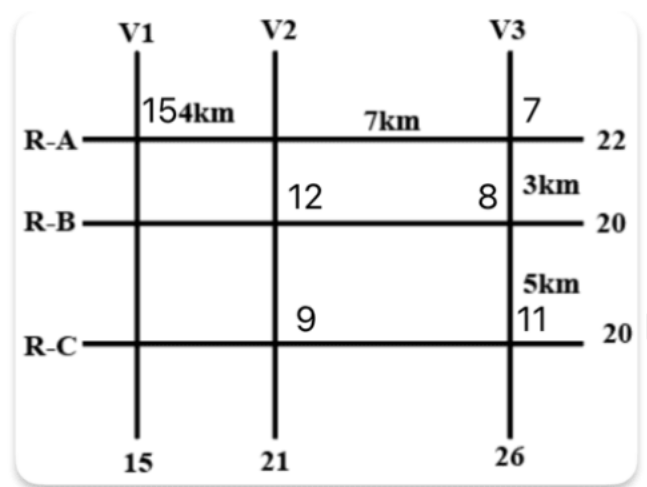
In both cases C2 holds 9 lakhs, so there is an ATM there and its amount is fixed.
Hence, option B (The ATM placed at the (R-C, V2) intersection has a cash requirement of Rs. 9 Lakhs.).
Q26TITALogical Puzzles
How many ATMs have cash requirements of Rs. 10 Lakhs or more?
Type in your answer (TITA). No negative mark for a wrong answer.
Answer and solution
Answer: 3
Call the intersection (R-B, V2) B2, and so on. Totals: R-A 22, R-B 20, R-C 20, V1 15, V2 21, V3 26. Amounts are distinct, 7 to 15.
C3 has an ATM; only B2 is 12 km from it by road (
), so the second-highest,
, is at B2.
The road with 7 and 15 totals at least 22. V3 would also need a 4, so R-A holds just 7 and 15. Neither is at A2: 15 leaves 6 for V2; 7 forces
, leaving 6 for R-B.
Case 1: 15 at A3, 7 at A1. V3 leaves 11, at C3. V1 needs 8; at C1, R-C would need 1 more, so 8 is at B1,
and C2 is 9.
Case 2: 15 at A1, 7 at A3. B3 and C3 share 19, so both are used. Totals give B3
, C2
and C3
. Only
keeps
largest with distinct values: 8, 9, 11.
In both cases the amounts are 7, 8, 9, 11, 12 and 15, so 11, 12 and 15 are 10 lakhs or more.
The answer is 3.
Q27MCQLogical Puzzles
Which of the following two statements is/are DEFINITELY true?
Statement A: Each of R-A, R-B, and R-C has two ATMs.
Statement B: Each of V1, V2, and V3 has two ATMs.
- AOnly Statement A
- BNeither Statement A nor Statement B
- COnly Statement B
- DBoth Statement A and Statement B
Answer and solution
Answer: (A) Only Statement A
Call the intersection (R-B, V2) B2, and so on. Totals: R-A 22, R-B 20, R-C 20, V1 15, V2 21, V3 26. Amounts are distinct, 7 to 15.
C3 has an ATM; only B2 is 12 km from it by road (
), so the second-highest,
, is at B2.
The road with 7 and 15 totals at least 22. V3 would also need a 4, so R-A holds just 7 and 15. Neither is at A2: 15 leaves 6 for V2; 7 forces
, leaving 6 for R-B.
Case 1: 15 at A3, 7 at A1. V3 leaves 11, at C3. V1 needs 8; at C1, R-C would need 1 more, so 8 is at B1,
and C2 is 9.
Case 2: 15 at A1, 7 at A3. B3 and C3 share 19, so both are used. Totals give B3
, C2
and C3
. Only
keeps
largest with distinct values: 8, 9, 11.
In both cases each horizontal road has two ATMs, so Statement A is definite. In Case 2, V1 has one ATM and V3 has three, so Statement B is not.
Hence, option A (Only Statement A).
Q28MCQLogical Puzzles
What best can be said about the road distance (in km) between the ATMs having the second highest and the second lowest cash requirements?
- A4 km
- B7 km
- C5 km
- DEither 4 km or 7 km
Answer and solution
Answer: (D) Either 4 km or 7 km
Call the intersection (R-B, V2) B2, and so on. Totals: R-A 22, R-B 20, R-C 20, V1 15, V2 21, V3 26. Amounts are distinct, 7 to 15.
C3 has an ATM; only B2 is 12 km from it by road (
), so the second-highest,
, is at B2.
The road with 7 and 15 totals at least 22. V3 would also need a 4, so R-A holds just 7 and 15. Neither is at A2: 15 leaves 6 for V2; 7 forces
, leaving 6 for R-B.
Case 1: 15 at A3, 7 at A1. V3 leaves 11, at C3. V1 needs 8; at C1, R-C would need 1 more, so 8 is at B1,
and C2 is 9.
Case 2: 15 at A1, 7 at A3. B3 and C3 share 19, so both are used. Totals give B3
, C2
and C3
. Only
keeps
largest with distinct values: 8, 9, 11.
The second-highest is 12, at B2. The second-lowest, 8, is at B1 (4 km away) in Case 1 and at B3 (7 km away) in Case 2. Both cases are valid.
Hence, option D (Either 4 km or 7 km).
Q29TITALogical Puzzles
What is the number of ATMs whose locations and cash requirements can both be uniquely determined?
Type in your answer (TITA). No negative mark for a wrong answer.
Answer and solution
Answer: 3
The only intersection 12 km by road from R-C/V3 is R-B/V2 (
), so the second-highest ATM is there.
7 and 15 share a road, so that road totals at least 22: R-A (22) or V3 (26). 15 cannot be on R-B or R-C (20 would leave 5) or on V2 (21 would leave 6), so 15 is at R-A/V1 or R-A/V3. 7 cannot join 15 on V1 (total 15) or on V3 (it would leave 4), so 7 is on R-A, which holds exactly 15 and 7.
Case 1, 15 at R-A/V3: V3 needs one more ATM, of 11, and that row needs a 9. The 9 cannot be on V1 (it would leave 6) or at R-B/V2 (the second-highest exceeds 11), so 9 is at R-C/V2 and 11 at R-C/V3. Then 7 is at R-A/V1 (at R-A/V2 it would leave 5 for R-B/V2), so R-B/V2 = 12 and R-B/V1 = 8.
Case 2, 15 at R-A/V1: if 7 were at R-A/V2, V2's other 14 could only be a single 14 at R-B/V2, and R-B would then need 6. So 7 is at R-A/V3, and the other four ATMs fill R-B/V2, R-B/V3, R-C/V2 and R-C/V3. R-B and R-C each need two distinct values from 8 to 14 that sum to 20, so one row holds 8 and 12 and the other holds 9 and 11. R-B/V2 holds the second-highest value, so it is 12. That gives R-B/V3 = 8, and V2's total gives R-C/V2 = 21 - 12 = 9 and R-C/V3 = 11.
Both cases share 12 at R-B/V2, 9 at R-C/V2 and 11 at R-C/V3.
The answer is 3.
Data set
Set for questions 30–33
The table given below shows the amount, in grams, of carbohydrate, protein, fat and all other nutrients, per 100 grams of nutrients in seven food grains. The first column shows the food grain category and the second column its codename. The table has some missing values.
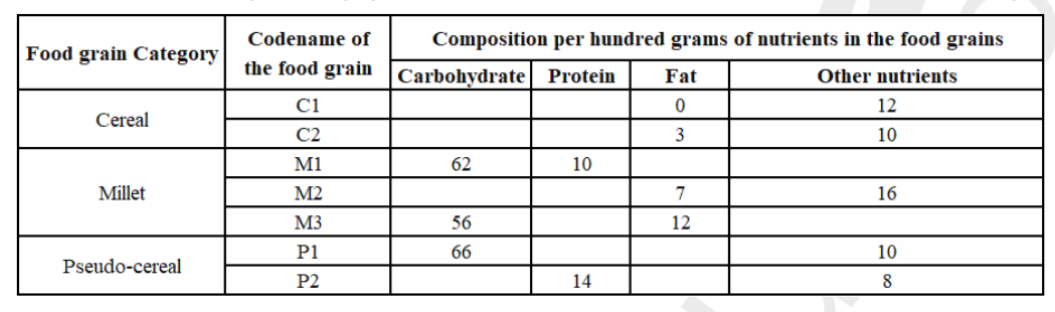
The following additional facts are known.
1. Both the pseudo-cereals had higher amounts of carbohydrate as well as higher amounts of protein than any millet.
2. Both the cereals had higher amounts of carbohydrate than any pseudo-cereal.
3. All the missing values of carbohydrate amounts (in grams) for all the food grains are non-zero multiples of 5.
4. All the missing values of protein, fat and other nutrients amounts (in grams) for all the food grains are non-zero multiples of 4.
5. P1 contained double the amount of protein that M3 contains.
Q30TITAMissing Value Tables
How many foodgrains had a higher amount of carbohydrate per 100 grams ofnutrients than M1?
Type in your answer (TITA). No negative mark for a wrong answer.
Answer and solution
Answer: 5
Each row sums to 100. Missing carbohydrate values are non-zero multiples of 5; missing protein, fat and other values are non-zero multiples of 4.
Clue 1: both pseudo-cereals have more carbohydrate than any millet, so P1 and P2 exceed M1's 62. Clue 2: both cereals exceed the pseudo-cereals, so C1 and C2 exceed 62 too.
M2: carbohydrate + protein
. By clue 1 its protein is below P2's 14, so it is 4, 8 or 12, making the carbohydrate 73, 69 or 65. Only 65 is a multiple of 5, so M2 has 65, above 62.
M3 has 56, below 62.
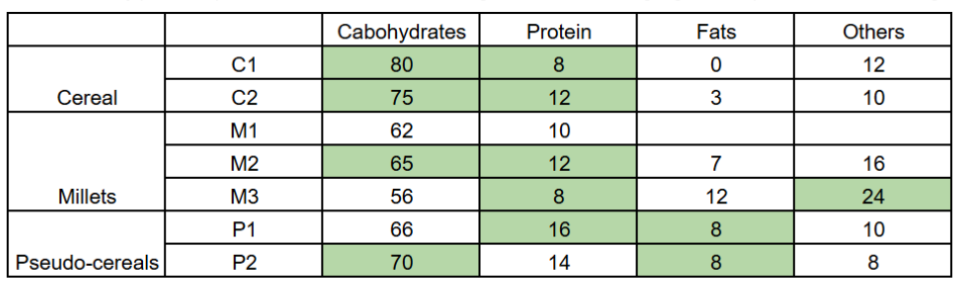
So C1, C2, M2, P1 and P2 have more carbohydrate than M1.
The answer is 5.
Q31TITAMissing Value Tables
How many grams of protein were there in 100 grams of nutrients in M2?
Type in your answer (TITA). No negative mark for a wrong answer.
Answer and solution
Answer: 12
Each row sums to 100. Missing carbohydrate values are non-zero multiples of 5, and missing protein values are non-zero multiples of 4.
For M2, fat is 7 and other nutrients are 16, so carbohydrate + protein
.
Clue 1 says both pseudo-cereals have more protein than any millet. P2 has 14 g of protein, so M2's protein is below 14: it is 4, 8 or 12.
The matching carbohydrate values are
,
and
. Only 65 is a multiple of 5, so M2 has 65 g of carbohydrate and 12 g of protein. This also fits clue 1, since 65 is below P1's 66.
The answer is 12.
Q32TITAMissing Value Tables
How many grams of other nutrients were there in 100 grams of nutrients in M3?
Type in your answer (TITA). No negative mark for a wrong answer.
Answer and solution
Answer: 24
Each row sums to 100, and missing protein, fat and other-nutrient values are non-zero multiples of 4.
For P1, carbohydrate is 66 and other nutrients are 10, so protein + fat
.
Clue 5: P1's protein is twice M3's. M3's protein is a multiple of 4, so P1's is a multiple of 8: 8, 16 or 24. It cannot be 24, because the fat would then be 0. By clue 1, P1 has more protein than any millet, including M1's 10, so it is not 8. Hence P1 has 16 g of protein and 8 g of fat, and M3 has
g of protein.
M3's other nutrients
.
The answer is 24.
Q33TITAMissing Value Tables
What is the median of the number of grams of protein in 100 grams of nutrients among these food grains?
Type in your answer (TITA). No negative mark for a wrong answer.
Answer and solution
Answer: 12
Each row sums to 100. Missing carbohydrate values are non-zero multiples of 5; missing protein, fat and other values are non-zero multiples of 4.
C1: carbohydrate + protein
. By clue 2 its carbohydrate exceeds P1's 66, so it is 70, 75, 80 or 85; only 80 leaves a multiple of 4, so its protein is 8.
C2: carbohydrate + protein
. Of 70, 75, 80 and 85, only 75 leaves a multiple of 4, so its protein is 12.
M2: carbohydrate + protein
, with protein below P2's 14 (clue 1), so 4, 8 or 12; only 12 leaves a multiple of 5 (65).
P1: protein + fat
. P1's protein is twice M3's (clue 5), so it is a multiple of 8. 24 leaves no fat and 8 is not above M1's 10, so P1 has 16 and M3 has 8.
The seven protein values in order are 8, 8, 10, 12, 12, 14, 16, and the median is the 4th.
The answer is 12.
Data set
Set for questions 34–37
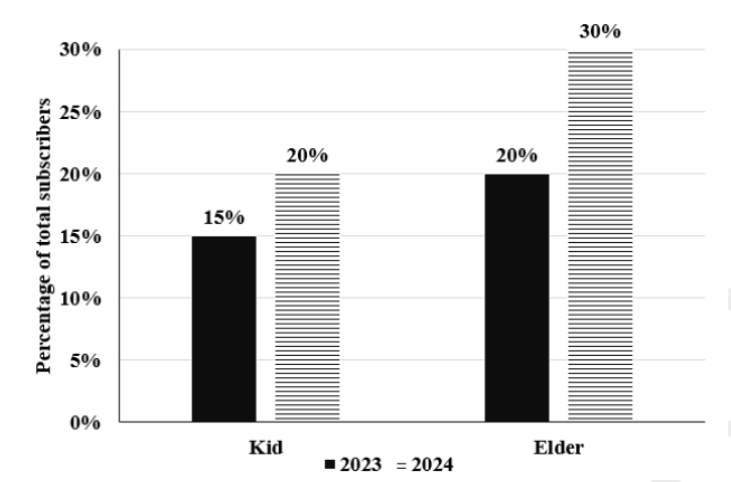
Over the top (OTT) subscribers of a platform are segregated into three categories: i) Kid, ii) Elder, and iii) Others. Some of the subscribers used one app and the others used multiple apps to access the platform. The figure below shows the percentage of the total number of subscribers in 2023 and 2024 who belong to the ‘Kid’ and ‘Elder’ categories.
The following additional facts are known about the numbers of subscribers.
1. The total number of subscribers increased by 10% from 2023 to 2024.
2. In 2024, 1/2 of the subscribers from the ‘Kid’ category and 2/3 of the subscribers from the ‘Elder’ category subscribers use one app.
3. In 2023, the number of subscribers from the ‘Kid’ category who used multiple apps was the same as the number of subscribers from the ‘Elder’ category who used one app.
4. 10,000 subscribers from the ‘Kid’ category used one app and 15,000 subscribers from the ‘Elder’ category used multiple apps in 2023.
Q34MCQBar & Line Charts
How many subscribers belonged to the ‘Others’ category in 2024?
- ACannot be determined
- B65000
- C55000
- D45000
Answer and solution
Answer: (C) 55000
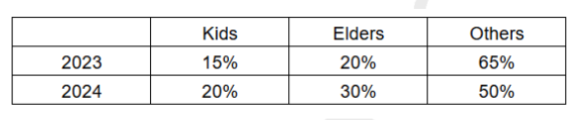
From the chart, Kids and Elders were 15% and 20% of subscribers in 2023, and 20% and 30% in 2024, so Others were 65% and 50%.
Let the 2023 total be
. It rose 10%, so the 2024 total is
. In 2023: Kids
, Elders
, Others
. In 2024: Kids
, Elders
, Others
.

In 2023, 10,000 Kids used one app, so
Kids used multiple apps. 15,000 Elders used multiple apps, so
Elders used one app. Clue 3 makes these equal:
, so
.
Others in 2024
.
Option B (65000) is the number of Others in 2023, not 2024. Since
is fixed, the value can be determined, so option A fails too.
Hence, option C (55000).
Q35MCQBar & Line Charts
What percentage of subscribers in the ‘Kid’ category used multiple apps in 2023?
- A33.33%
- B5.00%
- C25.50%
- D50.00%
Answer and solution
Answer: (A) 33.33%
From the chart, Kids and Elders were 15% and 20% of subscribers in 2023, and 20% and 30% in 2024, so Others were 65% and 50%.
Let the 2023 total be
. It rose 10%, so the 2024 total is
. In 2023: Kids
, Elders
, Others
. In 2024: Kids
, Elders
, Others
.
In 2023, 10,000 Kids used one app, so
Kids used multiple apps. 15,000 Elders used multiple apps, so
Elders used one app. Clue 3 makes these equal:
, so
.
Kids in 2023
, of whom
used multiple apps. That is
.
Option D (50.00%) would compare the 5,000 multi-app Kids with the 10,000 one-app Kids instead of with all 15,000 Kids.
Hence, option A (33.33%).
Q36MCQBar & Line Charts
What was the percentage increase in the number of subscribers in the ‘Elder’ categoryfrom 2023 to 2024?
- A60%
- B50%
- C65%
- D40%
Answer and solution
Answer: (C) 65%
From the chart, Kids and Elders were 15% and 20% of subscribers in 2023, and 20% and 30% in 2024, so Others were 65% and 50%.
Let the 2023 total be
. It rose 10%, so the 2024 total is
. In 2023: Kids
, Elders
, Others
. In 2024: Kids
, Elders
, Others
.
Elders:
in 2023 and
in 2024. The increase is
. (With
from clues 3 and 4, that is 20,000 rising to 33,000.)
Option B (50%) is the rise in the Elders' share of the total, from 20% to 30%; it ignores the 10% growth in the total.
Hence, option C (65%).
Q37MCQBar & Line Charts
What could be the minimum percentage of subscribers who used multiple apps in 2024?
- A16.5%
- B20.0%
- C10.0%
- D22.00%
Answer and solution
Answer: (B) 20.0%
From the chart, Kids and Elders were 15% and 20% of subscribers in 2023, and 20% and 30% in 2024, so Others were 65% and 50%.
Let the 2023 total be
. It rose 10%, so the 2024 total is
. In 2023: Kids
, Elders
, Others
. In 2024: Kids
, Elders
, Others
.
Clue 2: in 2024, half the Kids (
) and
of the Elders (
) used one app, so
Kids and
Elders used multiple apps.
Nothing is known about Others, so multiple-app users are fewest when all
Others use one app. The minimum is then
out of
, which is
. (With
, that is 22,000 of 110,000.)
Option D (22.00%) mistakes the count of 22,000 for a percentage.
Hence, option B (20.0%).
Data set
Set for questions 38–41
Out of 10 countries — Country 1 through Country 10 — Country 9 has the highest gross domestic product (GDP), and Country 10 has the highest GDP per capita. GDP per capita is the GDP of a country divided by its population. The table below provides the following data about Country 1 through Country 8 for the year 2024.
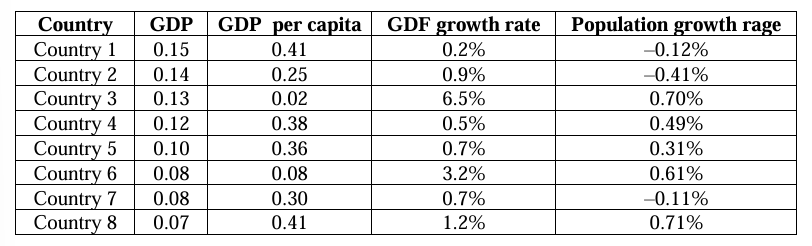
• Column 1 gives the country’s identity.
• Column 2 gives the country’s GDP as a fraction of the GDP of Country 9.
• Column 3 gives the country’s GDP per capita as a fraction of the GDP per capita of Country 10.
• Column 4 gives the country’s annual GDP growth rate.
• Column 5 gives the country’s annual population growth rate.
Assume that the GDP growth rates and population growth rates of the countries will remain constant for the next three years.
Q38MCQTables & Caselets
Which one among the countries 1 through 8, has the smallest population in 2024?
- ACountry 8
- BCountry 3
- CCountry 7
- DCountry 5
Answer and solution
Answer: (A) Country 8
The set’s starting point is the table below which gives data about Country 1 through Country 8 for 2024:
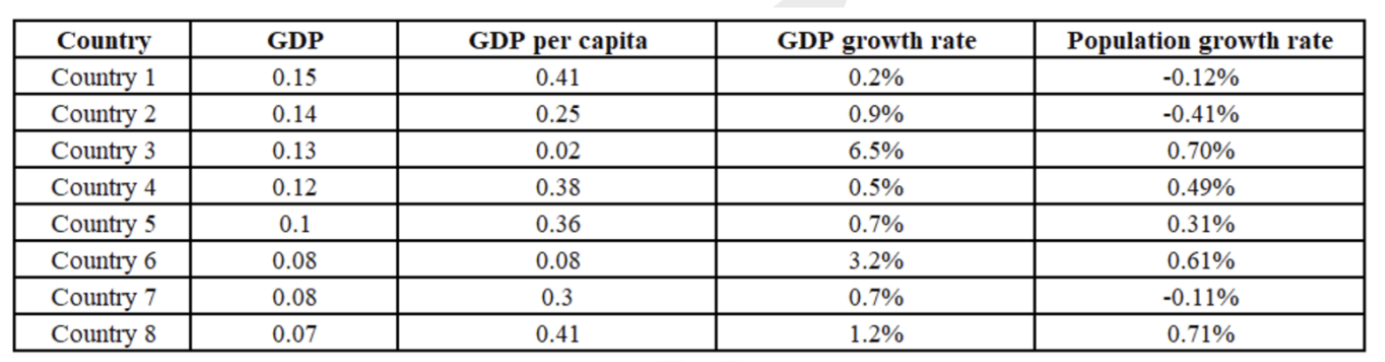
Recall: Population = GDP / GDP per capita (using the reference fractions). GDP per capita (absolute) = GDP per capita fraction × GDP per capita of Country 10.
We need to find the country with the smallest population in 2024. Population = GDP / GDP per capita.
Option A: Country 8 — GDP = 0.07, GDP per capita = 0.41 → Population ∝ 0.07/0.41 ≈ 0.1707
Option B: Country 3 — GDP = 0.13, GDP per capita = 0.02 → Population ∝ 0.13/0.02 = 6.5
Option C: Country 7 — GDP = 0.08, GDP per capita = 0.30 → Population ∝ 0.08/0.30 ≈ 0.267
Option D: Country 5 — GDP = 0.10, GDP per capita = 0.36 → Population ∝ 0.10/0.36 ≈ 0.278
Comparing the four values, 0.1707 is the smallest. Hence Country 8 is the answer.
Q39MCQTables & Caselets
The ratio of Country 4’s GDP to Country 5’s GDP in 2026 will be closest to
- A1.195
- B0.963
- C1.314
- D1.032
Answer and solution
Answer: (A) 1.195
GDP grows at a constant rate, so from 2024 to 2026 (two years) each GDP is multiplied by
.
Country 4:
.
Country 5:
.
Both GDPs are fractions of Country 9's 2024 GDP, so their ratio is
.
A quick check: the 2024 ratio is
, and Country 5 grows only 0.2% a year faster, so the 2026 ratio must be just below 1.2. The values 0.963, 1.314 and 1.032 are far from that.
Hence, option A (1.195).
Q40MCQTables & Caselets
Which one among the countries 1, 4, 5, and 7 will have the largest population in 2027?
- ACountry 1
- BCountry 5
- CCountry 7
- DCountry 4
Answer and solution
Answer: (A) Country 1
Population = GDP ÷ GDP per capita. Both are given as fractions of fixed reference values (Country 9's GDP and Country 10's GDP per capita), so these ratios compare populations directly.
2024 values: Country 1
, Country 4
, Country 5
, Country 7
.
Three years of growth to 2027:
Country 1 shrinks 0.12% a year:
.
Country 4 grows 0.49% a year:
.
Country 5 grows 0.31% a year:
.
Country 7 is already the smallest and shrinks 0.11% a year.
Country 4 is the closest rival, but it starts about 0.05 behind and grows less than 1.5% in three years, which is not enough to catch up.
Hence, option A (Country 1).
Q41TITATables & Caselets
For how many countries among Country 1 through Country 8 will the GDP per capita in 2027 be lower than that in 2024?
Type in your answer (TITA). No negative mark for a wrong answer.
Answer and solution
Answer: 0
The set’s starting point is the table below which gives data about Country 1 through Country 8 for 2024:
Recall: Population = GDP / GDP per capita (using the reference fractions). GDP per capita (absolute) = GDP per capita fraction × GDP per capita of Country 10.
We are asked to find the number of countries where the GDP per capita is lower in 2027 than it was in 2024. For the GDP per capita to be lower in the consequent years, the population growth rate has to exceed the GDP growth rate, since GDP per capita = GDP / Population.
That means if the population growth rate is greater than the GDP growth rate, the GDP per capita will decrease.
Checking each country: Countries 1, 2 and 7 have actually decreasing population rates, thereby definitely increasing the GDP per capita. The rest of the countries have GDP growth rates larger than the population growth rates. Hence, we can conclude that none (0) of the countries will have a smaller GDP per capita in 2027 when compared to 2024.
Data set
Set for questions 42–46
The air-conditioner (AC) in a large room can be operated either in REGULAR mode or in POWER mode to reduce the temperature.
If the AC operates in REGULAR mode, then it brings down the temperature inside the room (called inside temperature) at a constant rate to the set temperature in 1 hour. If it operates in POWER mode, then this is achieved in 30 minutes.
If the AC is switched off, then the inside temperature rises at a constant rate so as to reach the temperature outside at the time of switching off in 1 hour.
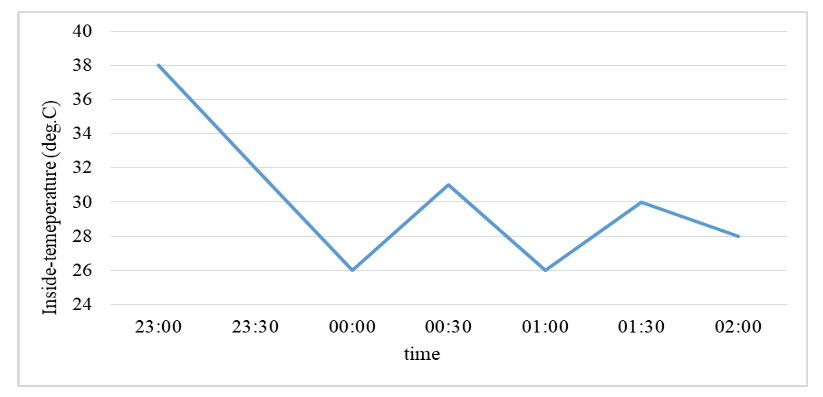
The temperature outside has been falling at a constant rate from 7 pm onward until 3 am on a particular night. The following graph shows the inside temperature between 11 pm (23:00) and 2 am (2:00) that night.
The following facts are known about the AC operation that night.
• The AC was turned on for the first time that night at 11 pm (23:00).
• The AC setting was changed (including turning it on/off, and/or setting different temperatures) only at the beginning of the hour or at 30 minutes after the hour.
• The AC was used in POWER mode for longer duration than in REGULAR mode during this 3-hour period.
Q42MCQBar & Line Charts
How many times the AC must have been turned off between 11:01 pm and 1:59 am?
- Acannot be determined
- B2
- C0
- D1
Answer and solution
Answer: (B) 2
With the AC off, the inside temperature rises towards the outside temperature; with it on, the temperature falls. Settings change only on the hour or half-hour.
From the graph, the inside temperature rises only from 0:00 to 0:30 (26 to 31) and from 1:00 to 1:30 (26 to 30). In every other half-hour between 23:00 and 2:00 it falls, so the AC is on.
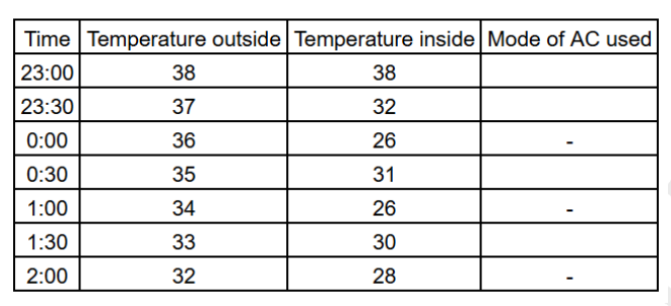
So the AC was switched off at 0:00 and at 1:00, and switched back on at 0:30 and 1:30, when the temperature starts falling again. These are the only two switch-offs between 11:01 pm and 1:59 am.
Option A fails because the graph fixes every on and off period: a rise is possible only with the AC off, and a fall only with it on.
Hence, option B (2).
Q43TITABar & Line Charts
What was the temperature outside, in degree Celsius, at 1 am?
Type in your answer (TITA). No negative mark for a wrong answer.
Answer and solution
Answer: 34
The set’s starting point is the conclusion that the temperature rises only when the AC is turned off. When the AC is turned off, the temperature rises linearly, reaching the temperature outside at the time it was turned off in one hour.
The temperature rises in two instances:
From 0:00 to 0:30, it rises from 26 to 31, so by 1:00 it would have reached 36 degrees, meaning that the temperature outside at 0:00 was 36°C.
From 1:00 to 1:30, it rises from 26 to 30, so by 2:00 it would have reached 34 degrees, meaning the temperature outside at 1:00 was 34°C.
Since the temperature outside decreases linearly from 7 pm onward: starting at 23:00 = 38°C, the drop rate = 2°C per hour.
From the table, we can determine that the temperature outside at 1 am was 34 degrees Celsius. Therefore, 34 is the correct answer.
Q44TITABar & Line Charts
What was the temperature outside, in degree Celsius, at 9 pm?
Type in your answer (TITA). No negative mark for a wrong answer.
Answer and solution
Answer: 42
The set’s starting point is the conclusion that the temperature rises only when the AC is turned off. When the AC is turned off, the temperature rises linearly, reaching the temperature outside at the time it was turned off in one hour.
The temperature rises in two instances:
From 0:00 to 0:30, it rises from 26 to 31, so by 1:00 it would have reached 36 degrees, meaning that the temperature outside at 0:00 was 36°C.
From 1:00 to 1:30, it rises from 26 to 30, so by 2:00 it would have reached 34 degrees, meaning the temperature outside at 1:00 was 34°C.
Since the temperature outside decreases linearly from 7 pm onward: starting at 23:00 = 38°C, the drop rate = 2°C per hour.
Extrapolating this linear chain of temperature drop (2 degrees drop every hour), we can see that the temperature at 22:00 would be 40 degrees Celsius, and the temperature at 21:00 or 9 pm would be 42 degrees Celsius. Therefore, 42 is the correct answer.
Q45MCQBar & Line Charts
What best can be concluded about the number of times the AC must have either been turned on or the AC temperature setting been altered between 11:01
pm and 1:59 am?
- AMore than 3
- BEither 2 or 3
- CExactly 2
- DExactly 3
Answer and solution
Answer: (D) Exactly 3
The inside temperature rises only from 0:00 to 0:30 and from 1:00 to 1:30, so the AC was off then and on in the half-hours starting 23:00, 23:30, 0:30 and 1:30. It was switched on at 0:30 and 1:30: two counted events.
POWER must run longer than REGULAR, so at least three of these four half-hours are in POWER mode.
Now consider 23:30. If REGULAR started at 23:00 and was left unchanged, it would run a full hour (38 down to 26), and POWER could then run at most one hour, breaking the last condition. If POWER started at 23:00, it reaches its set temperature in 30 minutes; the graph shows 32 at 23:30, so the set temperature was 32, and cooling on to 26 needs a new setting at 23:30. Either way, the setting was changed at 23:30.
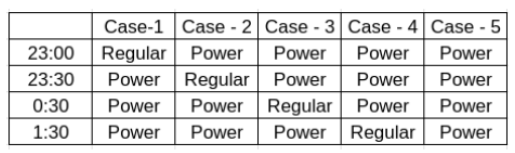
The only other change times, 0:00 and 1:00, are switch-offs. So there are exactly three events: 23:30, 0:30 and 1:30. Option B fails because the change at 23:30 is forced; each of the five valid mode patterns in the table has one.
Hence, option D (Exactly 3).
Q46TITABar & Line Charts
What was the maximum difference between temperature outside and inside temperature, in degree Celsius, between 11:01 pm and 1:59 am?
Type in your answer (TITA). No negative mark for a wrong answer.
Answer and solution
Answer: 10
When the AC is switched off, the inside temperature rises to the outside temperature at the switch-off time in one hour. From 0:00 it rises 5 degrees in 30 minutes, so the outside temperature at 0:00 was
. From 1:00 it rises 4 in 30 minutes, so at 1:00 it was
. The outside temperature therefore falls 2 degrees an hour, 1 degree each half-hour.
Both temperatures change at constant rates between half-hour marks, so the difference is largest at one of them:
23:30:
; 0:00:
; 0:30:
; 1:00:
; 1:30:
.
Just before 2:00 the difference is about
. The largest difference in the period is 10, at midnight.
The answer is 10.