- CATin
- CAT past papers
- CAT 2023 Slot 1
- QA
CAT 2023 Slot 1 — QA questions with answers
All 22 questions of the Quantitative Ability section (14 MCQs, 8 TITA). Try each one, then open its answer and solution.
CAT 2023 Slot 1, timed like the real exam (120 minutes, 40 a section) and scored the CAT way: +3 right, −1 for a wrong MCQ, 0 for a wrong TITA, with the full post-mock analysis. Free — sign in and you come straight back to this paper.
Sit this paper as a timed mock in CATin — freeQuantitative Ability
CAT 2023 Slot 1 · 40 minutes · +3 for a right answer, −1 for a wrong MCQ, 0 for a wrong TITA
Q45MCQProperties of Numbers
Let
be the least positive integer such that
is a factor of
. If
is the least positive integer such that
is a factor of
, then
equals
- A9
- B15
- C12
- D24
Answer and solution
Answer: (B) 15
Factorise:
and
.
For 168 to divide
, the power of 2 needs
(the powers of 3 and 7 are then enough). So
.
Then
.
For this to divide
, we need
,
and
. The power of 3 decides it:
.
So
.
Option C (12) is
alone; the question asks for
.
Hence, option B (15).
Q46MCQLogarithms
If
and
are positive real numbers such that
and
, then
equals
- A20
- B68
- C10
- D11
Answer and solution
Answer: (C) 10
means
, so
.
This factorises as
. Since
,
, and as
is positive,
.
gives
, so
and
.
So
.
Option B (68) comes from stopping at
and taking
, which gives
; but
means
.
Hence, option C (10).
Q47MCQIndices & Surds
If
, then
is equal to
- A
- B
- C
- D
Answer and solution
Answer: (C)
Let
and
. Then
and
.
So
.
Adding,
, so
and
.
gives
, so
. Check:
and
.
Then
, and
.
Option A (
) is the trap of reading
as
:
.
Hence, option C (
).
Q48MCQQuadratic & Polynomial Equations
If
and
are real numbers such that
, then the value
is
- A0
- B1
- C-1
- D2
Answer and solution
Answer: (B) 1
Move everything to one side:
.
The first three terms are
, so
.
A sum of two squares of real numbers is 0 only when both are 0. So
and
, which gives
.
These give
and
, so such real numbers exist.
Option A (0) is the value of
, not of
.
Hence, option B (1).
Q49TITAInequalities & Modulus
The number of integer solutions of equation
is
Type in your answer (TITA). No negative mark for a wrong answer.
Answer and solution
Answer: 3
Consider the sign of
.
: both sides are 0, so it is a solution.
:
, and dividing by
gives
, so
, i.e.
. So
or
; only
is an integer.
:
, and dividing by
gives
, so
, i.e.
. So
or
; only
is an integer.
The integer solutions are
, 0 and 2.
The answer is 3.
Q50TITAQuadratic & Polynomial Equations
The equation
has
as one of the roots. If the other two roots are real, then the minimum possible non-negative integer value of
is
Type in your answer (TITA). No negative mark for a wrong answer.
Answer and solution
Answer: 2
Since
is a root,
is a factor. Dividing it out (synthetic division by
):
Check: expanding gives
-coefficient
and
-coefficient
.
The other two roots are real when the quadratic's discriminant is non-negative:
, so
, i.e.
or
.
and
give a negative discriminant, so the smallest non-negative integer is
.
The answer is 2.
Q51TITAQuadratic & Polynomial Equations
Let
and
be the two distinct roots of the equation
, such that
and
are the distinct roots of the equation
. Then, the value of
is
Type in your answer (TITA). No negative mark for a wrong answer.
Answer and solution
Answer: 6
From
:
and
.
These two numbers are the roots of
, so
sum:
, and product:
.
Adding the two equations:
, and then
.
.
(Check:
has distinct real roots, and
.)
Q52MCQAverages, Mixtures & Alligations
A mixture P is formed by removing a certain amount of coffee from a coffee jar and replacing the same amount with cocoa powder. The same amount is again removed from mixture P and replaced with same amount of cocoa powder to form a new mixture Q. If the ratio of coffee and cocoa in the mixture Q is
, then the ratio of cocoa in mixture P to that in mixture Q is
- A
- B
- C
- D
Answer and solution
Answer: (C)
Take 25 units of coffee at the start, so mixture Q has 16 units of coffee and 9 of cocoa.
Let
units be removed and replaced with cocoa each time. Each replacement keeps a fraction
of the coffee, so after two replacements:
, so
and
.
Mixture P: the first removal takes out 5 units of pure coffee and adds 5 units of cocoa, so P has 5 units of cocoa.
Mixture Q has 9 units of cocoa.
So the ratio is
.
Option D (
) uses the 4 in
, which is P's share of coffee, not its cocoa.
Hence, option C (
).
Q53MCQClocks
The minor angle between the hours hand and minutes hand of a clock was observed at 8:48 am. The minimum duration, in minutes, after 8:48 am when this angle increases by 50% is
- A
- B2
- C4
- D
Answer and solution
Answer: (D)
At 8:48 the hour hand is
from 12, and the minute hand is
.
The minor angle is
, with the minute hand ahead.
A 50% increase makes it
, so the angle must grow by
.
The minute hand gains on the hour hand at
per minute, and since it is ahead, the angle starts growing at once. Time needed:
minutes.
Option B (2) comes from
, which ignores the hour hand's movement.
Hence, option D (
).
Q54MCQProfit, Loss & Discount
Gita sells two objects A and B at the same price such that she makes a profit of 20% on object A and a loss of 10% on object B. If she increases the selling price such that objects A and B are still sold at an equal price and a profit of 10% is made on object B, then the profit made on object A will be nearest to
- A42%
- B45%
- C47%
- D49%
Answer and solution
Answer: (C) 47%
Let the common selling price be
.
A is sold at a 20% profit, so its cost is
.
B is sold at a 10% loss, so its cost is
.
The new common price gives a 10% profit on B:
.
Profit on A
.
Profit % on A
.
This is nearest to 47%; options B (45%) and D (49%) are each more than 1.6 points away.
Hence, option C (47%).
Q55MCQTime, Speed & Distance
Brishti went on an 8-hour trip in a car. Before the trip, the car had travelled a total of
km till then, where
is a whole number and is palindromic, i.e.,
remains unchanged when its digits are reversed. At the end of the trip, the car had travelled a total of 26862 km till then, this number again being palindromic. If Brishti never drove at more than 110 km/h, then the greatest possible average speed at which she drove during the trip, in km/h, was
- A110
- B90
- C100
- D80
Answer and solution
Answer: (C) 100
The trip lasted 8 hours at no more than 110 km/h, so the distance was at most
km. The starting reading
was therefore at least
.
To make the average speed as large as possible,
must be the smallest palindrome from 25982 up.
Five-digit palindromes starting with 2 have the form
. With
the largest is 25952, below 25982. With
the smallest is 26062.
So
, the distance is
km, and the average speed is
km/h.
Option A (110) would need a starting reading of 25982, which is not a palindrome.
Hence, option C (100).
Q56MCQAverages, Mixtures & Alligations
In an examination, the average marks of 4 girls and 6 boys is 24. Each of the girls has the same marks while each of the boys has the same marks. If the marks of any girl is at most double the marks of any boy, but not less than the marks of any boy, then the number of possible distinct integer values of the total marks of 2 girls and 6 boys is
- A21
- B20
- C22
- D19
Answer and solution
Answer: (A) 21
Let each girl score
and each boy
. Then
, so
.
The total for 2 girls and 6 boys is
.
means
, so
.
means
, so
.
So
runs from
up to
, both ends included.
The integers in this range are 172 to 192, which is
values.
Option B (20) forgets to count both ends; 192 itself is reached when
.
Hence, option A (21).
Q57MCQPercentages
The salaries of three friends Sita, Gita and Mita are initially in the ratio
, respectively. In the first year, they get salary hikes of 20%, 25% and 20%, respectively. In the second year, Sita and Mita get salary hikes of 40% and 25%, respectively, and the salary of Gita becomes equal to the mean salary of the three friends. The salary hike of Gita in the second year is
- A25%
- B28%
- C26%
- D30%
Answer and solution
Answer: (C) 26%
Let the starting salaries be
,
and
.
After the first year's hikes of 20%, 25% and 20%: Sita
, Gita
, Mita
.
In the second year, Sita
and Mita
.
Let Gita's new salary be
. It equals the mean of the three:
, so
and
.
Gita's hike
.
Option A (25%) would give Gita
, which is not the mean
.
Hence, option C (26%).
Q58TITATime, Speed & Distance
Arvind travels from town A to town B, and Surbhi from town B to town A, both starting at the same time along the same route. After meeting each other, Arvind takes 6 hours to reach town B while Surbhi takes 24 hours to reach town A. If Arvind travelled at a speed of 54 km/h, then the distance, in km, between town A and town B is
Type in your answer (TITA). No negative mark for a wrong answer.
Answer and solution
Answer: 972
Let Arvind's speed be
km/h and Surbhi's be
, and let them meet after
hours.
After meeting, Arvind covers in 6 hours the stretch Surbhi covered in
hours:
.
Surbhi covers in 24 hours the stretch Arvind covered in
hours:
.
Multiplying,
, so
and
.
Then
km/h.
Distance
km.
Check: Arvind's whole trip takes
hours at 54 km/h, which is 972 km.
The answer is 972.
Q59TITASimple & Compound Interest
Anil invests Rs. 22000 for 6 years in a certain scheme with 4% interest per annum, compounded half-yearly. Sunil invests in the same scheme for 5 years, and then reinvests the entire amount received at the end of 5 years for one year at 10% simple interest. If the amounts received by both at the end of 6 years are same, then the initial investment made by Sunil, in rupees, is
Type in your answer (TITA). No negative mark for a wrong answer.
Answer and solution
Answer: 20808
4% a year compounded half-yearly is 2% per half-year.
Anil: 12 half-years, so his amount is
.
Sunil invests
: 10 half-years, then 10% simple interest for one year, so his amount is
.
Setting them equal:
.
The answer is 20808.
Q60TITATime & Work
The amount of job that Amal, Sunil and Kamal can individually do in a day, are in harmonic progression. Kamal takes twice as much time as Amal to do the same amount of job. If Amal and Sunil work for 4 days and 9 days, respectively, Kamal needs to work for 16 days to finish the remaining job. Then the number of days Sunil will take to finish the job working alone, is
Type in your answer (TITA). No negative mark for a wrong answer.
Answer and solution
Answer: 27
The daily amounts of work are in HP, so the times each takes alone are in AP. Let Amal take
days; Kamal takes
, so Sunil takes the middle term
.
Work done:
, so
.
Sunil alone takes
days.
Q61MCQPolygons & Circles
Let
be the circle
and
be the locus of the point of intersection of a pair of tangents to
with the angle between the two tangents equal to
. Then, the point at which
touches the line
is
- A
- B
- C
- D
Answer and solution
Answer: (B)
Write the circle as
: centre
, radius 4.
Let the tangents meet at
, at distance
from the centre. The line to the centre bisects the
angle, so it makes
with each tangent. In the right triangle with the radius to the point of contact,
, so
.
So
is the circle
, with centre
and radius 8.
Its rightmost point has
, so
touches the line
there, level with the centre:
. Check: at
,
gives
only.
The other options are not on
: for
,
.
Hence, option B (
).
Q62MCQPolygons & Circles
A quadrilateral
is inscribed in a circle such that
and
. If
and
intersect at the point
, then
equals
- A
- B
- C
- D
Answer and solution
Answer: (C)
ABCD is cyclic and its diagonals meet at E.
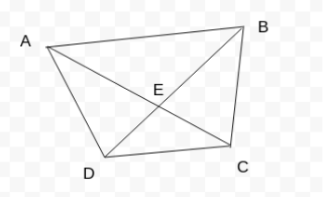
Angles in the same segment are equal:
and
. So triangles AED and BEC are similar, with A matching B and D matching C. Hence
.
Likewise
and
, so triangles AEB and DEC are similar, with A matching D and B matching C. Hence
.
Multiplying,
.
Option D (
) is
, the same ratio read the wrong way round.
Hence, option C (
).
Q63TITATriangles & Lines
In a right-angled triangle
, the altitude
is 5 cm, and the base
is 12 cm.
and
are two points on
such that the areas of
,
and
are in arithmetic progression. If the area of
is 1.5 times the area of
, the length of
, in cm, is
Type in your answer (TITA). No negative mark for a wrong answer.
Answer and solution
Answer: 2
Given that ABC is a right-angled triangle with AB = 5 and BC = 12 => Area of the triangle = 0.5 * 5 * 12 = 30.
Let us assume BP = p, BQ = q
=> Area of ABP = 0.5 * 5 * p = 2.5p
=> Area of ABQ = 0.5 * 5 * q = 2.5q
Given the area of ABC is 1.5 times that of ABP
=> 30 = 1.5 * 2.5p => 20 = 2.5p => p = 8.
Given Areas of ABP, ABQ and ABC are in A.P. => 2 * 2.5q = 2.5 * 8 + 30 => 5q = 50 => q = 10.
PQ = BQ - BP = q - p = 10 - 8 = 2.
Q64MCQSequences & Series
For some positive and distinct real numbers
,
and
, if
is the arithmetic mean of
and
, then the relationship which will always hold true, is
- A, and are in arithmetic progression
- B, and are in arithmetic progression
- C, and are in arithmetic progression
- D, and are in arithmetic progression
Answer and solution
Answer: (B) , and are in arithmetic progression
Write
,
and
. The condition says
.
Cross-multiplying:
.
The left side is
, and the right side is
.
Cancelling the common terms leaves
, i.e.
. So
is the arithmetic mean of
and
:
,
and
are in AP.
Options A and D are the traps: the relation holds for
,
,
themselves, not for their square roots. For example,
,
,
satisfy it, but
,
and
are not in AP in any order. Option C would need
instead.
Hence, option B (
,
and
are in arithmetic progression).
Q65MCQPermutations & Combinations
The number of all natural numbers up to 1000 with non-repeating digits is
- A504
- B648
- C738
- D585
Answer and solution
Answer: (C) 738
Count the numbers from 1 to 1000 whose digits are all different.
1-digit: 1 to 9, so 9.
2-digit: 9 choices for the first digit (1 to 9), then 9 for the second (0 to 9 except the first):
.
3-digit: 9 choices for the first digit, 9 for the second and 8 for the third:
.
1000 repeats the digit 0, so it is not counted.
Total
.
Option B (648) counts only the 3-digit numbers.
Hence, option C (738).
Q66TITASequences & Series
A lab experiment measures the number of organisms at 8 am every day. Starting with 2 organisms on the first day, the number of organisms on any day is equal to 3 more than twice the number on the previous day. If the number of organisms on the
day exceeds one million, then the lowest possible value of
is
Type in your answer (TITA). No negative mark for a wrong answer.
Answer and solution
Answer: 19
Let
be the count on day
:
and
.
Add 3 to both sides:
. So
doubles each day, starting from
:
, so
.
Check:
and
, matching
and
.
We need
, i.e.
.
is too small and
is enough, so
.
Check:
, below a million;
, above it.
The answer is 19.