Q25TITATeam Selection & Scheduling
Type in your answer (TITA). No negative mark for a wrong answer.
Answer and solution
Answer: 0
All 19 questions of the Data Interpretation & Logical Reasoning section (11 MCQs, 8 TITA, 4 sets). Try each one, then open its answer and solution. 1 question of the original section is left out while its answer key is checked.
CAT 2023 Slot 1, timed like the real exam (120 minutes, 40 a section) and scored the CAT way: +3 right, −1 for a wrong MCQ, 0 for a wrong TITA, with the full post-mock analysis. Free — sign in and you come straight back to this paper.
Sit this paper as a timed mock in CATin — freeCAT 2023 Slot 1 · 40 minutes · +3 for a right answer, −1 for a wrong MCQ, 0 for a wrong TITA
Data set
Type in your answer (TITA). No negative mark for a wrong answer.
Answer: 0
Type in your answer (TITA). No negative mark for a wrong answer.
Answer: 200
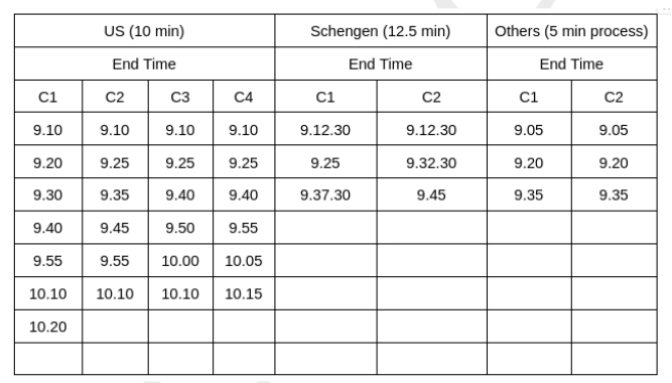
The table shows this largest case, 5 minutes per Others application. The total time for all Others applications is therefore at most minutes.
The answer is 200.Answer: (D) 9:45 am
Ira runs 9:20 to 9:32:30 and Vijay 9:25 to 9:37:30. Nandini takes Ira's counter at 9:32:30 and finishes 12.5 minutes later, at 9:45.
Option B (9:37) is when Vijay's processing ends, not Nandini's.
Hence, option D (9:45 am).Answer: (B) The application process of Mahira started after Nandini’s.
Mahira and Osman arrived on time at 9:30 and found both Others counters free, so both started at 9:30 and finished by 9:35.
A is true: Osman finished by 9:35, before 9:45.
C is true: Osman finished by 9:35, before Vijay at 9:37:30.
D is true: Mahira finished by 9:35, before Nandini at 9:45.
B is false: Mahira started at 9:30 and Nandini at 9:32:30, so Mahira started first.
Hence, option B (The application process of Mahira started after Nandini’s.).Answer: (A) 2:05 pm
9:00 slot: four run 9:00 to 9:10, and the fifth runs 9:10 to 9:20.
9:15 slot: three counters are free at 9:15, so three run 9:15 to 9:25. The fourth starts at 9:20, when the 9:00 slot's fifth ends, and the fifth starts at 9:25 and ends at 9:35.
Every later slot starting at time goes the same way: three start at , the fourth at and the fifth at , so the slot's last US application ends at . For the 9:30 slot that is 9:50, as the table shows.
The last slot starts at 1:45 pm, so all US processing ends at 2:05 pm. Equivalently, the first slot takes 20 minutes and each of the other 19 adds 15: minutes after 9:00 am.
Option C (2:00 pm) is when the last slot's time runs out, but its fifth US applicant is at a counter until 2:05 pm.
Hence, option A (2:05 pm).Data set

Type in your answer (TITA). No negative mark for a wrong answer.
Answer: 3
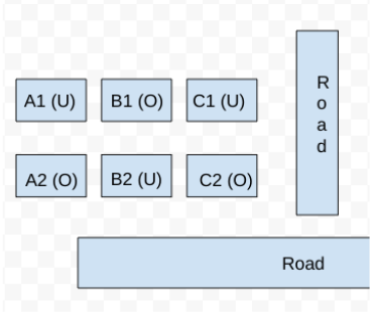
Check: A1 is quoted at most and C1 at most , both below 24.
The vacant houses in Block XX are A1, C1 and B2.
The answer is 3.Answer: (D) Either 2 or 3
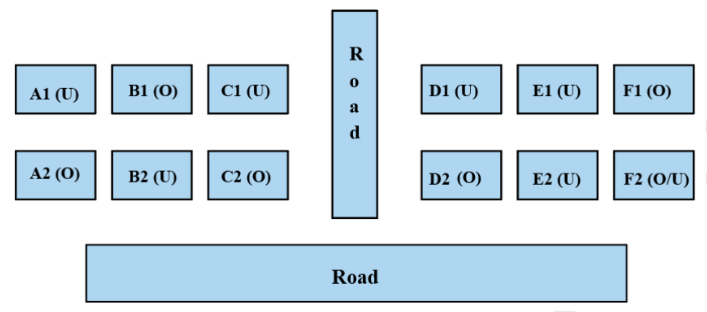
Vacant in Row-2: B2, E2 and possibly F2, so 2 or 3.
Option B fails, as A2, C2 and D2 are occupied; options A and C wrongly fix F2.
Hence, option D (Either 2 or 3).Type in your answer (TITA). No negative mark for a wrong answer.
Answer: 21
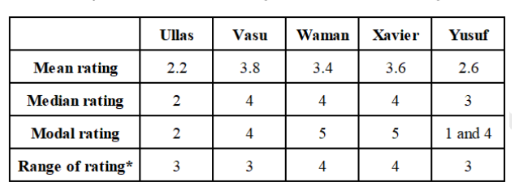
E2 has no parking, , and neighbours D2 (occupied), E1 (vacant) and F2. Its price is highest when F2 is occupied: .
The answer is 21.Answer: (A) E1
Block YY has only one house with parking, so F2, E2 and F1 (options B, C and D) have none.
Hence, option A (E1).Data set

Type in your answer (TITA). No negative mark for a wrong answer.
Answer: 0
All ratings are fixed.
The answer is 0.Type in your answer (TITA). No negative mark for a wrong answer.
Answer: 0
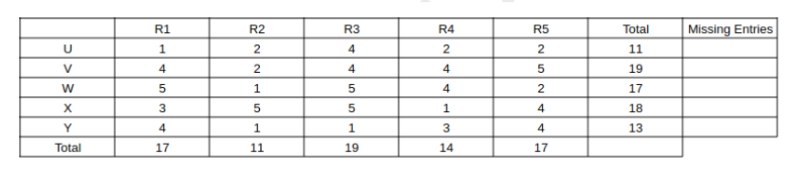
R2's ratings are U 2, V 2, W 1, X 5, Y 1. None of them is 4.
The answer is 0.Type in your answer (TITA). No negative mark for a wrong answer.
Answer: 3
The answer is 3.Type in your answer (TITA). No negative mark for a wrong answer.
Answer: 4
R3's ratings in order are 1, 4, 4, 5, 5, and the middle one is 4.
The answer is 4.Answer: (C) R4
Medians: R2 (1, 1, 2, 2, 5) is 2, given to U and V; R3 (1, 4, 4, 5, 5) is 4, to U and V; R5 (2, 2, 4, 4, 5) is 4, to X and Y; R4 (1, 2, 3, 4, 4) is 3, to Y only.
Hence, option C (R4).Data set
Answer: (A) Prof. Pakrasi and Prof. Qureshi
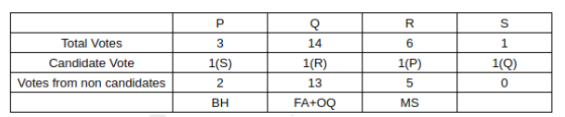
M&S voted for R, so R is not in M&S. S voted for P and Q voted for S, so S shares a department with neither. M&S's two candidates are therefore P and Q, and R and S are in O&Q and B&H, one each, in either order.

Options B and C pair candidates who must be in different departments. In option D, R and S are in different departments in both arrangements.
Hence, option A (Prof. Pakrasi and Prof. Qureshi).Answer: (D) 9
R is not in M&S (M&S voted for him), and S cannot share a department with P or Q (S voted for P, Q voted for S). So P and Q are in M&S, and R and S split O&Q and B&H.
Q's votes by department: F&A 9; O&Q 4, or 5 if R is there (R voted for Q); B&H 1 if R is there, else 0; M&S 0, as it is his own department.
So one department can give Q 9, 5, 4, 1 or 0 votes, never 6, 7 or 8.
Hence, option D (9).Answer: (D) Both statements A and B
R is not in M&S, since M&S voted for him. S voted for P and Q voted for S, so S is in neither P's nor Q's department. Hence M&S's two candidates are P and Q, and R and S fill O&Q and B&H.
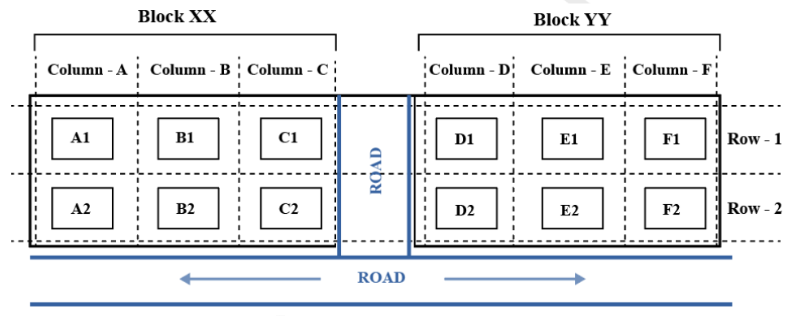
If S is in B&H, then R is the O&Q candidate (case 1 in the figure). P is in M&S, so Statement A is true; R is in O&Q, so Statement B is true.
Options A, B and C each reject a statement that holds.
Hence, option D (Both statements A and B).Answer: (B) It was either Prof. Ramaswamy or Prof. Samuel.
R is not in M&S (M&S voted for him), and S shares a department with neither P nor Q (S voted for P; Q voted for S). So P and Q are in M&S, and R and S fill O&Q and B&H.
Both arrangements obey every rule: no one votes within his own department. So the O&Q candidate is R or S, and the data cannot say which.
Options A and C name only one; option D is impossible, as P and Q are in M&S.
Hence, option B (It was either Prof. Ramaswamy or Prof. Samuel.).Answer: (B) Only statement B
R is not in M&S, since M&S voted for him. S voted for P and Q voted for S, so S shares a department with neither; hence P and Q are the two M&S candidates.
Statement A is false: the M&S non-candidates voted for R, and they could not have voted for Q, who is in their own department.
Statement B is true: the 9 F&A non-candidates voted for Q.
Options A and C accept the false statement A, and option D rejects the true statement B.
Hence, option B (Only statement B).