- CATin
- CAT past papers
- CAT 2019 Slot 2
- QA
CAT 2019 Slot 2 — QA questions with answers
All 34 questions of the Quantitative Ability section (23 MCQs, 11 TITA). Try each one, then open its answer and solution.
CAT 2019 Slot 2, timed like the real exam (180 minutes, 60 a section) and scored the CAT way: +3 right, −1 for a wrong MCQ, 0 for a wrong TITA, with the full post-mock analysis. Older official papers are in CATin Pro, with 80+ mocks and the full planner. The last three years of papers are free.
Sit this paper as a timed mock with CATin ProQuantitative Ability
CAT 2019 Slot 2 · 60 minutes · +3 for a right answer, −1 for a wrong MCQ, 0 for a wrong TITA
Q67MCQAverages, Mixtures & Alligations
The average of 30 integers is 5. Among these 30 integers, there are exactly 20 which do not exceed 5. What is the highest possible value of the average of
these 20 integers?
- A3.5
- B5
- C4.5
- D4
Answer and solution
Answer: (C) 4.5
The 30 integers add up to
.
The other 10 integers exceed 5, so each is at least 6 and together they are at least
. The 20 integers that do not exceed 5 therefore add up to at most
, and their average is at most
.
This is achievable: take ten 5s and ten 4s (sum 90) together with ten 6s (sum 60).
Option B (5) would need all 20 to equal 5, a sum of 100, which leaves only 50 for ten integers that must each be at least 6. So 5 is impossible.
Hence, option C (4.5).
Q68TITASimple & Compound Interest
Amal invests Rs 12000 at 8% interest, compounded annually, and Rs 10000 at 6% interest, compounded semi-annually, both investments being for one year.
Bimal invests his money at 7.5% simple interest for one year. If Amal and Bimal get the same amount of interest, then the amount, in Rupees, invested by
Bimal is
Type in your answer (TITA). No negative mark for a wrong answer.
Answer and solution
Answer: 20920
Let's calculate the amount with Amal at the end of 1 year.
Amal invests Rs 12,000 at 8% compounded annually:
Amount.
Amal also invests Rs 10,000 at 6% compounded semi-annually (so the rate is 3% per half-year):
Amount.
Total amount Amal receives = .
Total principal invested by Amal = .
Total interest received by Amal = .
Bimal invests an amount at 7.5% simple interest for one year.
Interest received by Bimal = .
We are given that Amal and Bimal get the same amount of interest:
.
The amount invested by Bimal is Rs 20,920.
Q69MCQProperties of Numbers
What is the largest positive integer
such that
is also a positive integer?
- A6
- B16
- C8
- D12
Answer and solution
Answer: (D) 12
Factorise:
and
.
For a positive integer
,
, so the expression equals
.
This is an integer only when
divides 8, so
and
. At
the value is
, a positive integer.
Option B (16) is the largest choice, but it fails:
is not an integer.
Hence, option D (12).
Q70TITAProperties of Numbers
How many pairs
of positive integers satisfy the equation
?
Type in your answer (TITA). No negative mark for a wrong answer.
Answer and solution
Answer: 4
We are given the equation .
Rearranging the terms, we get:
Since and are positive integers, both and must be integers.
Also, , and since their product is positive and , must also be positive.
Both factors must have the same parity (either both odd or both even) because their sum is , which is even. Since their product is 105 (odd), both factors must be odd.
Let's find the factor pairs of 105:
Each pair gives a valid system of equations:
1) and .
2) and .
3) and .
4) and .
All 4 pairs result in positive integers for and .
Thus, there are 4 such pairs.
Q71MCQTime, Speed & Distance
Two ants A and B start from a point P on a circle at the same time, with A moving clock-wise and B moving anti-clockwise. They meet for the first time at
10:00 am when A has covered 60% of the track. If A returns to P at 10:12 am, then B returns to P at
- A10:25 am
- B10:45 am
- C10:18 am
- D10:27 am
Answer and solution
Answer: (D) 10:27 am
Moving in opposite directions, A and B together cover one full lap by their first meeting. A has covered 60%, so B has covered 40%.
After the meeting, A covers its remaining 40% in 12 minutes (10:00 to 10:12). So A took
minutes for its first 60%, and both started at 9:42.
B covered 40% in those 18 minutes, so its remaining 60% takes
minutes. B returns to P at 10:27 am.
Option B (10:45 am) adds B's full-lap time of 45 minutes to 10:00, forgetting that B had already covered 40% of the lap by then.
Hence, option D (10:27 am).
Q72MCQSequences & Series
Let
be integers such that
, for all
. Then
equals
- A0
- B1
- C10
- D-1
Answer and solution
Answer: (B) 1
Let
. Then
, and for
,
gives
.
So
when
is odd and
when
is even.
The sum
has
terms. Pair them from the start:
is 486 pairs, each equal to
. The unpaired last term is
, since 1023 is odd.
So the sum is
.
Option A (0) would be right only if the number of terms were even; with 973 terms, one odd-indexed term is left over.
Hence, option B (1).
Q73MCQPolygons & Circles
Two circles, each of radius 4 cm, touch externally. Each of these two circles is touched externally by a third circle. If these three circles have a common tangent, then the radius of the third circle, in cm, is
- A
- B
- C
- D1
Answer and solution
Answer: (D) 1
Let the two circles of radius 4 cm have centres A and B, and let the third circle have centre C and radius
. All three touch the common tangent below them.
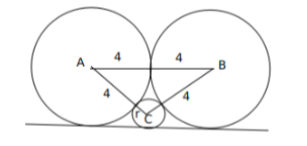
The big circles touch, so
cm, and both centres are 4 cm above the tangent. The third circle touches both equal circles, so by symmetry C lies directly below E, the midpoint of AB, and
cm. C is
above the tangent, so
. The small circle touches the big one externally, so
.
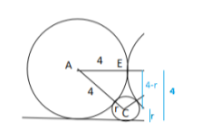
Triangle AEC has a right angle at E, so
.
Expanding,
, so
and
cm.
Option C (
) fails: with
,
, but
.
Hence, option D (1).
Q74MCQQuadratic & Polynomial Equations
Let
be a real number. Then the roots of the equation
are real and distinct if and only if
- A
- B
- C
- D
Answer and solution
Answer: (A)
The roots of
are real and distinct exactly when the discriminant is positive. Here
,
and
, so
.
Since the base 2 is greater than 1, this gives
. This also keeps
positive, as the logarithm requires.
Option B (
) reverses the inequality. For example,
gives
and a discriminant of
, so there are no real roots.
Hence, option A (
).
Q75MCQQuadratic & Polynomial Equations
The quadratic equation
has two roots
and
, where
is an integer. Which of the following is a possible value of
?
- A3721
- B361
- C427
- D549
Answer and solution
Answer: (D) 549
The roots are
and
, so
and
.
Then
. With
an integer,
must be
times a perfect square.
Check each option:
would need
, which is not a perfect square. This is the strongest trap, as it is a multiple of
.
is not a multiple of
(
and
).
would need
, which is not a perfect square.
gives
, so
works: the roots are
and
(or
and
), with
.
Hence, option D (549).
Q76MCQMensuration
The base of a regular pyramid is a square and each of the other four sides is an equilateral triangle, length of each side being 20 cm. The vertical height of
the pyramid, in cm, is
- A12
- B10√2
- C8√3
- D5√5
Answer and solution
Answer: (B) 10√2
Each face is an equilateral triangle of side 20 cm, so the square base has side 20 cm.
In the figure, A is the apex, O is the centre of the square base and B is the midpoint of a base edge. The apex lies directly above O, so AO is the vertical height
.
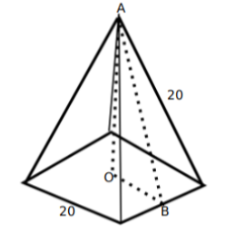
AB is the height of an equilateral face:
cm.
OB is half the side of the square:
cm.
Triangle AOB has a right angle at O, so
, giving
cm.
Option C (
) is close in size, but
, not 200.
Hence, option B (10√2).
Q77MCQTriangles & Lines
Let ABC be a right-angled triangle with hypotenuse BC of length 20 cm. If AP is perpendicular on BC, then the maximum possible length of AP, in cm, is
- A10
- B5
- C8√2
- D6√2
Answer and solution
Answer: (A) 10
Let the right angle be at A. In the figure,
, so
, and
.
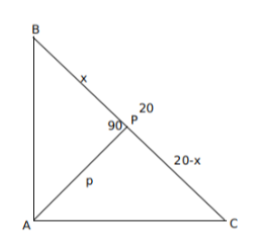
Triangles ABP and CAP are similar, since each has a right angle at P and
. So
, which gives
.
Now
, which is largest when
. Then
and
cm. This is the isosceles right triangle with
.
Option C (
) is impossible: A lies on the circle with diameter BC, whose radius is 10, so A is never more than 10 cm from BC.
Hence, option A (10).
Q78MCQLogarithms
If
is a real number, then
is a real number if and only if
- A
- B
- C
- D
Answer and solution
Answer: (A)
The square root is real only when
, that is, when
. This also makes the logarithm's argument positive.
So
, which is
, or
. This holds exactly when
.
Option B (
) contains only values that work, but it is not 'if and only if':
gives
and
, which is real, yet 3 lies outside that range.
Hence, option A (
).
Q79TITAIndices & Surds
If
and
, then
equals
Type in your answer (TITA). No negative mark for a wrong answer.
Answer and solution
Answer: 13
We are given two equations:
1)
2)
Let and . The equations can be written as:
1)
2)
Multiply equation 2 by 5 to eliminate the fraction:
Substitute into the modified equation 2:
Since , we have:
.
Now find :
Since , we have:
.
We need to find :
.
Q80MCQAverages, Mixtures & Alligations
The strength of a salt solution is p% if 100 ml of the solution contains p grams of salt. Each of three vessels A, B, C contains 500 ml of salt solution of
strengths 10%, 22%, and 32%, respectively. Now, 100 ml of the solution in vessel A is transferred to vessel B. Then, 100 ml of the solution in vessel B is
transferred to vessel C. Finally, 100 ml of the solution in vessel C is transferred to vessel A. The strength, in percentage, of the resulting solution in vessel A
is
- A15
- B13
- C12
- D14
Answer and solution
Answer: (D) 14
A p% solution has p grams of salt in every 100 ml. Initially A has
g, B has
g and C has
g of salt.
A to B: 100 ml is
of A, so it carries 10 g. A is left with 40 g in 400 ml, and B has 120 g in 600 ml.
B to C: 100 ml is
of B, so it carries 20 g. B keeps 100 g in 500 ml, and C has 180 g in 600 ml.
C to A: 100 ml is
of C, so it carries 30 g. C keeps 150 g in 500 ml, and A has
g in 500 ml.
The table tracks the volume, salt and water in each vessel after every transfer.
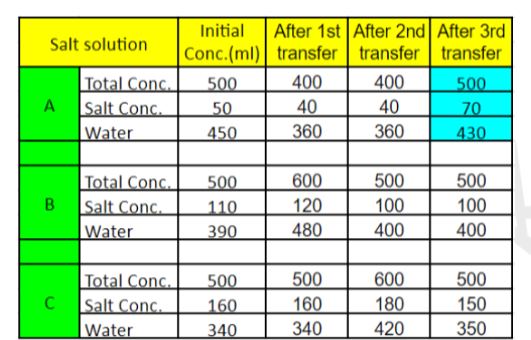
Strength of A
.
Option A (15) would need 75 g in A's 500 ml, but A keeps only 40 g after the first transfer and gains exactly 30 g from C.
Hence, option D (14).
Q81MCQTime, Speed & Distance
A cyclist leaves A at 10 am and reaches B at 11 am. Starting from 10:01 am, every minute a motorcycle leaves A and moves towards B. Forty-five such
motorcycles reach B by 11 am. All motorcycles have the same speed. If the cyclist had doubled his speed, how many motorcycles would have reached B by
the time the cyclist reached B?
- A22
- B23
- C15
- D20
Answer and solution
Answer: (C) 15
The cyclist takes 60 minutes. Motorcycles leave A at 10:01, 10:02 and so on, so the 45th leaves at 10:45 and the 46th at 10:46. Exactly 45 reach B by 11:00, so a motorcycle's travel time
satisfies
minutes.
At double speed the cyclist takes 30 minutes and reaches B at 10:30.
A motorcycle leaving
minutes after 10:00 reaches B
minutes after 10:00, so it arrives by 10:30 when
. For
,
, so it arrives; for
,
, so it does not. The motorcycles leaving from 10:01 to 10:15 arrive: 15 of them.
Options A (22) and B (23) come from halving 45, but the count is not proportional to the cyclist's time: each motorcycle needs about 15 minutes, so only those leaving in the first 15 minutes arrive by 10:30.
Hence, option C (15).
Q82MCQMensuration
A man makes complete use of 405 cc of iron, 783 cc of aluminium, and 351 cc of copper to make a number of solid right circular cylinders of each type of
metal. These cylinders have the same volume and each of these has radius 3 cm. If the total number of cylinders is to be kept at a minimum, then the total
surface area of all these cylinders, in sq cm, is
- A1026(1+π)
- B8464π
- C928π
- D1044(4+π)
Answer and solution
Answer: (A) 1026(1+π)
All cylinders have the same volume
and every metal is used up, so
,
and
must be whole numbers. The fewest cylinders come from the largest such
, the HCF.
,
and
, so
cc.
Number of cylinders
.
With radius 3 cm:
, so
cm.
Surface area of one cylinder
sq cm.
Total
sq cm.
Options B and C are pure multiples of
, but each curved surface,
, adds a part without
. Option D's
-part,
, would need 58 cylinders, not 57.
Hence, option A (1026(1+π)).
Q83MCQIndices & Surds
The real root of the equation
is
- A
- B
- C
- D
Answer and solution
Answer: (B)
Write
and
, and let
. The equation becomes
, which factorises as
.
Since
is always positive,
is rejected and
. Then
, so
and
.
Option D (
) would need
, but
; the 7 comes from the rejected root
with its sign dropped.
Hence, option B (
).
Q84TITAProperties of Numbers
How many factors of
are perfect squares which are greater than 1?
Type in your answer (TITA). No negative mark for a wrong answer.
Answer and solution
Answer: 44
Let the given number be .
First, find the prime factorization of :
.
Any factor of will be of the form , where , , and .
For the factor to be a perfect square, all the exponents must be even numbers.
Possible values for (even numbers from 0 to 8): 0, 2, 4, 6, 8 (5 options).
Possible values for (even numbers from 0 to 5): 0, 2, 4 (3 options).
Possible values for (even numbers from 0 to 4): 0, 2, 4 (3 options).
Total number of perfect square factors = .
The question asks for the number of perfect squares which are strictly greater than 1.
The value 1 corresponds to , which is included in the 45 factors.
So we must subtract 1 from the total.
Number of perfect squares greater than 1 = .
Q85TITADigits & Base Systems
In a six-digit number, the sixth, that is, the rightmost, digit is the sum of the first three digits, the fifth digit is the sum of first two digits, the third digit is equal
to the first digit, the second digit is twice the first digit and the fourth digit is the sum of fifth and sixth digits. Then, the largest possible value of the fourth
digit is
Type in your answer (TITA). No negative mark for a wrong answer.
Answer and solution
Answer: 7
Let the six-digit number be , where is the first digit (leftmost) and is the sixth digit (rightmost).
We are given the following relationships:
Let's express all digits in terms of :
Since is a six-digit number, the leading digit cannot be 0, so .
Also, every letter represents a single digit, so they must be between 0 and 9.
In particular, must be a single digit, so .
Since and is an integer, the only possible value for is 1.
If , then , which is not a single digit.
So, .
Then .
The largest possible value of the fourth digit () is 7.
Q86TITATime, Speed & Distance
John jogs on track A at 6 kmph and Mary jogs on track B at 7.5 kmph. The total length of tracks A and B is 325 metres. While John makes 9 rounds of track
A, Mary makes 5 rounds of track B. In how many seconds will Mary make one round of track A?
Type in your answer (TITA). No negative mark for a wrong answer.
Answer and solution
Answer: 48
Let the length of track A be and the length of track B be .
Total length m.
Speed of John = kmph.
Speed of Mary = kmph.
While John makes 9 rounds of track A, Mary makes 5 rounds of track B in the same amount of time.
Time taken by John = .
Time taken by Mary = .
Equating the times:
Substitute into the total length equation:
m.
We need to find the time it takes Mary to make one round of track A (100 m).
Speed of Mary = kmph = m/s = m/s = m/s = m/s.
Time taken = seconds.
Q87MCQPercentages
In 2010, a library contained a total of 11500 books in two categories - fiction and non-fiction. In 2015, the library contained a total of 12760 books in these two categories. During this period, there was 10% increase in the fiction category while there was 12% increase in the non-fiction category. How many fiction books were in the library in 2015?
- A6160
- B6600
- C6000
- D5500
Answer and solution
Answer: (B) 6600
Let the 2010 fiction count be
; non-fiction is then
.
After the increases,
, so
, giving
and
.
That is the 2010 figure. In 2015, fiction
. As a check, non-fiction
, and
.
Option C (6000) is the 2010 fiction count, and option A (6160) is the 2015 non-fiction count; neither answers the question.
Hence, option B (6600).
Q88TITALinear Equations
John gets Rs 57 per hour of regular work and Rs 114 per hour of overtime work. He works altogether 172 hours and his income from overtime hours is 15%
of his income from regular hours. Then, for how many hours did he work overtime?
Type in your answer (TITA). No negative mark for a wrong answer.
Answer and solution
Answer: 12
Let John work for hours of regular work and hours of overtime work.
Total hours = .
His income from regular work is .
His income from overtime work is .
We are given that his income from overtime is 15% of his income from regular hours:
Notice that , so we can divide both sides by 57:
Substitute into the total hours equation:
John worked 12 hours overtime.
Q89TITASequences & Series
If
, then what is the value of
?
Type in your answer (TITA). No negative mark for a wrong answer.
Answer and solution
Answer: 4851
The given series is .
This is an arithmetic progression where the first term and the common difference .
The last term is .
Let the number of terms be .
.
The sum of an arithmetic progression is given by .
.
We need to find the value of .
This is the sum of the first natural numbers, given by .
Sum =
.
Q90MCQProfit, Loss & Discount
A shopkeeper sells two tables, each procured at cost price p, to Amal and Asim at a profit of 20% and at a loss of 20%, respectively. Amal sells his table to
Bimal at a profit of 30%, while Asim sells his table to Barun at a loss of 30%. If the amounts paid by Bimal and Barun are x and y, respectively, then (x − y) / p
equals
- A1
- B1.2
- C0.50
- D0.7
Answer and solution
Answer: (A) 1
The shopkeeper sells to Amal at
(20% profit) and to Asim at
(20% loss).
Amal sells at a 30% profit, so Bimal pays
.
Asim sells at a 30% loss, so Barun pays
.
So
.
Options B (1.2) and D (0.7) are single price factors from the working, Amal's purchase multiplier and Asim's 30% loss multiplier, not the ratio asked for.
Hence, option A (1).
Q91MCQTriangles & Lines
In a triangle ABC, medians AD and BE are perpendicular to each other, and have lengths 12 cm and 9 cm, respectively. Then, the area of triangle ABC, in sq
cm, is
- A78
- B80
- C72
- D68
Answer and solution
Answer: (C) 72
The medians meet at the centroid G, which divides each median in the ratio
. So
cm,
cm,
cm and
cm.
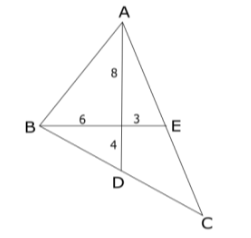
The medians are perpendicular, so
has a right angle at G and area
sq cm.
is half of
, since D is the midpoint of BC.
is
of
, since
and both triangles have the same height from B. So
is
of
.
Area of
sq cm.
Option B (80) would need
to have area
, but it is exactly
.
Hence, option C (72).
Q92MCQSequences & Series
The number of common terms in the two sequences: 15, 19, 23, 27, . . . . , 415 and 14, 19, 24, 29, . . . , 464 is
- A21
- B20
- C18
- D19
Answer and solution
Answer: (B) 20
The first sequence rises in steps of 4 from 15, and the second in steps of 5 from 14. Their first common term is 19, and after that common terms recur every
: 19, 39, 59, and so on.
A common term cannot exceed 415, where the first sequence ends. So
, giving
and
. The last common term is
, which also lies within the second sequence.
Option A (21) would add 419, which is beyond 415 and so not in the first sequence.
Hence, option B (20).
Q93MCQInequalities & Modulus
Let
be real numbers such that
,
, and
. If
, then
- A
- B
- C
- D
Answer and solution
Answer: (D)
We are given the following equations:
We can use the algebraic identity (Brahmagupta-Fibonacci identity) relating the products of sums of squares:
Substitute the given values into the identity:
Hence, Option D is the correct answer.
Q94MCQProfit, Loss & Discount
Mukesh purchased 10 bicycles in 2017, all at the same price. He sold six of these at a profit of 25% and the remaining four at a loss of 25%. If he made a
total profit of Rs. 2000, then his purchase price of a bicycle, in Rupees, was
- A6000
- B8000
- C4000
- D2000
Answer and solution
Answer: (C) 4000
Let the purchase price (CP) of one bicycle be .
Total cost for 10 bicycles = .
Mukesh sold 6 bicycles at a profit of 25%:
Selling price of these 6 bicycles = .
He sold the remaining 4 bicycles at a loss of 25%:
Selling price of these 4 bicycles = .
Total selling price of all 10 bicycles = .
Total profit = Total Selling Price - Total Cost Price
The purchase price of a bicycle was Rs 4000.
Hence, Option C is correct.
Q95TITAPercentages
In an examination, the score of A was 10% less than that of B, the score of B was 25% more than that of C, and the score of C was 20% less than that of D. If
A scored 72, then the score of D was
Type in your answer (TITA). No negative mark for a wrong answer.
Answer and solution
Answer: 80
Let the score of D be .
The score of C is 20% less than that of D:
.
The score of B is 25% more than that of C:
.
The score of A is 10% less than that of B:
.
We are given that A scored 72:
.
The score of D was 80.
Q96MCQRatios, Proportions & Partnership
The salaries of Ramesh, Ganesh and Rajesh were in the ratio 6:5:7 in 2010, and in the ratio 3:4:3 in 2015. If Ramesh’s salary increased by 25% during 2010-
2015, then the percentage increase in Rajesh’s salary during this period is closest to
- A10
- B7
- C9
- D8
Answer and solution
Answer: (B) 7
Let the salaries of Ramesh, Ganesh, and Rajesh in 2010 be , , and respectively.
Let their salaries in 2015 be , , and respectively.
We are given that Ramesh's salary increased by 25% during 2010-2015.
So, Ramesh's 2015 salary = 125% of his 2010 salary.
Now, let's look at Rajesh's salary.
Rajesh's salary in 2010 = .
Rajesh's salary in 2015 = .
Substitute into Rajesh's 2015 salary:
.
The percentage increase in Rajesh's salary is:
.
The closest integer percentage is 7%.
Hence, Option B is correct.
Q97TITAPolygons & Circles
Let A and B be two regular polygons having
and
sides, respectively. If
and each interior angle of B is
times each interior angle of A, then each interior angle, in degrees, of a regular polygon with
sides is
Type in your answer (TITA). No negative mark for a wrong answer.
Answer and solution
Answer: 150
The formula for each interior angle of a regular polygon with sides is .
For polygon A (sides = ):
Interior angle of A =
For polygon B (sides = ):
Interior angle of B =
We are given two conditions:
1)
2) Interior angle of B = Interior angle of A
Substitute these into the equation:
Multiply both sides by (since ):
So, and .
We need to find the interior angle of a regular polygon with sides.
sides.
Interior angle = .
Q98TITAFunctions & Graphs
Let
be a function such that
for every positive integers
and
. If
and
are positive integers,
, and
, then
equals
Type in your answer (TITA). No negative mark for a wrong answer.
Answer and solution
Answer: 12
Put
:
. As
is a positive integer,
.
Since
, we get
.
So
is the cube of a positive integer that divides
. The only such cubes are
and
, so
or
. The condition
rules out
. Hence
and
.
Now
, so
.
The answer is 12.
Q99MCQTime & Work
Anil alone can do a job in 20 days while Sunil alone can do it in 40 days. Anil starts the job, and after 3 days, Sunil joins him. Again, after a few more days,
Bimal joins them and they together finish the job. If Bimal has done 10% of the job, then in how many days was the job done?
- A12
- B13
- C15
- D14
Answer and solution
Answer: (B) 13
Let the total amount of work be the LCM of 20 and 40, which is 40 units.
Anil's rate = units/day.
Sunil's rate = unit/day.
Anil starts the job and works alone for 3 days.
Work done by Anil in these 3 days = units.
We are given that Bimal does 10% of the total job.
Work done by Bimal = 10% of 40 = 4 units.
The rest of the work must have been completed by Anil and Sunil.
Total work done by Anil and Sunil = Total work - Work done by Bimal = units.
Out of this, 6 units were done by Anil in the first 3 days.
So, the remaining work done by Anil and Sunil working together (and possibly alongside Bimal, but we only care about their contribution) = units.
The combined rate of Anil and Sunil is units/day.
Time taken by Anil and Sunil to complete these 30 units = days.
So, Anil worked alone for 3 days, and then Anil and Sunil worked for 10 more days to finish their portion of the work (and Bimal finished his 4 units during this time too).
Total time taken for the job = days.
Hence, Option B is correct.
Q100MCQRatios, Proportions & Partnership
In an examination, Rama's score was one-twelfth of the sum of the scores of Mohan and Anjali. After a review, the score of each of them increased by 6.
The revised scores of Anjali, Mohan, and Rama were in the ratio 11:10:3. Then Anjali's score exceeded Rama's score by
- A26
- B32
- C35
- D24
Answer and solution
Answer: (B) 32
Let the initial scores of Rama, Anjali, and Mohan be , , and respectively.
We are given that Rama's score was one-twelfth of the sum of the scores of Mohan and Anjali:
--- (1)
After a review, the score of each of them increased by 6.
Their new scores are , , and .
The revised scores of Anjali, Mohan, and Rama were in the ratio 11 : 10 : 3.
Let , , and .
From this, we get:
Substitute these expressions into equation (1):
.
We need to find by how much Anjali's score exceeded Rama's score:
Substitute :
.
Hence, Option B is correct.