- CATin
- CAT past papers
- CAT 2019 Slot 2
- DILR
CAT 2019 Slot 2 — DILR questions with answers
All 32 questions of the Data Interpretation & Logical Reasoning section (24 MCQs, 8 TITA, 8 sets). Try each one, then open its answer and solution.
CAT 2019 Slot 2, timed like the real exam (180 minutes, 60 a section) and scored the CAT way: +3 right, −1 for a wrong MCQ, 0 for a wrong TITA, with the full post-mock analysis. Older official papers are in CATin Pro, with 80+ mocks and the full planner. The last three years of papers are free.
Sit this paper as a timed mock with CATin ProData Interpretation & Logical Reasoning
CAT 2019 Slot 2 · 60 minutes · +3 for a right answer, −1 for a wrong MCQ, 0 for a wrong TITA
Data set
Set for questions 35–38
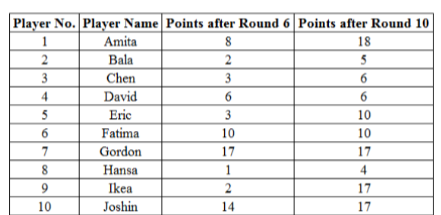
Ten players, as listed in the table below, participated in a rifle shooting competition comprising of 10 rounds. Each round had 6 participants. Players numbered
1 through 6 participated in Round 1, players 2 through 7 in Round 2,..., players 5 through 10 in Round 5, players 6 through 10 and 1 in Round 6, players 7 through
10, 1 and 2 in Round 7 and so on. The top three performances in each round were awarded 7, 3 and 1 points respectively. There were no ties in any of the 10 rounds. The table below gives the total number of points obtained by the 10 players after Round 6 and Round 10.
The following information is known about Rounds 1 through 6:
1. Gordon did not score consecutively in any two rounds.
2. Eric and Fatima both scored in a round.
The following information is known about Rounds 7 through 10:
1. Only two players scored in three consecutive rounds. One of them was Chen. No other player scored in any two consecutive rounds.
2. Joshin scored in Round 7, while Amita scored in Round 10.
3. No player scored in all the four rounds.
Q35MCQGames & Tournaments
What were the scores of Chen, David, and Eric respectively after Round 3?
- A3, 6, 3
- B3, 3, 3
- C3, 3, 0
- D3, 0, 3
Answer and solution
Answer: (B) 3, 3, 3
In Rounds 1 to 6, Joshin plays only 5 and 6, so his 14 is 7 + 7 there. Gordon plays Rounds 2 to 6 but never scores in consecutive rounds, so he scores in at most three (2, 4, 6); 17 then needs 7 + 7 + 3, with the 3 in Round 6, whose 7 is Joshin's. Amita's 8 is 7 in Round 1 and 1 in Round 6. Bala's 2 is 1 in Rounds 1 and 2, Ikea's 2 is 1 in Rounds 4 and 5 (Round 6's 1 is Amita's), and Hansa's 1 is then Round 3's.
Left: a 3 in each of Rounds 1, 2, 4 and 5, and 7 and 3 in Round 3, for Chen (3), David (6), Eric (3) and Fatima (10). Fatima needs 7 + 3, so she wins Round 3. Eric scored in a round with Fatima, so his 3 is in Round 3. Round 5's 3 is Fatima's, since Chen and David do not play it. Chen does not play Round 4, so David takes its 3, and Chen and David share Rounds 1 and 2.
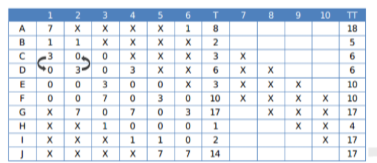
After Round 3: Chen 3, David 3, Eric 3. Option A gives David 6, but his second 3 comes in Round 4.
Hence, option B (3, 3, 3).
Q36MCQGames & Tournaments
Which three players were in the last three positions after Round 4?
- ABala, Ikea, Joshin
- BBala, Hansa, Ikea
- CBala, Chen, Gordon
- DHansa, Ikea, Joshin
Answer and solution
Answer: (D) Hansa, Ikea, Joshin
Each round awards 7, 3 and 1 points. Round
has players
to
, counting past 10 back to 1.
Joshin plays only Rounds 5 and 6 of the first six, so his 14 is 7 + 7 there and he has 0 after Round 4. Gordon plays Rounds 2 to 6 but never scores in consecutive rounds, so he scores in at most three (2, 4, 6); 17 then needs 7 + 7 + 3, with the 3 in Round 6, whose 7 is Joshin's. Amita's 8 is 7 in Round 1 and 1 in Round 6. Bala's 2 is 1 in Rounds 1 and 2. Ikea's 2 is 1 in Rounds 4 and 5, as Round 6's 1 is Amita's. Hansa's single point is then Round 3's 1.
With every 1 used, Fatima's 10 needs Round 3's 7, the only 7 still free. Eric scored in a round with Fatima, so his 3 is also in Round 3.
After Round 4: Joshin 0, Hansa 1, Ikea 1, Bala 2, Chen 3, Eric 3, David 6, Amita 7, Fatima at least 7, Gordon 14.
The bottom three are Joshin, Hansa and Ikea. Option A includes Bala, but his 2 points are more than Hansa's 1.
Hence, option D (Hansa, Ikea, Joshin).
Q37MCQGames & Tournaments
Which player scored points in maximum number of rounds?
- AJoshin
- BChen
- CAmita
- DIkea
Answer and solution
Answer: (D) Ikea
Round
has players
to
, counting past 10 back to 1. Points are 7, 3 and 1.
Rounds 1 to 6: Joshin's 14 is 7 + 7, Amita's 8 is 7 + 1 and Ikea's 2 is 1 + 1, two scoring rounds each. Chen's 3 cannot be 1 + 1 + 1 in Rounds 1 to 3, because Bala, who plays only Rounds 1 and 2, needs both their 1s for his 2; so Chen scored once.
Rounds 7 to 10, using each player's gain after Round 6: Ikea gains 15 in Rounds 7 to 9, which needs 7 + 7 + 1. Chen gains 3 in Rounds 8 to 10 and is one of the two players who scored in three consecutive rounds, so he scores 1 in each; Ikea's 1 is therefore in Round 7. With all the 1s taken, Amita's gain of 10 is 7 + 3, two rounds, and Joshin's gain of 3 is a single 3, in Round 7.
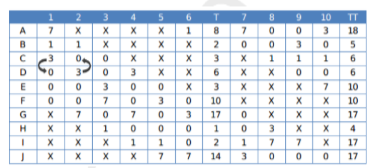
Scoring rounds: Ikea 2 + 3 = 5; Amita 2 + 2 = 4; Chen 1 + 3 = 4; Joshin 2 + 1 = 3. The nearest rivals, Amita and Chen, reach only 4.
Hence, option D (Ikea).
Q38MCQGames & Tournaments
Which players scored points in the last round?
- AAmita, Eric, Joshin
- BAmita, Chen, David
- CAmita, Bala, Chen
- DAmita, Chen, Eric
Answer and solution
Answer: (D) Amita, Chen, Eric
Compare each player's total after Round 6 with the total after Round 10. Round 10 has players 10, 1, 2, 3, 4 and 5: Joshin, Amita, Bala, Chen, David and Eric.
Eric goes from 3 to 10, gaining 7. Among Rounds 7 to 10 he plays only Round 10, so he won it.
Chen goes from 3 to 6, gaining 3, and among Rounds 7 to 10 he plays only Rounds 8, 9 and 10. He is one of the two players who scored in three consecutive rounds, so he scored in all three, 1 point each. So he took 1 point in Round 10.
Amita is given to have scored in Round 10, and only the 3-point place is left, so she took it.
Round 10's three scoring places are therefore Eric (7), Amita (3) and Chen (1). Option A has Joshin in place of Chen, but no place is left for Joshin; David, in option B, gained nothing after Round 6.
Hence, option D (Amita, Chen, Eric).
Data set
Set for questions 39–42
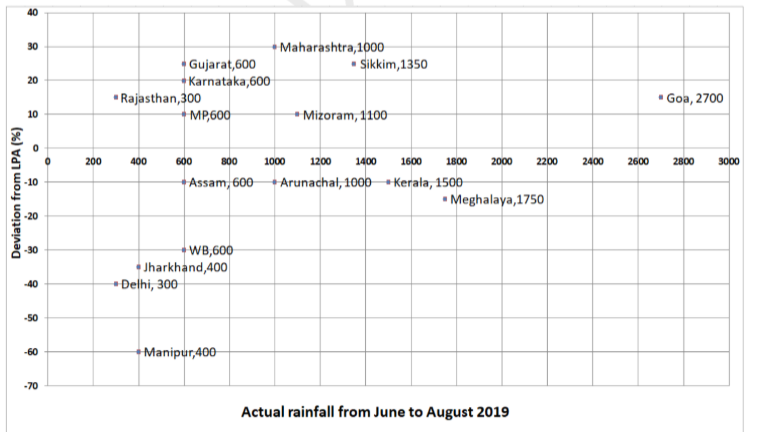
To compare the rainfall data, India Meteorological Department (IMD) calculated the Long Period Average (LPA) of rainfall during period June-August for each of the 16 states. The figure given below shows the actual rainfall (measured in mm) during June-August, 2019 and the percentage deviations from LPA of respective states in 2018. Each state along with its actual rainfall is presented in the figure.
Q39MCQPie & Scatter Charts
If a ‘Heavy Monsoon State’ is defined as a state with actual rainfall from June-August, 2019 of 900 mm or more, then approximately what percentage of
‘Heavy Monsoon States’ have a negative deviation from respective LPAs in 2019?
- A42.86
- B75.00
- C57.14
- D14.29
Answer and solution
Answer: (A) 42.86
From the figure, the states with actual rainfall of 900 mm or more are Maharashtra (1000), Mizoram (1100), Sikkim (1350), Goa (2700), Arunachal (1000), Kerala (1500) and Meghalaya (1750). That makes 7 Heavy Monsoon States.
Of these, only Arunachal (
), Kerala (
) and Meghalaya (
) lie below the zero line. The other four have positive deviations.
Required percentage
.
Option C (57.14) is the trap: it equals
, the share of Heavy Monsoon States with a positive deviation.
Hence, option A (42.86).
Q40MCQPie & Scatter Charts
If a ‘Low Monsoon State’ is defined as a state with actual rainfall from June-August, 2019 of 750 mm or less, then what is the median ‘deviation from LPA’(as defined in the Y-axis of the figure) of ‘Low Monsoon States’?
- A-10%
- B10%
- C-20%
- D-30%
Answer and solution
Answer: (A) -10%
From the figure, the states with actual rainfall of 750 mm or less, with their deviations from LPA, are:
Gujarat 600 mm,
; Karnataka 600 mm,
; Rajasthan 300 mm,
; MP 600 mm,
; Assam 600 mm,
; WB 600 mm,
; Jharkhand 400 mm,
; Delhi 300 mm,
; Manipur 400 mm,
.
Every other state has 1000 mm or more, so there are 9 Low Monsoon States. Their deviations in order are
(in %). With 9 values, the median is the 5th, which is
(Assam).
Option B (10%) is MP's deviation, the 4th value. Four values lie above
and four below it, so
is the middle one.
Hence, option A (-10%).
Q41MCQPie & Scatter Charts
What is the average rainfall of all states that have actual rainfall of 600 mm or less in 2019 and have a negative deviation from LPA?
- A367 mm
- B500 mm
- C450 mm
- D460 mm
Answer and solution
Answer: (D) 460 mm
From the figure, the states with actual rainfall of 600 mm or less and a negative deviation from LPA are:
Assam 600 mm (
), WB 600 mm (
), Jharkhand 400 mm (
), Delhi 300 mm (
) and Manipur 400 mm (
).
Gujarat, Karnataka, Rajasthan and MP also have 600 mm or less, but their deviations are positive, so they are left out.
Average
mm.
Option A (367 mm) is
, the average without Assam and WB. That reads “600 mm or less” as “less than 600 mm”; both states have exactly 600 mm and must be included.
Hence, option D (460 mm).
Q42MCQPie & Scatter Charts
The LPA of a state for a year is defined as the average rainfall in the preceding 10 years considering the period of June-August. For example, LPA in 2018 is
the average rainfall during 2009-2018 and LPA in 2019 is the average rainfall during 2010-2019. It is also observed that the actual rainfall in Gujarat in 2019
is 20% more than the rainfall in 2009. The LPA of Gujarat in 2019 is closest to
- A475 mm
- B505 mm
- C490 mm
- D525 mm
Answer and solution
Answer: (C) 490 mm
From the figure, Gujarat's actual rainfall in 2019 is 600 mm, with a deviation of
from its 2018 LPA, which is the average rainfall over 2009–2018.
So LPA(2018)
mm, and the total rainfall over 2009–2018 is
mm.
The 2019 rainfall is 20% more than the 2009 rainfall:
, so
mm.
The LPA of 2019 covers 2010–2019, so drop 2009 and add 2019:
LPA(2019)
mm.
Option A (475 mm) is the trap for stopping at 480 mm, the 2018 LPA; moving the window to 2010–2019 adds
mm.
Hence, option C (490 mm).
Data set
Set for questions 43–46
The first year students in a business school are split into six sections. In 2019 the Business Statistics course was taught in these six sections by Annie, Beti, Chetan, Dave, Esha, and Fakir. All six sections had a common midterm (MT) and a common endterm (ET) worth 100 marks each. ET contained more questions than MT. Questions for MT and ET were prepared collectively by the six faculty members. Considering MT and ET together, each faculty member prepared the same number of questions.
Each of MT and ET had at least four questions that were worth 5 marks, at least three questions that were worth 10 marks, and at least two questions that were worth 15 marks. In both MT and ET, all the 5-mark questions preceded the 10-mark questions, and all the 15- mark questions followed the 10-mark questions.
The following additional facts are known.
i. Annie prepared the fifth question for both MT and ET. For MT, this question carried 5 marks.
ii. Annie prepared one question for MT. Every other faculty member prepared more than one questions for MT.
iii. All questions prepared by a faculty member appeared consecutively in MT as well as ET.
iv. Chetan prepared the third question in both MT and ET; and Esha prepared the eighth question in both.
v. Fakir prepared the first question of MT and the last one in ET. Dave prepared the last question of MT and the first one in ET.
Q43MCQLogical Puzzles
The second question in ET was prepared by:
- AChetan
- BBeti
- CEsha
- DDave
Answer and solution
Answer: (D) Dave
A paper needs at least four 5-mark, three 10-mark and two 15-mark questions: 9 questions worth 80 marks. The other 20 marks need 2, 3 or 4 more questions (for example
,
or
), so a paper has 11, 12 or 13 questions.
Everyone set the same number of questions, so MT and ET together have a multiple of 6 questions. ET is longer than MT, so only
works, and each person set 4.
In MT, Annie set one of the 11 questions and the other five set the remaining 10, at least 2 each, so exactly 2 each. In ET, Annie therefore set 3 and everyone else 2.
ET in blocks: Dave set the first question, so Q1–Q2. Chetan has Q3, so Q3–Q4. Annie's three include Q5, so Q5–Q7. Esha has Q8, so Q8–Q9. Fakir set the last question, so Q12–Q13, leaving Q10–Q11 for Beti. The completed ET table shows these blocks:

So the second ET question is Dave's. Chetan (option A) set Q3–Q4, Beti (option B) Q10–Q11 and Esha (option C) Q8–Q9.
Hence, option D (Dave).
Q44MCQLogical Puzzles
How many 5‐mark questions were there in MT and ET combined?
- A13
- B12
- C10
- DCannot be determined
Answer and solution
Answer: (A) 13
A paper needs at least four 5-mark, three 10-mark and two 15-mark questions: 9 questions worth 80 marks. The other 20 marks come from
,
,
or
, giving 13, 12, 11 or 11 questions.
Everyone set the same number of questions, so MT and ET together have a multiple of 6. ET is longer, so only
works: MT has 11 questions and ET has 13.
ET's 13 questions mean its extra 20 marks are
, so ET has
five-mark questions.
MT's 11 questions mean its extra is
(four 5-mark questions) or
(five). With only four, MT's fifth question would carry 10 marks, but Annie's fifth MT question carries 5. So MT has five. The completed MT and ET tables show these marks:

Total
.
Option B (12) is the count if MT had only four 5-mark questions, which statement (i) rules out. Both papers are fully fixed, so option D fails too.
Hence, option A (13).
Q45MCQLogical Puzzles
Who prepared 15-mark questions for MT and ET?
- AOnly Beti, Dave, Esha and Fakir
- BOnly Dave and Fakir
- COnly Esha and Fakir
- DOnly Dave, Esha and Fakir
Answer and solution
Answer: (D) Only Dave, Esha and Fakir
A paper needs at least four 5s, three 10s and two 15s: 9 questions worth 80 marks. The other 20 marks add 2, 3 or 4 questions, so a paper has 11, 12 or 13. Equal shares make MT plus ET a multiple of 6, and ET is longer, so only
works: each person set 4.
An 11-question paper has four 5s (extra
) or five (extra
). MT's fifth question carries 5 marks, so MT has five 5s, three 10s and three 15s (Q9–Q11). ET's 13 questions need extra
: eight 5s, three 10s and two 15s (Q12–Q13).
MT: Annie set only Q5, so the others set 2 each: Fakir Q1–Q2, Chetan Q3–Q4, Dave Q10–Q11. Esha has Q8; taking Q7–Q8 would split Beti's pair, so Esha has Q8–Q9 and Beti Q6–Q7.
ET: Annie set 3 and the others 2: Dave Q1–Q2, Chetan Q3–Q4, Annie Q5–Q7, Esha Q8–Q9, Beti Q10–Q11, Fakir Q12–Q13.
The 15-mark questions came from Esha (MT Q9), Dave (MT Q10–Q11) and Fakir (ET Q12–Q13). Option A adds Beti, whose questions all carry 10 marks; options B and C each leave someone out.
Hence, option D (Only Dave, Esha and Fakir).
Q46MCQLogical Puzzles
Which of the following questions did Beti prepare in ET?
- ASeventh question
- BFourth question
- CNinth question
- DTenth question
Answer and solution
Answer: (D) Tenth question
A paper needs at least four 5-mark, three 10-mark and two 15-mark questions: 9 questions worth 80 marks. The other 20 marks need 2, 3 or 4 more questions, so a paper has 11, 12 or 13 questions.
Everyone set the same number, so MT and ET together have a multiple of 6 questions. ET is longer, so only
works, and each person set 4.
In MT, Annie set one of the 11 questions and the other five set the remaining 10, at least 2 each, so exactly 2 each. In ET, Annie therefore set 3 and everyone else 2.
ET in blocks: Dave set the first question, so Q1–Q2. Chetan has Q3, so Q3–Q4. Annie's three include Q5, so Q5–Q7. Esha has Q8, so Q8–Q9. Fakir set the last question, so Q12–Q13. That leaves Q10–Q11 for Beti. The completed ET table shows these blocks:
So Beti set the tenth question. The seventh (option A) is Annie's, the fourth (option B) Chetan's and the ninth (option C) Esha's.
Hence, option D (Tenth question).
Data set
Set for questions 47–50
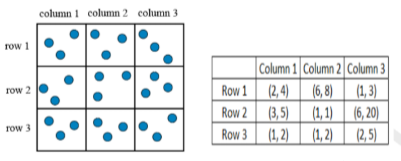
Three pouches (each represented by a filled circle) are kept in each of the nine slots in a 3 × 3 grid, as shown in the figure. Every pouch has a certain number of one-rupee coins. The minimum and maximum amounts of money (in rupees) among the three pouches in each of the nine slots are given in the table. For example, we know that among the three pouches kept in the second column of the first row, the minimum amount in a pouch is Rs. 6 and the maximum amount is Rs. 8.
There are nine pouches in any of the three columns, as well as in any of the three rows. It is known that the average amount of money (in rupees) kept in the nine pouches in any column or in any row is an integer. It is also known that the total amount of money kept in the three pouches in the first column of the third row is Rs. 4.
Q47TITAMissing Value Tables
What is the total amount of money (in rupees) in the three pouches kept in the first column of the second row?
Type in your answer (TITA). No negative mark for a wrong answer.
Answer and solution
Answer: 13
Each row and each column has nine pouches with an integer average, so every row total and column total is a multiple of 9.
Three pouches with minimum
and maximum
hold between
and
coins, depending on the middle pouch.
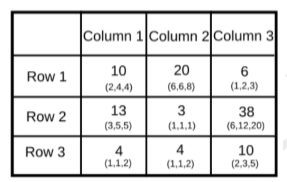
Column 1: the row 1 slot (minimum 2, maximum 4) holds 8 to 10 coins, the row 2 slot (3, 5) holds 11 to 13, and the row 3 slot holds exactly 4 (given). So the column total lies between
and
.
The only multiple of 9 in that range is 27, and reaching it needs both slots at their maximum: row 1 holds
and row 2 holds
. The completed grid, with each slot's total and its three pouches, shows these in column 1:
The answer is 13.
Q48TITAMissing Value Tables
How many pouches contain exactly one coin?
Type in your answer (TITA). No negative mark for a wrong answer.
Answer and solution
Answer: 8
Each row and column has nine pouches with an integer average, so its total is a multiple of 9. Three pouches with minimum
and maximum
hold between
and
coins.
Column 1: 8 to 10, 11 to 13 and the given 4 total 23 to 27, so 27. The pouches are
and
, and the 4 coins (minimum 1, maximum 2) are
.
Column 2: 20 to 22, the centre's 3 (every pouch holds 1) and 4 to 5 total 27 to 30, so 27. The pouches are
, then
, then
.
Column 3 follows from the rows. Row 1:
plus 5 to 7 must be 36, so
. Row 2:
plus 32 to 46 must be 54, so
. Row 3:
plus 9 to 12 must be 18, so
.
The completed grid shows every slot's pouches:
Pouches with exactly one coin: 2 in row 3 column 1, 3 in the centre, 2 in row 3 column 2 and 1 in row 1 column 3, so
.
The answer is 8.
Q49TITAMissing Value Tables
What is the number of slots for which the average amount (in rupees) of its three pouches is an integer?
Type in your answer (TITA). No negative mark for a wrong answer.
Answer and solution
Answer: 2
A slot's average is an integer exactly when its three-pouch total is a multiple of 3, so find all nine totals.
Each row and column has nine pouches with an integer average, so its total is a multiple of 9. Three pouches with minimum
and maximum
hold between
and
coins.
Column 1: 8 to 10, 11 to 13 and the given 4 total 23 to 27, so 27, giving 10, 13 and 4.
Column 2: 20 to 22, then 3 in the centre (every pouch holds 1), then 4 to 5 total 27 to 30, so 27, giving 20, 3 and 4.
Column 3 follows from the rows. Row 1:
plus 5 to 7 must be 36, so 6. Row 2:
plus 32 to 46 must be 54, so 38. Row 3:
plus 9 to 12 must be 18, so 10.
The completed grid gives each slot's total with its three pouches below it:
The nine totals are 10, 20, 6, 13, 3, 38, 4, 4 and 10. Only 3 (the centre) and 6 (row 1, column 3) are multiples of 3.
The answer is 2.
Q50TITAMissing Value Tables
The number of slots for which the total amount in its three pouches strictly exceeds Rs. 10 is
Type in your answer (TITA). No negative mark for a wrong answer.
Answer and solution
Answer: 3
Each row and column has nine pouches with an integer average, so its total is a multiple of 9. Three pouches with minimum
and maximum
hold between
and
coins.
Column 1: 8 to 10, 11 to 13 and the given 4 total 23 to 27, so 27: the slots hold 10, 13 and 4.
Column 2: 20 to 22, then 3 in the centre (every pouch holds 1), then 4 to 5 total 27 to 30, so 27: the slots hold 20, 3 and 4.
Column 3 follows from the rows. Row 1:
plus 5 to 7 must be 36, so 6. Row 2:
plus 32 to 46 must be 54, so 38. Row 3:
plus 9 to 12 must be 18, so 10.
The completed grid gives each slot's total with its three pouches below it:
Totals above Rs. 10: 13, 20 and 38. The two slots with exactly Rs. 10 (row 1 column 1 and row 3 column 3) do not count, because the total must strictly exceed Rs. 10.
The answer is 3.
Data set
Set for questions 51–54
Three doctors, Dr. Ben, Dr. Kane and Dr. Wayne visit a particular clinic Monday to Saturday to see patients. Dr. Ben sees each patient for 10 minutes and charges Rs. 100/-. Dr. Kane sees each patient for 15 minutes and charges Rs. 200/-, while Dr. Wayne sees each patient for 25 minutes and charges Rs. 300/-. The clinic has three rooms numbered 1, 2 and 3 which are assigned to the three doctors as per the following table.
The clinic is open from 9 a.m. to 11.30 a.m. every Monday to Saturday.
On arrival each patient is handed a numbered token indicating their position in the queue, starting with token number 1 every day. As soon as any doctor becomes free, the next patient in the queue enters that emptied room for consultation. If at any time, more than one room is free then the waiting patient enters the room with the smallest number. For example, if the next two patients in the queue have token numbers 7 and 8 and if rooms numbered 1 and 3 are free, then patient with token number 7 enters room number 1 and patient with token number 8 enters room number 3.

Q51MCQTeam Selection & Scheduling
What is the maximum number of patients that the clinic can cater to on any single day?
- A12
- B30
- C31
- D15
Answer and solution
Answer: (C) 31
The clinic is open from 9 a.m. to 11.30 a.m., which is 150 minutes. The most patients are seen when every doctor works without a break all morning.
Dr. Ben takes 10 minutes per patient, so he sees
. Dr. Kane takes 15 minutes, so he sees
. Dr. Wayne takes 25 minutes, so he sees
.
Total
.
Option B (30) would lose one patient, but no time is wasted: each consultation time divides 150 exactly, so even Dr. Wayne's sixth patient (11:05 to 11:30) finishes by closing time.
Hence, option C (31).
Q52MCQTeam Selection & Scheduling
The queue is never empty on one particular Saturday. Which of the three doctors would earn the maximum amount in consultation charges on that day?
- ADr. Wayne
- BDr. Kane
- CDr. Ben
- DBoth Dr. Wayne and Dr. Kane
Answer and solution
Answer: (B) Dr. Kane
With the queue never empty, each doctor sees patients back to back for all 150 minutes from 9 a.m. to 11.30 a.m., whichever room he is in.
Dr. Ben sees
patients and earns
rupees.
Dr. Kane sees
patients and earns
rupees.
Dr. Wayne sees
patients and earns
rupees.
Dr. Wayne (option A) charges the most per patient, but his 6 patients bring in Rs. 1800, less than Dr. Kane's Rs. 2000. So option D (a tie between them) fails as well.
Hence, option B (Dr. Kane).
Q53MCQTeam Selection & Scheduling
Mr. Singh visited the clinic on Monday, Wednesday, and Friday of a particular week, arriving at 8:50 a.m. on each of the three days. His token number was 13
on all three days. On which day was he at the clinic for the maximum duration?
- ASame duration on all three days
- BFriday
- CMonday
- DWednesday
Answer and solution
Answer: (C) Monday
Mr. Singh arrived at 8:50 with token 13, so patients 1 to 13 were all waiting when the clinic opened at 9 a.m. The timings below therefore hold on all three days; only the rooms differ.
Dr. Ben (10 minutes) becomes free at 9:10, 9:20, 9:30, 9:40 and 9:50; Dr. Kane (15 minutes) at 9:15, 9:30 and 9:45; Dr. Wayne (25 minutes) at 9:25 and 9:50.
Patients 1 to 3 go in at 9:00, then patient 4 at 9:10, 5 at 9:15, 6 at 9:20, 7 at 9:25, 8 and 9 at 9:30, 10 at 9:40 and 11 at 9:45. At 9:50 Ben and Wayne are both free: patient 12 takes the lower-numbered room and patient 13 the other.
Monday: Ben is in room 1 and Wayne in room 3, so Mr. Singh sees Wayne from 9:50 to 10:15. Wednesday (Wayne in room 1, Ben in room 2) and Friday (Wayne in room 2, Ben in room 3): he sees Ben from 9:50 to 10:00. Timelines for Monday, Wednesday and Friday, top to bottom (doctors in room order):
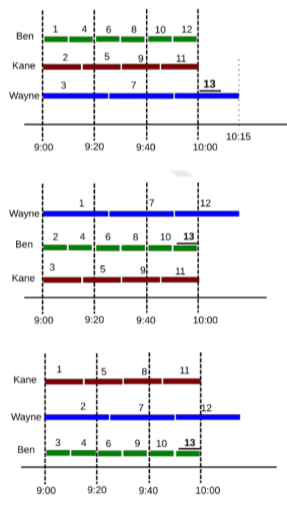
He stays 85 minutes on Monday but 70 minutes on the other two days, so the durations are not equal (option A), and Friday (option B) and Wednesday (option D) are shorter.
Hence, option C (Monday).
Q54MCQTeam Selection & Scheduling
On a slow Thursday, only two patients are waiting at 9 a.m. After that two patients keep arriving at exact 15-minute intervals starting at 9:15 a.m. -- i.e. at
9:15 a.m., 9:30 a.m., 9:45 a.m. etc. Then the total duration in minutes when all three doctors are simultaneously free is
- A30
- B10
- C15
- D0
Answer and solution
Answer: (D) 0
On Thursday, room 1 has Dr. Wayne (25 minutes), room 2 Dr. Ben (10 minutes) and room 3 Dr. Kane (15 minutes).
9:00: the two waiting patients take rooms 1 and 2: Wayne (till 9:25) and Ben (till 9:10). Kane stays free.
9:15: two arrive. Wayne is busy, so they go to Ben (till 9:25) and Kane (till 9:30).
9:30: two arrive just as Kane's patient leaves, and take rooms 1 and 2: Wayne (till 9:55) and Ben (till 9:40).
9:45: two arrive. Wayne is busy, so Ben (till 9:55) and Kane (till 10:00) take them.
At 10:00 the situation is the same as at 9:30, so this 30-minute cycle repeats until closing. The timeline shows the pattern:
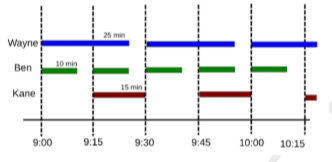
Wayne is free only from 9:25 to 9:30, 9:55 to 10:00, and so on, and Kane is busy during each of these gaps (till 9:30, till 10:00, and so on). Kane's own free spells, such as 9:00 to 9:15 and 9:30 to 9:45, all fall while Wayne is busy, so option C (15) fails. The three doctors are never free together.
Hence, option D (0).
Data set
Set for questions 55–58
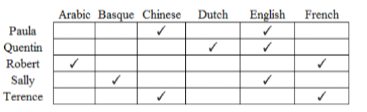
In the table below the check marks indicate all languages spoken by five people: Paula, Quentin, Robert, Sally and Terence. For example, Paula speaks only Chinese and English.
These five people form three teams, Team 1, Team 2 and Team 3. Each team has either 2 or 3 members. A team is said to speak a particular language if at least one of its members speak that language.
The following facts are known.
(1) Each team speaks exactly four languages and has the same number of members.
(2) English and Chinese are spoken by all three teams, Basque and French by exactly two teams and the other languages by exactly one team.
(3) None of the teams include both Quentin and Robert.
(4) Paula and Sally are together in exactly two teams.
(5) Robert is in Team 1 and Quentin is in Team 3.
Q55MCQTeam Selection & Scheduling
Who among the following four is not a member of Team 2?
- APaula
- BTerence
- CQuentin
- DSally
Answer and solution
Answer: (C) Quentin
Arabic and Dutch are each spoken by exactly one team (fact 2). Only Quentin speaks Dutch, so Quentin is in exactly one team, Team 3, and not in Team 2. Likewise, only Robert speaks Arabic, so Robert is only in Team 1.
Now check the others. Team 2 has neither Robert nor Quentin, so it speaks neither Arabic nor Dutch; its four languages must be English, Chinese, Basque and French. Basque needs Sally, and French needs Terence (Robert is not available), so both are in Team 2.
Team 1 already speaks Arabic, French, English and Chinese, so Sally, who would add Basque, is not in it. Basque is spoken by exactly two teams and only Sally speaks it, so Sally is in Teams 2 and 3. Paula is with Sally in exactly two teams, so Paula is in Team 2 as well. So Team 1 is Paula, Terence and Robert; Team 2 is Paula, Sally and Terence; Team 3 is Paula, Sally and Quentin.
So Paula (option A), Terence (option B) and Sally (option D) are all members of Team 2.
Hence, option C (Quentin).
Q56MCQTeam Selection & Scheduling
Who among the following four people is a part of exactly two teams?
- APaula
- BQuentin
- CSally
- DRobert
Answer and solution
Answer: (C) Sally
Basque is spoken only by Sally, and exactly two teams speak Basque, so Sally is in exactly two teams.
The other options fail. Arabic and Dutch are each spoken by exactly one team; only Robert speaks Arabic and only Quentin speaks Dutch, so Robert (option D) and Quentin (option B) are each in just one team.
Paula (option A) is in all three. Team 1 contains Robert (Arabic, French) and, like every team, speaks English and Chinese, so those are its only four languages. Its English must come from Paula, because Quentin cannot be with Robert and Sally would add Basque. So Sally's two teams are Teams 2 and 3, and since Paula is with Sally in exactly two teams, Paula is in Teams 2 and 3 as well.
So Team 1 is Paula, Terence and Robert; Team 2 is Paula, Sally and Terence; Team 3 is Paula, Sally and Quentin. Sally is in Teams 2 and 3 only, and Paula is in all three.
Hence, option C (Sally).
Q57MCQTeam Selection & Scheduling
Who among the five people is a member of all teams?
- ATerence
- BSally
- CPaula
- DNo one
Answer and solution
Answer: (C) Paula
Team 1 contains Robert, who speaks Arabic and French. Every team speaks English and Chinese and exactly four languages, so these four are Team 1's only languages.
Team 1's English speaker must be Paula, because Quentin cannot be with Robert and Sally would add Basque. So Paula is in Team 1 and Sally is not.
Basque is spoken only by Sally and by exactly two teams, so Sally is in exactly two teams: Teams 2 and 3. Paula is with Sally in exactly two teams, so Paula is in Teams 2 and 3 as well. Paula is therefore in all three teams: Team 1 is Paula, Terence and Robert; Team 2 is Paula, Sally and Terence; Team 3 is Paula, Sally and Quentin.
Terence (option A) is not in Team 3: that team has Quentin (Dutch) and Sally (Basque) besides English and Chinese, so his French would be a fifth language. Sally (option B) is in only two teams, and option D fails because Paula qualifies.
Hence, option C (Paula).
Q58MCQTeam Selection & Scheduling
Apart from Chinese and English, which languages are spoken by Team 1?
- AArabic and French
- BBasque and French
- CArabic and Basque
- DBasque and Dutch
Answer and solution
Answer: (A) Arabic and French
Robert is in Team 1, and he speaks Arabic and French, so Team 1 speaks both. Every team also speaks English and Chinese, and each team speaks exactly four languages. So Team 1's languages are exactly Chinese, English, Arabic and French.
Team 1 is Paula, Terence and Robert: Paula speaks English and Chinese, Terence speaks Chinese and French, and Robert speaks Arabic and French.
Option B (Basque and French) is the closest, since French is right, but Basque would be a fifth language for Team 1. Options C and D also include Basque, so they fail for the same reason.
Hence, option A (Arabic and French).
Data set
Set for questions 59–62
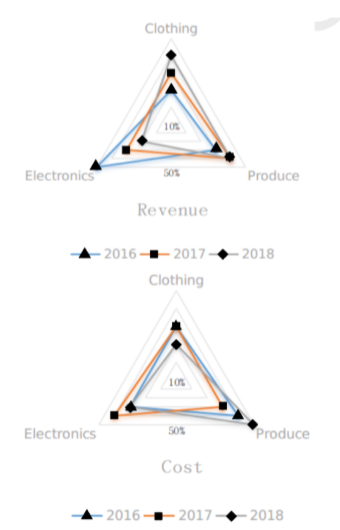
A large store has only three departments, Clothing, Produce, and Electronics. The following figure shows the percentages of revenue and cost from the three departments for the years 2016, 2017 and 2018. The dotted lines depict percentage levels. So for example, in 2016, 50% of store's revenue came from its Electronics department while 40% of its costs were incurred in the Produce department In this setup, Profit is computed as (Revenue - Cost) and Percentage Profit as Profit/Cost × 100%.
It is known that
1. The percentage profit for the store in 2016 was 100%.
2. The store’s revenue doubled from 2016 to 2017, and its cost doubled from 2016 to 2018.
3. There was no profit from the Electronics department in 2017.
4. In 2018, the revenue from the Clothing department was the same as the cost incurred in the Produce department.
Q59TITARadar & Special Graphs
What was the percentage profit of the store in 2018?
Type in your answer (TITA). No negative mark for a wrong answer.
Answer and solution
Answer: 25
Take the store's 2016 cost as 100. A percentage profit of 100% means profit equals cost, so 2016 revenue was 200.
Cost doubled from 2016 to 2018, so the 2018 cost is 200. The chart shows Produce incurred 50% of the 2018 cost, which is
.
In 2018, Clothing's revenue equalled Produce's cost, so Clothing earned 100. Clothing brought in 40% of the 2018 revenue, so the total revenue was
.
The completed cost and revenue tables (2016 cost taken as 100) show these values:
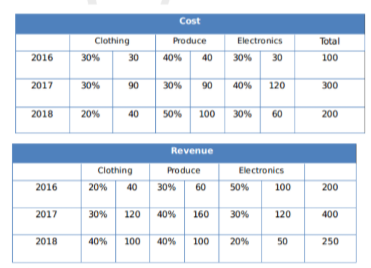
Percentage profit in 2018
.
The answer is 25.
Q60MCQRadar & Special Graphs
What was the ratio of revenue generated from the Produce department in 2017 to that in 2018?
- A16 : 9
- B4 : 3
- C9 : 16
- D8 : 5
Answer and solution
Answer: (D) 8 : 5
Take the 2016 cost as 100. A 100% profit means 2016 revenue was 200.
2017: revenue doubled to 400, and the chart shows Produce earned 40% of it, which is 160.
2018: cost doubled from 2016 to 200. Produce incurred 50% of it, which is 100, and this equals Clothing's 2018 revenue. Clothing earned 40% of the 2018 revenue, so the total was
. Produce also earned 40% of it, which is 100.
The completed cost and revenue tables (2016 cost taken as 100) show these values:
Ratio
.
Option A (16 : 9) would need 2018 Produce revenue of 90, and option B (4 : 3) would need 120, but it is 100.
Hence, option D (8 : 5).
Q61TITARadar & Special Graphs
What percentage of the total profits for the store in 2016 was from the Electronics department?
Type in your answer (TITA). No negative mark for a wrong answer.
Answer and solution
Answer: 70
Take the store's 2016 cost as 100. A percentage profit of 100% means profit equals cost, so revenue was 200 and profit was 100.
The chart shows Electronics earned 50% of the 2016 revenue, which is
, and incurred 30% of the 2016 cost, which is
.
The completed cost and revenue tables (2016 cost taken as 100) show these values:
Electronics profit
.
Share of the store's profit
.
The answer is 70.
Q62MCQRadar & Special Graphs
What was the approximate difference in profit percentages of the store in 2017 and 2018?
- A15.5
- B25.0
- C8.3
- D33.3
Answer and solution
Answer: (C) 8.3
Take the 2016 cost as 100. A 100% profit means 2016 revenue was 200.
2017: revenue doubled to 400. Electronics earned 30% of it, which is 120, and made no profit, so its cost was also 120. The chart puts Electronics at 40% of the 2017 cost, so total cost
. Profit percentage
.
2018: cost doubled from 2016 to 200. Produce's 50% share of that cost is 100, which equals Clothing's revenue; Clothing earned 40% of revenue, so revenue
. Profit percentage
.
The completed cost and revenue tables (2016 cost taken as 100) show these totals:
Difference
percentage points.
Options B (25.0) and D (33.3) are the two years' profit percentages themselves, not their difference.
Hence, option C (8.3).
Data set
Set for questions 63–66
Students in a college are discussing two proposals --
A: a proposal by the authorities to introduce dress code on campus, and
B: a proposal by the students to allow multinational food franchises to set up outlets on college campus.
A student does not necessarily support either of the two proposals.
In an upcoming election for student union president, there are two candidates in fray:
Sunita and Ragini. Every student prefers one of the two candidates.
A survey was conducted among the students by picking a sample of 500 students. The following information was noted from this survey.
1. 250 students supported proposal A and 250 students supported proposal B.
2. Among the 200 students who preferred Sunita as student union president, 80% supported proposal A.
3. Among those who preferred Ragini, 30% supported proposal A.
4. 20% of those who supported proposal B preferred Sunita.
5. 40% of those who did not support proposal B preferred Ragini.
6. Every student who preferred Sunita and supported proposal B also supported proposal A.
7. Among those who preferred Ragini, 20% did not support any of the proposals.
Q63TITASet Theory
Among the students surveyed who supported proposal A, what percentage preferred Sunita for student union president?
Type in your answer (TITA). No negative mark for a wrong answer.
Answer and solution
Answer: 64
Every student prefers exactly one of the two candidates. 200 prefer Sunita, so
prefer Ragini.
By statement 2, 80% of Sunita's 200, which is 160, support proposal A. By statement 3, 30% of Ragini's 300, which is 90, support proposal A. Together
, matching the 250 supporters of proposal A in statement 1.
The solved diagrams for Sunita's and Ragini's supporters show these as A(160) and A(90); their split of proposal B is not needed here.
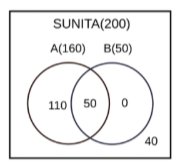
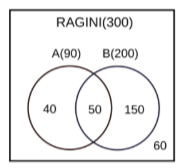
Share of proposal A's supporters who prefer Sunita
.
The answer is 64.
Q64TITASet Theory
What percentage of the students surveyed who did not support proposal A preferred Ragini as student union president?
Type in your answer (TITA). No negative mark for a wrong answer.
Answer and solution
Answer: 84
Every student prefers exactly one candidate: 200 prefer Sunita, so
prefer Ragini.
By statement 1, 250 students supported proposal A, so
did not.
By statement 3,
of Ragini's 300 students, that is 90, supported A. So
of Ragini's students did not support A.
Check with statement 2:
of Sunita's 200, that is 160, supported A, and
, as statement 1 says. So
of Sunita's students did not support A, and
.
The completed diagrams, built from all seven statements, show the same split: 40 of Sunita's students and
of Ragini's lie outside A.
Statements 4 to 7 fill in the proposal B regions but are not needed here.
Required percentage
.
The answer is 84.
Q65MCQSet Theory
What percentage of the students surveyed who supported both proposals A and B preferred Sunita as student union president?
- A40
- B25
- C20
- D50
Answer and solution
Answer: (D) 50
Every student prefers one candidate: 200 prefer Sunita, so
prefer Ragini.
Sunita: by statement 4,
of the 250 supporters of proposal B prefer Sunita, which is 50. By statement 6, all 50 also support proposal A, so 50 of Sunita's students support both proposals.
Ragini: by statement 3,
of her 300 students, that is 90, support proposal A. By statement 5,
of the 250 students who do not support proposal B, that is 100, prefer Ragini. By statement 7,
of her 300 students, that is 60, support neither proposal. So
of them support proposal A only, and
support both.
So
students support both proposals, and 50 of them prefer Sunita:
.
Option C (20) is the share of all proposal B supporters who prefer Sunita (statement 4), not the share among those who support both.
Hence, option D (50).
Q66MCQSet Theory
How many of the students surveyed supported proposal B, did not support proposal A and preferred Ragini as student union president?
- A150
- B210
- C200
- D40
Answer and solution
Answer: (A) 150
Every student prefers one candidate: 200 prefer Sunita, so
prefer Ragini.
By statement 4,
of the 250 supporters of proposal B prefer Sunita, which is 50, so
of Ragini's students support proposal B.
By statement 3,
of Ragini's 300 students, that is 90, support proposal A. By statement 5,
of the 250 students who do not support proposal B, that is 100, prefer Ragini. By statement 7,
of her 300 students, that is 60, support neither proposal. So
support proposal A only, and
support both proposals.
Ragini's students who support proposal B but not proposal A
.
Option C (200) counts every Ragini student who supports proposal B, including the 50 who also support proposal A.
Hence, option A (150).