- CATin
- CAT past papers
- CAT 2018 Slot 1
- QA
CAT 2018 Slot 1 — QA questions with answers
All 34 questions of the Quantitative Ability section (22 MCQs, 12 TITA). Try each one, then open its answer and solution.
CAT 2018 Slot 1, timed like the real exam (180 minutes, 60 a section) and scored the CAT way: +3 right, −1 for a wrong MCQ, 0 for a wrong TITA, with the full post-mock analysis. Older official papers are in CATin Pro, with 80+ mocks and the full planner. The last three years of papers are free.
Sit this paper as a timed mock with CATin ProQuantitative Ability
CAT 2018 Slot 1 · 60 minutes · +3 for a right answer, −1 for a wrong MCQ, 0 for a wrong TITA
Q67MCQLogarithms
If
is a positive quantity such that
, then
is equal to
- A
- B
- C
- D
Answer and solution
Answer: (D)
Use the identity
, which holds because both sides have the same logarithm to base
, namely
.
So
, and the equation becomes
, giving
.
No option is written this way, so rewrite it:
.
Option B looks similar, but
, which is the reciprocal of
, not the same number. Option C is
, twice the answer, and option A,
, is a different number.
Hence, option D (
).
Q68MCQPolygons & Circles
In a circle, two parallel chords on the same side of a diameter have lengths 4 cm and 6 cm. If the distance between these chords is 1 cm, then the radius of the circle, in cm, is
- A
- B
- C
- D
Answer and solution
Answer: (A)
Let the chords be AB = 6 cm and CD = 4 cm, with midpoints M and N. The perpendicular from the centre O to a chord bisects it, so AM = 3 cm and CN = 2 cm, and O, M, N lie on one line.
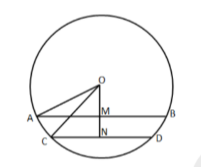
The longer chord is nearer the centre. Both chords are on the same side of the centre, so if OM
, then ON
.
OA and OC are both radii, so
, i.e.
, which gives
.
Radius
cm. Check: the chords are then 2 cm and 3 cm from the centre, 1 cm apart, as required.
Option D,
, is close, but it would put the chords
cm and
cm from the centre, about 1.1 cm apart instead of 1 cm.
Hence, option A (
).
Q69MCQTime & Work
Humans and robots can both perform a job but at different efficiencies. Fifteen humans and five robots working together take thirty days to finish the job, whereas five humans and fifteen robots working together take sixty days to finish it. How many days will fifteen humans working together (without any robot) take to finish it?
- A45
- B36
- C32
- D40
Answer and solution
Answer: (C) 32
Let one human do
units of work a day and one robot
units.
The job is the same in both cases, so
. Dividing by 30 gives
, so
and
: one human does the work of 5 robots.
Total work
.
Fifteen humans do
a day, so they need
days.
This makes sense: the 5 robots in the first team do only as much as 1 human, so without them the team's daily work falls from
to
and 30 days stretch to
. Option B, 36 days, would mean the 5 robots did the work of 3 humans.
Hence, option C (32).
Q70MCQPolygons & Circles
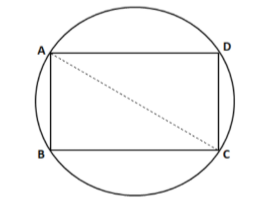
Let ABCD be a rectangle inscribed in a circle of radius 13 cm. Which one of the following pairs can represent, in cm, the possible length and breadth of ABCD?
- A24, 10
- B25, 9
- C25, 10
- D24, 12
Answer and solution
Answer: (A) 24, 10
We know that AC is the diameter and
. So
cm.
In right angle triangle ABC:
Checking the options:
- Option A:
✓
- Option B:
- Option C:
- Option D:
Therefore, option A is the correct answer.
Q71MCQPolygons & Circles
Points E, F, G, H lie on the sides AB, BC, CD, and DA, respectively, of a square ABCD. If EFGH is also a square whose area is 62.5% of that of ABCD and CG is longer than EB, then the ratio of length of EB to that of CG is
- A3 : 8
- B2 : 5
- C4 : 9
- D1 : 3
Answer and solution
Answer: (D) 1 : 3
Let AE : EB
. For EFGH to be a square, the four corner triangles must be congruent, so BF, CG and DH also equal
, while FC, GD and HA equal 1. The side of ABCD is
, with CG
and EB
.
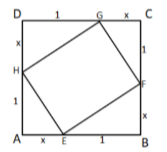
In right triangle EBF,
. This is the area of EFGH, which is 62.5%, i.e.
, of
.
So
, which gives
, i.e.
. Then
or
. CG is longer than EB, so
and EB : CG
.
Check option B: EB : CG
would give EFGH an area of
of ABCD, not 62.5%.
Hence, option D (1 : 3).
Q72TITATime, Speed & Distance
Point P lies between points A and B such that the length of BP is thrice that of AP. Car 1 starts from A and moves towards B. Simultaneously, car 2 starts from B and moves towards A. Car 2 reaches P one hour after car 1 reaches P. If the speed of car 2 is half that of car 1, then the time, in minutes, taken by car 1 in reaching P from A is
Type in your answer (TITA). No negative mark for a wrong answer.
Answer and solution
Answer: 12
Let AP
, so BP
. Let car 1's speed be
; car 2's speed is then
.
Both cars start together. Car 1 reaches P after
, and car 2 after
.
Car 2 arrives 60 minutes later, so
. This gives
, so
minutes.
So car 1 takes 12 minutes to go from A to P, and car 2 takes 72 minutes to reach P.
The answer is 12.
Q73TITAFunctions & Graphs
Let
, where
is any positive real number. Then the maximum possible value of
is
Type in your answer (TITA). No negative mark for a wrong answer.
Answer and solution
Answer: 32
For
,
increases as
grows, while
decreases. So
, the smaller of the two, follows
up to the point where they meet and then follows
down. Its largest value is where they are equal.
gives
, i.e.
. Since
,
.
.
For smaller
,
; for larger
,
.
The answer is 32.
Q74TITAInequalities & Modulus
While multiplying three real numbers, Ashok took one of the numbers as 73 instead of 37. As a result, the product went up by 720. Then the minimum possible value of the sum of squares of the other two numbers is
Type in your answer (TITA). No negative mark for a wrong answer.
Answer and solution
Answer: 40
Let the product of the other two numbers be
. Taking 73 instead of 37 raises the product by
, so
and
.
Call the two numbers
and
, with
. For any real numbers,
, so
.
Equality needs
, i.e.
(or both
), which is allowed because the numbers are real. So the minimum of
is
.
The answer is 40.
Q75TITATime, Speed & Distance
Train T leaves station X for station Y at 3 pm. Train S, traveling at three quarters of the speed of T, leaves Y for X at 4 pm. The two trains pass each other at a station Z, where the distance between X and Z is three-fifths of that between X and Y. How many hours does train T take for its journey from X to Y?
Type in your answer (TITA). No negative mark for a wrong answer.
Answer and solution
Answer: 15
Let T's speed be
, so S's speed is
. Let the trains meet
hours after 3 pm; S, which started at 4 pm, has then been running for
hours.
Z is three-fifths of the way from X to Y, so at the meeting T has covered
of the distance and S the other
:
.
So T covers
of the journey in 9 hours, and the whole journey takes
hours.
Check: in its 8 hours S covers
, which T covers in 6 hours, and
of T's 15-hour journey is indeed 6 hours.
The answer is 15.
Q76MCQAverages, Mixtures & Alligations
Two types of tea, A and B, are mixed and then sold at Rs. 40 per kg. The profit is 10% if A and B are mixed in the ratio 3 : 2, and 5% if this ratio is 2 : 3. The cost prices, per kg, of A and B are in the ratio
- A17 : 25
- B18 : 25
- C19 : 24
- D21 : 25
Answer and solution
Answer: (C) 19 : 24
Let the cost prices of A and B be Rs.
and Rs.
per kg. The mixture sells at Rs. 40 per kg.
Mixed 3 : 2 at 10% profit, the mixture costs
per kg, so
, i.e.
.
Mixed 2 : 3 at 5% profit,
, i.e.
.
Equating the left sides:
, so
and
.
Option D (21 : 25) is the closest value, but it fails
:
, while
.
Hence, option C (19 : 24).
Q77MCQSequences & Series
Given an equilateral triangle
with side 24 cm, a second triangle
is formed by joining the midpoints of the sides of
. Then a third triangle
is formed by joining the midpoints of the sides of
. If this process of forming triangles is continued, the sum of the areas, in sq cm, of infinitely many such triangles
will be
- A
- B
- C
- D
Answer and solution
Answer: (D)
Joining the midpoints of the sides gives a triangle with half the side length. The three joins split
into four congruent equilateral triangles, and
is the middle one, so each new triangle has
of the area of the one before.
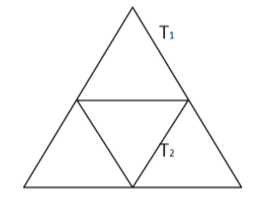
Area of
sq cm.
The areas form an infinite geometric series with first term
and common ratio
:
sq cm.
Option A (
) is the tempting near miss, but it cannot be right, and neither can C: the first three triangles alone give
, and every further triangle adds more.
Hence, option D (
).
Q78MCQLogarithms
If
, then
is equal to
- A
- B
- C
- D
Answer and solution
Answer: (D)
Since
, we have
. As
, this says
, so
.
Write
. Then
, so
.
By componendo and dividendo,
. So
.
Therefore
.
Option B (
) has the right base but equals
, not
: it is about 1.55, while the expression is about 1.16.
Hence, option D (
).
Q79TITASimple & Compound Interest
John borrowed Rs. 2,10,000 from a bank at an interest rate of 10% per annum, compounded annually. The loan was repaid in two equal instalments, the first after one year and the second after another year. The first instalment was interest of one year plus part of the principal amount, while the second was the rest of the principal amount plus due interest thereon. Then each instalment, in Rs., is
Type in your answer (TITA). No negative mark for a wrong answer.
Answer and solution
Answer: 121000
Let each instalment be Rs.
.
Left unpaid, the loan would grow to
rupees by the end of Year 2.
The first instalment is paid at the end of Year 1, so by the end of Year 2 it is worth
; the second is worth
. Together they must settle the loan:
.
Check: Year 1 interest is Rs. 21,000, so the first instalment repays Rs. 1,00,000 of principal and leaves Rs. 1,10,000. Year 2 interest on that is Rs. 11,000, and
, the same amount.
The answer is 121000.
Q80MCQTime & Work
When they work alone, B needs 25% more time to finish a job than A does. They two finish the job in 13 days in the following manner: A works alone till half the job is done, then A and B work together for four days, and finally B works alone to complete the remaining 5% of the job. In how many days can B alone finish the entire job?
- A20
- B22
- C16
- D18
Answer and solution
Answer: (A) 20
Take the whole job as 100 units, and let A and B do
and
units per day.
B needs 25% more time than A, so
, which gives
.
A alone does the first 50 units and B alone the last 5, so the 4 days of joint work cover
units:
.
So B alone needs
days. Check with the 13 days: A, at 6.25 units a day, takes 8 days for the first half, then come 4 days together, and B needs 1 day for the last 5 units:
.
Option C (16) is the trap: it is A's time alone (
), not B's.
Hence, option A (20).
Q81TITAPermutations & Combinations
How many numbers with two or more digits can be formed with the digits 1,2,3,4,5,6,7,8,9, so that in every such number, each digit is used at most once and the digits appear in the ascending order?
Type in your answer (TITA). No negative mark for a wrong answer.
Answer and solution
Answer: 502
Because the digits must appear in ascending order, each set of chosen digits gives exactly one number: once the digits are picked, their order is fixed. So we only need to count the ways to choose 2 or more of the 9 digits.
That count is
.
All subsets of the 9 digits number
. Removing the empty choice (
) and the nine one-digit choices (
):
.
The answer is 502.
Q82TITAMensuration
A right circular cone, of height 12 ft, stands on its base which has diameter 8 ft. The tip of the cone is cut off with a plane which is parallel to the base and 9 ft from the base. With
, the volume, in cubic ft, of the remaining part of the cone is
Type in your answer (TITA). No negative mark for a wrong answer.
Answer and solution
Answer: 198
The cone has radius 4 ft (half the 8 ft diameter) and height 12 ft. In the figure, O is the tip, AB is the cut and CD is the 4 ft base radius.
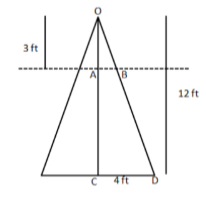
The cut is 9 ft above the base, so the piece removed is a small cone of height
ft at the tip. By similar triangles its radius is
ft.
Remaining volume = full cone minus small cone:
.
With
, this is
cubic ft.
The answer is 198.
Q83MCQRatios, Proportions & Partnership
Raju and Lalitha originally had marbles in the ratio 4:9. Then Lalitha gave some of her marbles to Raju. As a result, the ratio of the number of marbles with Raju to that with Lalitha became 5:6. What fraction of her original number of marbles was given by Lalitha to Raju?
- A
- B
- C
- D
Answer and solution
Answer: (D)
Let Raju and Lalitha start with
and
marbles, and let Lalitha give
marbles to Raju. Then
, so
.
The fraction of her original marbles that she gave away is
.
Check with
: they start with 44 and 99; she gives 21, leaving 65 and 78, which is
.
Option A (
) is the closest value, but giving
of
, i.e.
, leaves
and
, a ratio of
, not
.
Hence, option D (
).
Q84TITASet Theory
Each of 74 students in a class studies at least one of the three subjects H, E and P. Ten students study all three subjects, while twenty study H and E, but not P. Every student who studies P also studies H or E or both. If the number of students studying H equals that studying E, then the number of students studying H is
Type in your answer (TITA). No negative mark for a wrong answer.
Answer and solution
Answer: 52
Every student studies at least one subject, and anyone who studies P also studies H or E, so no one studies P alone.
Known regions: 10 study all three, 20 study H and E but not P, and 0 study P only.
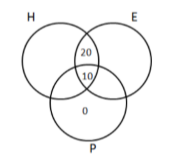
The remaining
students fall into four regions: only H, H and P but not E, only E, and E and P but not H.
Let
= (only H) + (H and P but not E) and
= (only E) + (E and P but not H). Then
.
The students of H number
and those of E number
. These are equal, so
.
Number studying H
.
The answer is 52.
Q85MCQProfit, Loss & Discount
A wholesaler bought walnuts and peanuts, the price of walnut per kg being thrice that of peanut per kg. He then sold 8 kg of peanuts at a profit of 10% and 16 kg of walnuts at a profit of 20% to a shopkeeper. However, the shopkeeper lost 5 kg of walnuts and 3 kg of peanuts in transit. He then mixed the remaining nuts and sold the mixture at Rs. 166 per kg, thus making an overall profit of 25%. At what price, in Rs. per kg, did the wholesaler buy the walnuts?
- A96
- B98
- C86
- D84
Answer and solution
Answer: (A) 96
Let the wholesaler's cost of peanuts be Rs.
per kg, so walnuts cost Rs.
per kg.
The shopkeeper pays 10% more for peanuts (
per kg) and 20% more for walnuts (
per kg). His total cost is
.
After losing 3 kg of peanuts and 5 kg of walnuts he has
kg, which he sells for
rupees at a 25% profit. So his cost was
rupees.
, so the wholesaler bought walnuts at
rupees per kg.
Option B (98), the nearest value, would make the shopkeeper's cost
rupees, a profit of only about 22%, not 25%.
Hence, option A (96).
Q86MCQSet Theory
If among 200 students, 105 like pizza and 134 like burger, then the number of students who like only burger can possibly be
- A23
- B26
- C96
- D93
Answer and solution
Answer: (D) 93
Let
students like both. Then the number who like only burger is
.
At most all 105 pizza lovers also like burger, so
and only burger is at least
.
The students who like at least one item number
, which cannot exceed 200, so
and only burger is at most
. Put simply, only-burger students are among the
who do not like pizza.
So the number who like only burger lies between 29 and 95.
Options A (23) and B (26) are below 29. Option C (96) is the closest trap, but it would need 96 students outside the pizza group, and there are only 95. Option D (93) lies in the range.
Hence, option D (93).
Q87TITASequences & Series
If
for all positive integers
, and
, then
equals
Type in your answer (TITA). No negative mark for a wrong answer.
Answer and solution
Answer: 54
Each term is the sum of the two terms before it. Let
; we know
.
Then
and
.
Next,
, and
.
Since
, we get
, so
and
.
Check: the terms from
to
are
, and each is the sum of the two before it.
The answer is 54.
Q88MCQAverages, Mixtures & Alligations
In an apartment complex, the number of people aged 51 years and above is 30 and there are at most 39 people whose ages are below 51 years. The average age of all the people in the apartment complex is 38 years. What is the largest possible average age, in years, of the people whose ages are below 51 years?
- A27
- B25
- C26
- D28
Answer and solution
Answer: (D) 28
The overall average is 38. Each of the 30 people aged 51 or above is at least
years above it, so together they are at least
years above the average.
The people below 51 must be below the average by the same total. If there are
of them, their average is at most
, reached when all 30 older people are exactly 51.
This bound grows with
, so it is largest at the maximum,
:
.
Check:
.
Option B (25) is the trap of taking only 30 people below 51:
. Fewer people must share the same shortfall, so their average is lower.
Hence, option D (28).
Q89MCQAverages, Mixtures & Alligations
A trader sells 10 litres of a mixture of paints A and B, where the amount of B in the mixture does not exceed that of A. The cost of paint A per litre is Rs. 8 more than that of paint B. If the trader sells the entire mixture for Rs. 264 and makes a profit of 10%, then the highest possible cost of paint B, in Rs. per litre, is
- A16
- B26
- C20
- D22
Answer and solution
Answer: (C) 20
The mixture sells for Rs. 264 at 10% profit, so it cost
rupees for 10 litres.
Let B cost Rs.
per litre, so A costs Rs.
. If the mixture has
litres of A and
litres of B:
.
So B's price is highest when the mixture has as little A as possible. B does not exceed A, so
, and
gives
.
Option D (22) would need
, i.e. 2.5 litres of A and 7.5 litres of B, which breaks the condition that B does not exceed A. Option B (26) is impossible, since the cheaper paint cannot cost more than the average of 24.
Hence, option C (20).
Q90MCQPolygons & Circles
In a parallelogram ABCD of area 72 sq cm, the sides CD and AD have lengths 9 cm and 16 cm, respectively. Let P be a point on CD such that AP is perpendicular to CD. Then the area, in sq cm, of triangle APD is
- A
- B
- C
- D
Answer and solution
Answer: (A)
The area of a parallelogram is base times height. With CD as the base,
, so the perpendicular from A to line CD is
cm.
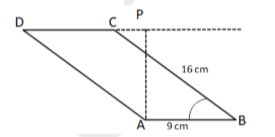
In the figure, AB = CD = 9 cm and BC = AD = 16 cm. Triangle APD is right-angled at P with hypotenuse
cm, so
cm.
Area of triangle APD
sq cm.
Since
is more than
, the foot P lies on CD extended beyond C, as drawn; the area is unaffected.
With
fixed at 8, the area is
, and
is fixed by
, so no other option is possible. For example, option C (
) would need
, which would make
, not 16.
Hence, option A (
).
Q91MCQQuadratic & Polynomial Equations
If
, then what is the value of
?
- A
- B
- C
- D
Answer and solution
Answer: (C)
Move everything to one side:
.
Expanding,
and
. The
terms cancel, leaving
.
Completing the squares:
, since
.
A sum of two non-negative terms is zero only if both are zero, so
and
.
Then
.
Option D (
) is the sign-slip trap: it is the value of
, not
.
Hence, option C (
).
Q92MCQPolygons & Circles
In a circle with center O and radius 1 cm, an arc AB makes an angle 60 degrees at O. Let R be the region bounded by the radii OA, OB and the arc AB. If C and D are two points on OA and OB, respectively, such that OC = OD and the area of triangle OCD is half that of R, then the length of OC, in cm, is
- A
- B
- C
- D
Answer and solution
Answer: (C)
R is a
sector of a circle of radius 1, so its area is
.
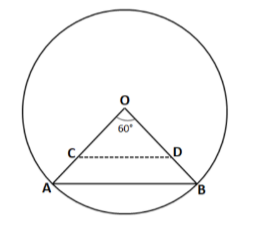
Let
. Triangle OCD has the
angle at O, so its area is
.
This is half the area of R:
, so
.
Option B,
, is the trap of dropping the
factor:
gives
, but that formula needs a right angle at O.
Hence, option C (
).
Q93MCQTime, Speed & Distance
The distance from A to B is 60 km. Partha and Narayan start from A at the same time and move towards B. Partha takes four hours more than Narayan to reach B. Moreover, Partha reaches the mid-point of A and B two hours before Narayan reaches B. The speed of Partha, in km per hour, is
- A6
- B4
- C3
- D5
Answer and solution
Answer: (D) 5
Let Partha take
hours for the 60 km, so Narayan takes
hours.
Partha reaches the midpoint, half the distance, at time
, and this is 2 hours before Narayan reaches B:
.
So Partha's speed is
km/h. Check: Narayan takes 8 hours, and Partha is at the midpoint after 6 hours, 2 hours earlier.
Option A (6 km/h) would give Partha 10 hours and Narayan 6 hours; Partha would reach the midpoint at 5 hours, only 1 hour before Narayan reaches B, not 2.
Hence, option D (5).
Q94MCQSequences & Series
Let x, y, z be three positive real numbers in a geometric progression such that x < y < z. If 5x, 16y, and 12z are in an arithmetic progression then the common ratio of the geometric progression is
- A
- B
- C
- D
Answer and solution
Answer: (C)
Let the terms be
,
and
, with
.
Since
,
and
are in AP, twice the middle term equals the sum of the other two:
.
, so
or
.
The terms are positive and increasing (
), which needs
. With
each term would be smaller than the one before, so option B (
), the other root, is ruled out. With
the terms increase as required.
Hence, option C (
).
Q95MCQIndices & Surds
Given that
, and
, then the value of
is
- A
- B
- C
- D
Answer and solution
Answer: (D)
Dividing the second equation by the first:
, so
or
.
If
, the first equation gives
. Since
,
, so
and
.
If
, it gives
, so
and again
.
In both cases
and
, so
.
Option A (
) is the value of
, the trap of subtracting instead of adding.
Hence, option D (
).
Q96TITATime & Work
A tank is fitted with pipes, some filling it and the rest draining it. All filling pipes fill at the same rate, and all draining pipes drain at the same rate. The empty tank gets completely filled in 6 hours when 6 filling and 5 draining pipes are on, but this time becomes 60 hours when 5 filling and 6 draining pipes are on. In how many hours will the empty tank get completely filled when one draining and two filling pipes are on?
Type in your answer (TITA). No negative mark for a wrong answer.
Answer and solution
Answer: 10
Let each filling pipe fill
units per hour and each draining pipe drain
units per hour, and let the tank hold
units.
6 filling and 5 draining pipes take 6 hours:
.
5 filling and 6 draining pipes take 60 hours:
.
Equating:
, so
and
.
Then
.
With 2 filling pipes and 1 draining pipe the net rate is
, so the time is
hours.
The answer is 10.
Q97MCQLogarithms
If
and
, then
is equal to
- A59
- B40
- C32
- D67
Answer and solution
Answer: (A) 59
From the first equation,
, so
and
.
From the second,
. Substituting
:
, so
and
.
Check:
and
.
Therefore
.
Option C (32) is the trap of stopping at
; the question asks for
.
Hence, option A (59).
Q98TITAAverages, Mixtures & Alligations
A CAT aspirant appears for a certain number of tests. His average score increases by 1 if the first 10 tests are not considered, and decreases by 1 if the last 10 tests are not considered. If his average scores for the first 10 and the last 10 tests are 20 and 30, respectively, then the total number of tests taken by him is
Type in your answer (TITA). No negative mark for a wrong answer.
Answer and solution
Answer: 60
Let the number of tests be
and the overall average be
, so the total score is
.
The first 10 tests total
. Leaving them out raises the average by 1:
.
The last 10 tests total
. Leaving them out lowers the average by 1:
.
Adding the two equations:
, so
, and then
.
The answer is 60.
Q99TITAProperties of Numbers
The number of integers
such that
and
is perfectly divisible by either 3 or 4, is
Type in your answer (TITA). No negative mark for a wrong answer.
Answer and solution
Answer: 5
means
. Since
, the integers are
.
For
and
,
is 2.25 or 2.5, not an integer, so it cannot be divisible by 3 or 4.
For the rest,
is:
: 3 (divisible by 3);
: 4 (by 4);
: 6 (by 3);
: 10 (neither);
: 18 (by 3);
: 34 (neither);
: 66 (by 3);
: 130 (neither).
The valid values are
, which is 5 values.
The answer is 5.
Q100MCQPercentages
In an examination, the maximum possible score is N while the pass mark is 45% of N. A candidate obtains 36 marks, but falls short of the pass mark by 68%. Which one of the following is then correct?
- A
- B
- C
- D
Answer and solution
Answer: (B)
The pass mark is
. Falling short of it by 68% means the candidate's 36 marks are 68% below the pass mark, that is, 32% of it:
.
Check: the pass mark is
, and the shortfall
is 68% of 112.5.
Since
, option B is correct.
Option A (
) is the trap of reading the shortfall as scoring 68% of the pass mark:
gives
.
Hence, option B (
).