- CATin
- CAT past papers
- CAT 2018 Slot 1
- DILR
CAT 2018 Slot 1 — DILR questions with answers
All 32 questions of the Data Interpretation & Logical Reasoning section (24 MCQs, 8 TITA, 8 sets). Try each one, then open its answer and solution.
CAT 2018 Slot 1, timed like the real exam (180 minutes, 60 a section) and scored the CAT way: +3 right, −1 for a wrong MCQ, 0 for a wrong TITA, with the full post-mock analysis. Older official papers are in CATin Pro, with 80+ mocks and the full planner. The last three years of papers are free.
Sit this paper as a timed mock with CATin ProData Interpretation & Logical Reasoning
CAT 2018 Slot 1 · 60 minutes · +3 for a right answer, −1 for a wrong MCQ, 0 for a wrong TITA
Common data
Set for questions 35–38
Adriana, Bandita, Chitra, and Daisy are four female students, and Amit, Barun, Chetan, and Deb are four male students. Each of them studies in one of three institutes - X, Y, and Z. Each student majors in one subject among Marketing, Operations, and Finance, and minors in a different one among these three subjects. The following facts are known about the eight students:
1. Three students are from X, three are from Y, and the remaining two students, both female, are from Z.
2. Both the male students from Y minor in Finance, while the female student from Y majors in Operations.
3. Only one male student majors in Operations, while three female students minor in Marketing.
4. One female and two male students major in Finance.
5. Adriana and Deb are from the same institute. Daisy and Amit are from the same institute.
6. Barun is from Y and majors in Operations. Chetan is from X and majors in Finance.
7. Daisy minors in Operations.
Q35MCQLogical Puzzles
Who are the students from the institute Z?
- AChitra and Daisy
- BAdriana and Bandita
- CBandita and Chitra
- DAdriana and Daisy
Answer and solution
Answer: (C) Bandita and Chitra
Z has two students, both female. Clue 2 speaks of both the male students from Y and the female student from Y, so Y has two males and one female, and X has the other two males and one female. Barun is in Y and Chetan in X, so Amit and Deb take one place each in X and Y.
Daisy is in the same institute as Amit, a male, so she is not in Z. She minors in Operations, so she cannot be Y's female, who majors in Operations. Hence Daisy and Amit are in X, Deb is in Y, and Adriana, who is with Deb, is Y's female.
The two students left, Bandita and Chitra, form institute Z, as the table built from the clues shows:
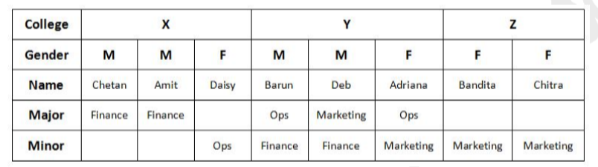
Every other option names Adriana or Daisy. Option D (Adriana and Daisy) fails because Adriana is in Y with Deb and Daisy is in X with Amit.
Hence, option C (Bandita and Chitra).
Q36MCQLogical Puzzles
Which subject does Deb minor in?
- AOperations
- BFinance
- CMarketing
- DCannot be determined uniquely from the given information
Answer and solution
Answer: (B) Finance
Z has two students, both female. Clue 2 speaks of both the male students from Y and the female student from Y, so Y has two males and one female, and X has the other two males and one female. Barun is in Y and Chetan in X, so Amit and Deb take one place each in X and Y.
Daisy is with Amit, so she is not in Z. She minors in Operations, so she cannot be Y's female, who majors in Operations. So Daisy and Amit are in X, and Deb is the second male in Y.
Both males from Y minor in Finance, so Deb minors in Finance. His major is then Marketing: he cannot major in his minor, and Barun is the only male who majors in Operations. The table built from the clues shows this:
Option D (cannot be determined) fails because the clues fix Deb's institute, and with it his minor.
Hence, option B (Finance).
Q37MCQLogical Puzzles
Which subject does Amit major in?
- AMarketing
- BOperations
- CCannot be determined uniquely from the given information
- DFinance
Answer and solution
Answer: (D) Finance
Z has two students, both female. Clue 2 speaks of both the male students from Y and the female student from Y, so Y has two males and one female, and X has the other two males and one female. Barun is in Y and Chetan in X, so Amit and Deb take one place each in X and Y.
Daisy is with Amit, so she is not in Z. She minors in Operations, so she cannot be Y's female, who majors in Operations. So Amit and Daisy are in X, and Deb is in Y.
Two males major in Finance. Barun majors in Operations, and Deb, as a male from Y, minors in Finance and so cannot also major in it. The two male Finance majors must therefore be Chetan and Amit, as the table built from the clues shows:
Option B (Operations) fails because only one male majors in Operations, and that is Barun.
Hence, option D (Finance).
Q38MCQLogical Puzzles
If Chitra majors in Finance, which subject does Bandita major in?
- AFinance
- BCannot be determined uniquely from the given information
- COperations
- DMarketing
Answer and solution
Answer: (C) Operations
Three of the four female students minor in Marketing. Daisy minors in Operations, so the other three, Adriana, Bandita and Chitra, all minor in Marketing, as the table built from the clues shows:
A student's major and minor are different subjects, so Bandita cannot major in Marketing.
Exactly one female student majors in Finance. If that student is Chitra, Bandita cannot major in Finance either.
The only subject left for Bandita is Operations.
Option B (cannot be determined) is the tempting choice, but the Marketing minor and the single female Finance major leave Bandita just one possible major.
Hence, option C (Operations).
Common data
Set for questions 39–42
An ATM dispenses exactly Rs. 5000 per withdrawal using 100, 200 and 500 rupee notes. The ATM requires every customer to give her preference for one of the three denominations of notes. It then dispenses notes such that the number of notes of the customer’s preferred denomination exceeds the total number of notes of other denominations dispensed to her.
Q39TITALogical Puzzles
In how many different ways can the ATM serve a customer who gives 500 rupee notes as her preference?
Type in your answer (TITA). No negative mark for a wrong answer.
Answer and solution
Answer: 7
With 500 as her preference, the customer must get more 500-rupee notes than all other notes together. Let there be
notes of 500,
of 200 and
of 100, so
and
.
If
, the other Rs. 1500 needs at least 8 notes (
), which is not fewer than 7. Smaller
only makes this worse, so
.
: Rs. 1000 remains and
must be at most 7. This allows
; the next choice,
, uses 8 notes. That is 3 ways.
: Rs. 500 remains, as
or
, each with fewer than 9 notes. That is 3 ways.
: the whole amount in 500s. That is 1 way.
Total
.
The answer is 7.
Q40TITALogical Puzzles
If the ATM could serve only 10 customers with a stock of fifty 500 rupee notes and a sufficient number of notes of other denominations, what is the maximum number of customers among these 10 who could have given 500 rupee notes as their preferences?
Type in your answer (TITA). No negative mark for a wrong answer.
Answer and solution
Answer: 6
A customer who prefers 500s must get more 500-rupee notes than all other notes combined. With seven 500s, the remaining Rs. 1500 needs at least 8 notes (
), which is too many. With eight 500s (Rs. 4000), the remaining Rs. 1000 can be paid as five 200s, and
. So each such customer takes at least 8 notes of 500.
The stock has 50 notes of 500. Six such customers can be served with
of them, but seven would need at least
, more than 50.
The other four customers can prefer 100s or 200s and be served with few or no 500-rupee notes (for example, fifty 100s each), so 6 is achievable.
The answer is 6.
Q41MCQLogical Puzzles
What is the maximum number of customers that the ATM can serve with a stock of fifty 500 rupee notes and a sufficient number of notes of other denominations, if all the customers are to be served with at most 20 notes per withdrawal?
- A12
- B10
- C13
- D16
Answer and solution
Answer: (A) 12
The 500-rupee notes are the only limited stock, so each withdrawal should use as few of them as possible while keeping to at most 20 notes. For a given number of 500s, the fewest notes come from paying the rest mainly in 200s.
With no 500s, Rs. 5000 needs 25 notes of 200. With one 500, Rs. 4500 needs
, so 24 notes in all. With two, twenty 200s make 22 in all. With three, Rs. 3500 needs
, so 21 in all. With four, Rs. 3000 is fifteen 200s, so 19 in all, which is allowed. This withdrawal suits a customer who prefers 200s, since 15 exceeds the 4 other notes.
So every customer needs at least four 500-rupee notes, and 50 notes serve at most
customers. Option C (13) fails because 13 customers would need at least
notes of 500.
Hence, option A (12).
Q42MCQLogical Puzzles
What is the number of 500 rupee notes required to serve 50 customers with 500 rupee notes as their preferences and another 50 customers with 100 rupee notes as their preferences, if the total number of notes to be dispensed is the smallest possible?
- A900
- B800
- C750
- D1400
Answer and solution
Answer: (A) 900
Each customer should receive as few notes as possible.
A customer who prefers 500s is best served with ten 500-rupee notes, the fewest possible (10 is more than the 0 other notes). So the 50 such customers take
notes of 500.
A customer who prefers 100s must get more 100s than all other notes combined. With
notes of 500,
of 200 and
of 100,
, so the total is
, smallest when
is largest. The condition
becomes
, i.e.
. Within this limit
is largest at
,
, so
: 18 notes, with
. Nine 500s would leave room for only five 100s, which breaks the preference.
So the 50 customers who prefer 100s take
notes of 500.
Number of 500-rupee notes
. Option D (1400) is the total number of notes of all kinds,
, not the number of 500s.
Hence, option A (900).
Common data
Set for questions 43–46
You are given an n×n square matrix to be filled with numerals so that no two adjacent cells have the same numeral. Two cells are called adjacent if they touch each other horizontally, vertically or diagonally. So a cell in one of the four corners has three cells adjacent to it, and a cell in the first or last row or column which is not in the corner has five cells adjacent to it. Any other cell has eight cells adjacent to it.
Q43TITALogical Puzzles
What is the minimum number of different numerals needed to fill a 3×3 square matrix?
Type in your answer (TITA). No negative mark for a wrong answer.
Answer and solution
Answer: 4
Any
block of cells contains four cells that all touch one another, horizontally, vertically or diagonally. A
matrix contains such blocks, and the four cells of a block need four different numerals. So at least 4 numerals are needed.
Four numerals are enough. Fill the three rows as 1 2 1, then 3 4 3, then 1 2 1:
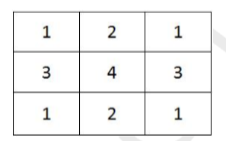
Within each row, neighbouring cells differ. The first and third rows use only 1 and 2, while the middle row uses only 3 and 4, so no cell touches a cell with the same numeral in the row above or below.
The answer is 4.
Q44TITALogical Puzzles
What is the minimum number of different numerals needed to fill a 5×5 square matrix?
Type in your answer (TITA). No negative mark for a wrong answer.
Answer and solution
Answer: 4
Any
block of cells contains four cells that all touch one another, so those four cells need four different numerals. Hence a
matrix needs at least 4 numerals.
Four are enough. Fill rows 1, 3 and 5 as 1 2 1 2 1, and rows 2 and 4 as 3 4 3 4 3:
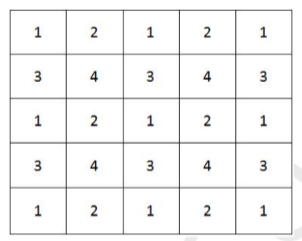
Within a row, neighbouring cells alternate, so they differ. Neighbouring rows use different pairs of numerals, 1 and 2 against 3 and 4, so no cell touches a cell with the same numeral above, below or diagonally. Rows 2 and 4 do not touch each other, so they can reuse 3 and 4.
The answer is 4.
Q45MCQLogical Puzzles
Suppose you are allowed to make one mistake, that is, one pair of adjacent cells can have the same numeral. What is the minimum number of different numerals required to fill a 5×5 matrix?
- A4
- B16
- C9
- D25
Answer and solution
Answer: (A) 4
Without any mistake, a
matrix needs 4 numerals, and 4 are enough, for example with rows alternating 1 2 1 2 1 and 3 4 3 4 3:
Allowing one mistake can only keep this number the same or lower it.
It cannot lower it to 3. Every
block has four cells that all touch one another, so with only 3 numerals each block must contain a pair of touching cells with the same numeral. A
matrix has 16 such blocks, and one pair of touching cells lies in at most two of them. One allowed mistake can therefore cover at most 2 blocks, leaving at least 14 that break the rule.
So the minimum is still 4. Options B, C and D (16, 9 and 25) are more numerals than the 4 that already suffice.
Hence, option A (4).
Q46MCQLogical Puzzles
Suppose that all the cells adjacent to any particular cell must have different numerals. What is the minimum number of different numerals needed to fill a 5×5 square matrix?
- A25
- B4
- C16
- D9
Answer and solution
Answer: (D) 9
Take the centre cell of the
matrix. Its 8 neighbours must all differ from one another under the new rule, and each must differ from the centre cell under the original rule. So the central
block needs 9 different numerals, as below, and at least 9 are required.
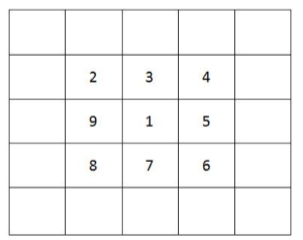
Nine are enough. Fill row 1 as 1 2 3 1 2, row 2 as 4 5 6 4 5 and row 3 as 7 8 9 7 8, then repeat rows 1 and 2 as rows 4 and 5. Two cells with the same numeral are then 3 apart in their row numbers or in their column numbers. Two cells that share a neighbour are at most 2 apart in both, and touching cells at most 1 apart, so no rule is broken.
So the minimum is 9. Option B (4) is the answer for the original rule only, and 16 or 25 use more numerals than needed.
Hence, option D (9).
Common data
Set for questions 47–50
Fuel contamination levels at each of 20 petrol pumps P1, P2, …, P20 were recorded as either high, medium, or low.
1. Contamination levels at three pumps among P1 - P5 were recorded as high.
2. P6 was the only pump among P1 - P10 where the contamination level was recorded as low.
3. P7 and P8 were the only two consecutively numbered pumps where the same levels of contamination were recorded.
4. High contamination levels were not recorded at any of the pumps P16 - P20.
5. The number of pumps where high contamination levels were recorded was twice the number of pumps where low contamination levels were recorded.
Q47MCQLogical Puzzles
Which of the following MUST be true?
- AThe contamination level at P20 was recorded as medium.
- BThe contamination level at P13 was recorded as low.
- CThe contamination level at P12 was recorded as high.
- DThe contamination level at P10 was recorded as high.
Answer and solution
Answer: (D) The contamination level at P10 was recorded as high.
Only P7 and P8 are equal neighbours, and P6 is the only low up to P10, so P1–P5, with three highs, read H-M-H-M-H. P16–P20 have no high, so they alternate low and medium, with at least 2 lows; with P6,
, so
.
If P7 = P8 = M, then P9 = H and P10 = M: 4 highs, plus at most 3 in P11–P15. As
is even,
and
, so P11–P15 need 2 highs, 3 mediums and no low: M-H-M-H-M, which repeats P10 = M. So P7 = P8 = H, and P1–P10 read H-M-H-M-H-L-H-H-M-H.
So P10 is always high. All six arrangements that fit the clues are shown below:
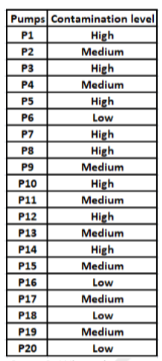
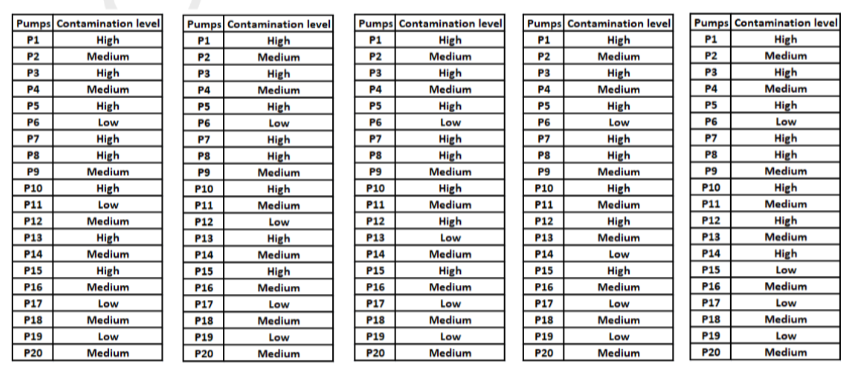
The others need not hold. P11–P20 = M-H-M-H-M-L-M-L-M-L fits every clue (8 highs, 4 lows), yet P20 is low and P13 medium, so A and B fail. P11–P20 = L-M-H-M-H-M-L-M-L-M also fits, yet P12 is medium, so C fails.
Hence, option D (The contamination level at P10 was recorded as high.).
Q48MCQLogical Puzzles
What best can be said about the number of pumps at which the contamination levels were recorded as medium?
- AAt least 8
- BMore than 4
- CExactly 8
- DAt most 9
Answer and solution
Answer: (C) Exactly 8
Only P7 and P8 are equal neighbours, and P6 is the only low up to P10, so P1–P5, with three highs, read H-M-H-M-H. P16–P20 have no high, so they alternate low and medium, with at least 2 lows; with P6,
, so
.
If P7 = P8 = M, then P9 = H and P10 = M: 4 highs, plus at most 3 in P11–P15. As
is even,
and
, so P11–P15 need 2 highs, 3 mediums and no low: M-H-M-H-M, which repeats P10 = M. So P7 = P8 = H, and P1–P10 read H-M-H-M-H-L-H-H-M-H.
Up to P10 there are 6 highs; P11 cannot be high (P10 is), so P12–P15 add at most 2. So
and
. Up to P10 there are 3 mediums, and P11–P20 hold at most 5, as no two neighbours there match, so
. As
, all three bounds are reached: exactly 8 mediums, as in each arrangement below.
Options A, B and D are also true, but only C pins the number down.
Hence, option C (Exactly 8).
Q49MCQLogical Puzzles
If the contamination level at P11 was recorded as low, then which of the following MUST be true?
- AThe contamination level at P12 was recorded as high.
- BThe contamination level at P15 was recorded as medium.
- CThe contamination level at P18 was recorded as low.
- DThe contamination level at P14 was recorded as medium.
Answer and solution
Answer: (D) The contamination level at P14 was recorded as medium.
Only P7 and P8 are equal neighbours, and P6 is the only low up to P10, so P1–P5, with three highs, read H-M-H-M-H. P16–P20 have no high, so they alternate low and medium, with at least 2 lows; with P6,
, so
.
If P7 = P8 = M, then P9 = H and P10 = M: 4 highs, plus at most 3 in P11–P15. As
is even,
and
, so P11–P15 need 2 highs, 3 mediums and no low: M-H-M-H-M, which repeats P10 = M. So P7 = P8 = H, and P1–P10 read H-M-H-M-H-L-H-H-M-H.
Let P11 be low. Counting P6, P11 and at least 2 lows in P16–P20,
, so
. Only P12–P15 can add highs, at most 2, so
and
. Then P16–P20 hold just 2 lows (M-L-M-L-M), and P12–P15, with no low, alternate high and medium; P15 cannot be medium beside P16 = M, so they read M-H-M-H. This is the first arrangement below:
So P14 is medium, while P12 is medium (A fails), P15 is high (B fails) and P18 is medium (C fails).
Hence, option D (The contamination level at P14 was recorded as medium.).
Q50MCQLogical Puzzles
If contamination level at P15 was recorded as medium, then which of the following MUST be FALSE?
- AContamination levels at P13 and P17 were recorded as the same.
- BContamination levels at P11 and P16 were recorded as the same.
- CContamination level at P14 was recorded to be higher than that at P15.
- DContamination levels at P10 and P14 were recorded as the same.
Answer and solution
Answer: (B) Contamination levels at P11 and P16 were recorded as the same.
Only P7 and P8 are equal neighbours, and P6 is the only low up to P10, so P1–P5, with three highs, read H-M-H-M-H. P16–P20 have no high, so they alternate low and medium, with at least 2 lows; with P6,
, so
.
If P7 = P8 = M, then P9 = H and P10 = M: 4 highs, plus at most 3 in P11–P15. As
is even,
and
, so P11–P15 need 2 highs, 3 mediums and no low: M-H-M-H-M, which repeats P10 = M. So P7 = P8 = H, and P1–P10 read H-M-H-M-H-L-H-H-M-H.
Let P15 be medium. Then P16 is not medium, so P16–P20 read L-M-L-M-L; with P6,
, so
. As P11 cannot be high (P10 is), P12–P15 add at most 2 highs, so
,
, and P11–P15, with no low, read M-H-M-H-M:
So P11 is medium and P16 low, and B must be false. The rest hold: P13 and P17 are both medium (A), P14 is high, above P15 (C), and P10 and P14 are both high (D).
Hence, option B (Contamination levels at P11 and P16 were recorded as the same.).
Common data
Set for questions 51–54
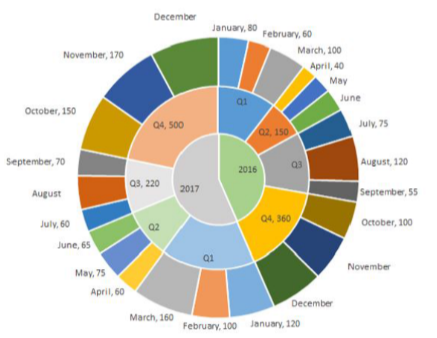
The multi-layered pie-chart below shows the sales of LED television sets for a big retail electronics outlet during 2016 and 2017. The outer layer shows the monthly sales during this period, with each label showing the month followed by sales figure of that month. For some months, the sales figures are not given in the chart. The middle-layer shows quarterwise aggregate sales figures (in some cases, aggregate quarter-wise sales numbers are not given next to the quarter). The innermost layer shows annual sales. It is known that the sales figures during the three months of the second quarter (April, May, June) of 2016 form an arithmetic progression, as do the three monthly sales figures in the fourth quarter (October, November, December) of that year.
Q51MCQPie & Scatter Charts
What is the percentage increase in sales in December 2017 as compared to the sales in December 2016?
- A38.46
- B22.22
- C28.57
- D50.00
Answer and solution
Answer: (C) 28.57
December 2016 is not shown, but October, November and December 2016 form an arithmetic progression. October is 100 and the fourth quarter of 2016 totals 360, so with common difference
:
, giving
. So December 2016
.
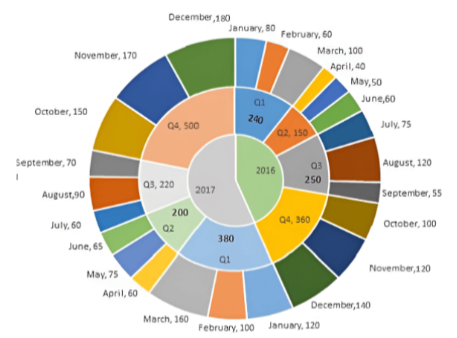
December 2017 is not shown either. The fourth quarter of 2017 totals 500, with October 150 and November 170, so December 2017
. The chart with the missing figures filled in:
Percentage increase
.
Option B (22.22) is the trap: it divides the increase by the 2017 figure,
, instead of by the 2016 base.
Hence, option C (28.57).
Q52MCQPie & Scatter Charts
In which quarter of 2017 was the percentage increase in sales from the same quarter of 2016 the highest?
- AQ2
- BQ1
- CQ4
- DQ3
Answer and solution
Answer: (B) Q1
Compare each quarter of 2017 with the same quarter of 2016. The chart below has the missing figures filled in.
Q1: 2016
; 2017
. Growth
.
Q2: 2016
(given); 2017
. Growth
.
Q3: 2016
; 2017
(given). Sales fell.
Q4: 2016
; 2017
(both given). Growth
.
Option C (Q4) is the closest rival: it rose by 140 sets, the same as Q1, but from a larger base of 360 against 240, so its percentage growth is smaller.
Hence, option B (Q1).
Q53MCQPie & Scatter Charts
During which quarter was the percentage decrease in sales from the previous quarter’s sales the highest?
- AQ2 of 2017
- BQ4 of 2017
- CQ2 of 2016
- DQ1 of 2017
Answer and solution
Answer: (A) Q2 of 2017
Only quarterly totals are needed. The chart below has the missing figures filled in.
2016: Q1
, Q2
, Q3
, Q4
.
2017: Q1
, Q2
, Q3
, Q4
.
Sales fall from the previous quarter only twice:
Q2 2016:
decrease.
Q2 2017:
decrease.
Every other quarter shows an increase, including Q1 2017 (
) and Q4 2017 (
), so options D and B cannot be the answer. Option C (Q2 of 2016) is the closest rival, but its fall is smaller.
Hence, option A (Q2 of 2017).
Q54MCQPie & Scatter Charts
During which month was the percentage increase in sales from the previous month’s sales the highest?
- AMarch of 2017
- BOctober of 2017
- CMarch of 2016
- DOctober of 2016
Answer and solution
Answer: (B) October of 2017
Read the monthly figures from the chart and compare each option with the month before it. The chart below has the missing figures filled in.
March 2017: February 2017
, March
, a rise of
.
October 2017: September 2017
, October
, a rise of
.
March 2016: February 2016
, March
, a rise of
.
October 2016: September 2016
, October
, a rise of
.
Option D (October of 2016) is the closest rival, but only October 2017 more than doubles the previous month's sales.
Hence, option B (October of 2017).
Common data
Set for questions 55–58
Twenty four people are part of three committees which are to look at research, teaching, and administration respectively. No two committees have any member in common. No two committees are of the same size. Each committee has three types of people: bureaucrats, educationalists, and politicians, with at least one from each of the three types in each committee. The following facts are also known about the committees:
1. The numbers of bureaucrats in the research and teaching committees are equal, while the number of bureaucrats in the research committee is 75% of the number of bureaucrats in the administration committee.
2. The number of educationalists in the teaching committee is less than the number of educationalists in the research committee. The number of educationalists in the research committee is the average of the numbers of educationalists in the other two committees.
3. 60% of the politicians are in the administration committee, and 20% are in the teaching committee.
Q55MCQLogical Puzzles
Based on the given information, which of the following statements MUST be FALSE?
- AIn the teaching committee the number of educationalists is equal to the number of politicians
- BIn the administration committee the number of bureaucrats is equal to the number of educationalists
- CThe size of the research committee is less than the size of the teaching committee
- DThe size of the research committee is less than the size of the administration committee
Answer and solution
Answer: (C) The size of the research committee is less than the size of the teaching committee
Let the administration committee have
bureaucrats, so research and teaching have
each (75% of
). Let research have
educationalists; as
is the average of the other two and teaching has fewer, teaching has
and administration
, with
. Let there be
politicians:
in administration,
in teaching and
in research.
In total,
. If
, then
, impossible since every type is present. So
and
, solved only by
,
.
Teaching has
educationalists, so
or
. Sizes: research
, teaching
(6 or 5), administration
(11 or 12). In the table, entries like 6/5 cover
and
.
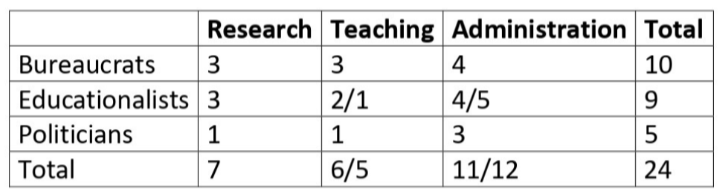
Research (7) is always bigger than teaching, so C must be false. A can hold: with
, teaching has 1 educationalist and 1 politician. B can hold: with
, administration has 4 bureaucrats and 4 educationalists. D always holds.
Hence, option C (The size of the research committee is less than the size of the teaching committee).
Q56TITALogical Puzzles
What is the number of bureaucrats in the administration committee?
Type in your answer (TITA). No negative mark for a wrong answer.
Answer and solution
Answer: 4
Let the administration committee have
bureaucrats, so research and teaching have
each (75% of
). Let research have
educationalists; as
is the average of the other two and teaching has fewer, teaching has
and administration
, with
. Let there be
politicians:
in administration,
in teaching and
in research.
In total,
. If
, then
, impossible since every type is present. So
and
, solved only by
,
.
So the administration committee has
bureaucrats, and research and teaching have 3 each. The educationalists split as 3 (research),
(teaching) and
(administration) with
or
. Both values give three different committee sizes (7, 6, 11 or 7, 5, 12), but neither changes the bureaucrat count. In the table, entries like 6/5 cover
and
.
The answer is 4.
Q57TITALogical Puzzles
What is the number of educationalists in the research committee?
Type in your answer (TITA). No negative mark for a wrong answer.
Answer and solution
Answer: 3
Let the administration committee have
bureaucrats, so research and teaching have
each (75% of
). Let research have
educationalists; as
is the average of the other two and teaching has fewer, teaching has
and administration
, with
. Let there be
politicians:
in administration,
in teaching and
in research.
In total,
. If
, then
, impossible since every type is present. So
and
, solved only by
,
.
So the research committee has
educationalists. Teaching has
and administration
, with
or
since teaching needs at least one. The value of
changes those two committees but not research. In the table, entries like 2/1 cover
and
.
The answer is 3.
Q58MCQLogical Puzzles
Which of the following CANNOT be determined uniquely based on the given information?
- AThe size of the teaching committee
- BThe size of the research committee
- CThe total number of bureaucrats in the three committees
- DThe total number of educationalists in the three committees
Answer and solution
Answer: (A) The size of the teaching committee
Let the administration committee have
bureaucrats, so research and teaching have
each (75% of
). Let research have
educationalists; as
is the average of the other two and teaching has fewer, teaching has
and administration
, with
. Let there be
politicians:
in administration,
in teaching and
in research.
In total,
. If
, then
, impossible since every type is present. So
and
, solved only by
,
.
Teaching has
educationalists, so
or
, giving sizes: research
, teaching
, administration
. In the table, entries like 6/5 cover
and
.
Research is always 7, the bureaucrats total
, and the educationalists total
. Only the teaching committee, 6 or 5, changes with
. D is the tempting one: the educationalists in teaching and administration change, but their total stays 9.
Hence, option A (The size of the teaching committee).
Common data
Set for questions 59–62
1600 satellites were sent up by a country for several purposes. The purposes are classified as broadcasting (B), communication (C), surveillance (S), and others (O). A satellite can serve multiple purposes; however a satellite serving either B, or C, or S does not serve O. The following facts are known about the satellites:
1. The numbers of satellites serving B, C, and S (though may be not exclusively) are in the ratio 2:1:1.
2. The number of satellites serving all three of B, C, and S is 100.
3. The number of satellites exclusively serving C is the same as the number of satellites exclusively serving S. This number is 30% of the number of satellites exclusively serving B.
4. The number of satellites serving O is the same as the number of satellites serving both C and S but not B.
Q59MCQSet Theory
What best can be said about the number of satellites serving C?
- AMust be at least 100
- BCannot be more than 800
- CMust be between 450 and 725
- DMust be between 400 and 800
Answer and solution
Answer: (C) Must be between 450 and 725
No satellite serving B, C or S also serves O. Let
satellites serve only B, so only C and only S have
each. Let
serve only B and C,
only B and S,
only C and S, and 100 all three; O then has
satellites.
C and S are equal in size, so
. B is twice C, so
, giving
. The total,
, then gives
. The diagram shows every region in terms of
.
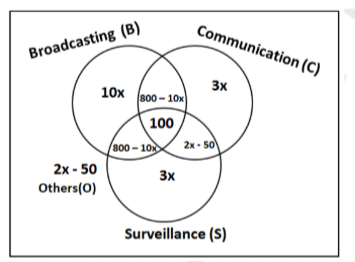
As
and
,
. Also
.
As
runs from 25 to 80,
runs from 725 down to 450, and both ends are possible. So the number serving C must be between 450 and 725. Options A, B and D are also true but looser; D's range of 400 to 800 includes values that cannot occur.
Hence, option C (Must be between 450 and 725).
Q60MCQSet Theory
What is the minimum possible number of satellites serving B exclusively?
- A250
- B100
- C500
- D200
Answer and solution
Answer: (A) 250
No satellite serving B, C or S also serves O. Let
satellites serve only B, so only C and only S have
each. Let
serve only B and C,
only B and S,
only C and S, and 100 all three; O then has
satellites.
C and S are equal in size, so
. B is twice C, so
, giving
. The total,
, then gives
. The diagram shows every region in terms of
.
As
and
,
.
Satellites serving only B number
, which is least when
is least.
is allowed (then
and
), giving
. Smaller answers such as 200 or 100 need
, which makes
negative.
Hence, option A (250).
Q61MCQSet Theory
If at least 100 of the 1600 satellites were serving O, what can be said about the number of satellites serving S?
- AAt most 475
- BExactly 475
- CNo conclusion is possible based on the given information
- DAt least 475
Answer and solution
Answer: (A) At most 475
No satellite serving B, C or S also serves O. Let
satellites serve only B, so only C and only S have
each. Let
serve only B and C,
only B and S,
only C and S, and 100 all three; O then has
satellites.
C and S are equal in size, so
. B is twice C, so
, giving
. The total,
, then gives
. The diagram shows every region in terms of
.
As
and
,
. Also
.
Now O has at least 100 satellites:
, so
, and
. Then
goes from 475 (at
) down to 450 (at
). So the number serving S is at most 475. 'Exactly 475' holds only at
, and 'at least 475' fails for any larger
.
Hence, option A (At most 475).
Q62MCQSet Theory
If the number of satellites serving at least two among B, C, and S is 1200, which of the following MUST be FALSE?
- AThe number of satellites serving B exclusively is exactly 250
- BThe number of satellites serving B is more than 1000
- CThe number of satellites serving C cannot be uniquely determined
- DAll 1600 satellites serve B or C or S
Answer and solution
Answer: (C) The number of satellites serving C cannot be uniquely determined
No satellite serving B, C or S also serves O. Let
satellites serve only B, so only C and only S have
each. Let
serve only B and C,
only B and S,
only C and S, and 100 all three; O then has
satellites.
C and S are equal in size, so
. B is twice C, so
, giving
. The total,
, then gives
. As
and
,
.
Satellites in at least two of B, C and S number
. Setting this to 1200 gives
: only-B
, only-C
only-S
,
,
, and O is empty.
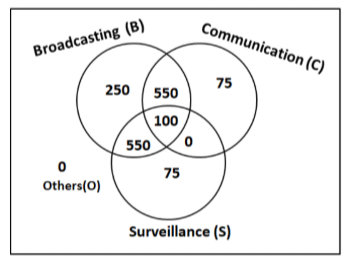
So A and D hold, and so does B, as
. But
is fixed, so C must be false.
Hence, option C (The number of satellites serving C cannot be uniquely determined).
Common data
Set for questions 63–66
A company administers a written test comprising of three sections of 20 marks each - Data Interpretation (DI), Written English (WE) and General Awareness (GA), for recruitment. A composite score for a candidate (out of
80) is calculated by doubling her marks in DI and adding it to the sum of her marks in the other two sections. Candidates who score less than 70% marks in two or more sections are disqualified. From among the rest, the four with the highest composite scores are recruited. If four or less candidates qualify, all who qualify are recruited.
Ten candidates appeared for the written test. Their marks in the test are given in the table below. Some marks in the table are missing, but the following facts are known:
1. No two candidates had the same composite score.
2. Ajay was the unique highest scorer in WE.
3. Among the four recruited, Geeta had the lowest composite score.
4. Indu was recruited.
5. Danish, Harini, and Indu had scored the same marks the in GA.
6. Indu and Jatin both scored 100% in exactly one section and Jatin’s composite score was 10 more than Indu’s.
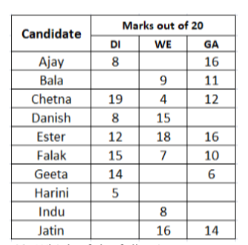
Q63MCQMissing Value Tables
Which of the following statements MUST be true?
1. Jatin's composite score was more than that of Danish.
2. Indu scored less than Chetna in DI.
3. Jatin scored more than Indu in GA.
- ABoth 2 and 3
- BOnly 1
- COnly 2
- DBoth 1 and 2
Answer and solution
Answer: (D) Both 1 and 2
Composite
, and anyone with under 14 marks (70%) in two sections is disqualified.
Jatin has WE 16 and GA 14, so his 100% section is DI and his composite is
. Indu's is then 60. Indu's WE is 8. If her 20 were in DI, her GA would be
, two sections below 14, but she was recruited. So her GA is 20 and her DI is
.
Danish has the same GA as Indu, 20, so his composite is
. The completed table below shows these values; the WE marks of Ajay and Geeta in it are not needed here.
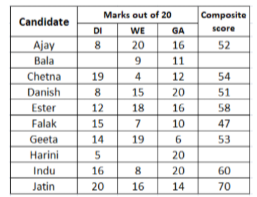
Statement 1: 70 is more than 51, so it is true. Statement 2: Indu's DI of 16 is less than Chetna's 19, so it is true. Statement 3: Jatin's GA of 14 is less than Indu's 20, so it is false. Option A (Both 2 and 3) fails because of statement 3.
Hence, option D (Both 1 and 2).
Q64MCQMissing Value Tables
Which of the following statements MUST be FALSE?
- ABala scored same as Jatin in DI
- BHarini’s composite score was less than that of Falak
- CBala’s composite score was less than that of Ester
- DChetna scored more than Bala in DI
Answer and solution
Answer: (A) Bala scored same as Jatin in DI
Composite
, and no two candidates share a composite.
Jatin has WE 16 and GA 14, so his 20 is in DI and his composite is 70; Indu's is 60. Indu's WE is 8, and a DI of 20 would leave her GA at 12, two sections below 14, although she was recruited. So her GA is 20 (and her DI 16). The completed table below lists every known mark and composite.
A: if Bala had Jatin's DI of 20, his composite would be
, the same as Indu's. That is not allowed, so A must be false.
The others can be true. Harini shares Indu's GA of 20, so she scores
; with a WE of 12 she scores 42, below Falak's 47 (B). Bala scores
; with a DI of 10 he scores 40, below Ester's 58 (C), and 10 is below Chetna's 19 (D). All composites stay different.
Hence, option A (Bala scored same as Jatin in DI).
Q65TITAMissing Value Tables
If all the candidates except Ajay and Danish had different marks in DI, and Bala's composite score was less than Chetna's composite score, then what is the maximum marks that Bala could have scored in DI?
Type in your answer (TITA). No negative mark for a wrong answer.
Answer and solution
Answer: 13
Composite
.
Jatin has WE 16 and GA 14, so his 20 is in DI and he scores 70; Indu scores 60. Indu's WE is 8, and a DI of 20 would leave her GA at 12, two sections below 14, although she was recruited. So her GA is 20 and her DI is
. The completed table below shows every known DI mark.
Chetna scores
. Bala has WE 9 and GA 11, so with a DI of
he scores
. This must be below 54, so
, i.e.
.
Apart from Ajay and Danish, everyone's DI marks differ. 16 is Indu's, 15 is Falak's and 14 is Geeta's, so Bala's highest possible DI is 13. That gives him a composite of 46, which does not clash with any other candidate.
The answer is 13.
Q66TITAMissing Value Tables
If all the candidates scored different marks in WE then what is the maximum marks that Harini could have scored in WE?
Type in your answer (TITA). No negative mark for a wrong answer.
Answer and solution
Answer: 14
Composite
; under 14 marks (70%) in two sections disqualifies.
Jatin's 20 must be in DI (WE 16, GA 14), so he scores 70 and Indu 60. Indu's WE is 8, and a DI of 20 would leave her GA at 12 and disqualify her, so her GA is 20. Danish therefore scores 51, and Harini
.
Geeta is recruited but scores
, as her WE is below Ajay's, so Jatin, Indu and Ester (58), who all qualify, are the other recruits. Danish qualifies with 51 and is not recruited, so Geeta must beat 51: her WE is 18 or 19. Ajay scores
with WE above Ester's 18. If Geeta had 18 (52), Ajay would score 51 or 52 and tie someone, so Geeta has 19 and Ajay 20.
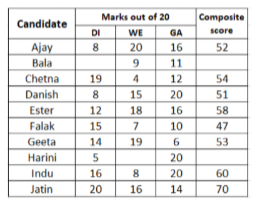
Now the WE marks 20, 19, 18, 16, 15, 9, 8, 7 and 4 are taken. Harini's best free mark is 17, but that gives her 47, equal to Falak's. The next free mark is 14, giving 44, which clashes with no one.
The answer is 14.