- CATin
- CAT past papers
- CAT 2025 Slot 3
- QA
CAT 2025 Slot 3 — QA questions with answers
All 22 questions of the Quantitative Ability section (14 MCQs, 8 TITA). Try each one, then open its answer and solution.
CAT 2025 Slot 3, timed like the real exam (120 minutes, 40 a section) and scored the CAT way: +3 right, −1 for a wrong MCQ, 0 for a wrong TITA, with the full post-mock analysis. Free — sign in and you come straight back to this paper.
Sit this paper as a timed mock in CATin — freeQuantitative Ability
CAT 2025 Slot 3 · 40 minutes · +3 for a right answer, −1 for a wrong MCQ, 0 for a wrong TITA
Q47MCQQuadratic & Polynomial Equations
If
and
, then the value of
is
- A
- B
- C
- D
Answer and solution
Answer: (B)
Given
and
.
Then
, so
(positive, since
).
Cubing:
.
Squaring the given value:
.
Now
.
So
.
Option D (
) is the product alone; it forgets to subtract the cross term
.
Hence, option B (
).
Q48MCQFunctions & Graphs
For real values of
, the range of the function
is
- A
- B
- C
- D
Answer and solution
Answer: (C)
Let
. Then
, i.e.
.
For
this is a quadratic in
, and a real
exists only when its discriminant is non-negative:
.
So
or
. The value
is also reached, at
.
The denominator is
at
and
, but these never solve the quadratic: substituting them gives
and
. The endpoints are reached:
and
.
So the range is
.
Option A has the right lower part but starts the upper part at
, leaving out values such as
.
Hence, option C (
).
Q49MCQDigits & Base Systems
For a 4-digit number (greater than 1000), sum of the digits in the thousands, hundreds, and tens places is 15. Sum of the digits in the hundreds, tens, and units places is 16. Also, the digit in the tens place is 6 more than the digit in the units place. The difference between the largest and smallest possible value of the number is
- A811
- B4078
- C735
- D3289
Answer and solution
Answer: (A) 811
Let the number be
with
.
The conditions are
,
and
.
Subtracting the first from the second gives
, so
and
.
Since
,
; and
. So
or
.
If
:
,
,
, giving 1682.
If
:
,
,
, giving 2493.
Check 2493:
,
and
. No other number fits.
Difference
.
Because only these two numbers are possible, the difference is fixed. A value such as 735 (option C) would need a different pair of numbers, and no other pair satisfies all three conditions.
Hence, option A (811).
Q50MCQTime & Work
Teams A, B, and C consist of five, eight, and ten members, respectively, such that every member within a team is equally productive. Working separately, teams A, B, and C can complete a certain job in 40 hours, 50 hours, and 4 hours, respectively. Two members from team A, three members from team B, and one member from team C together start the job, and the member from team C leaves after 23 hours. The number of additional member(s) from team B, that would be required to replace the member from team C, to finish the job in the next one hour, is
- A2
- B4
- C1
- D3
Answer and solution
Answer: (A) 2
Take the job as 200 units (LCM of 40, 50 and 4).
Team A does
units/hour, so each of its 5 members does 1 unit/hour. Team B does
units/hour, so each of its 8 members does 0.5 unit/hour. Team C does
units/hour, so each of its 10 members does 5 units/hour.
2 members of A, 3 of B and 1 of C together do
units/hour.
In 23 hours they do
units, leaving
units.
The C member leaves. Let
extra B members join so that the rest is done in 1 hour:
.
With only 1 extra member (option C), the rate is
units/hour, short of the 4.5 units needed in one hour.
Hence, option A (2).
Q51MCQAverages, Mixtures & Alligations
The average salary of 5 managers and 25 engineers in a company is 60000 rupees. If each of the managers received 20% salary increase while the salary of the engineers remained unchanged, the average salary of all 30 employees would have increased by 5%. The average salary, in rupees, of the engineers is
- A50000
- B45000
- C40000
- D54000
Answer and solution
Answer: (D) 54000
Let each manager's average salary be
and each engineer's be
(in rupees).
Total salary:
.
After the managers' 20% raise, the average rises by 5% to
, so the new total is
:
.
Subtracting the first equation gives
.
Then
, so
.
Check option A (50000): then
, and a 20% raise for the managers would add
, not the required
.
Hence, option D (54000).
Q52MCQProfit, Loss & Discount
The monthly sales of a product from January to April were 120, 135, 150 and 165 units, respectively. The cost price of the product was Rs. 240 per unit, and a fixed marked price was used for the product in all the four months. Discounts of 20%, 10% and 5% were given on the marked price per unit in January, February and March, respectively, while no discounts were given in April. If the total profit from January to April was Rs. 138825, then the marked price per unit, in rupees, was
- A525
- B515
- C520
- D510
Answer and solution
Answer: (A) 525
Let the marked price be
rupees; the cost price is Rs 240 per unit.
Selling prices per unit: January
, February
, March
, April
.
Total revenue
.
Total units
, so total cost
.
Profit:
.
Check option C (520): the profit would be
, short of 138825.
Hence, option A (525).
Q53MCQSet Theory
In a class of 150 students, 75 students chose physics, 111students chose mathematics and 40 students chose chemistry. All students chose at least one of the three subjects and at least one student chose all three subjects. The number of students who chose both physics and chemistry is equal to the number of students who chose both chemistry and mathematics, and this is half the number of students who chose both physics and mathematics. The maximum possible number of students who chose physics but not mathematics, is
- A35
- B30
- C40
- D55
Answer and solution
Answer: (A) 35
Let
,
and
, with
.
Inclusion–exclusion:
, so
, i.e.
.
Since
,
, so
. Since
(the triple overlap cannot exceed a pair overlap),
, so
.
Physics but not mathematics
. This is largest when
is smallest,
, which gives
.
Check the regions for
,
: physics only 19, mathematics only 55, chemistry only 4, P and M only 36, P and C only 16, M and C only 16, all three 4. They total 150 and none is negative.
So the maximum is
.
Option C (40) would need
, which is not a whole number, and any
makes
.
Hence, option A (35).
Q54MCQQuadratic & Polynomial Equations
If
, then the sum of all real roots of the equation
is
- A
- B
- C
- D
Answer and solution
Answer: (A)
Let
. Then
, so
.
The equation becomes
.
Case 1:
, so
. Its discriminant is
, so it has two real roots, and their sum is
.
Case 2:
, so
. Its discriminant is
, so it has no real roots.
The sum of all real roots is therefore
.
Option D (
) adds the root sums of both quadratics, but the second quadratic has no real roots.
Hence, option A (
).
Q55MCQTime, Speed & Distance
Rahul starts on his journey at 5 pm at a constant speed so that he reaches his destination at 11 pm the same day. However, on his way, he stops for 20 minutes, and after that, increases his speed by 3 km per hour to reach on time. If he had stopped for 10 minutes more, he would have had to increase his speed by 5 km per hour to reach on time. His initial speed, in km per hour, was
- A12
- B20
- C18
- D15
Answer and solution
Answer: (D) 15
The planned journey takes 6 hours (5 pm to 11 pm) at speed
.
Let the stop happen when
planned hours remain, so the remaining distance is
.
Stop of 20 minutes: he covers
at
in
hours.
.
Stop of 30 minutes: he covers
at
in
hours.
.
Equating:
.
Check:
, so 30 km remain. At 18 km/h that takes 100 minutes, plus the 20-minute stop makes 2 hours; at 20 km/h it takes 90 minutes, plus 30 minutes makes 2 hours.
Option C (18) gives
from the first case but
from the second, so it cannot satisfy both.
Hence, option D (15).
Q56TITATime, Speed & Distance
Ankita walks from A to C through B, and runs back through the same route at a speed that is 40% more than her walking speed. She takes exactly 3 hours 30 minutes to walk from B to C as well as to run from B to A. The total time, in minutes, she would take to walk from A to B and run from B to C, is
Type in your answer (TITA). No negative mark for a wrong answer.
Answer and solution
Answer: 444
Let the walking speed be
; the running speed is then
.
3 hours 30 minutes
hours.
Walking from B to C takes 3.5 hours, so
.
Running from B to A takes 3.5 hours, so
.
Walking from A to B takes
hours
minutes.
Running from B to C takes
hours
minutes.
Total time
minutes.
The answer is 444.
Q57MCQDigits & Base Systems
The sum of all the digits of the number
is
- A324
- B255
- C212
- D221
Answer and solution
Answer: (D) 221
Write the number as
.
is 1 followed by 25 zeros, so
is a 25-digit number: twenty-two 9s followed by 877. (Compare
: two 9s, then 877.)
is 1 followed by 50 zeros, a 51-digit number. Adding the 25-digit number fills its last 25 places, so the result is a 1, then 25 zeros, then twenty-two 9s, then 877, which is
digits in all.
Sum of digits
.
Option C (212) is 9 less, which is what you get by counting only twenty-one 9s.
Hence, option D (221).
Q58TITATriangles & Lines
A triangle ABC is formed with AB = AC = 50 cm and BC = 80 cm. Then, the sum of the lengths, in cm, of all three altitudes of the triangle ABC is
Type in your answer (TITA). No negative mark for a wrong answer.
Answer and solution
Answer: 126
Triangle ABC has
cm and
cm.
Area by Heron's formula:
, so the area is
cm².
(Check: the altitude from A bisects BC, so it is
cm, and
.)
Altitude from A to BC:
cm.
Altitude from C to AB:
cm. The altitude from B to AC is also 48 cm, because
.
Sum of the three altitudes
cm.
The answer is 126.
Q59TITAAverages, Mixtures & Alligations
Vessels A and B contain 60 litres of alcohol and 60 litres of water, respectively. A certain volume is taken out from A and poured into B. After stirring, the same volume is taken out from B and poured into A. If the resultant ratio of alcohol and water in A is 15 : 4, then the volume, in litres, initially taken out from A is
Type in your answer (TITA). No negative mark for a wrong answer.
Answer and solution
Answer: 16
Vessel A starts with 60 L of alcohol and vessel B with 60 L of water. Let
L be moved each time.
After the first transfer, A has
L of alcohol, and B has 60 L of water and
L of alcohol,
L in all.
The
L taken from B has the same make-up, so it carries
L of water and
L of alcohol.
A ends with 60 L again, and all its water comes from this pour. Since alcohol : water in A is 15 : 4, the water in A is
L.
So
.
Check: water in A
L and alcohol
L, a ratio of
.
The answer is 16.
Q60TITASequences & Series
In an arithmetic progression, if the sum of fourth, seventh and tenth terms is 99, and the sum of the first fourteen terms is 497, then the sum of first five terms is
Type in your answer (TITA). No negative mark for a wrong answer.
Answer and solution
Answer: 65
Given: Sum of 4th, 7th and 10th terms = 99.
Also, sum of first 14 terms = 497:
From (1) × 2: . Subtract from (2):
Substituting back: .
Sum of first 5 terms:
.
Q61TITAProperties of Numbers
Let p, q and r be three natural numbers such that their sum is 900, and r is a perfect square whose value lies between 150 and 500. If p is not less than 0.3q and not more than 0.7q, then the sum of the maximum and minimum possible values of p is
Type in your answer (TITA). No negative mark for a wrong answer.
Answer and solution
Answer: 397
We have
,
a perfect square between 150 and 500, and
.
The possible values of
run from
to
.
Maximum
: make
as large as possible (
, so
) and give
its largest share,
.
and
. Both are natural numbers, so this is attainable.
Minimum
: make
as small as possible (
, so
) and give
its smallest share,
.
and
.
Sum of the maximum and minimum values of
.
The answer is 397.
Q62TITARatios, Proportions & Partnership
The ratio of the number of coins in boxes A and B was 17:7. After 108 coins were shifted from box A to box B, this ratio became 37:20. The number of coins that needs to be shifted further from A to B, to make this ratio 1:1, is
Type in your answer (TITA). No negative mark for a wrong answer.
Answer and solution
Answer: 272
Let the coins in boxes A and B be
and
.
After 108 coins move from A to B:
.
.
Now A has
coins and B has
coins. (Check:
.)
The total, 1824, does not change, so for a 1 : 1 ratio each box needs 912 coins.
Coins still to move from A to B
.
The answer is 272.
Q63MCQTime & Work
The rate of water flow through three pipes A, B and C are in the ratio 4 : 9 : 36. An empty tank can be filled up completely by pipe A in 15 hours. If all the three pipes are used simultaneously to fill up this empty tank, the time, in minutes, required to fill up the entire tank completely is nearest to
- A71
- B78
- C73
- D76
Answer and solution
Answer: (C) 73
The flow rates of A, B and C are in the ratio 4 : 9 : 36, so take them as 4, 9 and 36 units per hour.
A fills the tank in 15 hours, so the tank holds
units.
All three together fill
units per hour.
Time taken
hours
minutes
minutes.
The nearest option is 73. Option A (71) and option D (76) are each more than 2 minutes away from 73.47, so neither is the nearest.
Hence, option C (73).
Q64MCQPolygons & Circles
ABCD is a trapezium in which AB is parallel to DC, AD is perpendicular to AB, and AB = 3DC. If a circle inscribed in the trapezium touching all the sides has a radius of 3 cm, then the area, in sq. cm, of the trapezium is
- A30√3
- B54
- C48
- D36√2
Answer and solution
Answer: (C) 48
AD is perpendicular to both parallel sides, and the circle touches AB and DC, so the height AD equals the circle's diameter:
cm.
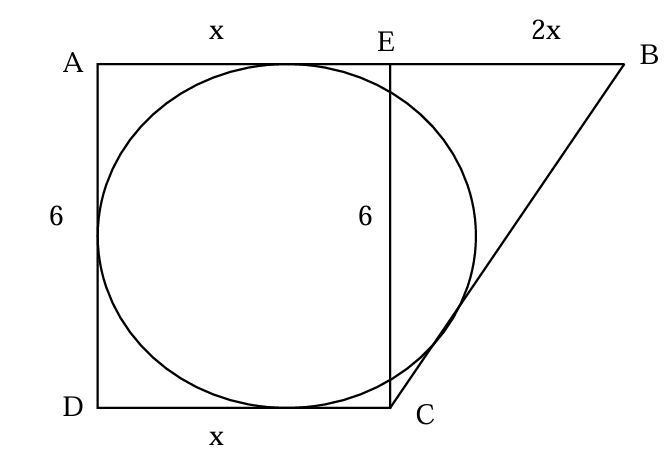
Let
, so
.
A circle can be inscribed in a quadrilateral only if the sums of opposite sides are equal:
. So
, giving
.
Drop a perpendicular CE from C to AB. Then
,
and
.
In right triangle CEB:
, so
.
.
So
,
and
(check:
).
Area
cm².
Option B (54) would need
, i.e.
; then
, but
.
Hence, option C (48).
Q65MCQTriangles & Lines
In ∆ABC, AB = AC = 12 cm and D is a point on side BC such that AD = 8 cm. If AD is extended to a point E such that ∠ACB = ∠AEB, then the length, in cm, of AE is
- A16
- B18
- C20
- D14
Answer and solution
Answer: (B) 18
Since
,
. We are given
, so
.
E lies on AD extended, so triangles ABD and AEB share the angle at A (
).
With two pairs of equal angles, triangle ABD is similar to triangle AEB (A matches A, B matches E, and D matches B). Hence
.
So
cm.
This holds wherever D lies on BC; D need not be the foot of the perpendicular from A.
Option C (20) would need
, but
.
Hence, option B (18).
Q66TITAIndices & Surds
If
, where
,
and
are natural numbers, then
equals
Type in your answer (TITA). No negative mark for a wrong answer.
Answer and solution
Answer: 112
Given equation:
Expressing all bases in terms of prime factors :
Expanding the exponents:
Combining powers of the same base on the LHS:
Equating the exponents of corresponding prime bases:
1) For base 3:
2) For base 5:
3) For base 2:
Since ,
Therefore, .
Q67TITAAverages, Mixtures & Alligations
In a school with 1500 students, each student chooses any one of the streams out of science, arts, and commerce, by paying a fee of Rs 1100, Rs 1000, and Rs 800, respectively. The total fee paid by all the students is Rs 15,50,000. If the number of science students is not more than the number of arts students, then the maximum possible number of science students in the school is
Type in your answer (TITA). No negative mark for a wrong answer.
Answer and solution
Answer: 700
Let
,
and
be the numbers of science, arts and commerce students.
and
, i.e.
.
Substitute
:
, so
and
.
The condition
gives
.
At
:
and
, all whole and non-negative.
Check the fees:
.
So the maximum possible number of science students is 700.
The answer is 700.
Q68MCQLogarithms
The sum of all possible real values of
for which
is
- A
- B
- C
- D
Answer and solution
Answer: (C)
For the logarithms to be defined, the base needs
and
, so
and
. Then
and
as well.
Write
. The equation becomes
,
so
.
Since
, divide by
:
, so
.
.
Only
is greater than 3 (and it is not 4); the other root is negative. So the sum of all valid values is
.
Option D (3) is the sum of both roots of the quadratic, but it wrongly includes the negative root, where the base
is negative.
Hence, option C (
).