- CATin
- CAT past papers
- CAT 2025 Slot 3
- DILR
CAT 2025 Slot 3 — DILR questions with answers
All 22 questions of the Data Interpretation & Logical Reasoning section (11 MCQs, 11 TITA, 5 sets). Try each one, then open its answer and solution.
CAT 2025 Slot 3, timed like the real exam (120 minutes, 40 a section) and scored the CAT way: +3 right, −1 for a wrong MCQ, 0 for a wrong TITA, with the full post-mock analysis. Free — sign in and you come straight back to this paper.
Sit this paper as a timed mock in CATin — freeData Interpretation & Logical Reasoning
CAT 2025 Slot 3 · 40 minutes · +3 for a right answer, −1 for a wrong MCQ, 0 for a wrong TITA
Data set
Set for questions 25–28
DIRECTIONS for questions 25-28: Read the information given below and answer the question that follows.
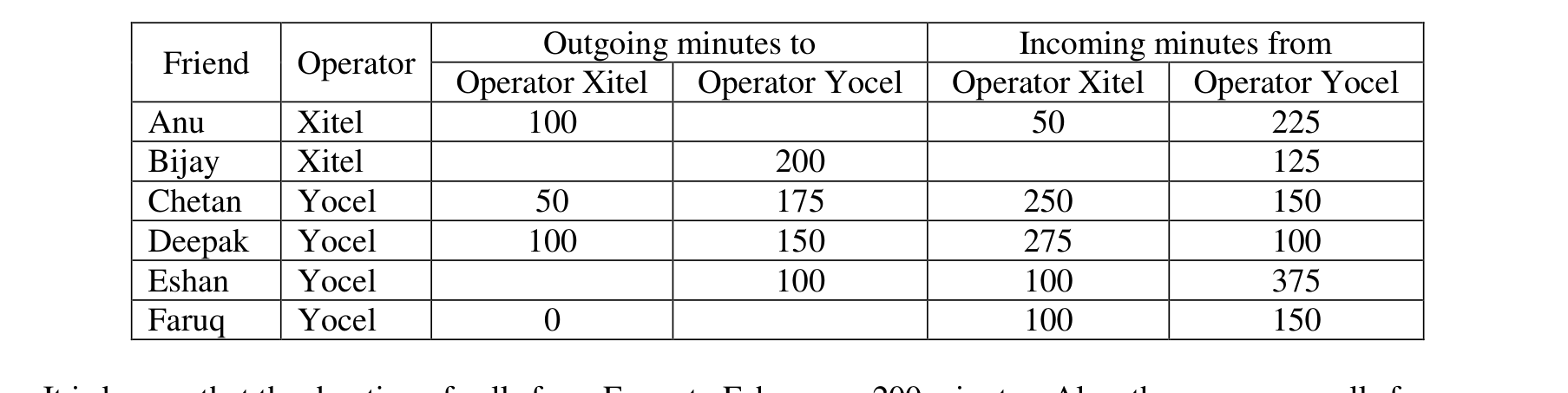
Anu, Bijay, Chetan, Deepak, Eshan, and Faruq are six friends. Each of them uses a mobile number from exactly one of the two mobile operators - Xitel and Yocel. During the last month, the six friends made several calls to each other. Each call was made by one of these six friends to another. The table below summarizes the number of minutes of calls that each of the six made to (outgoing minutes) and received from (incoming minutes) these friends, grouped by the operators. Some of the entries are missing.
It is known that the duration of calls from Faruq to Eshan was 200 minutes. Also, there were no calls from:
i. Bijay to Eshan,
ii. Chetan to Anu and Chetan to Deepak,
iii. Deepak to Bijay and Deepak to Faruq,
iv. Eshan to Chetan and Eshan to Deepak.
Q25TITATables & Caselets
What was the duration of calls (in minutes) from Bijay to Anu?
Type in your answer (TITA). No negative mark for a wrong answer.
Answer and solution
Answer: 50
Only Anu and Bijay use Xitel, and no one calls themselves. So every minute Anu received from Xitel users came from Bijay, and every minute Anu made to Xitel users went to Bijay.
The table shows that Anu received 50 minutes of calls from Xitel users. So Bijay called Anu for 50 minutes.
In the same way, Anu made 100 minutes of calls to Xitel users, so Anu called Bijay for 100 minutes. This also fills Bijay's missing entries: 50 minutes made to Xitel and 100 minutes received from Xitel.
The Xitel-to-Xitel calls (each row is the caller, each column the receiver):
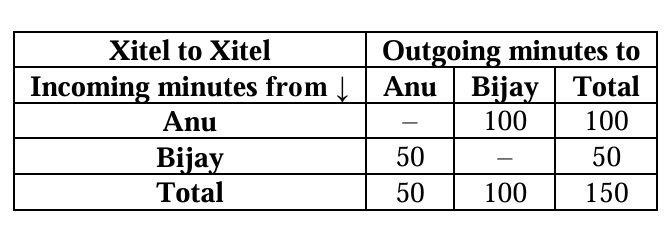
The answer is 50.
Q26TITATables & Caselets
What was the total duration of calls (in minutes) made by Anu to friends having mobile numbers from Operator Yocel?
Type in your answer (TITA). No negative mark for a wrong answer.
Answer and solution
Answer: 525
Anu and Bijay use Xitel; Chetan, Deepak, Eshan and Faruq use Yocel. So every minute a Yocel user received from Xitel was a call from Anu or Bijay.
From the table, the Yocel users received
minutes from Xitel (Chetan, Deepak, Eshan and Faruq).
Bijay made 200 minutes of calls to Yocel users, so Anu made
minutes.
The Xitel-to-Yocel calls (each row is the caller, each column the receiver):
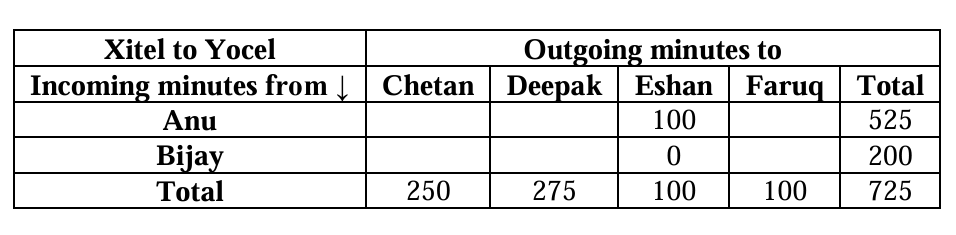
Bijay made no calls to Eshan, so all 100 of Eshan's minutes from Xitel came from Anu. The other cells are not needed here.
The answer is 525.
Q27TITATables & Caselets
What was the total duration of calls (in minutes) made by Faruq to friends having mobile numbers from Operator Yocel?
Type in your answer (TITA). No negative mark for a wrong answer.
Answer and solution
Answer: 350
Chetan, Deepak, Eshan and Faruq are the Yocel users. Every call between two Yocel users is counted once as outgoing and once as incoming, so the Yocel users' total minutes made to Yocel equal their total minutes received from Yocel.
Received from Yocel:
minutes (Chetan, Deepak, Eshan and Faruq).
Made to Yocel by Chetan, Deepak and Eshan:
minutes.
So Faruq made
minutes of calls to Yocel users.
The completed Yocel-to-Yocel table (each row is the caller, each column the receiver) shows this as Faruq's row total. Its other cells come from the calls known not to have been made and are not needed here.
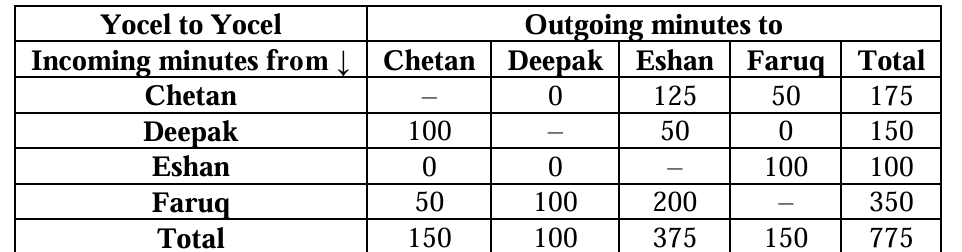
The answer is 350.
Q28MCQTables & Caselets
What was the duration of calls (in minutes) from Deepak to Chetan?
- A100
- B0
- C125
- D50
Answer and solution
Answer: (A) 100
Chetan, Deepak, Eshan and Faruq use Yocel. First find Faruq's calls to Yocel users: the Yocel users received
minutes from Yocel, and Chetan, Deepak and Eshan made
of them, so Faruq made
.
Deepak received 100 minutes from Yocel users. Neither Chetan nor Eshan called Deepak, so Faruq called Deepak for 100 minutes.
Faruq called Eshan for 200 minutes, so Faruq called Chetan for
minutes.
Chetan received 150 minutes from Yocel users. Eshan did not call Chetan, and Faruq's share was 50, so Deepak called Chetan for
minutes.
The completed Yocel-to-Yocel table (each row is the caller, each column the receiver):
Option D (50) is Faruq's time to Chetan, the other part of Chetan's 150 minutes, not Deepak's.
Hence, option A (100).
Data set
Set for questions 29–33
Aurevia, Brelosia, Cyrenia and Zerathania are four countries with their currencies being Aurels, Brins, Crowns, and Zentars, respectively. The currencies have different exchange values. Crown's currency exchange rate with Zentars = 0.5, i.e., 1 Crown is worth 0.5 Zentars.
Three travelers, Jano, Kira, and Lian set out from Zerathania visiting exactly two of the countries. Each country is visited by exactly two travelers. Each traveler has a unique Flight Cost, which represents the total cost of airfare in traveling to both the countries and back to Zerathania. The Flight Cost of Jano was 4000 Zentars, while that of the other two travelers were 5000 and 6000 Zentars, not necessarily in that order.
When visiting a country, a traveler spent either 1000, 2000 or 3000 in the country's local currency. Each traveler had different spends (in the country's local currency) in the two countries he/she visited. Across all the visits, there were exactly two spends of 1000 and exactly one spend of 3000 (in the country's local currency).
The total 'Travel Cost' for a traveler is the sum of his/her Flight Cost and the money spent in the countries visited.
The citizens of the four countries with knowledge of these travels made a few observations, with spends measured in their respective local currencies:
i.Aurevia citizen: Jano and Kira visited our country, and their Travel Costs were 3500 and 8000, respectively.
ii.Brelosia citizen: Kira and Lian visited our country, spending 2000 and 3000, respectively. Kira's Travel Cost was 4000.
iii.Cyrenia citizen: Lian visited our country and her Travel Cost was 36000.
Q29TITATables & Caselets
What is the sum of Travel Costs for all travelers in Zentars?
Type in your answer (TITA). No negative mark for a wrong answer.
Answer and solution
Answer: 41000
Aurevia had Jano and Kira, and Brelosia had Kira and Lian, so Cyrenia had Jano and Lian.
Lian's 3000 in Brelosia is the only 3000. Kira spent 2000 in Brelosia, so 1000 in Aurevia. Jano's two spends differ, so they are 1000 and 2000, which uses up both 1000s; so Lian spent 2000 in Cyrenia.
Kira's Travel Cost is 8000 Aurels and also 4000 Brins, so
. Lian's is 36000 Crowns
Zentars, since a Crown is worth 0.5 Zentars.
Kira: flight
Brins
Aurels
Brins; 1000 Aurels are 500 Brins, so the flight is 1500 Brins. Lian: flight
Brins
Crowns
Zentars; 2000 Crowns are 1000 Zentars, so flight
Brins
Zentars.
If Kira's flight were 5000 Zentars, a Brin would be
Zentars, but Lian's 6000-Zentar flight would make it
. So Kira's flight is 6000 Zentars,
Zentars,
Zentars, and Lian's flight is 5000 Zentars.
Travel Costs in Zentars: Jano
, Kira
, Lian
.

Sum
Zentars.
The answer is 41000.
Q30TITATables & Caselets
How many Zentars did Lian spend in the two countries he visited?
Type in your answer (TITA). No negative mark for a wrong answer.
Answer and solution
Answer: 13000
Aurevia had Jano and Kira, and Brelosia had Kira and Lian, so Cyrenia had Jano and Lian.
Lian's 3000 in Brelosia is the only 3000. Kira spent 2000 in Brelosia, so 1000 in Aurevia. Jano's two spends differ, so they are 1000 and 2000, which uses up both 1000s; so Lian spent 2000 in Cyrenia.
Kira's Travel Cost is 8000 Aurels and also 4000 Brins, so
. Lian's is 36000 Crowns
Zentars, since a Crown is worth 0.5 Zentars.
Kira: flight
Brins
Aurels
Brins; 1000 Aurels are 500 Brins, so the flight is 1500 Brins. Lian: flight
Brins
Crowns
Zentars; 2000 Crowns are 1000 Zentars, so flight
Brins
Zentars.
If Kira's flight were 5000 Zentars, a Brin would be
Zentars, but Lian's 6000-Zentar flight would make it
. So Kira's flight is 6000 Zentars,
Zentars, and Lian's flight is 5000 Zentars.
Lian spent 3000 Brins
Crowns
Zentars.
The answer is 13000.
Q31TITATables & Caselets
What was Jano's total spend in the two countries he visited, in Aurels?
Type in your answer (TITA). No negative mark for a wrong answer.
Answer and solution
Answer: 1500
Aurevia had Jano and Kira, and Brelosia had Kira and Lian, so Cyrenia had Jano and Lian.
Lian's 3000 in Brelosia is the only 3000. Kira spent 2000 in Brelosia, so 1000 in Aurevia. Jano's two spends differ, so they are 1000 and 2000, which uses up both 1000s; so Lian spent 2000 in Cyrenia.
Kira's Travel Cost is 8000 Aurels and also 4000 Brins, so
. Lian's is 36000 Crowns
Zentars, since a Crown is worth 0.5 Zentars.
Kira: flight
Brins
Aurels
Brins; 1000 Aurels are 500 Brins, so the flight is 1500 Brins. Lian: flight
Brins
Crowns
Zentars; 2000 Crowns are 1000 Zentars, so flight
Brins
Zentars.
If Kira's flight were 5000 Zentars, a Brin would be
Zentars, but Lian's 6000-Zentar flight would make it
. So Kira's flight is 6000 Zentars,
Zentars and
Zentars.
Jano's Travel Cost is 3500 Aurels
Zentars and his flight is 4000 Zentars, so he spent
Zentars
Aurels.
The answer is 1500.
Q32MCQTables & Caselets
One Brin is equivalent to how many Crowns?
- A0.5
- B8
- C0.125
- D4
Answer and solution
Answer: (B) 8
Aurevia had Jano and Kira, and Brelosia had Kira and Lian, so Cyrenia had Jano and Lian.
Lian's 3000 in Brelosia is the only 3000. Kira spent 2000 in Brelosia, so 1000 in Aurevia. Jano's two spends differ, so they are 1000 and 2000, which uses up both 1000s; so Lian spent 2000 in Cyrenia.
Kira's Travel Cost is 8000 Aurels and also 4000 Brins, so
. Lian's is 36000 Crowns
Zentars, since a Crown is worth 0.5 Zentars.
Kira: flight
Brins
Aurels
Brins; 1000 Aurels are 500 Brins, so the flight is 1500 Brins. Lian: flight
Brins
Crowns
Zentars; 2000 Crowns are 1000 Zentars, so flight
Brins
Zentars.
If Kira's flight were 5000 Zentars, a Brin would be
Zentars, but Lian's 6000-Zentar flight would make it
. So Kira's flight is 6000 Zentars and
.
Since
,
.
Option D (4) is the Brin's value in Zentars, not Crowns, and option C (0.125) turns the ratio upside down.
Hence, option B (8).
Q33MCQTables & Caselets
Which of the following statements is NOT true about money spent in the local currency?
- AJano spent 2000 in Aurevia
- BLian spent 2000 in Cyrenia
- CJano spent 2000 in Cyrenia
- DKira spent 1000 in Aurevia
Answer and solution
Answer: (A) Jano spent 2000 in Aurevia
Aurevia had Jano and Kira, and Brelosia had Kira and Lian, so Cyrenia had Jano and Lian.
Lian's 3000 in Brelosia is the only 3000. Kira spent 2000 in Brelosia, so 1000 in Aurevia. Jano's two spends differ, so they are 1000 and 2000, which uses up both 1000s; so Lian spent 2000 in Cyrenia.
Kira's Travel Cost is 8000 Aurels and also 4000 Brins, so a Brin is 2 Aurels. Kira's flight
Brins, as her 1000 Aurels are 500 Brins. Lian's Travel Cost is 36000 Crowns
Zentars, and her 2000 Crowns are 1000 Zentars, so flight
Brins
Zentars.
If Kira's flight were 5000 Zentars, a Brin would be
Zentars, but Lian's 6000-Zentar flight would make it
. So Kira's flight is 6000 Zentars, a Brin is 4 Zentars and an Aurel 2 Zentars.
Jano spent
Zentars (3500 Aurels less his flight). 1000 Aurels
Crowns
Zentars fits; 2000 Aurels
Crowns
Zentars does not. So Jano spent 1000 in Aurevia and 2000 in Cyrenia.
Options B, C and D are all true; only A is false.
Hence, option A (Jano spent 2000 in Aurevia).
Data set
Set for questions 34–37
DIRECTIONS for questions 34-37: Read the information given below and answer the question that follows.
Anirbid, Chandranath, Koushik, and Suranjan participated in a puzzle solving competition. The competition comprised 10 puzzles that had to be solved in the same sequence, i.e., a competitor got access to a puzzle as soon as they solved the previous puzzle. Some of the puzzles were visual puzzles and the others were number-based puzzles. The winner of the competition was the one who solved all puzzles in the least time.
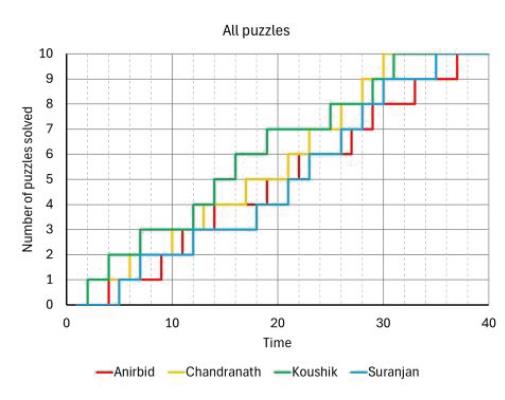
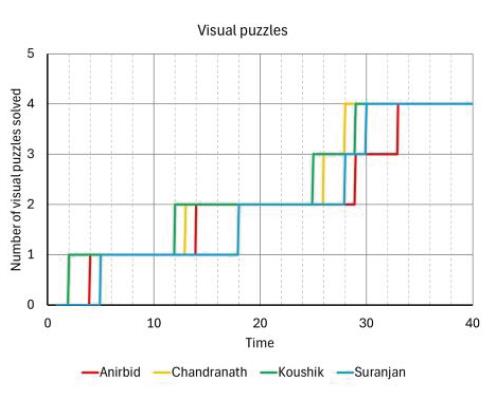
The following charts describe their progress in the competition. The chart on the left shows the number of puzzles solved by each competitor at a given time (in minutes) after the start of the competition. The chart on the right shows the number of visual puzzles solved by each competitor at a given time (in minutes) after the start of the competition.
Q34MCQBar & Line Charts
Who had solved the largest number of puzzles by the 20-th minute from the start of the competition?
- ASuranjan
- BChandranath
- CKoushik
- DAnirbid
Answer and solution
Answer: (C) Koushik
The left chart gives the minute at which each competitor solved each puzzle. Figure 1 lists these minutes; its 'Time taken' columns are minutes from the start, not durations.
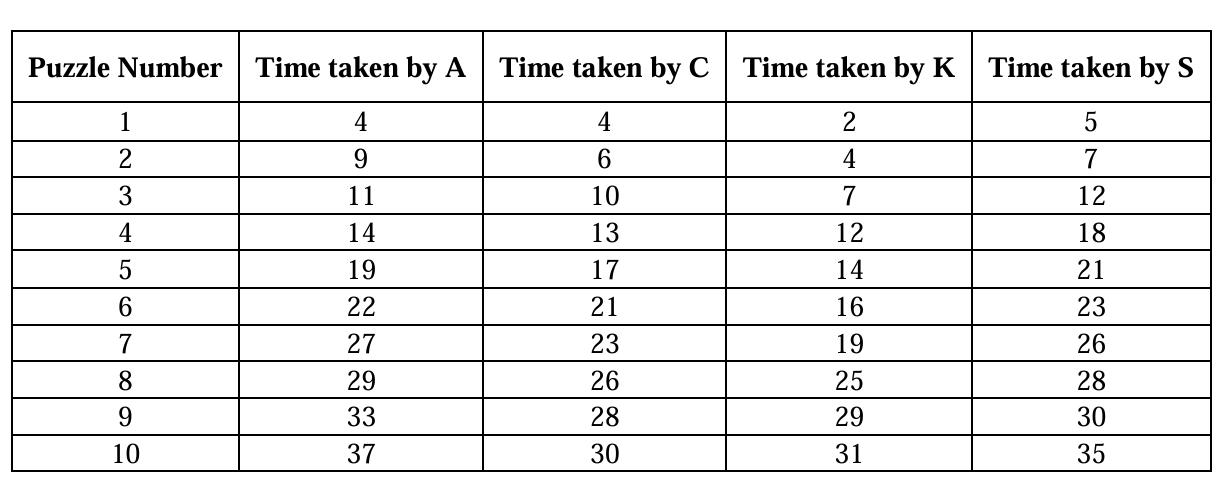
Puzzles solved by minute 20:
Anirbid solved puzzles at 4, 9, 11, 14 and 19 minutes, so 5 (the next came at 22).
Chandranath solved puzzles at 4, 6, 10, 13 and 17 minutes, so 5 (the next came at 21).
Koushik solved puzzles at 2, 4, 7, 12, 14, 16 and 19 minutes, so 7 (the next came at 25).
Suranjan solved puzzles at 5, 7, 12 and 18 minutes, so 4 (the next came at 21).
Anirbid (option D) and Chandranath (option B) are tied on 5, two behind Koushik.
Hence, option C (Koushik).
Q35TITABar & Line Charts
How many minutes did Suranjan take to solve the third visual puzzle in the competition?
Type in your answer (TITA). No negative mark for a wrong answer.
Answer and solution
Answer: 2
From the right chart, Suranjan's count of visual puzzles rises at minutes 5, 18, 28 and 30, so he solved his third visual puzzle at minute 28.
From the left chart, Suranjan solved puzzles 1 to 10 at minutes 5, 7, 12, 18, 21, 23, 26, 28, 30 and 35. Minute 28 is his 8th solve, so the third visual puzzle is puzzle 8, and he started it when he finished puzzle 7 at minute 26.
The tables list these minutes; their 'Time taken' columns are minutes from the start, and figure 2 numbers the visual puzzles 1 to 4.
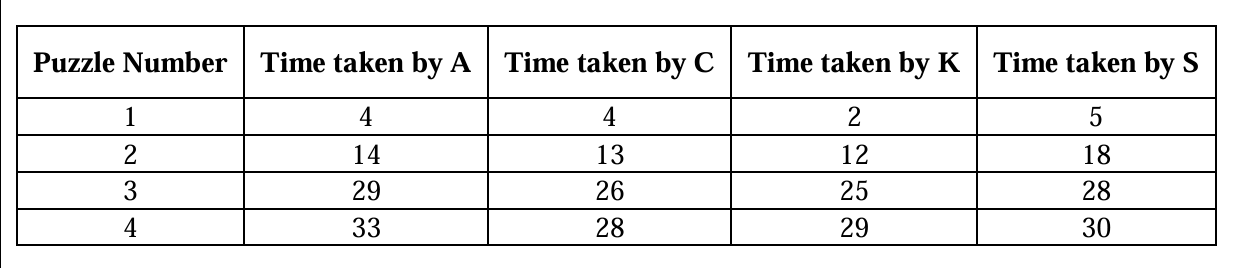
Time on the third visual puzzle
minutes.
The answer is 2.
Q36TITABar & Line Charts
At what number in the sequence was the fourth number-based puzzle?
Type in your answer (TITA). No negative mark for a wrong answer.
Answer and solution
Answer: 6
All competitors solve the same puzzles in the same order, so one competitor's charts identify the visual puzzles.
Anirbid solved puzzles 1 to 10 at minutes 4, 9, 11, 14, 19, 22, 27, 29, 33 and 37 (left chart). His visual-puzzle count rose at minutes 4, 14, 29 and 33 (right chart). These are his puzzles 1, 4, 8 and 9.
The others agree: Koushik's visual puzzles came at minutes 2, 12, 25 and 29, which are also his puzzles 1, 4, 8 and 9.
The tables list these minutes; their 'Time taken' columns are minutes from the start, and figure 2 numbers the visual puzzles 1 to 4.
So the number-based puzzles are puzzles 2, 3, 5, 6, 7 and 10, and the fourth of them is puzzle 6.
The answer is 6.
Q37MCQBar & Line Charts
Which of the following is the closest to the average time taken by Anirbid to solve the number-based puzzles in the competition?
- A3.3 minutes
- B2.5 minutes
- C4.0 minutes
- D3.8 minutes
Answer and solution
Answer: (C) 4.0 minutes
Anirbid solved puzzles 1 to 10 at minutes 4, 9, 11, 14, 19, 22, 27, 29, 33 and 37 (left chart), and his visual-puzzle count rose at minutes 4, 14, 29 and 33 (right chart). So puzzles 1, 4, 8 and 9 are visual, and the number-based puzzles are 2, 3, 5, 6, 7 and 10.
The tables list these minutes; their 'Time taken' columns are minutes from the start.
Each puzzle takes the gap since the previous one was solved: puzzle 2:
; puzzle 3:
; puzzle 5:
; puzzle 6:
; puzzle 7:
; puzzle 10:
.
Average
minutes.
Option D (3.8) is near his average over all ten puzzles,
, and option A (3.3) is near his visual-puzzle average,
.
Hence, option C (4.0 minutes).
Data set
Set for questions 38–42
DIRECTIONS for questions 38-42: Read the information given below and answer the question that follows.
Three countries — Pumpland (P), Xiland (X) and Cheeseland (C) — trade among themselves and with the (other countries in) Rest of World (ROW). All trade volumes are given in IC (international currency). The following terminology is used:
- Trade balance = Exports – Imports
- Total trade = Exports + Imports
- Normalized trade balance = Trade balance / Total trade, expressed in percentage terms
The following information is known:
- The normalized trade balances of P, X and C are 0%, 10%, and –20%, respectively.
- 40% of exports of X are to P. 22% of imports of P are from X.
- 90% of exports of C are to P; 4% are to ROW.
- 12% of exports of ROW are to X, 40% are to P.
- The export volumes of P, in IC, to X and C are 600 and 1200, respectively. P is the only country that exports to C.
Q38TITATables & Caselets
How much is exported from C to X, in IC?
Type in your answer (TITA). No negative mark for a wrong answer.
Answer and solution
Answer: 48
Normalised trade balance
for exports
and imports
. For C it is
, so
, i.e.
and
.
P is the only country that exports to C, and P sends C 1200. So C imports 1200 and exports
.
Of C's exports,
(720) go to P and
(32) go to ROW. The rest go to X:
.
The completed matrix (each row is the exporter, each column the importer); C's row reads 720, 48 and 32:
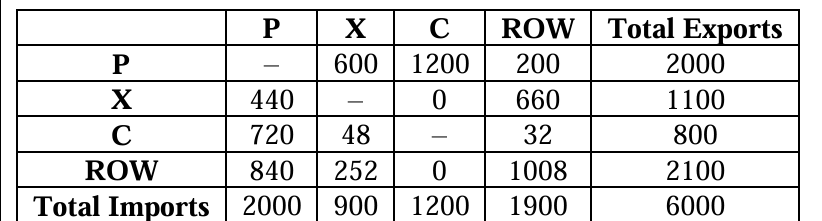
The answer is 48.
Q39TITATables & Caselets
How much is exported from P to ROW, in IC?
Type in your answer (TITA). No negative mark for a wrong answer.
Answer and solution
Answer: 200
Normalised trade balance
. So P has
; X (
) has
; C (
) has
.
P is the only exporter to C, so C imports 1200 and exports 800: 720 to P (
), 32 to ROW (
) and the other 48 to X.
Let X export
and import
. X sends
to P and nothing to C. This is
of P's imports, so P imports, and exports,
.
Let ROW export
:
to P,
to X, none to C and
within ROW.
P's imports:
, so
.
X's imports:
, so
.
Then
, so
,
, and P exports
.
The completed matrix (each row is the exporter, each column the importer):
P exports 600 to X and 1200 to C, so it exports
to ROW.
The answer is 200.
Q40TITATables & Caselets
How much is exported from ROW to ROW, in IC?
Type in your answer (TITA). No negative mark for a wrong answer.
Answer and solution
Answer: 1008
Normalised trade balance
. So P has
; X (
) has
; C (
) has
.
P is the only exporter to C, so C imports 1200 and exports 800: 720 to P (
), 32 to ROW (
) and the other 48 to X.
Let X export
and import
. X sends
to P and nothing to C. This is
of P's imports, so P imports, and exports,
.
Let ROW export
:
(
) goes to P,
(
) to X, none to C, and the remaining
(
) stays within ROW.
P's imports:
, so
.
X's imports:
, so
.
Then
, so
and
.
The completed matrix (each row is the exporter, each column the importer):
ROW's exports within ROW are
.
The answer is 1008.
Q41MCQTables & Caselets
What is the trade balance of ROW?
- A200
- B0
- C-200
- D100
Answer and solution
Answer: (A) 200
Normalised trade balance
. So P has
; X (
) has
; C (
) has
.
P is the only exporter to C, so C imports 1200 and exports 800: 720 to P, 32 to ROW and 48 to X.
Let X export
and import
. X sends
to P, none to C and
to ROW.
is
of P's imports, so P imports, and exports,
.
Let ROW export
:
to P,
to X, none to C and
within ROW.
P's imports:
, so
. X's imports:
, so
. Then
,
,
.
ROW exports
. It imports 200 from P (
),
from X, 32 from C and
from ROW: 1900 in all.
Trade balance
. Option C (
) is imports minus exports.
Hence, option A (200).
Q42MCQTables & Caselets
Which among the countries P, X, and C has/have the least total trade?
- AOnly P
- BBoth X and C
- COnly C
- DOnly X
Answer and solution
Answer: (B) Both X and C
Normalised trade balance
. So P has
; X (
) has
; C (
) has
.
P is the only exporter to C, so C imports 1200 and exports 800: 720 to P (
), 32 to ROW (
) and the other 48 to X.
Let X export
and import
. X sends
to P and nothing to C. This is
of P's imports, so P imports, and exports,
.
Let ROW export
:
to P,
to X, none to C and
within ROW.
P's imports:
, so
. X's imports:
, so
. Then
, so
and
.
Total trade: P
; X
; C
.
X and C tie for the least, so option C (Only C) misses X.
Hence, option B (Both X and C).
Data set
Set for questions 43–46
DIRECTIONS for questions 43-46: Read the information given below and answer the question that follows.
Seven children, Aarav, Bina, Chirag, Diya, Eshan, Farhan, and Gaurav, are sitting in a circle facing inside (not necessarily in the same order) and playing a game of ‘Passing the Buck’.
The game is played over 10 rounds. In each round, the child holding the Buck must pass it directly to a child sitting in one of the following positions: Immediately to the left; Immediate to the right; Second to the left; or Second to the right.
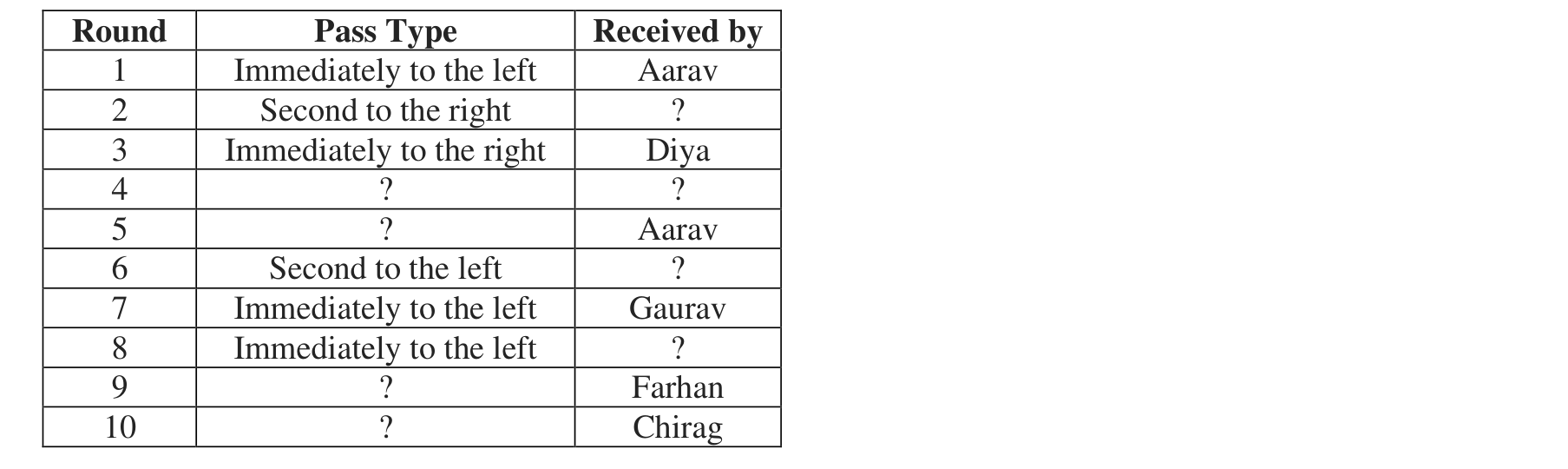
The game starts with Bina passing the Buck and ends with Chirag receiving the Buck. The table below provides some information about the pass types and the child receiving the Buck. Some information is missing and labelled as ‘?’.
Q43MCQCircular Arrangement
Who is sitting immediately to the right of Bina?
- AEshan
- BFarhan
- CAarav
- DChirag
Answer and solution
Answer: (A) Eshan
The children face the centre, so a child's right is the next seat anticlockwise. Number the seats 0 to 6 anticlockwise, with Bina on 0; right adds 1 or 2, left subtracts 1 or 2 (mod 7).
Round 1 (left) puts Aarav on 6; round 2 (second right) goes to 1; round 3 (right) puts Diya on 2. Round 6 (second left) goes from Aarav to 4, round 7 (left) puts Gaurav on 3, and round 8 (left) returns to Diya.
Chirag, Eshan and Farhan fill seats 1, 4 and 5. Farhan receives from Diya (round 9), and seat 5 is three away from seat 2, so Farhan is on 1 or 4. Chirag receives from Farhan (round 10), and seats 4 and 5 are both three away from seat 1, so Farhan is on 4, Chirag on 5 and Eshan on 1.
Anticlockwise from Bina: Eshan, Diya, Gaurav, Farhan, Chirag, Aarav.
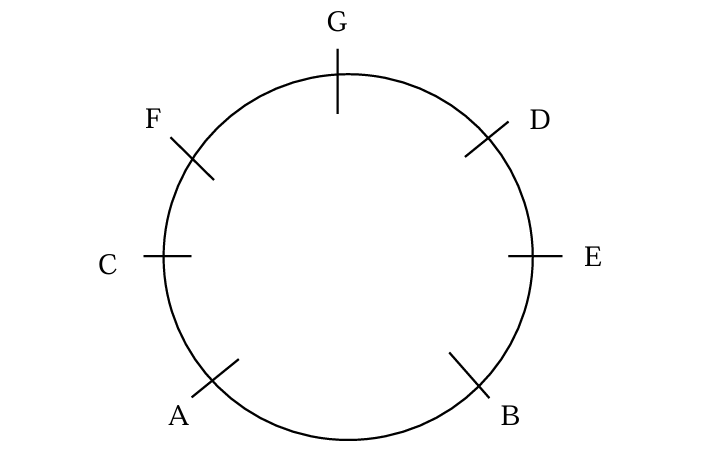
So Eshan (seat 1) is immediately to Bina's right. Option C (Aarav) is immediately to her left, from round 1.
Hence, option A (Eshan).
Q44MCQCircular Arrangement
Who is sitting third to the left of Eshan?
- AGaurav
- BChirag
- CDivya
- DAarav
Answer and solution
Answer: (B) Chirag
The children face the centre, so a child's right is the next seat anticlockwise. Number the seats 0 to 6 anticlockwise, with Bina on 0; right adds 1 or 2, left subtracts 1 or 2 (mod 7).
Round 1 (left) puts Aarav on 6; round 2 (second right) goes to 1; round 3 (right) puts Diya on 2. Round 6 (second left) goes from Aarav to 4, round 7 (left) puts Gaurav on 3, and round 8 (left) returns to Diya.
Chirag, Eshan and Farhan fill seats 1, 4 and 5. Farhan receives from Diya (round 9), and seat 5 is three away from seat 2, so Farhan is on 1 or 4. Chirag receives from Farhan (round 10), and seats 4 and 5 are both three away from seat 1, so Farhan is on 4, Chirag on 5 and Eshan on 1.
Eshan is on seat 1. Third to his left is seat
, i.e. seat 5: Chirag. Option D (Aarav, seat 6) is only second to his left, and option A (Gaurav, seat 3) is second to his right.
Hence, option B (Chirag).
Q45MCQCircular Arrangement
For which of the following pass types can the total number of occurrences be uniquely determined?
- AImmediately to the right
- BSecond to the right
- CSecond to the left
- DImmediately to the left
Answer and solution
Answer: (A) Immediately to the right
Facing the centre, a child's right is anticlockwise. Number seats 0 to 6 anticlockwise from Bina (0): a pass to the right adds, to the left subtracts (mod 7).
Round 1 (left) puts Aarav on 6; round 2 (second right) goes to 1; round 3 (right) puts Diya on 2. Round 6 (second left) goes from Aarav to 4, round 7 (left) puts Gaurav on 3, and round 8 (left) returns to Diya.
Chirag, Eshan and Farhan fill seats 1, 4 and 5. Farhan receives from Diya (round 9); seat 5 is three from seat 2, so Farhan is on 1 or 4. Chirag receives from Farhan (round 10); seats 4 and 5 are three away from seat 1, so Farhan is on 4, Chirag on 5 and Eshan on 1.
Rounds 9 and 10 are second right and right. In round 4 Diya passes to Eshan, Bina or Farhan, the only children within two seats of her and Aarav. Rounds 4 and 5 are then left and second left, second left and left, or second right twice.
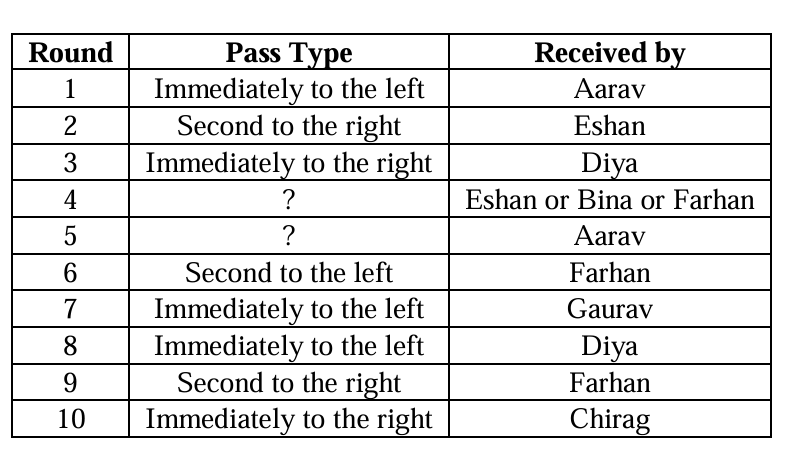
Only rounds 3 and 10 are 'immediately to the right': exactly 2. The others vary: second right 2 or 4, second left 1 or 2, immediately left 3 or 4.
Hence, option A (Immediately to the right).
Q46MCQCircular Arrangement
For which of the following children is it possible to determine how many times they received the Buck?
- ABina
- BEshan
- CFarhan
- DGaurav
Answer and solution
Answer: (D) Gaurav
The children face the centre, so a child's right is the next seat anticlockwise. Number the seats 0 to 6 anticlockwise, with Bina on 0; right adds 1 or 2, left subtracts 1 or 2 (mod 7).
Round 1 (left) puts Aarav on 6; round 2 (second right) goes to 1; round 3 (right) puts Diya on 2. Round 6 (second left) goes from Aarav to 4, round 7 (left) puts Gaurav on 3, and round 8 (left) returns to Diya.
Chirag, Eshan and Farhan fill seats 1, 4 and 5. Farhan receives from Diya (round 9), and seat 5 is three away from seat 2, so Farhan is on 1 or 4. Chirag receives from Farhan (round 10), and seats 4 and 5 are both three away from seat 1, so Farhan is on 4, Chirag on 5 and Eshan on 1.
The receivers are Aarav (rounds 1 and 5), Eshan (2), Diya (3 and 8), Farhan (6 and 9), Gaurav (7) and Chirag (10). Round 4 goes from Diya to a child who can pass to Aarav: Eshan, Bina or Farhan.
So Bina received the Buck 0 or 1 times, Eshan 1 or 2 and Farhan 2 or 3, but Gaurav exactly once.
Hence, option D (Gaurav).