- CATin
- CAT past papers
- CAT 2025 Slot 2
- DILR
CAT 2025 Slot 2 — DILR questions with answers
All 22 questions of the Data Interpretation & Logical Reasoning section (11 MCQs, 11 TITA, 5 sets). Try each one, then open its answer and solution.
CAT 2025 Slot 2, timed like the real exam (120 minutes, 40 a section) and scored the CAT way: +3 right, −1 for a wrong MCQ, 0 for a wrong TITA, with the full post-mock analysis. Free — sign in and you come straight back to this paper.
Sit this paper as a timed mock in CATin — freeData Interpretation & Logical Reasoning
CAT 2025 Slot 2 · 40 minutes · +3 for a right answer, −1 for a wrong MCQ, 0 for a wrong TITA
Data set
Set for questions 25–29
DIRECTIONS for questions 25-29: Read the information given below and answer the question(s) that follow(s).
Ananya Raga, Bhaskar Tala, Charu Veena, and Devendra Sur are four musicians. Each of them started and completed their training as students under each of three Gurus - Pandit Meghnath, Ustad Samiran, and Acharya Raghunath between 2013 and 2024, including both the years. Each Guru trains any student for consecutive years only, for a span of 2, 3, or 4 years, with each Guru having a different span. During some of these years, a student may not have trained under these Gurus; however, they never trained under multiple Gurus in the same year. In none of these years, any of these Gurus trained more than two of these students at the same time. When two students train under the same Guru at the same time, they are referred to as Gurubhai, irrespective of their gender.
The following additional facts are known.
1. Ustad Samiran never trained more than one of these students in the same year.
2. Acharya Raghunath did not train any of these students during 2015-2018, as well as during 2021-24.
3. Ananya and Devendra were never Gurubhai; neither were Bhaskar and Charu. All other pairs of musicians were Gurubhai for exactly 2 years.
4. In 2013, Ananya and Bhaskar started their trainings under Pandit Meghnath and under Ustad Samiran, respectively.
Q25MCQTeam Selection & Scheduling
In which of the following years were Ananya and Bhaskar Gurubhai?
- A2021
- B2018
- C2014
- D2020
Answer and solution
Answer: (D) 2020
Write A, B, C, D for the four musicians, and R, S, M for Raghunath, Samiran and Meghnath.
R teaches only in 2013–14 and 2019–20, so his span is 2 years, two students per window. In 2013 A is with M and B with S, so R has C and D in 2013–14 and A and B in 2019–20. That gives CD and AB their 2 Gurubhai years.
S teaches one at a time, so AC and BD share 2 years under M. A starts with M in 2013 while C is with R until 2014, so a 3-year span would give them at most one year. Hence M's span is 4 and S's is 3: A is with M in 2013–16, joined by C in 2015–16 (AD is barred; B is with S), and C stays till 2018.
B's only free 4-year stretch is 2021–24, his M span; D overlaps it by exactly 2 years with 2019–22.
Under S: B 2013–15, D 2016–18. A is free for 3 years only from 2021, so A takes 2022–24 and C 2019–21.
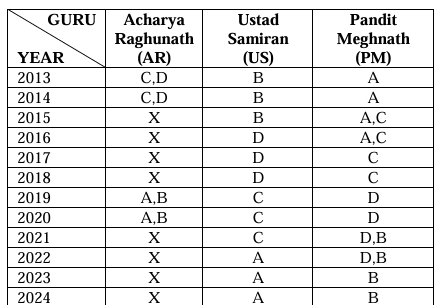
A and B are Gurubhai only under R in 2019–20. In 2014 A is with M and B with S; in 2018 neither trains; in 2021 B is with M but A is not training.
Hence, option D (2020).
Q26MCQTeam Selection & Scheduling
In which year did Charu begin her training under Pandit Meghnath?
- A2021
- B2015
- C2016
- D2017
Answer and solution
Answer: (B) 2015
Write A, B, C, D for the four musicians, and R, S, M for Raghunath, Samiran and Meghnath.
R teaches only in 2013–14 and 2019–20, so his span is 2 years, two students per window. In 2013 A is with M and B with S, so R has C and D in 2013–14 and A and B in 2019–20. That gives CD and AB their 2 Gurubhai years.
S teaches one at a time, so AC and BD share 2 years under M. A starts with M in 2013 while C is with R until 2014, so a 3-year span would give them at most one year. Hence M's span is 4 and S's is 3: A is with M in 2013–16, joined by C in 2015–16 (AD is barred; B is with S), and C stays till 2018.
B's only free 4-year stretch is 2021–24, his M span; D overlaps it by exactly 2 years with 2019–22.
Under S: B 2013–15, D 2016–18. A is free for 3 years only from 2021, so A takes 2022–24 and C 2019–21.
Charu's training under M runs from 2015 to 2018, so it began in 2015. Option C (2016) is its second year, when A and C were Gurubhai.
Hence, option B (2015).
Q27MCQTeam Selection & Scheduling
In which of the following years were Bhaskar and Devendra Gurubhai?
- A2018
- B2020
- C2015
- D2022
Answer and solution
Answer: (D) 2022
Write A, B, C, D for the four musicians, and R, S, M for Raghunath, Samiran and Meghnath.
R teaches only in 2013–14 and 2019–20, so his span is 2 years, two students per window. In 2013 A is with M and B with S, so R has C and D in 2013–14 and A and B in 2019–20. That gives CD and AB their 2 Gurubhai years.
S teaches one at a time, so AC and BD share 2 years under M. A starts with M in 2013 while C is with R until 2014, so a 3-year span would give them at most one year. Hence M's span is 4 and S's is 3: A is with M in 2013–16, joined by C in 2015–16 (AD is barred; B is with S), and C stays till 2018.
B's only free 4-year stretch is 2021–24, his M span; D overlaps it by exactly 2 years with 2019–22.
Under S: B 2013–15, D 2016–18. A is free for 3 years only from 2021, so A takes 2022–24 and C 2019–21.
B and D are Gurubhai only under M in 2021–22. In 2020 D is with M but B is with R; in 2015 and 2018 only one of them is training.
Hence, option D (2022).
Q28MCQTeam Selection & Scheduling
Which of the following statements is TRUE?
- AAnanya was training under Ustad Samiran in 2018.
- BCharu was training under Ustad Samiran in 2019.
- CAnanya was training under Ustad Samiran in 2015.
- DCharu was training under Ustad Samiran in 2018.
Answer and solution
Answer: (B) Charu was training under Ustad Samiran in 2019.
Write A, B, C, D for the four musicians, and R, S, M for Raghunath, Samiran and Meghnath.
R teaches only in 2013–14 and 2019–20, so his span is 2 years, two students per window. In 2013 A is with M and B with S, so R has C and D in 2013–14 and A and B in 2019–20. That gives CD and AB their 2 Gurubhai years.
S teaches one at a time, so AC and BD share 2 years under M. A starts with M in 2013 while C is with R until 2014, so a 3-year span would give them at most one year. Hence M's span is 4 and S's is 3: A is with M in 2013–16, joined by C in 2015–16 (AD is barred; B is with S), and C stays till 2018.
B's only free 4-year stretch is 2021–24, his M span; D overlaps it by exactly 2 years with 2019–22.
Under S: B 2013–15, D 2016–18. A is free for 3 years only from 2021, so A takes 2022–24 and C 2019–21.
Charu is with S in 2019. Options A and C fail, as Ananya is with S only in 2022–24; D fails, as Charu is with M in 2018.
Hence, option B (Charu was training under Ustad Samiran in 2019.).
Q29TITATeam Selection & Scheduling
In how many of the years between 2013-24, were only two of these four musicians training under these three Gurus?
Type in your answer (TITA). No negative mark for a wrong answer.
Answer and solution
Answer: 4
Write A, B, C, D for the four musicians, and R, S, M for Raghunath, Samiran and Meghnath.
R teaches only in 2013–14 and 2019–20, so his span is 2 years, two students per window. In 2013 A is with M and B with S, so R has C and D in 2013–14 and A and B in 2019–20. That gives CD and AB their 2 Gurubhai years.
S teaches one at a time, so AC and BD share 2 years under M. A starts with M in 2013 while C is with R until 2014, so a 3-year span would give them at most one year. Hence M's span is 4 and S's is 3: A is with M in 2013–16, joined by C in 2015–16 (AD is barred; B is with S), and C stays till 2018.
B's only free 4-year stretch is 2021–24, his M span; D overlaps it by exactly 2 years with 2019–22.
Under S: B 2013–15, D 2016–18. A is free for 3 years only from 2021, so A takes 2022–24 and C 2019–21.
All four train in 2013–14 and 2019–20, and three in 2015–16 and 2021–22. Only C and D train in 2017–18, and only A and B in 2023–24.
The answer is 4.
Data set
Set for questions 30–33
DIRECTIONS for questions 30-33: Read the information given below and answer the question that follows.
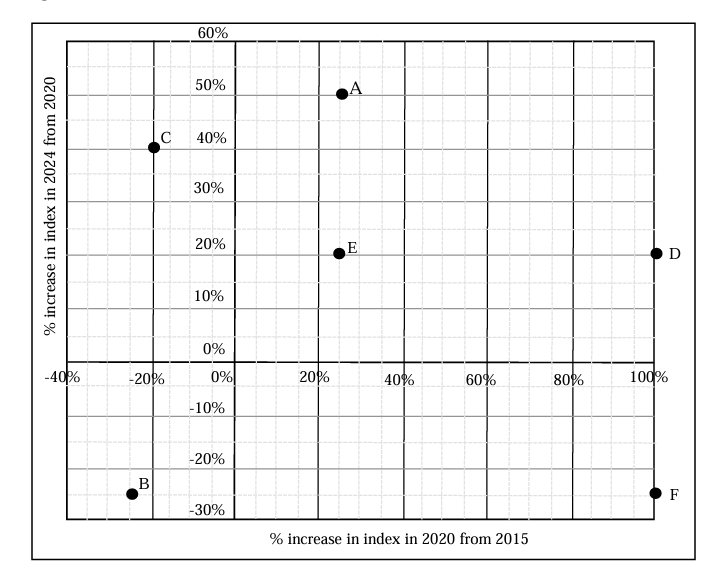
The Sustainability Index (SI) of a country at a point in time is an integer between 1 and 100. This question is related to SI of six countries - A, B, C, D, E, and F - at three different points in time - 2016, 2020, and 2024. The plot represents the exact changes in their SI, with X-coordinate representing % increase in 2020 from 2016, i.e., (SI in 2020 minus SI in 2016) / (SI in 2016), and Y-coordinate representing % increase in 2024 from 2020. At any point in time, the country with highest SI is ranked 1, while the country with the lowest SI is ranked 6. The following additional facts are known.
1. In 2016, B, C, E, and A had ranks 1, 2, 3, and 4 respectively.
2. F had lower SI than any other country in 2016, 2020, and 2024.
3. In 2024, E was the only country with SI of 90.
4. The range of SI of the six countries was 60 in 2016 as well as in 2024.
Q30TITAPie & Scatter Charts
What was the SI of E in 2016?
Type in your answer (TITA). No negative mark for a wrong answer.
Answer and solution
Answer: 60
In the plot, the x-coordinate is the % change in SI from 2016 to 2020 and the y-coordinate the % change from 2020 to 2024. E is at
.
By fact 3, E's SI in 2024 is 90. A 20% rise from 2020 to 2024 means
, so
.
A 25% rise from 2016 to 2020 means
, so
.
This fits fact 1, where E ranks third in 2016, below B and C. The table shows E's values alongside those of B and F, which follow from facts 2 and 4:
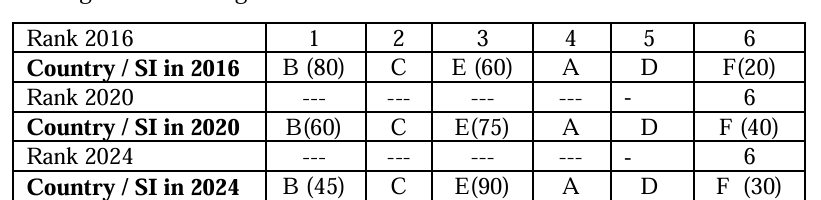
The answer is 60.
Q31TITAPie & Scatter Charts
What was the SI of F in 2020?
Type in your answer (TITA). No negative mark for a wrong answer.
Answer and solution
Answer: 40
In the plot, x is the % change from 2016 to 2020 and y the % change from 2020 to 2024: A
, B
, C
, D
, E
, F
.
E:
(fact 3), so
and
.
No country is above 90 in 2024. Every SI is an integer.
C:
, so
is a multiple of 25 between 60 and 100:
,
.
A:
with
a multiple of 8.
gives 105 (over 100) and
gives 90 (only E has 90), so
and
.
D:
with
and
a multiple of 5, so
and
.
B falls in both periods, to at most 56.
So the 2024 maximum is 90, and with a range of 60 the lowest, F, has 30. Then
.
The answer is 40.
Q32TITAPie & Scatter Charts
What was the SI of C in 2024?
Type in your answer (TITA). No negative mark for a wrong answer.
Answer and solution
Answer: 84
In the plot, C is at
: its SI fell 20% from 2016 to 2020 and rose 40% from 2020 to 2024.
Let C's SI in 2016 be
. Then
and
. Every SI is an integer, and 28 and 25 share no factor, so
is a multiple of 25.
E's point is
and its 2024 SI is 90 (fact 3), so
and
.
In 2016 C ranks second: above E (60) and below B, whose SI is at most 100. So
, and the only multiple of 25 there is 75.
Then
and
.
The answer is 84.
Q33MCQPie & Scatter Charts
What was the SI of B in 2024?
- A54
- B60
- C45
- D80
Answer and solution
Answer: (C) 45
In the plot, x is the % change from 2016 to 2020 and y the % change from 2020 to 2024. B is at
and F at
.
E is at
with
(fact 3), so
and
.
No country tops 90 in 2024 (every SI is an integer). C at
gives
, so
is a multiple of 25 between 60 and 100:
and
. A at
gives
with
a multiple of 8;
gives 105 and
gives 90, so A is at most 75. D at
gives
with
a multiple of 5, so at most 84. B falls.
With a 2024 range of 60, F has
, so
and
. The 2016 range of 60 then gives the top country
, so
and
.
Option B (60) is B's 2020 value and option D (80) its 2016 value.
Hence, option C (45).
Data set
Set for questions 34–38
DIRECTIONS for questions 34-38: Read the information given below and answer the question(s) that follow(s).
The two most populous cities and the non-urban region (NUR) of each of three states, Whimshire, Fogglia, and Humbleset, are assigned Pollution Measures (PMs). These nine PMs are all distinct multiples of 10, ranging from 10 to 90. The six cities in increasing order of their PMs are: Blusterburg, Noodleton, Splutterville, Quackford, Mumpypore, Zingaloo.
The Pollution Index (PI) of a state is a weighted average of the PMs of its NUR and cities, with a weight of 50% for the NUR, and 25% each for its two cities.
There is only one pair of an NUR and a city (considering all cities and all NURs) where the PM of the NUR is greater than that of the city. That NUR and the city both belong to Humbleset.
The PIs of all three states are distinct integers, with Humbleset and Fogglia having the highest and the lowest PI respectively.
Q34TITALogical Puzzles
What is the PI of Whimshire?
Type in your answer (TITA). No negative mark for a wrong answer.
Answer and solution
Answer: 45
Let the NURs of Whimshire, Fogglia and Humbleset have PMs
,
,
.
Only one NUR–city pair has the NUR higher, and both are in Humbleset. So
and
are below all six cities, and
is above exactly one city, which must be the lowest, Blusterburg, in Humbleset.
So
Blusterburg
the other cities: Blusterburg
,
,
, then Noodleton 50, Splutterville 60, Quackford 70, Mumpypore 80, Zingaloo 90.
PI
is an integer only if each state's cities sum to a multiple of 20. So Blusterburg's partner is 50, 70 or 90:
With 50:
, but the others get at least
, so Humbleset is not highest.
With 70:
; pairs (50, 90) and (60, 80) give the others 40 and 45, a tie.
With 90:
; pairs (50, 70) and (60, 80) with NURs 10 and 20 give 35 and 45 (swapped: 40 and 40, a tie).
So Whimshire has NUR 20 with Splutterville and Mumpypore (Fogglia, the lowest, has NUR 10 with Noodleton and Quackford).
.
The answer is 45.
Q35TITALogical Puzzles
What is the PI of Fogglia?
Type in your answer (TITA). No negative mark for a wrong answer.
Answer and solution
Answer: 35
Only one NUR–city pair has the NUR above the city, and both are in Humbleset. So Humbleset's NUR is above exactly one city, the lowest, Blusterburg, and the other NURs are below every city. The four smallest PMs therefore go to the Whimshire and Fogglia NURs (10 and 20), Blusterburg (30, in Humbleset) and Humbleset's NUR (40). The other cities are Noodleton 50, Splutterville 60, Quackford 70, Mumpypore 80 and Zingaloo 90.
, and NUR/2 is a whole number, so each state's two city PMs must add to a multiple of 4.
Humbleset's other city
needs
divisible by 4, so
is 50, 70 or 90. With 50, Humbleset's PI is 40 and the state holding 70 and 90 would beat it. With 70, both other pairs total 140, so one state ties Humbleset at 45. So
and Humbleset's PI is 50.
The remaining pairs are (50, 70) and (60, 80). NUR 10 with (50, 70) gives 35 and NUR 20 with (60, 80) gives 45; the other way round both are 40. So Fogglia's PI, the lowest, is 35.
The answer is 35.
Q36TITALogical Puzzles
What is the PI of Humbleset?
Type in your answer (TITA). No negative mark for a wrong answer.
Answer and solution
Answer: 50
Let the NURs of Whimshire, Fogglia and Humbleset have PMs
,
,
.
Only one NUR–city pair has the NUR higher, and both are in Humbleset. So
and
are below all six cities, and
is above exactly one city, which must be the lowest, Blusterburg, in Humbleset.
So
Blusterburg
the other cities: Blusterburg
,
,
, then Noodleton 50, Splutterville 60, Quackford 70, Mumpypore 80, Zingaloo 90.
PI
is an integer only if each state's cities sum to a multiple of 20. So Blusterburg's partner is 50, 70 or 90:
With 50:
, but the others get at least
, so Humbleset is not highest.
With 70:
; pairs (50, 90) and (60, 80) give the others 40 and 45, a tie.
With 90:
; pairs (50, 70) and (60, 80) with NURs 10 and 20 give 35 (Fogglia) and 45 (Whimshire); swapped, they give 40 and 40, a tie.
So Humbleset has NUR 40 with Blusterburg and Zingaloo:
.
The answer is 50.
Q37MCQLogical Puzzles
Which pair of cities definitely belong to the same state?
- ABlusterburg, Mumpypore
- BMumpypore, Zingaloo
- CNoodleton, Quackford
- DSplutterville, Quackford
Answer and solution
Answer: (C) Noodleton, Quackford
Let the NURs of Whimshire, Fogglia and Humbleset have PMs
,
,
.
Only one NUR–city pair has the NUR higher, and both are in Humbleset. So
and
are below all six cities, and
is above exactly one city, which must be the lowest, Blusterburg, in Humbleset.
So
Blusterburg
the other cities: Blusterburg
,
,
, then Noodleton 50, Splutterville 60, Quackford 70, Mumpypore 80, Zingaloo 90.
PI
is an integer only if each state's cities sum to a multiple of 20. So Blusterburg's partner is 50, 70 or 90:
With 50:
, but the others get at least
, so Humbleset is not highest.
With 70:
; pairs (50, 90) and (60, 80) give the others 40 and 45, a tie.
With 90:
; pairs (50, 70) and (60, 80) with NURs 10 and 20 give 35 and 45 (swapped: 40 and 40, a tie).
So Fogglia has Noodleton and Quackford; Whimshire, Splutterville and Mumpypore; Humbleset, Blusterburg and Zingaloo.
Option D fails: Splutterville is in Whimshire, Quackford in Fogglia. A and B pair Mumpypore (Whimshire) with a Humbleset city.
Hence, option C (Noodleton, Quackford).
Q38TITALogical Puzzles
For how many of the cities and NURs is it possible to identify their PM and the state they belong to?
Type in your answer (TITA). No negative mark for a wrong answer.
Answer and solution
Answer: 9
Let the NURs of Whimshire, Fogglia and Humbleset have PMs
,
,
.
Only one NUR–city pair has the NUR higher, and both are in Humbleset. So
and
are below all six cities, and
is above exactly one city, which must be the lowest, Blusterburg, in Humbleset.
So
Blusterburg
the other cities: Blusterburg
,
,
, then Noodleton 50, Splutterville 60, Quackford 70, Mumpypore 80, Zingaloo 90.
PI
is an integer only if each state's cities sum to a multiple of 20. So Blusterburg's partner is 50, 70 or 90:
With 50:
, but the others get at least
, so Humbleset is not highest.
With 70:
; pairs (50, 90) and (60, 80) give the others 40 and 45, a tie.
With 90:
; pairs (50, 70) and (60, 80) with NURs 10 and 20 give 35 and 45 (swapped: 40 and 40, a tie).
Only the last works: Humbleset NUR 40, Blusterburg 30, Zingaloo 90; Fogglia NUR 10, Noodleton 50, Quackford 70; Whimshire NUR 20, Splutterville 60, Mumpypore 80.
So all 6 cities and 3 NURs are fully identified.
The answer is 9.
Data set
Set for questions 39–42
DIRECTIONS for questions 39-42: Read the information given below and answer the question that follows.
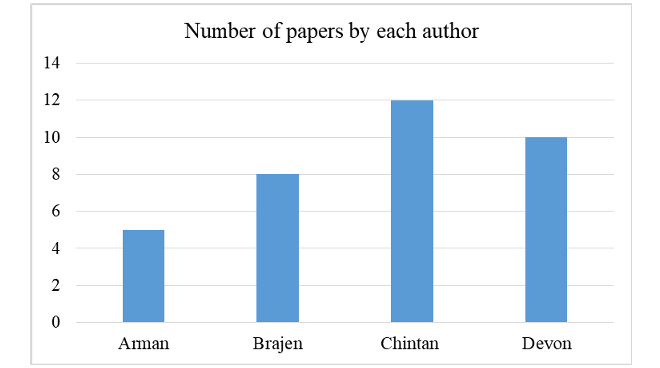
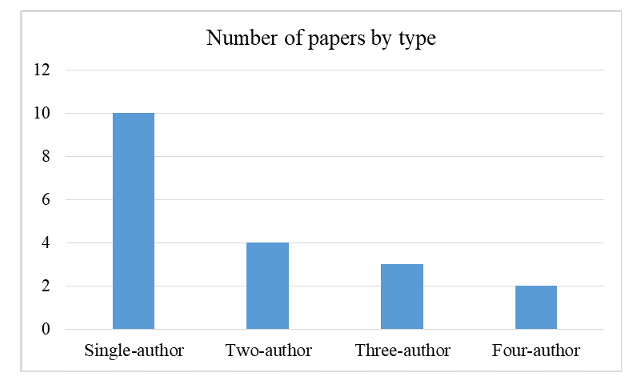
The following charts depict details of research papers written by four authors, Arman, Brajen, Chintan, and Devon. The papers were of four types, singleauthor, two-author, three-author, and four-author, that is, written by one, two, three, or all four of these authors, respectively. No other authors were involved in writing these papers.
The following additional facts are known.
1. Each of the authors wrote at least one of each of the four types of papers.
2. The four authors wrote different numbers of single-author papers.
3. Both Chintan and Devon wrote more three-author papers than Brajen
4. The number of single-author and two-author papers written by Brajen were the same.
Q39TITA
What was the total number of two-author and three-author papers written by Brajen?
Type in your answer (TITA). No negative mark for a wrong answer.
Answer and solution
Answer: 4
From the charts: Arman wrote 5 papers, Brajen 8, Chintan 12 and Devon 10; there were 10 single-, 4 two-, 3 three- and 2 four-author papers.
Every four-author paper includes all four authors, so each author wrote 2 of them.
Arman's other
papers cover the three remaining types, at least one each, so Arman wrote exactly 1 three-author paper.
The 3 three-author papers have
author places, so Brajen, Chintan and Devon fill 8. Nobody can be on more than 3, and Chintan and Devon each exceed Brajen (fact 3). Brajen cannot have 3, and with 1 the other two would need 7 places, more than
. So Brajen wrote 2 (Chintan and Devon 3 each).
Brajen's single- and two-author papers total
and are equal (fact 4), so he wrote 2 of each.
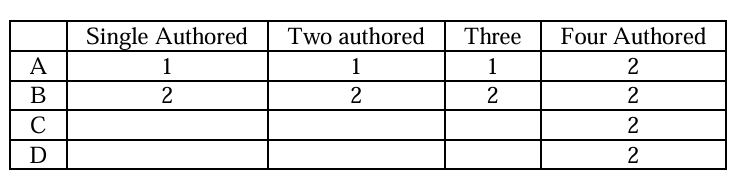
Brajen's two-author plus three-author papers:
.
The answer is 4.
Q40MCQ
Which of the following statements is/are NECESSARILY true? i. Chintan wrote exactly three two-author papers. ii. Chintan wrote more single-author papers than Devon.
- AOnly ii
- BBoth i and ii
- CNeither i nor ii
- DOnly i
Answer and solution
Answer: (C) Neither i nor ii
From the charts: Arman wrote 5 papers, Brajen 8, Chintan 12, Devon 10; there were 10 single-, 4 two-, 3 three- and 2 four-author papers.
Every author is on both four-author papers, so Arman's other 3 papers are one of each other type. The 9 three-author places then split Arman 1, Brajen 2, Chintan 3, Devon 3 (Chintan and Devon above Brajen, nobody above 3). Brajen's other 4 papers are 2 single and 2 two-author (fact 4).
The four single-author counts are distinct and total 10, so they are 1, 2, 3, 4; Chintan and Devon have 3 and 4 in some order. Chintan's single plus two-author papers total
, Devon's
. Both orders work (two-author places total 8 either way):
Case 1: Chintan 3 single, 4 two-author; Devon 4 single, 1 two-author.
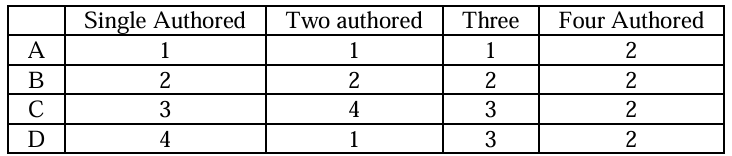
Case 2: Chintan 4 single, 3 two-author; Devon 3 single, 2 two-author.
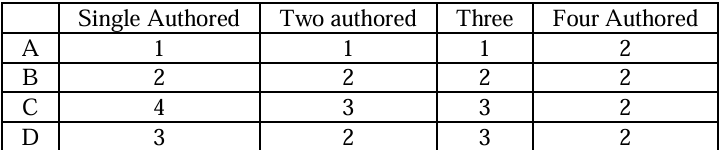
Statement i (Chintan wrote three two-author papers) and statement ii (Chintan wrote more single-author papers than Devon) both hold only in Case 2. Case 1 breaks both, so neither is necessarily true; options A, B and D each need at least one of them.
Hence, option C (Neither i nor ii).
Q41MCQ
Which of the following statements is/are NECESSARILY true? i. Arman wrote three-author papers only with Chintan and Devon. ii. Brajen wrote three-author papers only with Chintan and Devon.
- AOnly I
- BNeither i or ii
- COnly ii
- DBoth i and ii
Answer and solution
Answer: (D) Both i and ii
From the charts: Arman wrote 5 papers, Brajen 8, Chintan 12, Devon 10; there were 3 three-author and 2 four-author papers.
Every author is on both four-author papers. Arman's other 3 papers must then be one single, one two-author and one three-author paper, since each type needs at least one.
The 3 three-author papers have
author places. Arman takes 1, leaving 8 for Brajen, Chintan and Devon, with nobody above 3 and Chintan and Devon each above Brajen (fact 3). Brajen cannot have 3, and with 1 the other two would need 7 places, more than
. So Brajen 2, Chintan 3, Devon 3.
The two possible full tables differ only in single- and two-author counts; the three-author column is 1, 2, 3, 3 in both.
Chintan and Devon are on all 3 three-author papers, so each such paper is Chintan, Devon and one more author: Arman once, Brajen twice. The papers are {Arman, Chintan, Devon} and {Brajen, Chintan, Devon} twice.
So both statements are true. Options A and C each leave out a statement that holds.
Hence, option D (Both i and ii).
Q42TITA
If Devon wrote more than one two-author papers, then how many two-author papers did Chintan write?
Type in your answer (TITA). No negative mark for a wrong answer.
Answer and solution
Answer: 3
From the charts: Arman wrote 5 papers, Brajen 8, Chintan 12, Devon 10; there were 10 single-, 4 two-, 3 three- and 2 four-author papers.
Every author is on both four-author papers, so Arman's other 3 papers are one of each other type. The 9 three-author places then split Arman 1, Brajen 2, Chintan 3, Devon 3 (Chintan and Devon above Brajen, nobody above 3). Brajen's other 4 papers are 2 single and 2 two-author (fact 4).
The four single-author counts are distinct and total 10, so they are 1, 2, 3, 4, and Chintan and Devon have 3 and 4. Devon's single plus two-author papers total
, and Chintan's total
.
If Devon wrote more than one two-author paper, Devon cannot have 4 singles, which would leave only 1 two-author paper. So Devon has 3 singles and 2 two-author papers, and Chintan has 4 singles and
two-author papers.
Check: two-author places
.
The answer is 3.
Data set
Set for questions 43–46
DIRECTIONS for questions 43-46: Read the information given below and answer the question(s) that follow(s).
There are six spherical balls, B1, B2, B3, B4, B5, and B6, and four circular hoops H1, H2, H3, and H4. Each ball was tested on each hoop once, by attempting to pass the ball through the hoop. If the diameter of a ball is not larger than the diameter of the hoop, the ball passes through the hoop and makes a "ping". Any ball having a diameter larger than that of the hoop gets stuck on that hoop and does not make a ping.
The following additional information is known:
1. B1 and B6 each made a ping on H4, but B5 did not.
2. B4 made a ping on H3, but B1 did not.
3. All balls, except B3, made pings on H1.
4. None of the balls, except B2, made a ping on H2.
Q43TITALogical Puzzles
What was the total number of pings made by B1, B2, and B3?
Type in your answer (TITA). No negative mark for a wrong answer.
Answer and solution
Answer: 6
A ball pings on a hoop exactly when it is not larger than the hoop.
Fact 3: every ball but B3 passes H1, so B3 is larger than every other ball. Fact 4: only B2 passes H2, so B2 is the smallest.
On H3, B4 passes and B1 does not, so
. On H4, B1 and B6 pass but B5 does not, so
and
.
So
and
.
This fills the table: B3 fails H3 and H4 (it is larger than B1 and B5, which fail there); B2 passes H3 and H4 (it is smaller than B4 and B1, which pass); B4 passes H4 (smaller than B1); B5 fails H3 (larger than B1). Only B6 on H3 stays open.
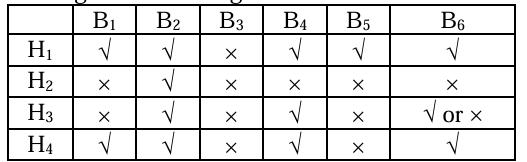
B1 pings on H1 and H4 (2), B2 on all four hoops (4), and B3 on none (0).
Total
.
The answer is 6.
Q44MCQLogical Puzzles
Which of the following statements about the relative sizes of the balls is NOT NECESSARILY true?
- AB1 < B6 < B3
- BB2 < B1 < B5
- CB4 < B5 < B3
- DB1 < B5 < B3
Answer and solution
Answer: (A) B1 < B6 < B3
A ball pings on a hoop exactly when it is not larger than the hoop.
Fact 3: every ball but B3 passes H1, so B3 is larger than every other ball. Fact 4: only B2 passes H2, so B2 is the smallest.
On H3, B4 passes and B1 does not, so
. On H4, B1 and B6 pass but B5 does not, so
and
.
So
and
, with B6 never compared with B1 or B4.
Options B, C and D follow from the chain:
,
and
are all certain.
Option A needs
, but B6 is only known to be below B5. It could be smaller than B4 (then it passes H3) or lie between B1 and B5 (then it does not), and every fact still holds. So
is not necessarily true.
Hence, option A (B1 < B6 < B3).
Q45MCQLogical Puzzles
Which of the following statements about the relative sizes of the hoops is true?
- AH2 < H4 < H3 < H1
- BH2 < H3 < H4 < H1
- CH1 < H3 < H4 < H2
- DH1 < H4 < H3 < H2
Answer and solution
Answer: (B) H2 < H3 < H4 < H1
A ball pings on a hoop exactly when it is not larger than the hoop. So if a ball passes one hoop but gets stuck on another, the first hoop is the larger.
B4 passes H3 (fact 2) but not H2 (fact 4):
.
B1 passes H4 (fact 1) but not H3 (fact 2):
.
B5 passes H1 (fact 3) but not H4 (fact 1):
.
So
.
The completed table agrees: H2 gets 1 ping (B2), H3 gets 2 or 3 (B2, B4 and perhaps B6), H4 gets 4 (B1, B2, B4, B6) and H1 gets 5 (all but B3). A larger hoop lets through every ball a smaller one does.
Option A swaps H3 and H4, but B1 passes H4 and not H3, so H4 is the larger. Options C and D put H1 below H2, but H2 is the smallest hoop and H1 the largest.
Hence, option B (H2 < H3 < H4 < H1).
Q46MCQLogical Puzzles
What BEST can be said about the total number of pings from all the tests undertaken?
- A12 or 13 or 14
- B13 or 14
- CAt least 9
- D12 or 13
Answer and solution
Answer: (D) 12 or 13
A ball pings on a hoop exactly when it is not larger than the hoop.
Fact 3: every ball but B3 passes H1, so B3 is the largest. Fact 4: only B2 passes H2, so B2 is the smallest. On H3, B4 passes and B1 does not, so
. On H4, B1 and B6 pass but B5 does not, so
and
.
So B3 fails H3 and H4 (larger than B1 and B5), B2 passes H3 and H4 (smaller than B4 and B1), B4 passes H4 (smaller than B1), and B5 fails H3 (larger than B1).
Pings: H1 5, H2 1, H4 4 (B1, B2, B4, B6), H3 2 (B2, B4) plus B6 if it fits.
B6 only has to lie between B2 and B5, so it can be smaller than B4 (a ping on H3) or larger than B1 (no ping). Both are possible.
Total
, or 13 with B6's ping.
Option A adds 14, but B6 on H3 is the only open test. Option C (at least 9) is true but not the best.
Hence, option D (12 or 13).