- CATin
- CAT past papers
- CAT 2025 Slot 1
- QA
CAT 2025 Slot 1 — QA questions with answers
All 22 questions of the Quantitative Ability section (14 MCQs, 8 TITA). Try each one, then open its answer and solution.
CAT 2025 Slot 1, timed like the real exam (120 minutes, 40 a section) and scored the CAT way: +3 right, −1 for a wrong MCQ, 0 for a wrong TITA, with the full post-mock analysis. Free — sign in and you come straight back to this paper.
Sit this paper as a timed mock in CATin — freeQuantitative Ability
CAT 2025 Slot 1 · 40 minutes · +3 for a right answer, −1 for a wrong MCQ, 0 for a wrong TITA
Q47MCQRatios, Proportions & Partnership
The ratio of the number of students in the morning shift and afternoon shift of a school was 13 : 9. After 21 students moved from the morning shift to the afternoon shift, this ratio became 19 : 14. Next, some new students joined the morning and afternoon shifts in the ratio 3 : 8 and then the ratio of the number of students in the morning shift and the afternoon shift became 5 : 4. The number of new students who joined is
- A110
- B121
- C88
- D99
Answer and solution
Answer: (D) 99
Let the shifts start with
(morning) and
(afternoon) students.
After 21 students move,
, so
, i.e.
. Then
and
.
The shifts now have
and
students.
Let
new students join the morning shift and
the afternoon shift:
, so
, giving
and
.
Check: the shifts become
and
, and
.
New students
.
Every option is a multiple of 11, so each could be split
; only
gives
. For option A (110),
gives
, and
.
Hence, option D (99).
Q48MCQLogarithms
The number of distinct integers
for which
is
- A0
- B1
- CInfinite
- D2
Answer and solution
Answer: (A) 0
The base lies between 0 and 1, so exactly when . Both halves matter: the upper bound, and the requirement that the argument be positive at all.
Upper bound. , so . The only integers are and .
Positivity. has roots , about and , so the expression is positive only for or . This overlaps the first range only on and , which contain no integers, so it excludes both and .
Checking the two candidates directly: at , ; at , . Both are negative, so the logarithm is undefined at both and neither qualifies.
The two conditions have no integer in common, so the count is — option A.
Q49MCQPolygons & Circles
In a circle with center C and radius
cm, PQ and SR are two parallel chords separated by one of the diameters. If
, and the ratio of the perpendicular distance of PQ and SR from C is 3:2, then the area, in sq. cm, of the quadrilateral PQRS is
- A
- B
- C
- D
Answer and solution
Answer: (A)
CP and CQ are radii, so triangle PCQ is isosceles. With
, we get
.
Let M and N be the feet of the perpendiculars from C to PQ and SR; they bisect the chords. In right triangle CMQ the angle at Q is
, so
cm. Hence
cm.
The distances are in the ratio
, so
cm. Then
cm, and
cm.
A diameter separates the chords, so they lie on opposite sides of C, and the distance between them is
cm.
PQRS is a trapezium with parallel sides PQ and SR:
Area
sq. cm.
Option B,
, comes from placing both chords on the same side of C, which gives a height of
cm instead of 10 cm.
Hence, option A (
).
Q50MCQAverages, Mixtures & Alligations
A container holds 200 litres of a solution of acid and water, having 30% acid by volume. Atul replaces 20% of this solution with water, then replaces 10% of the resulting solution with acid, and finally replaces 15% of the solution thus obtained, with water. The percentage of acid by volume in the final solution obtained after these three replacements, is nearest to
- A27
- B25
- C29
- D23
Answer and solution
Answer: (A) 27
The container starts with 200 L, of which
, or 60 L, is acid. Each step removes some solution and adds back the same volume, so the total stays 200 L.
Step 1: removing
of the solution removes
of the acid, leaving
L. Water is added, so the acid stays 48 L (
).
Step 2: removing 20 L (
) leaves
L of acid; then 20 L of acid is added, giving
L (
).
Step 3: removing 30 L (
) leaves
L of acid, and water is added.
Final acid percentage
.
This is
away from 27 but
away from 25 (option B), the next-closest option, and further still from 29 and 23.
Hence, option A (27).
Q51MCQTime, Speed & Distance
Shruti travels a distance of 224 km in four parts for a total travel time of 3 hours. Her speeds in these four parts follow an arithmetic progression, and the corresponding time taken to cover these four parts follow another arithmetic progression. If she travels at a speed of 960 meters per minute for 30 minutes to cover the first part, then the distance, in meters, she travels in the fourth part is
- A76800
- B112000
- C86400
- D96000
Answer and solution
Answer: (C) 86400
Work in metres and minutes: the total distance is 224000 m and the total time 180 min.
The first part takes 30 min at 960 m/min, covering
m.
The times form an AP with first term 30 and sum 180:
, so
and the times are 30, 40, 50 and 60 min.
Let the speeds be
,
,
and
. Then
, so
.
The speeds are 960, 1120, 1280 and 1440 m/min, giving distances 28800, 44800, 64000 and 86400 m, which add to 224000 m.
The fourth part covers
m.
Option A (76800) is
: it uses the third part's speed with the fourth part's time.
Hence, option C (86400).
Q52TITAInequalities & Modulus
The number of distinct pairs of integers
satisfying the inequalities
and
is
Type in your answer (TITA). No negative mark for a wrong answer.
Answer and solution
Answer: 16
We need integers with
and
.
Since
, we get
, so
and
. So
is 3, 4, 5 or 6.
For each
,
runs over the integers with
:
:
, so
(7 pairs).
:
, so
(5 pairs).
:
, so
(3 pairs).
:
, so
(1 pair).
Total
.
The answer is 16.
Q53MCQFunctions & Graphs
Let
and
, where
is the greatest integer not exceeding
. If set
represents all feasible values of
, then a possible subset of
is
- A
- B
- C
- D
Answer and solution
Answer: (A)
Take each value of
in turn.
: we need
, i.e.
, so
.
: we need
, so
.
: we need
, so
.
:
, which works.
So
.
A:
lies inside
, so it is a subset.
B and C both contain
, which is not in
(
).
D contains numbers between
and
, which are not in
.
The answer is A.
Q54TITAAverages, Mixtures & Alligations
Kamala divided her investment of Rs 100000 between stocks, bonds, and gold. Her investment in bonds was 25% of her investment in gold. With annual returns of 10%, 6%, 8% on stocks, bonds, and gold, respectively, she gained a total amount of Rs 8200 in one year. The amount, in rupees, that she gained from the bonds, was
Type in your answer (TITA). No negative mark for a wrong answer.
Answer and solution
Answer: 900
Let investment in stocks be , bonds be , gold be .
and .
Total return = .
Substitute and :
.
Then .
Gain from bonds = rupees.
Q55MCQSimple & Compound Interest
At a certain simple rate of interest, a given sum amounts to Rs.13920 in 3 years, and to Rs 18960 in 6 years and 6 months. If the same given sum had been invested for 2 years at the same rate as before but with interest compounded every 6 months, then the total interest earned, in rupees, would have been nearest to
- A3221
- B3180
- C3150
- D3096
Answer and solution
Answer: (A) 3221
Let principal be , simple rate .
Difference in interest for 3.5 years = .
Simple interest per year = .
Interest for 3 years = .
Principal .
Rate .
If compounded semi-annually for 2 years at 15% p.a., rate per period is 7.5% and number of periods is 4.
Amount .
Total CI earned = .
Q56MCQPermutations & Combinations
A cafeteria offers 5 types of sandwiches. Moreover, for each type of sandwich, a customer can choose one of 4 breads and opt for either small or large sized sandwich. Optionally, the customer may also add up to 2 out of 6 available sauces. The number of different ways in which an order can be placed for a sandwich, is
- A840
- B800
- C880
- D600
Answer and solution
Answer: (C) 880
The customer chooses a sandwich type (5 ways), a bread (4 ways) and a size (2 ways).
Sauces are optional, up to 2 of the 6:
no sauce: 1 way; one sauce:
ways; two sauces:
ways.
So there are
sauce choices.
Number of orders
.
Option A (840) is
: it leaves out the order with no sauce, which the word 'optionally' allows.
Hence, option C (880).
Q57MCQTime & Work
Arun, Varun and Tarun, if working alone, can complete a task in 24, 21, and 15 days, respectively. They charge Rs 2160, Rs 2400, and Rs 2160 per day, respectively, even if they are employed for a partial day. On any given day, any of the workers may or may not be employed to work. If the task needs to be completed in 10 days or less, then the minimum possible amount, in rupees, required to be paid for the entire task is
- A47040
- B38880
- C34400
- D38400
Answer and solution
Answer: (D) 38400
Cost of the whole task if one person did it alone: Arun
, Varun
, Tarun
.
When a share of the work takes whole days, its cost is that share of the worker's whole-task cost. So give as much work as possible to the cheapest worker, Tarun, and the rest to the next cheapest, Varun.
In 10 days Tarun does
of the task for
.
The remaining
takes Varun
whole days, working alongside Tarun within the 10 days, for
.
Total
rupees.
Option B (38880) uses Arun for the last third instead:
days cost
, which is 480 more.
Hence, option D (38400).
Q58TITAQuadratic & Polynomial Equations
The number of non-negative integer values of
for which the quadratic equation
has only integer roots, is
Type in your answer (TITA). No negative mark for a wrong answer.
Answer and solution
Answer: 3
Let the integer roots be
and
. Then
and
.
We need
. Both roots cannot be negative, since they add to 5. If one were negative, the other would exceed 5 and the product would be negative. So both roots are non-negative integers adding to 5.
The unordered pairs are:
, giving
;
, giving
;
, giving
.
Swapping the roots gives the same
. So
can be 0, 4 or 6: three values.
The answer is 3.
Q59MCQCoordinate Geometry
The
coordinates of vertices P, Q and R of a parallelogram PQRS are
,
and
, respectively. If the diagonal SQ intersects the x-axis at
, then the value of
is
- A
- B
- C
- D
Answer and solution
Answer: (B)
The diagonals of a parallelogram bisect each other, so the midpoint M of PR is also the midpoint of SQ.
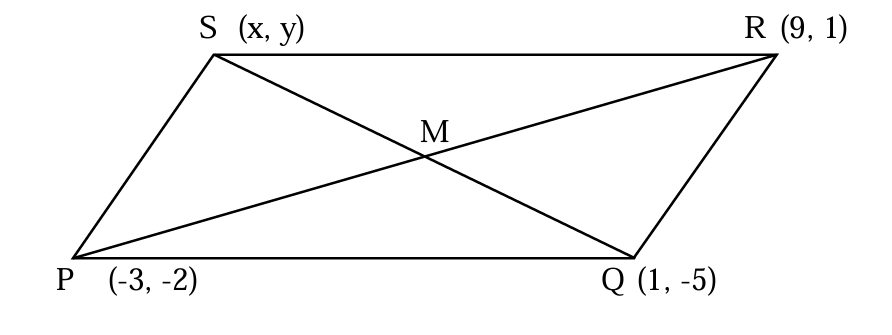
Midpoint of PR
.
If
, then
and
, so
.
Slope of SQ
, so the line through
is
.
On the x-axis
:
, so
and
.
The options are close together, so check the nearest one. Option C,
, gives
on line SQ, not 0.
Hence, option B (
).
Q60TITADigits & Base Systems
In a 3-digit number
, the digits are non-zero and distinct such that none of the digits is a perfect square, and only one of the digits is a prime number. Then, the number of factors of the minimum possible value of
is
Type in your answer (TITA). No negative mark for a wrong answer.
Answer and solution
Answer: 6
The digits of are non-zero (1 to 9), distinct, and none are perfect squares.
Allowed digits (not 1, 4, 9) = .
Exactly one digit must be prime. The primes in the set are . The non-primes are .
To form a 3-digit number, we need two non-primes and one prime. So the digits must be 6, 8, and one prime.
To minimize the number, we place the smallest digit at the hundreds place. The smallest prime is 2.
So the digits are 2, 6, 8. The minimum possible number is 268.
Prime factorization of 268 = .
Number of factors = .
Q61TITALinear Equations
Stocks A, B and C are priced at rupees 120, 90 and 150 per share, respectively. A trader holds a portfolio consisting of 10 shares of stock A, and 20 shares of stocks B and C put together. If the total value of her portfolio is rupees 3300, then the number of shares of stock B that she holds, is
Type in your answer (TITA). No negative mark for a wrong answer.
Answer and solution
Answer: 15
Price of stocks A, B, C: 120, 90, 150. Shares of A = 10. Shares of B+C = 20.
Value of A shares = .
Total value = 3300. Value of B and C shares = .
Let shares of B be and shares of C be . .
Value of B and C = .
.
Q62MCQLinear Equations
If
and
, where
and
are real numbers, the value of
is
- A18
- B15
- C20
- D14
Answer and solution
Answer: (A) 18
Label the equations
(1) and
(2).
From (2),
, so the required value is
. We only need
.
Doubling (2) gives
. Adding (1) cancels
and
:
, so
.
Then
.
Check:
, and (1) gives
, as required.
Option D (14) is
, a sign slip.
Hence, option A (18).
Q63MCQQuadratic & Polynomial Equations
A value of
for which the minimum value of
is greater than the maximum value of
, is
- A
- B
- C
- D
Answer and solution
Answer: (D)
The minimum of
is at
:
.
The maximum of
is at
:
.
We need
, i.e.
, i.e.
, so
.
Of the options
,
,
and
, only
lies between
and
(
is too large, and the negative values fail). The answer is
.
Q64TITALinear Equations
In a class, there were more than 10 boys and a certain number of girls. After 40% of the girls and 60% of the boys left the class, the remaining number of girls was 8 more than the remaining number of boys. Then, the minimum possible number of students initially in the class was
Type in your answer (TITA). No negative mark for a wrong answer.
Answer and solution
Answer: 55
Let initial number of boys be and girls be .
Remaining girls = . Remaining boys = .
Given: .
Since 40% of girls and 60% of boys left, must be a multiple of 5, and must be a multiple of 5.
Let and .
.
We need to minimize , so minimize .
Given .
If , (not div by 3).
If , (not div by 3).
If , .
Minimum students = .
Q65MCQSequences & Series
In the set of consecutive odd numbers
, there is a number
such that the sum of all the elements less than
is equal to the sum of all the elements greater than
. Then,
equals
- A43
- B37
- C39
- D41
Answer and solution
Answer: (D) 41
The set
has
terms. The sum of the first
odd numbers is
, so the total is
.
Let
be the
-th term, so
and the terms before it add to
. The terms after it must add to the same amount:
, so
, i.e.
and
.
So
. Check: below 41 the sum is
; above it,
.
Option C (39) is the 20th term: the sum below it is
, but the sum above it is
.
Hence, option D (41).
Q66TITAProfit, Loss & Discount
A shopkeeper offers a discount of 22% on the marked price of each chair, and gives 13 chairs to a customer for the discounted price of 12 chairs to earn a profit of 26% on the transaction. If the cost price of each chair is Rs 100, then the marked price, in rupees, of each chair is
Type in your answer (TITA). No negative mark for a wrong answer.
Answer and solution
Answer: 175
Let the marked price of one chair be . Cost price = 100.
Total CP for 13 chairs = .
Profit is 26%, so Total SP = .
Customer buys 13 chairs for the discounted price of 12 chairs.
Discounted price per chair = .
Total amount paid by customer = .
This must equal the total SP: .
Q67TITAPolygons & Circles
If the length of a side of a rhombus is 36 cm and the area of the rhombus is 396 sq. cm, then the absolute value of the difference between the lengths, in cm, of the diagonals of the rhombus is
Type in your answer (TITA). No negative mark for a wrong answer.
Answer and solution
Answer: 60
Side of rhombus cm, Area = 396 sq cm.
Area = .
Also, .
We need .
.
.
Q68MCQSequences & Series
For any natural number
, let
. The smallest natural number
for which
, is
- A57
- B56
- C59
- D58
Answer and solution
Answer: (D) 58
Since
,
.
Left side:
, because
.
Right side:
. This AP has
terms, so its sum is
.
We need
, i.e.
.
The positive root of
is
, so check the integers on either side:
:
, so the inequality fails.
:
, so it holds.
Option A (57) falls just short: its exponent is
, below
.
Hence, option D (58).