- CATin
- CAT past papers
- CAT 2025 Slot 1
- DILR
CAT 2025 Slot 1 — DILR questions with answers
All 22 questions of the Data Interpretation & Logical Reasoning section (11 MCQs, 11 TITA, 5 sets). Try each one, then open its answer and solution.
CAT 2025 Slot 1, timed like the real exam (120 minutes, 40 a section) and scored the CAT way: +3 right, −1 for a wrong MCQ, 0 for a wrong TITA, with the full post-mock analysis. Free — sign in and you come straight back to this paper.
Sit this paper as a timed mock in CATin — freeData Interpretation & Logical Reasoning
CAT 2025 Slot 1 · 40 minutes · +3 for a right answer, −1 for a wrong MCQ, 0 for a wrong TITA
Data set
Set for questions 25–29
DIRECTIONS for questions 25-29: Read the information given below and answer the question(s) that follow(s).
A train travels from Station A to Station E, passing through stations B, C, and D, in that order. The train has a seating capacity of 200. A ticket may be booked from any station to any other station ahead on the route, but not to any earlier station. A ticket from one station to another reserves one seat on every intermediate segment of the route. For example, a ticket from B to E reserves a seat in the intermediate segments B – C, C – D, and D – E. The occupancy factor for a segment is the total number of seats reserved in the segment as a percentage of the seating capacity. The total number of seats reserved for any segment cannot exceed 200.
The following information is known.
1. Segment C – D had an occupancy factor of 95%. Only segment B – C had a higher occupancy factor.
2. Exactly 40 tickets were booked from B to C and 30 tickets were booked from B to E.
3. Among the seats reserved on segment D – E, exactly four-sevenths were from stations before C.
4. The number of tickets booked from A to C was equal to that booked from A to E, and it was higher than that from B to E.
5. No tickets were booked from A to B, from B to D and from D to E.
6. The number of tickets booked for any segment was a multiple of 10.
Q25MCQTables & Caselets
What was the occupancy factor for segment D – E?
- A35%
- B70%
- C84%
- D77%
Answer and solution
Answer: (B) 70%
Let
be the tickets from A to B, C, D, E;
from B to C, D, E;
from C to D, E; and
from D to E.
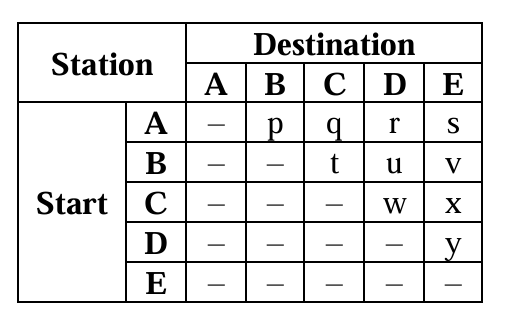
Points 2 and 5 give
,
and
. Point 4 gives
.
D–E carries
seats, of which
are from A or B. By point 3,
, so
. All counts are multiples of 10:
give
, and
gives
but
seats on D–E (larger
is worse). So
and
.
C–D carries 95% of 200, i.e. 190 seats:
, so
.
Only B–C is fuller, so it carries more than 190 seats, a multiple of 10 not above 200, i.e. 200:
gives
, so
and
.
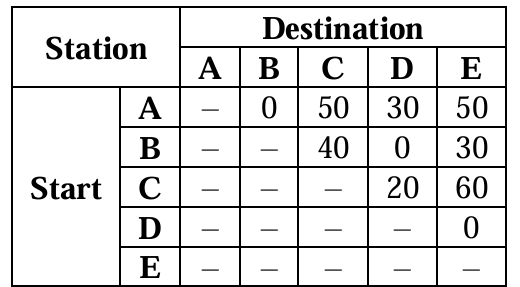
D–E carries
seats, so its occupancy factor is
. The other options would need 70, 168 or 154 seats on D–E.
Hence, option B (70%).
Q26TITATables & Caselets
How many tickets were booked from Station A to Station E?
Type in your answer (TITA). No negative mark for a wrong answer.
Answer and solution
Answer: 50
Let
be the tickets from A to B, C, D, E;
from B to C, D, E;
from C to D, E; and
from D to E.
Points 2 and 5 give
,
and
. Point 4 gives
.
D–E carries
seats, of which
are from A or B. By point 3,
, so
. All counts are multiples of 10:
give
, and
gives
but
seats on D–E (larger
is worse). So
and
.
C–D carries 95% of 200, i.e. 190 seats:
, so
.
Only B–C is fuller, so it carries more than 190 seats, a multiple of 10 not above 200, i.e. 200:
gives
, so
and
.
The tickets from A to E number
.
The answer is 50.
Q27TITATables & Caselets
How many tickets were booked from Station C?
Type in your answer (TITA). No negative mark for a wrong answer.
Answer and solution
Answer: 80
Let
be the tickets from A to B, C, D, E;
from B to C, D, E;
from C to D, E; and
from D to E.
Points 2 and 5 give
,
and
. Point 4 gives
.
D–E carries
seats, of which
are from A or B. By point 3,
, so
. All counts are multiples of 10:
give
, and
gives
but
seats on D–E (larger
is worse). So
and
.
C–D carries 95% of 200, i.e. 190 seats:
, so
.
Only B–C is fuller, so it carries more than 190 seats, a multiple of 10 not above 200, i.e. 200:
gives
, so
and
.
Tickets from C go to D or E:
.
The answer is 80.
Q28TITATables & Caselets
What is the difference between the number of tickets booked to Station C and the number of tickets booked to Station D?
Type in your answer (TITA). No negative mark for a wrong answer.
Answer and solution
Answer: 40
Let
be the tickets from A to B, C, D, E;
from B to C, D, E;
from C to D, E; and
from D to E.
Points 2 and 5 give
,
and
. Point 4 gives
.
D–E carries
seats, of which
are from A or B. By point 3,
, so
. All counts are multiples of 10:
give
, and
gives
but
seats on D–E (larger
is worse). So
and
.
C–D carries 95% of 200, i.e. 190 seats:
, so
.
Only B–C is fuller, so it carries more than 190 seats, a multiple of 10 not above 200, i.e. 200:
gives
, so
and
.
Tickets to C:
. Tickets to D:
. The difference is
.
The answer is 40.
Q29TITATables & Caselets
How many tickets were booked to travel in exactly one segment?
Type in your answer (TITA). No negative mark for a wrong answer.
Answer and solution
Answer: 60
Let
be the tickets from A to B, C, D, E;
from B to C, D, E;
from C to D, E; and
from D to E.
Points 2 and 5 give
,
and
. Point 4 gives
.
D–E carries
seats, of which
are from A or B. By point 3,
, so
. All counts are multiples of 10:
give
, and
gives
but
seats on D–E (larger
is worse). So
and
.
C–D carries 95% of 200, i.e. 190 seats:
, so
.
Only B–C is fuller, so it carries more than 190 seats, a multiple of 10 not above 200, i.e. 200:
gives
, so
and
.
Tickets covering exactly one segment are A to B, B to C, C to D and D to E:
.
The answer is 60.
Data set
Set for questions 30–34
DIRECTIONS for questions 30-34: Read the information given below and answer the question(s) that follow(s).
At InnovateX, six employees, Asha, Bunty, Chintu, Dolly, Eklavya, and Falguni, were split into two groups of three each: Elite led by Manager Kuku, and Novice led by Manager Lalu. At the end of each quarter, Kuku and Lalu handed out ratings to all members in their respective groups. In each group, each employee received a distinct integer rating from 1 to 3.
The score for an employee at the end of a quarter is defined as their cumulative rating from the beginning of the year. At the end of each quarter the employee in Novice with the highest score was promoted to Elite, and the employee in Elite with the minimum score was demoted to Novice. If there was a tie in scores, the employee with a higher rating in the latest quarter was ranked higher.
1. Asha, Bunty, and Chintu were in Elite at the beginning of Quarter
1. All of them were in Novice at the beginning of Quarter 4.
2. Dolly and Falguni were the only employees who got the same rating across all the quarters.
3. The following is known about ratings given by Lalu: - Bunty received a rating of 1 in Quarter 2. - Asha and Dolly received ratings of 1 and 2, respectively, in Quarter 3.
Q30TITALogical Puzzles
What was Eklavya’s score at the end of Quarter 2?
Type in your answer (TITA). No negative mark for a wrong answer.
Answer and solution
Answer: 4
Lalu rated Bunty in Quarter 2, so Bunty was in Novice then. He started in Elite, so he was demoted after Quarter 1, which means he had Elite's lowest rating, 1.
Dolly got 2 in Quarter 3, and her rating never changes, so she got 2 every quarter. In Quarter 1's Novice group, Eklavya and Falguni therefore got 1 and 3. If Falguni got 1 (and so 1 every quarter), Eklavya would be promoted with 3, leaving Falguni in Novice in Quarter 2 with a rating of 1, the same as Bunty's. That is impossible, so Falguni got 3 and was promoted, and Eklavya got 1.
In Quarter 2, Novice is Bunty (1), Dolly (2) and Eklavya, who therefore got 3.
Eklavya's score at the end of Quarter 2 is
.
The answer is 4.
Q31TITALogical Puzzles
How many employees changed groups more than once up to the beginning of Quarter 4?
Type in your answer (TITA). No negative mark for a wrong answer.
Answer and solution
Answer: 0
At the end of each quarter exactly one Elite member is demoted and exactly one Novice member is promoted, so up to the beginning of Quarter 4 there are three swaps.
Asha, Bunty and Chintu begin in Elite and are all in Novice at the beginning of Quarter 4. Each of them must be demoted at least once, and there are only three demotions, so each swap demotes a different one of them. None of them can be promoted back, because returning to Novice would then need another demotion, more than the three available. In the same way, the three promotions go to Dolly, Eklavya and Falguni, one each.
So every employee changed group exactly once. The full working agrees: Bunty and Falguni swap after Quarter 1, Asha and Eklavya after Quarter 2, and Chintu and Dolly after Quarter 3.
The answer is 0.
Q32TITALogical Puzzles
What was Bunty’s score at the end of Quarter 3?
Type in your answer (TITA). No negative mark for a wrong answer.
Answer and solution
Answer: 5
At the end of each quarter one Elite member swaps with one Novice member. Asha, Bunty and Chintu start in Elite and are all in Novice by Quarter 4, so the three swaps demote each of them exactly once, and none of them returns to Elite.
Lalu rated Bunty in Quarter 2, so Bunty was demoted after Quarter 1. That means he had Elite's lowest score, so his Quarter 1 rating was 1. In Quarter 2 he got 1 from Lalu (given).
Bunty stays in Novice for Quarter 3. In that quarter Lalu gave Asha 1 and Dolly 2, so Asha and Dolly are the other two Novice members, and Bunty, needing a different rating, got 3.
Bunty's score at the end of Quarter 3 is
.
The answer is 5.
Q33TITALogical Puzzles
For how many employees can the scores at the end of Quarter 3 be determined with certainty?
Type in your answer (TITA). No negative mark for a wrong answer.
Answer and solution
Answer: 4
Each quarter-end swaps one Elite member with one Novice member. Asha, Bunty and Chintu start in Elite and are all in Novice by Quarter 4, so each swap demotes one of them and promotes one of Dolly, Eklavya and Falguni.
Lalu rated Bunty in Quarter 2, so Bunty had Elite's lowest Quarter 1 rating, 1; Asha and Chintu got 2 and 3. Dolly got 2 in Quarter 3, so 2 every quarter. If Falguni always got 1, Eklavya (3) would move up and Falguni would clash with Bunty's 1 in Quarter 2; so Falguni always gets 3 and Eklavya got 1.
Quarter 2 Novice: Bunty 1, Dolly 2, Eklavya 3; Eklavya wins the tie with Dolly on 4. In Elite, Asha must drop (Lalu rates her next), which needs Asha 1 and Chintu 2.
Quarter 3 Novice: Asha 1, Dolly 2, Bunty 3. In Elite, Chintu must drop, which needs Chintu 1 and Eklavya 2.
Fixed scores: Bunty
, Dolly
, Eklavya
, Falguni
. Asha has 4 or 5 and Chintu 6 or 5. Both Quarter 1 orders work, because any tie goes against the person with the lower latest rating, who is the one demoted.
The answer is 4.
Q34MCQLogical Puzzles
Which of the following statements is/are NECESSARILY true? I. Asha received a rating of 2 in Quarter 1. II. Asha received a rating of 1 in Quarter 2.
- AOnly II
- BOnly I
- CBoth I and II
- DNeither I nor II
Answer and solution
Answer: (A) Only II
Each quarter-end swaps one Elite member with one Novice member, and Asha, Bunty and Chintu (Elite at the start) are all in Novice by Quarter 4, so each of them is demoted once.
Lalu rated Bunty in Quarter 2, so Bunty had Elite's lowest Quarter 1 rating, 1, and Asha and Chintu got 2 and 3. Dolly got 2 in Quarter 3, so 2 every quarter. If Falguni always got 1, Eklavya (3) would move up and Falguni would clash with Bunty's 1 in Quarter 2; so Falguni always gets 3 and is promoted.
In Quarter 2, Elite is Asha, Chintu and Falguni (3). Lalu rates Asha in Quarter 3, so she is demoted. If Asha got 2 and Chintu 1, Chintu would score no more than Asha and lose any tie on the latest rating, so he would drop instead. Hence Asha got 1 and Chintu 2: statement II is true.
Statement I need not hold. If Asha got 3 in Quarter 1, she ties Chintu on 4 and still drops on her lower latest rating; if she got 2, she has 3 against his 5. Either way the later quarters work out.
So C fails because I is not forced, and B and D fail because II is.
Hence, option A (Only II).
Data set
Set for questions 35–38
DIRECTIONS for questions 35-38: Read the information given below and answer the question(s) that follow(s).
A round table has seven chairs around it. The chairs are numbered 1 through 7 in a clockwise direction. Four friends, Aslam, Bashir, Chhavi, and Davies, sit on four of the chairs. In the starting position, Aslam and Chhavi are sitting next to each other, while for Bashir as well as Davies, there are empty chairs on either side of the chairs that are sitting on. The friends take turns moving either clockwise or counterclockwise from their chair. The friend who has to move in a turn occupies the first empty chair in whichever direction (s)he chooses to move. Aslam moves first (Turn 1), followed by Bashir, Chhavi, and Davies (Turns 2, 3, and 4, respectively). Then Aslam moves again followed by Bashir, and Chhavi (Turns 5, 6, and 7, respectively).
The following information is known.
1. The four friends occupy adjacent chairs only at the end of Turn 2 and Turn 6.
2. Davies occupies Chair 2 after Turn 1 and Chair 4 after Turn 5, and Chhavi occupies Chair 7 after Turn 2
Q35TITACircular Arrangement
What is the number of the chair initially occupied by Bashir?
Type in your answer (TITA). No negative mark for a wrong answer.
Answer and solution
Answer: 4
Only Aslam moves in Turn 1, and Davies is on Chair 2 after it, so Davies starts on Chair 2. Davies has empty chairs on both sides, so Chairs 1 and 3 are empty.
Only Aslam and Bashir move in Turns 1 and 2, and Chhavi is on Chair 7 after Turn 2, so she starts on Chair 7.
Aslam sits next to Chhavi. Chair 1 is empty, so Aslam is on Chair 6.
Bashir also has empty chairs on both sides. The chairs left are 3, 4 and 5. Chair 3 is empty, and Chair 5 is next to Aslam on Chair 6, so Bashir cannot sit there. So Bashir is on Chair 4, with Chairs 3 and 5 empty beside him.
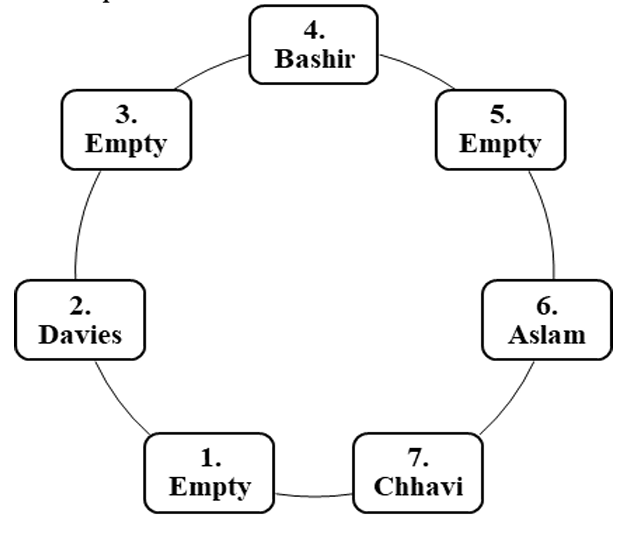
The answer is 4.
Q36MCQCircular Arrangement
Who sits on the chair numbered 4 at the end of Turn 3?
- ABashir
- BChhavi
- CDavies
- DNo one
Answer and solution
Answer: (D) No one
Davies is on Chair 2 after Turn 1, when only Aslam has moved, so he starts there, with Chairs 1 and 3 empty. Chhavi is on 7 after Turn 2, so she starts there. Aslam sits beside her with Chair 1 empty, so he is on 6, and Bashir, needing empty neighbours, is on 4.
After Turn 2 all four sit together. If Aslam went counterclockwise to 5, Bashir could reach only 3 or 6, with no block. So Aslam goes clockwise to 1, and Bashir to 3 (going to 5 leaves a gap), giving the block 7, 1, 2, 3.
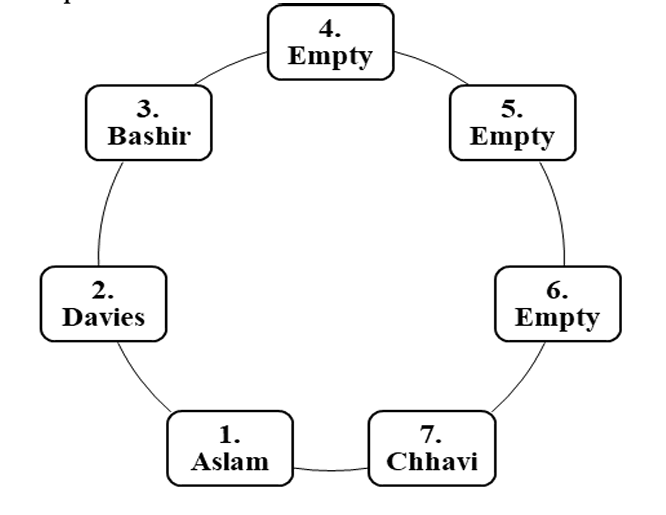
Davies is on Chair 4 after Turn 5, which is Aslam's turn, so he gets there in Turn 4. Had Chhavi gone clockwise to Chair 4 in Turn 3, Davies could reach only 5 or 7. So in Turn 3 Chhavi goes counterclockwise to 6, and Davies moves to 4 in Turn 4.
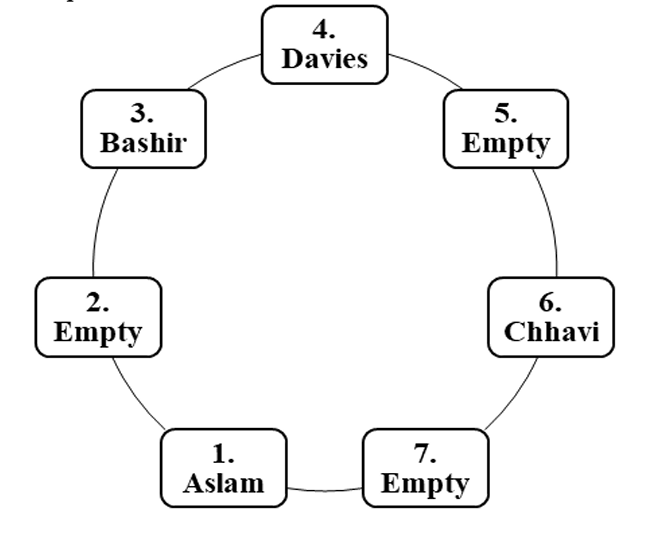
At the end of Turn 3, Aslam is on 1, Davies on 2, Bashir on 3 and Chhavi on 6. Chair 4 is empty: Bashir left it in Turn 2, and Davies (option C) arrives only in Turn 4.
Hence, option D (No one).
Q37MCQCircular Arrangement
Which of the chairs are occupied at the end of Turn 6?
- AChairs numbered 1, 2, 6, and 7
- BChairs numbered 2, 3, 4, and 5
- CChairs numbered 1, 2, 3, and 4
- DChairs numbered 4, 5, 6, and 7
Answer and solution
Answer: (D) Chairs numbered 4, 5, 6, and 7
Davies is on Chair 2 after Turn 1, when only Aslam has moved, so he starts there, with Chairs 1 and 3 empty. Chhavi likewise starts on 7, Aslam beside her on 6 (Chair 1 is empty), and Bashir, needing empty neighbours, on 4.
After Turn 2 all four sit together. Aslam moving to 5 leaves Bashir only 3 or 6, with no block; so Aslam goes clockwise to 1 and Bashir to 3 (5 leaves a gap), giving 7, 1, 2, 3.
Davies must reach Chair 4 in Turn 4, since Turn 5 is Aslam's. Had Chhavi taken Chair 4 in Turn 3, Davies could reach only 5 or 7, so Chhavi goes to 6 and Davies to 4.
After Turn 6 all four sit together again. Aslam moving clockwise to 2 leaves Bashir only 1 or 5, with no block; so Aslam goes counterclockwise to 7 and Bashir clockwise past Davies to 5.
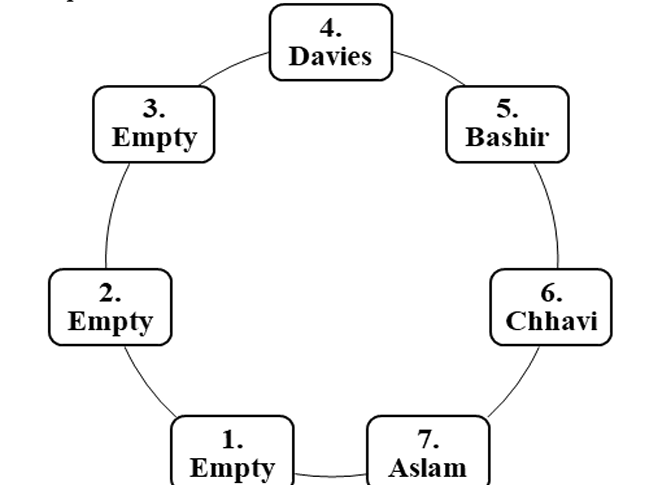
Chairs 4 (Davies), 5 (Bashir), 6 (Chhavi) and 7 (Aslam) are occupied. Options A, B and C each include Chair 1, 2 or 3, which are empty.
Hence, option D (Chairs numbered 4, 5, 6, and 7).
Q38MCQCircular Arrangement
Which of the following BEST describes the friends sitting on chairs adjacent to the one occupied by Bashir at the end of Turn 7?
- ADavies only
- BChhavi and Davies
- CAslam and Chhavi
- DChhavi only
Answer and solution
Answer: (A) Davies only
Davies is on Chair 2 after Turn 1, when only Aslam has moved, so he starts there, with Chairs 1 and 3 empty. Chhavi likewise starts on 7, Aslam beside her on 6, and Bashir, needing empty neighbours, on 4.
After Turn 2 all four sit together. Aslam moving to 5 leaves no block, so Aslam goes clockwise to 1 and Bashir to 3, giving 7, 1, 2, 3.
Davies must reach Chair 4 in Turn 4, since Turn 5 is Aslam's. Had Chhavi taken Chair 4 in Turn 3, Davies could reach only 5 or 7, so Chhavi goes to 6 and Davies to 4.
After Turn 6 all four sit together again. Aslam moving to 2 leaves Bashir only 1 or 5, with no block; so Aslam goes to 7 and Bashir clockwise to 5.
In Turn 7 Chhavi leaves Chair 6 for Chair 1 (clockwise, past Aslam) or Chair 3 (counterclockwise, past Bashir and Davies). Either way Chair 6 is empty, so Bashir on 5 has Davies on 4 and an empty chair on 6. Options B, C and D need Chhavi or Aslam beside him, but Chhavi has left and Aslam is on 7.
Hence, option A (Davies only).
Data set
Set for questions 39–42
DIRECTIONS for questions 39-42: Read the information given below and answer the question(s) that follow(s).
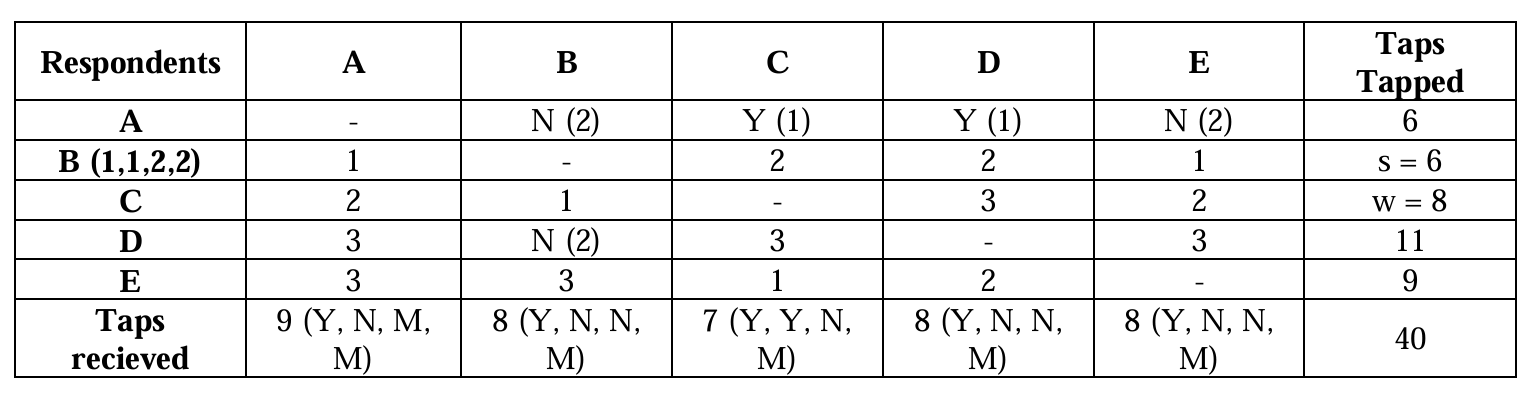
Alia, Badal, Clive, Dilshan, and Ehsaan played a game in which each asks a unique question to all the others and they respond by tapping their feet, either once or twice or thrice. One tap means “Yes”, two taps mean “No”, and three taps mean “Maybe”. A total of 40 taps were heard across the five questions. Each question received at least one “Yes”, one “No”, and one “Maybe.”
The following information is known.
1. Alia tapped a total of 6 times and received 9 taps to her question. She responded “Yes” to the questions asked by both Clive and Dilshan.
2. Dilshan and Ehsaan tapped a total of 11 and 9 times respectively. Dilshan responded “No” to Badal.
3. Badal, Dilshan, and Ehsaan received equal number of taps to their respective questions.
4. No one responded “Yes” more than twice.
5. No one’s answer to Alia’s question matched the answer that Alia gave to that person’s question. This was also true for Ehsaan.
6. Clive tapped more times in total than Badal.
Q39TITALogical Puzzles
How many taps did Clive receive for his question?
Type in your answer (TITA). No negative mark for a wrong answer.
Answer and solution
Answer: 7
Each question gets 4 replies, with at least one Yes (1 tap), one No (2) and one Maybe (3). Those three give 6 taps, and the fourth reply adds 1, 2 or 3, so every question receives 7, 8 or 9 taps.
Alia's question received 9 taps. Badal, Dilshan and Ehsaan received equal numbers, say
each, and Clive received
. The total is 40, so
, i.e.
.
With
and
between 7 and 9:
needs
, and
needs
, both impossible. So
and
.
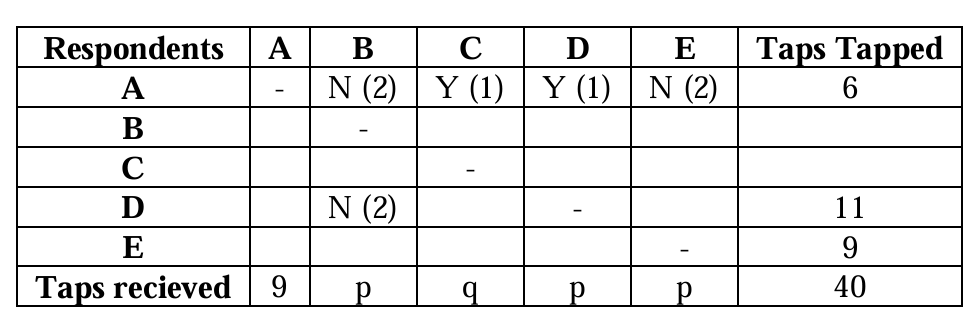
The table also shows Alia's own replies: she tapped 6 times with Yes to Clive and Dilshan, and a third Yes is not allowed, so her replies to Badal and Ehsaan are both No. Dilshan's No to Badal is given.
Clive's question received 7 taps: Yes, Yes, No, Maybe.
The answer is 7.
Q40MCQLogical Puzzles
Which two people tapped an equal number of times in total?
- ABadal and Dilshan
- BClive and Ehsaan
- CDilshan and Clive
- DAlia and Badal
Answer and solution
Answer: (D) Alia and Badal
Every person answers the four questions asked by the others, tapping once for Yes, twice for No and three times for Maybe. The 40 taps heard in all are the taps given by the five people.
Alia tapped 6, Dilshan 11 and Ehsaan 9, which is 26. So Badal and Clive tapped
between them.
No one said Yes more than twice, so at least two of each person's four answers take 2 or more taps. Everyone therefore taps at least
times.
Badal and Clive share 14 with each at least 6, so the split is 6 and 8, or 7 and 7. Clive tapped more than Badal, so Badal tapped 6 and Clive 8.
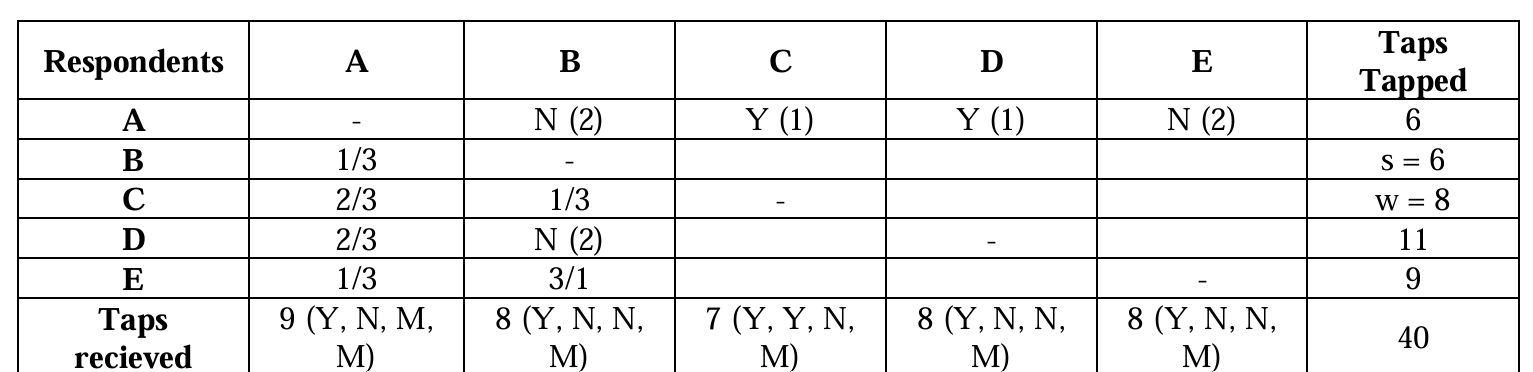
In the table's last column,
and
are Badal's and Clive's totals:
and
.
The totals are Alia 6, Badal 6, Clive 8, Dilshan 11 and Ehsaan 9, so the only equal pair is Alia and Badal. The nearest trap, option B, pairs Clive (8) and Ehsaan (9), who differ by one; options A and C involve Dilshan's 11, which no one else matches.
Hence, option D (Alia and Badal).
Q41MCQLogical Puzzles
What was Clive’s response to Ehsaan’s question?
- AYes
- BMaybe
- CCannot be determined
- DNo
Answer and solution
Answer: (D) No
Each question gets at least one Yes (1 tap), No (2) and Maybe (3), plus one more reply, so it receives 7, 8 or 9 taps. With Badal, Dilshan and Ehsaan on
each and Clive on
,
forces
,
. So Ehsaan's question got Yes, No, No, Maybe; Clive's got Yes, Yes, No, Maybe.
Alia tapped 6 with Yes to Clive and Dilshan; a third Yes is not allowed, so she said No to Badal and Ehsaan. Dilshan tapped 11 with No to Badal, so he said Maybe to the other three.
So Badal and Clive gave Ehsaan one Yes and one No. Suppose Badal said No. Badal tapped at most 6 (he and Clive tapped
, Clive more), and his other replies are at least 1, 1 and 2 (Dilshan's one Yes came from Alia). So Badal said Yes to Alia and Clive, and No to Dilshan. Clive's Yeses and Maybe are then taken, so Ehsaan told Clive No, and Alia Maybe (fact 5 bars No; Badal gave her the one Yes). His remaining 4 taps go to Badal (Yes or Maybe) and Dilshan (No or Maybe), so he told Dilshan Maybe, matching Dilshan's reply and breaking fact 5.
So Clive said No, which also rules out 'Cannot be determined'.
Hence, option D (No).
Q42TITALogical Puzzles
How many “Yes” responses were received across all the questions?
Type in your answer (TITA). No negative mark for a wrong answer.
Answer and solution
Answer: 6
There are
replies and 40 taps. If
,
,
count the Yes, No and Maybe replies,
and
. Subtracting gives
, so
. Each question has at least one of each, so
is at least 5, which leaves three cases.
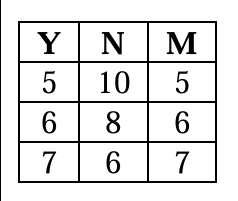
To choose between them, look at each question. Its three compulsory replies give 6 taps and the fourth adds 1, 2 or 3, so it receives 7, 8 or 9 taps. Alia's got 9, Badal, Dilshan and Ehsaan got
each, and Clive got
. From
,
, and only
,
keeps both between 7 and 9.
So the fourth reply is a Maybe for Alia (9 taps), a No for Badal, Dilshan and Ehsaan (8 each) and a Yes for Clive (7). The bottom row of the table lists these.
Clive's question has 2 Yes replies and each of the other four has 1, so the total is
.
The answer is 6.
Data set
Set for questions 43–46
DIRECTIONS for questions 43-45: Read the information given below and answer the question that follows.
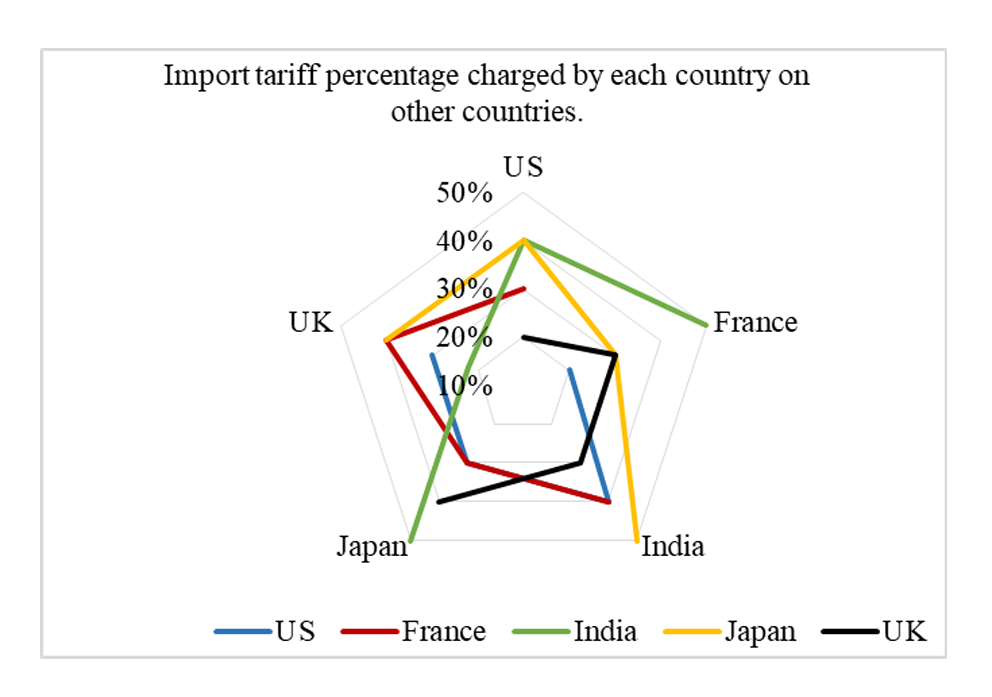
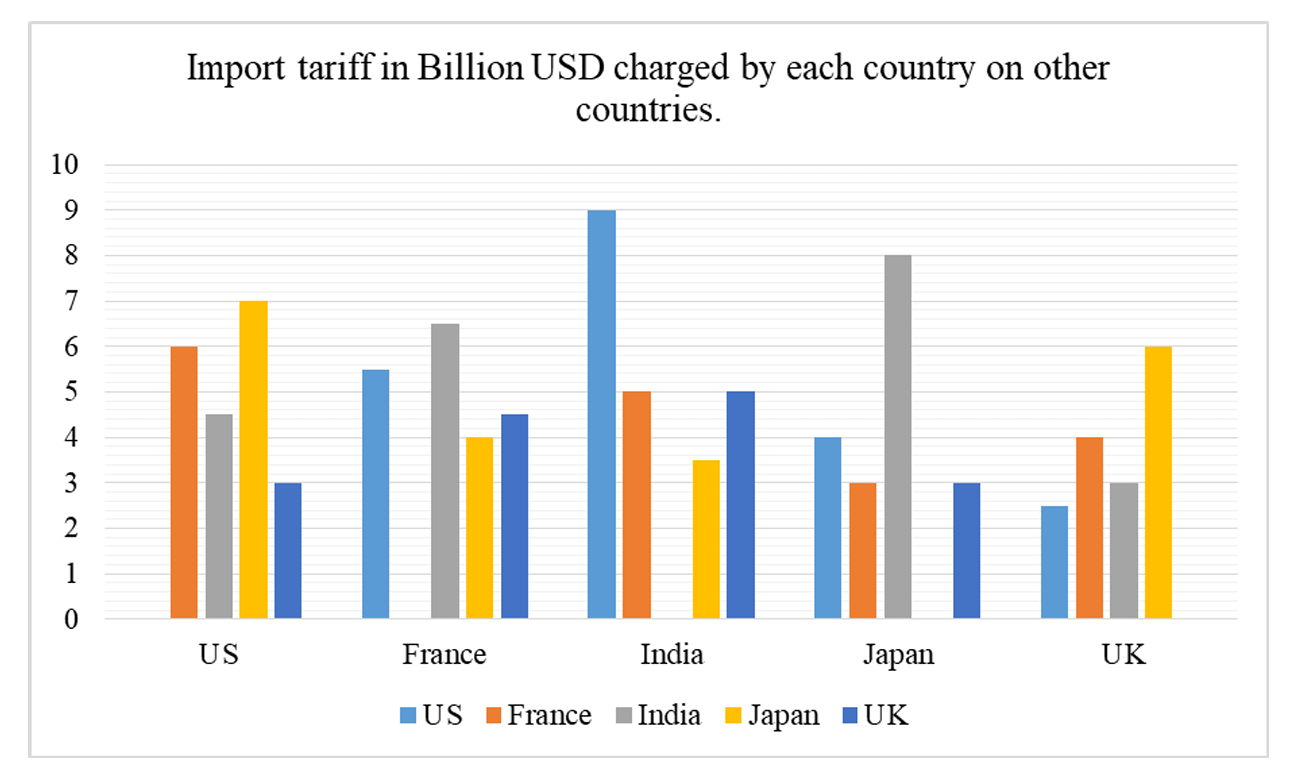
Five countries engage in trade with each other. Each country levies import tariffs on the other countries. The import tariff levied by Country X on Country Y is calculated by multiplying the corresponding tariff percentage with the total imports of Country X from Country Y.
The radar chart below depicts different import tariff percentages charged by each of the five countries on the others. For example, US (the blue line in the chart) charges 20%, 40%, 30%, and 30% import tariff percentages on imports from France, India, Japan, and UK, respectively. The bar chart depicts the import tariffs levied by each county on other countries. For example, US charged import tariff of 3 billion USD on UK.
Assume that imports from one country to another equals the exports from the latter to the former.
The trade surplus of Country X with Country Y is defined as follows.
Trade surplus = Exports from Country X to Country Y – Imports to Country X from Country Y.
A negative trade surplus is called trade deficit.
Q43MCQRadar & Special Graphs
How much is Japan's export to India worth?
- A8.5 Billion USD
- B7.0 Billion USD
- C16.0 Billion USD
- D1.75 Billion USD
Answer and solution
Answer: (B) 7.0 Billion USD
An import tariff is the tariff percentage times the imports, so imports equal the tariff divided by the percentage. The radar chart gives the percentages and the bar chart the tariffs (each row is the country charging):
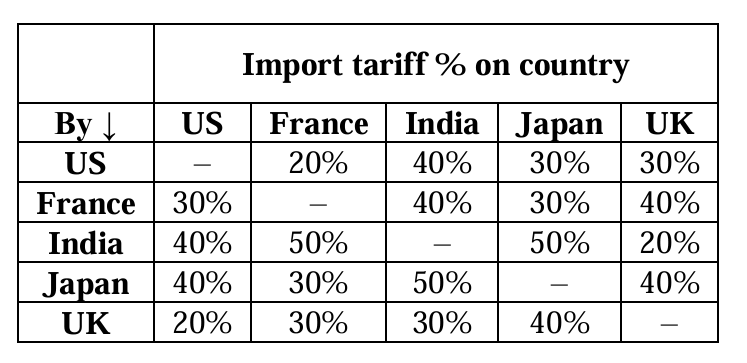
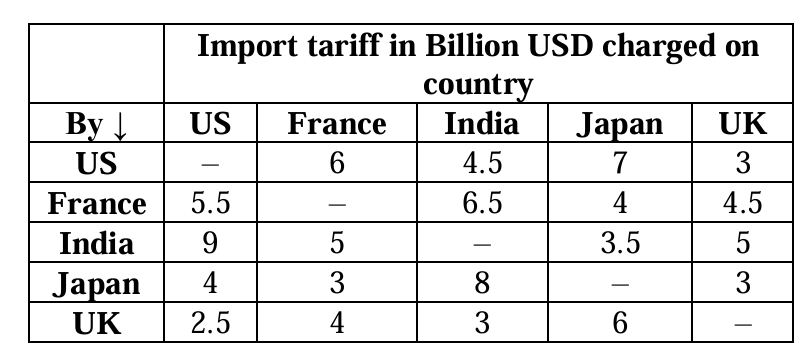
For example, the US charges France 20% and collects 6 billion USD, so US imports from France are
billion USD. Doing this for every pair gives the imports table (each row imports from the column country). A country's exports to another equal that country's imports from it.
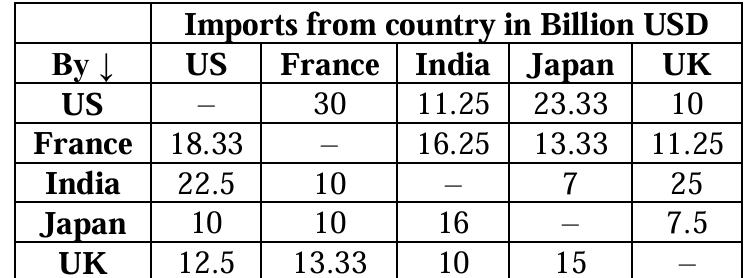
Japan's exports to India equal India's imports from Japan. India charges Japan 50% and collects 3.5 billion USD, so this is
billion USD.
Option C (16.0) is the flow the other way: Japan imports
from India. Option D (1.75) multiplies
instead of dividing.
Hence, option B (7.0 Billion USD).
Q44MCQRadar & Special Graphs
Which among the following is the highest?
- AExports by France to Japan
- BImports by France from India
- CImports by US from France
- DExports by Japan to UK
Answer and solution
Answer: (C) Imports by US from France
An import tariff is the tariff percentage times the imports, so imports equal the tariff divided by the percentage. The radar chart gives the percentages and the bar chart the tariffs (each row is the country charging):
For example, the US charges France 20% and collects 6 billion USD, so US imports from France are
billion USD. Doing this for every pair gives the imports table (each row imports from the column country). A country's exports to another equal that country's imports from it.
A: France's exports to Japan = Japan's imports from France =
.
B: France's imports from India =
.
C: US imports from France =
.
D: Japan's exports to UK = UK's imports from Japan =
.
The largest is 30. Option B is the next largest, but 16.25 is far below it.
Hence, option C (Imports by US from France).
Q45MCQRadar & Special Graphs
What is the trade surplus/trade deficit of India with UK?
- ADeficit of 10.0 Billion USD
- BSurplus of 15.0 Billion USD
- CSurplus of 10.0 Billion USD
- DDeficit of 15.0 Billion USD
Answer and solution
Answer: (D) Deficit of 15.0 Billion USD
An import tariff is the tariff percentage times the imports, so imports equal the tariff divided by the percentage. The radar chart gives the percentages and the bar chart the tariffs (each row is the country charging):
For example, the US charges France 20% and collects 6 billion USD, so US imports from France are
billion USD. Doing this for every pair gives the imports table (each row imports from the column country). A country's exports to another equal that country's imports from it.
India's trade surplus with UK = India's exports to UK − India's imports from UK.
India's exports to UK = UK's imports from India =
billion USD.
India's imports from UK =
billion USD.
Surplus
, a deficit of 15 billion USD. Option B has the right size but the wrong sign: India buys more from the UK than it sells there.
Hence, option D (Deficit of 15.0 Billion USD).
Q46MCQRadar & Special Graphs
Among France and UK, who has/have trade surplus(es) with US?
- ANeither France nor UK
- BBoth France and UK
- COnly France
- DOnly UK
Answer and solution
Answer: (C) Only France
An import tariff is the tariff percentage times the imports, so imports equal the tariff divided by the percentage. The radar chart gives the percentages and the bar chart the tariffs (each row is the country charging):
For example, the US charges France 20% and collects 6 billion USD, so US imports from France are
billion USD. Doing this for every pair gives the imports table (each row imports from the column country). A country's exports to another equal that country's imports from it.
France: exports to US = US imports from France = 30; imports from US =
. Surplus
billion USD.
UK: exports to US = US imports from UK =
; imports from US =
. Balance
, a deficit.
So only France has a surplus with the US. Option B fails because the UK runs a deficit.
Hence, option C (Only France).