- CATin
- CAT past papers
- CAT 2024 Slot 1
- QA
CAT 2024 Slot 1 — QA questions with answers
All 22 questions of the Quantitative Ability section (14 MCQs, 8 TITA). Try each one, then open its answer and solution.
CAT 2024 Slot 1, timed like the real exam (120 minutes, 40 a section) and scored the CAT way: +3 right, −1 for a wrong MCQ, 0 for a wrong TITA, with the full post-mock analysis. Free — sign in and you come straight back to this paper.
Sit this paper as a timed mock in CATin — freeQuantitative Ability
CAT 2024 Slot 1 · 40 minutes · +3 for a right answer, −1 for a wrong MCQ, 0 for a wrong TITA
Q47MCQPermutations & Combinations
Consider two sets
and
. Let
be a function from
to
such that for every element
in
, there is at least one element
in
such that
. Then, the total number of such functions
is
- A665
- B667
- C537
- D540
Answer and solution
Answer: (D) 540
Every element of
must be hit, so count the onto functions by inclusion–exclusion.
All functions: each of the 6 elements of
can go to any of the 3 elements of
, giving
.
Functions missing one given element of
map into the other 2:
. There are 3 choices of the missed element:
.
Functions missing two given elements send everything to the third:
. There are
such pairs. Each of these constant functions was subtracted twice above but counted only once in 729, so add the 3 back.
Onto functions
.
Option C, 537, is
: it forgets to add back the 3 constant functions.
Hence, option D (540).
Q48MCQQuadratic & Polynomial Equations
Let
,
, and
be real numbers satisfying
Then
equals
- A3
- B
- C4
- D1
Answer and solution
Answer: (A) 3
Substitute
from the first equation into the second:
Write
as
and complete the squares:
A sum of squares of real numbers is 0 only if each square is 0, so
,
,
.
Then
. The second equation agrees:
.
Since
,
,
are forced,
has no other value; option C, 4, would need
, but it is
.
Hence, option A (3).
Q49TITAQuadratic & Polynomial Equations
If the equations
,
and
have a common negative root, then the value of
is
Type in your answer (TITA). No negative mark for a wrong answer.
Answer and solution
Answer: 38
Let
be the common negative root.
Subtract the first equation from the third:
, so
.
Subtract the second equation from the third:
, so
.
Put
into the first equation:
, so
. The root is negative, so
.
Then
and
.
Check in the second equation:
.
So
.
The answer is 38.
Q50MCQSequences & Series
Suppose
are in arithmetic progression such that
and
. Then,
equals
- A-194
- B-196
- C204
- D206
Answer and solution
Answer: (A) -194
Let the first term be
and the common difference
, so
.
gives
.
So
, which gives
, i.e.
.
gives
, so
and
.
.
Option B,
, comes from using
instead of
.
Hence, option A (-194).
Q51TITATime & Work
Renu would take 15 days working 4 hours per day to complete a certain task whereas Seema would take 8 days working 5 hours per day to complete the same task. They decide to work together to complete this task. Seema agrees to work for double the number of hours per day as Renu, while Renu agrees to work for double the number of days as Seema. If Renu works 2 hours per day, then the number of days Seema will work, is
Type in your answer (TITA). No negative mark for a wrong answer.
Answer and solution
Answer: 6
Renu alone needs
hours, so she does
of the task per hour. Seema alone needs
hours, so she does
per hour.
Let Seema work
days. Renu works 2 hours a day for
days, that is
hours. Seema works
hours a day for
days, also
hours.
Together they complete the task:
, so
and
.
Seema works 6 days, and Renu 12 days.
The answer is 6.
Q52MCQRemainders
When
is divided by 7, the remainder is
- A3
- B4
- C1
- D6
Answer and solution
Answer: (B) 4
Since
,
leaves the same remainder as
when divided by 7.
Powers of 3 modulo 7:
,
,
,
,
,
. The remainders repeat every 6 powers.
, so
.
So
leaves remainder 4.
Option C, 1, would need the exponent to be a multiple of 6, and 100 is not.
Hence, option B (4).
Q53MCQIndices & Surds
The sum of all real values of
for which
, is
- A2/3
- B4/3
- C-2/3
- D-4/3
Answer and solution
Answer: (C) -2/3
, so write every term as a power of
.
Left side:
.
Right side:
.
Equating exponents:
. Multiplying by
(with
):
, so
.
Its discriminant is
, so both roots are real, and they are non-zero since their product is
. Their sum is
.
Option A (
) has the wrong sign: the sum of the roots of
is
.
Hence, option C (-2/3).
Q54TITAFunctions & Graphs
For any natural number
, let
be the largest integer not exceeding
. Then the value of
is
Type in your answer (TITA). No negative mark for a wrong answer.
Answer and solution
Answer: 217
stays the same between consecutive perfect squares:
for
, which is
values of
.
So, up to
:
for
to
(3 terms),
for
to
(5 terms),
for
to
(7 terms),
for
to
(9 terms),
for
to
(11 terms),
for
to
(13 terms), and
for
(2 terms).
Check:
terms.
Sum
.
The answer is 217.
Q55MCQPercentages
In September, the incomes of Kamal, Amal and Vimal are in the ratio
. They rent a house together, and Kamal pays 15%, Amal pays 12% and Vimal pays 18% of their respective incomes to cover the total house rent in that month. In October, the house rent remains unchanged while their incomes increase by 10%, 12% and 15%, respectively. In October, the percentage of their total income that will be paid as house rent, is nearest to
- A15.18
- B13.26
- C14.84
- D12.75
Answer and solution
Answer: (B) 13.26
Take the September incomes as
,
and
(ratio
).
Rent paid: Kamal
of
, Amal
of
, Vimal
of
. Total rent
.
October incomes: Kamal
, Amal
, Vimal
. Total
.
The rent is unchanged, so the share of income paid as rent is
, about
.
Option C,
, is September's share,
; it ignores the rise in incomes.
Hence, option B (13.26).
Q56TITAPermutations & Combinations
The sum of all four-digit numbers that can be formed with the distinct non-zero digits
,
,
, and
, with each digit appearing exactly once in every number, is
, where
is a single digit natural number. Then, the value of
is
Type in your answer (TITA). No negative mark for a wrong answer.
Answer and solution
Answer: 31
The 4 distinct digits form
numbers. In each place, each digit appears
times, so the digits in any one place add up to
.
Sum of all the numbers
.
This equals
with
from 1 to 9, so a multiple of 6666 must lie between 153311 and 153319.
lies in that range, while
and
do not. So
and
.
(A sum of 23 is possible with distinct non-zero digits, e.g. 9, 8, 5, 1.)
.
The answer is 31.
Q57TITATriangles & Lines
is a rectangle with sides
cm and
cm, and
is the midpoint of side
. Then, the length, in cm, of radius of incircle of
is
Type in your answer (TITA). No negative mark for a wrong answer.
Answer and solution
Answer: 10
is the midpoint of
, and
cm, so
cm. Also
cm.
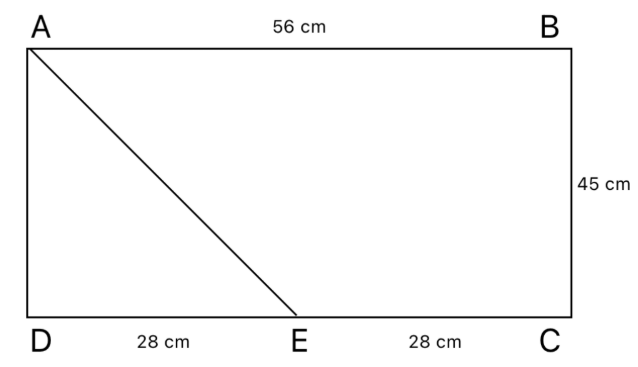
Triangle
has a right angle at
, a corner of the rectangle, with legs
and
.
Hypotenuse:
, so
.
For a right triangle with legs
,
and hypotenuse
, the inradius is
.
.
Check with area over semi-perimeter: area
, semi-perimeter
, and
.
The answer is 10.
Q58MCQCoordinate Geometry
In the
-plane, the area, in sq. units, of the region defined by the inequalities
and
is
- A
- B
- C
- D
Answer and solution
Answer: (A)
Complete the squares in the middle expression:
.
So
means
.
This is the ring between two circles centred at
with radii
and
.
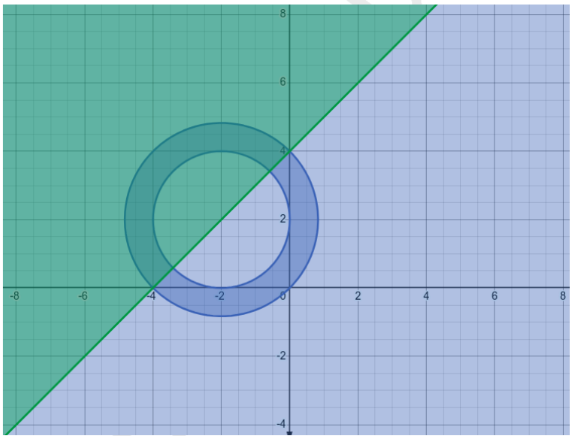
The line
passes through the centre, since
. So it cuts the ring into two equal halves, and
keeps the half above the line.
Ring area
.
Required area
.
Option B,
, is the whole ring; it ignores the condition
.
Hence, option A (
).
Q59TITALogarithms
If
is a positive real number such that
, then the greatest integer not exceeding
, is
Type in your answer (TITA). No negative mark for a wrong answer.
Answer and solution
Answer: 31
Change every log to base 10, using
:
and
.
The equation becomes
.
So
, which gives
.
Then
.
Since
, we get
(
).
The greatest integer not exceeding
is 31.
The answer is 31.
Q60MCQProfit, Loss & Discount
The selling price of a product is fixed to ensure 40% profit. If the product had cost 40% less and had been sold for 5 rupees less, then the resulting profit would have been 50%. The original selling price, in rupees, of the product is
- A15
- B14
- C10
- D20
Answer and solution
Answer: (B) 14
Let the original cost price be
. A
profit makes the selling price
.
The new cost price is
less,
, and the new selling price is
. This gives a
profit, so
, so
.
Original selling price
rupees.
Check: new cost
, new price
, profit
.
Option C, 10, is the original cost price, not the selling price.
Hence, option B (14).
Q61MCQAverages, Mixtures & Alligations
A glass is filled with milk. Two-thirds of its content is poured out and replaced with water. If this process of pouring out two-thirds the content and replacing with water is repeated three more times, then the final ratio of milk to water in the glass, is
- A
- B
- C
- D
Answer and solution
Answer: (B)
Each time two-thirds of the contents is poured out, one-third of the milk present stays; the water only refills the glass.
This happens once and then three more times, 4 times in all.
Milk left
of the glass.
Water
of the glass.
Milk : water
.
Option C,
, compares the milk with the whole glass, not with the water.
Hence, option B (
).
Q62TITARatios, Proportions & Partnership
A fruit seller has a total of 187 fruits consisting of apples, mangoes and oranges. The number of apples and mangoes are in the ratio
. After she sells 75 apples, 26 mangoes and half of the oranges, the ratio of number of unsold apples to number of unsold oranges becomes
. The total number of unsold fruits is
Type in your answer (TITA). No negative mark for a wrong answer.
Answer and solution
Answer: 66
Let the apples be
and the mangoes
. Then the oranges are
.
After the sales,
apples and
oranges remain, in the ratio
:
, so
and
.
So there were 105 apples, 42 mangoes and
oranges.
Unsold: apples
, mangoes
, oranges
. Check:
.
Total unsold
.
The answer is 66.
Q63MCQTime, Speed & Distance
Two places
and
are 45 kms apart and connected by a straight road. Anil goes from
to
while Sunil goes from
to
. Starting at the same time, they cross each other in exactly 1 hour 30 minutes. If Anil reaches
exactly 1 hour 15 minutes after Sunil reaches
, the speed of Anil, in km per hour, is
- A18
- B16
- C14
- D12
Answer and solution
Answer: (D) 12
They meet after 90 minutes. Let Sunil need
more minutes to reach
. Anil reaches
75 minutes after Sunil reaches
, so Anil needs
more minutes.
After the meeting, each covers the stretch the other covered in 90 minutes. If their speeds are
and
, Anil takes
minutes and Sunil
, so the product of these times is
:
, i.e.
, so
.
Anil needs
minutes after the meeting, so his total time is
minutes
hours.
Anil's speed
km/h.
Option A, 18, is Sunil's speed: his total time is
minutes, and
km/h.
Hence, option D (12).
Q64TITAAverages, Mixtures & Alligations
There are four numbers such that average of first two numbers is 1 more than the first number, average of first three numbers is 2 more than average of first two numbers, and average of first four numbers is 3 more than average of first three numbers. Then, the difference between the largest and the smallest numbers, is
Type in your answer (TITA). No negative mark for a wrong answer.
Answer and solution
Answer: 15
Call the numbers
,
,
,
in the given order.
gives
.
. Multiply by 6:
, so
and
.
. Multiply by 12:
, so
and
.
The numbers are
,
,
,
. Whatever
is, the smallest is
and the largest is
.
Their difference is 15.
The answer is 15.
Q65MCQSimple & Compound Interest
An amount of Rs 10000 is deposited in bank
for a certain number of years at a simple interest of 5% per annum. On maturity, the total amount received is deposited in bank
for another 5 years at a simple interest of 6% per annum. If the interests received from bank
and bank
are in the ratio
, then the investment period, in years, in bank
is
- A4
- B5
- C3
- D6
Answer and solution
Answer: (D) 6
Let the money stay in bank
for
years.
Interest from
:
. Amount at maturity:
.
Interest from
:
.
The ratio is
:
, so
and
.
Check: the interests are 3000 and
, in the ratio
.
Option B, 5, gives 2500 and
, a ratio of
, not
.
Hence, option D (6).
Q66MCQLinear Equations
A shop wants to sell a certain quantity (in kg) of grains. It sells half the quantity and an additional 3 kg of these grains to the first customer. Then, it sells half of the remaining quantity and an additional 3 kg of these grains to the second customer. Finally, when the shop sells half of the remaining quantity and an additional 3 kg of these grains to the third customer, there are no grains left. The initial quantity, in kg, of grains is
- A50
- B36
- C42
- D18
Answer and solution
Answer: (C) 42
Work backwards from the end. If the shop has
kg before a customer, it sells
kg and keeps
kg.
After the third customer nothing is left:
, so
kg before the third customer.
Before the second customer:
, so
kg.
At the start:
, so
kg.
Check: from
the shop sells
and keeps
; then sells
and keeps
; then sells
and keeps
.
Option D (18) is the stock before the second customer, not the initial quantity. Option B (36) fails the check: it leaves
, then
, and the third customer would need
kg.
Hence, option C (42).
Q67MCQIndices & Surds
If
is the positive square root of
, where
and
are integers, and
is a natural number, then the maximum possible value of
is
- A18
- B22
- C4
- D6
Answer and solution
Answer: (A) 18
Try to write
as a perfect square:
.
Since
, the positive square root is
.
So
. The rational parts must match, so
and
.
With
an integer and
natural, this allows
, giving
, or
, giving
.
The maximum is 18. The option 4 is the trap of stopping at the first form.
Hence, option A (18).
Q68MCQMensuration
The surface area of a closed rectangular box, which is inscribed in a sphere, is 846 sq cm, and the sum of the lengths of all its edges is 144 cm. The volume, in cubic cm, of the sphere is
- A
- B
- C
- D
Answer and solution
Answer: (C)
Let the box have edges
,
,
.
Edges:
, so
. Surface area:
.
So
.
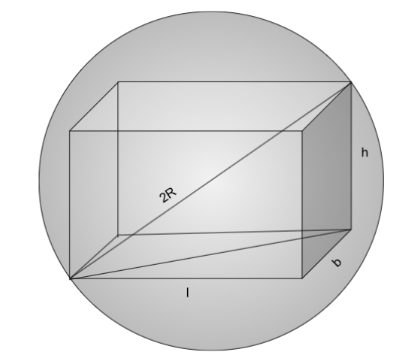
The box is inscribed in the sphere, so its space diagonal is a diameter:
. Then
,
and
.
Volume
.
Option A,
, drops the factor
; it stays because
is irrational, so
carries it.
Hence, option C (
).