- CATin
- CAT past papers
- CAT 2024 Slot 1
- DILR
CAT 2024 Slot 1 — DILR questions with answers
All 22 questions of the Data Interpretation & Logical Reasoning section (12 MCQs, 10 TITA, 5 sets). Try each one, then open its answer and solution.
CAT 2024 Slot 1, timed like the real exam (120 minutes, 40 a section) and scored the CAT way: +3 right, −1 for a wrong MCQ, 0 for a wrong TITA, with the full post-mock analysis. Free — sign in and you come straight back to this paper.
Sit this paper as a timed mock in CATin — freeData Interpretation & Logical Reasoning
CAT 2024 Slot 1 · 40 minutes · +3 for a right answer, −1 for a wrong MCQ, 0 for a wrong TITA
Data set
Set for questions 25–28
DIRECTIONS for questions 25–28: Read the information given below and answer the question(s) that follow(s).
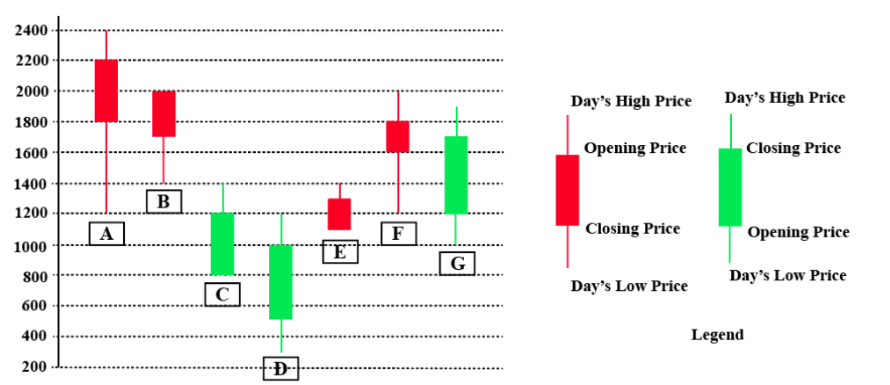
The chart below shows the price data for seven shares - A, B, C, D, E, F, and G as a candlestick plot for a particular day. The vertical axis shows the price of the share in rupees. A share whose closing price (price at the end of the day) is more than its opening price (price at the start of the day) is called a bullish share; otherwise, it is called a bearish share. All bullish and bearish shares are shown in green and red colour respectively.
Q25MCQBar & Line Charts
Daily Share Price Variability (SPV) is defined as (Day’s high price - Day’s low price) / (Average of the opening and closing prices during the day). Which among the shares A, C, D and F had the highest SPV on that day?
- AF
- BA
- CD
- DC
Answer and solution
Answer: (C) D
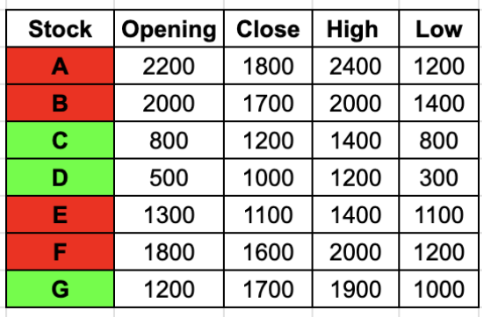
Reading the candlestick chart gives these prices:
SPV
.
F: opening 1800, closing 1600, high 2000, low 1200. SPV
.
A: opening 2200, closing 1800, high 2400, low 1200. SPV
.
D: opening 500, closing 1000, high 1200, low 300. SPV
.
C: opening 800, closing 1200, high 1400, low 800. SPV
.
Share D has by far the highest SPV. A has the widest range (1200), but its average price is also high; D's range of 900 is large compared with its low average price of 750. A and C, at 0.6, are only half as large.
Hence, option C (D).
Q26TITABar & Line Charts
Daily Share Price Variability (SPV) is defined as (Day’s high price - Day’s low price) / (Average of the opening and closing prices during the day). How many shares had an SPV greater than 0.5 on that day?
Type in your answer (TITA). No negative mark for a wrong answer.
Answer and solution
Answer: 4
Reading the candlestick chart gives these prices:
SPV
. For each share:
A:
B:
C:
D:
E:
F:
G:
The shares with SPV greater than 0.5 are A, C, D and G. F is the closest miss, at about 0.47.
The answer is 4.
Q27MCQBar & Line Charts
Daily loss for a share is defined as (Opening price - Closing price) / (Opening price). Which among the shares A, B, F and G had the highest daily loss on that day?
- AG
- BB
- CA
- DF
Answer and solution
Answer: (C) A
Reading the candlestick chart gives these prices:
Daily loss
. It is positive only for bearish (red) shares.
A: opening 2200, closing 1800. Loss
.
B: opening 2000, closing 1700. Loss
.
F: opening 1800, closing 1600. Loss
.
G is bullish: it opened at 1200 and closed at 1700, so it gained and had no loss.
Share A has the highest daily loss; B comes second at 0.15.
Hence, option C (A).
Q28MCQBar & Line Charts
What would have been the percentage wealth gain for a trader, who bought equal numbers of all bullish shares at opening price and sold them at their day’s high?
- A80%
- B50%
- C72%
- D100%
Answer and solution
Answer: (A) 80%
Reading the candlestick chart gives these prices:
The bullish (green) shares, which closed above their opening price, are C, D and G.
Suppose the trader buys one share of each at the opening price and sells it at the day's high.
C: buys at 800, sells at 1400.
D: buys at 500, sells at 1200.
G: buys at 1200, sells at 1900.
Total cost
, and total sale value
.
Gain
, that is, 80%.
Option D (100%) would need the shares to sell for 5000, double the cost; they sell for 4500.
Hence, option A (80%).
Data set
Set for questions 29–32
DIRECTIONS for questions 29–32: Read the information given below and answer the question(s) that follow(s).
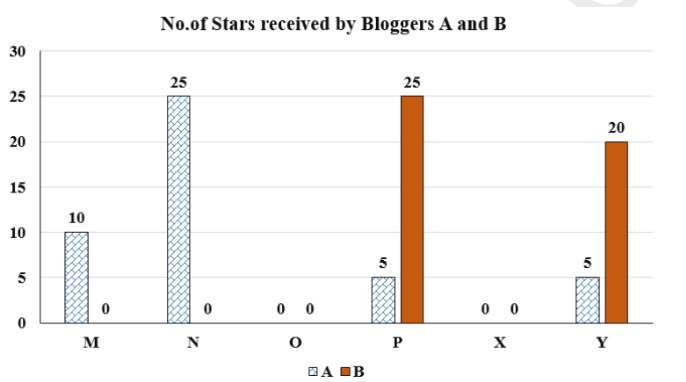
Six web surfers M, N, O, P, X, and Y each had 30 stars which they distributed among four bloggers A, B, C, and D. The number of stars received by A and B from the six web surfers is shown in the figure below.
The following additional facts are known regarding the number of stars received by the bloggers from the surfers.
1. The numbers of stars received by the bloggers from the surfers were all multiples of 5 (including 0).
2. The total numbers of stars received by the bloggers were the same.
3. Each blogger received a different number of stars from M.
4. Two surfers gave all their stars to a single blogger.
5. D received more stars than C from Y.
Q29TITABar & Line Charts
What was the total number of stars received by D?
Type in your answer (TITA). No negative mark for a wrong answer.
Answer and solution
Answer: 45
Six surfers each gave 30 stars, so
stars were given in all.
By fact 2, the four bloggers received the same total, so each received
stars.
This matches the chart: A received
and B received
. So C and D together received the remaining 90.
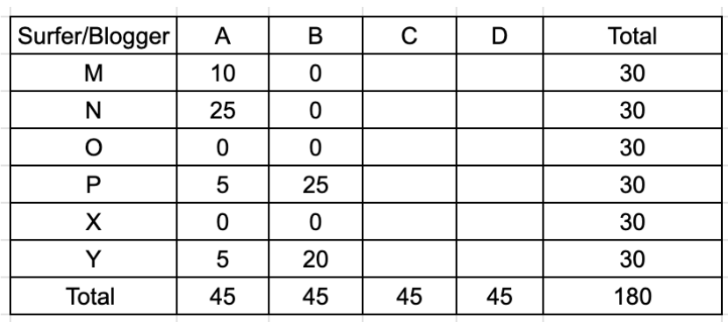
Working out the full distribution confirms this: D gets 5 from M, 5 from N, 5 from Y and 30 from one of O and X, which is again 45.
The answer is 45.
Q30MCQBar & Line Charts
What was the number of stars received by D from Y?
- A5
- B10
- CCan't be determined
- D0
Answer and solution
Answer: (A) 5
From the chart, Y gave 5 stars to A and 20 to B, so Y had
stars left for C and D.
Every number of stars given is a multiple of 5 (fact 1), so these 5 stars went entirely to C or entirely to D.
By fact 5, D received more stars than C from Y. So D got 5 and C got 0.
Option B (10) is impossible, since Y had only 5 stars left. Option D (0) would give C 5 and D 0, breaking fact 5. The value is fixed, so option C (can't be determined) fails too.
Hence, option A (5).
Q31TITABar & Line Charts
How many surfers distributed their stars among exactly 2 bloggers?
Type in your answer (TITA). No negative mark for a wrong answer.
Answer and solution
Answer: 2
Each surfer gave 30 stars in multiples of 5. From the chart, the stars given to A and B are:
M gave A 10 and B 0, leaving 20 for C and D. By fact 3, M gave each blogger a different number; 0 and 10 are taken, so C and D got two different multiples of 5 adding to 20, other than 0 and 10: 5 and 15. M gave to 3 bloggers.
N gave A 25 and B 0, so its last 5 stars went to one of C or D: 2 bloggers.
P gave A 5 and B 25, all 30 stars: 2 bloggers.
Y gave A 5 and B 20, and by fact 5 its last 5 went to D: 3 bloggers.
O and X gave nothing to A or B. Every other surfer has already given to at least two bloggers, so by fact 4 O and X are the two who gave all 30 stars to one blogger. They cannot pick the same one, as each blogger's total is
. The two possible tables:
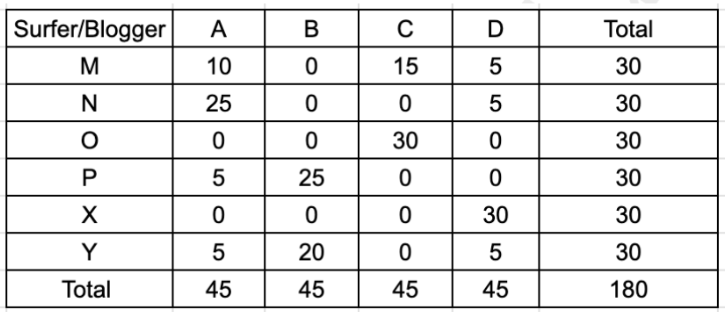
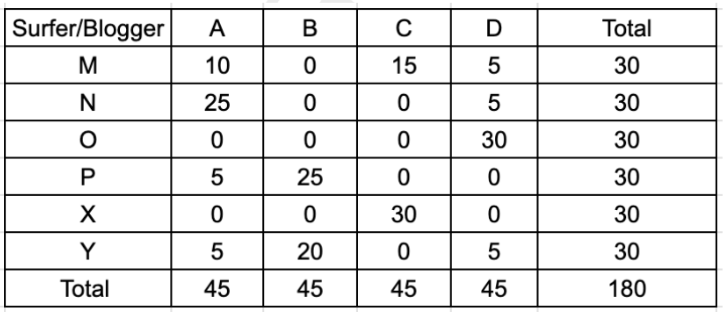
In both, exactly N and P gave to 2 bloggers.
The answer is 2.
Q32MCQBar & Line Charts
Which of the following can be determined with certainty?
I. The number of stars received by C from M
II. The number of stars received by D from O
- ANeither I or II
- BOnly I
- COnly II
- DBoth I and II
Answer and solution
Answer: (B) Only I
All 180 stars are shared equally, so each blogger received 45. From the chart, A and B already have 45 each:
Y has 5 stars left after A and B; by fact 5 they go to D.
O and X gave nothing to A or B, and every other surfer has already split its stars, so by fact 4 O and X each gave all 30 to one blogger. They cannot both choose the same blogger (
), so one gave C 30 and the other gave D 30.
M gave A 10 and B 0, so by fact 3 C and D got 5 and 15 in some order. If D got 15 from M, D would have at least
. So M gave C 15 and D 5, and N's last 5 goes to D, making both totals 45.
Statement I is determined: C got 15 from M in both tables. Statement II is not: D got 0 from O in one table and 30 in the other, since nothing fixes whether O or X chose D.
Hence, option B (Only I).
Data set
Set for questions 33–37
DIRECTIONS for questions 33–37: Read the information given below and answer the question(s) that follow(s).
The game of QUIET is played between two teams. Six teams, numbered 1, 2, 3, 4, 5, and 6, play in a QUIET tournament. These teams are divided equally into two groups. In the tournament, each team plays every other team in the same group only once, and each team in the other group exactly twice. The tournament has several rounds, each of which consists of a few games. Every team plays exactly one game in each round.
The following additional facts are known about the schedule of games in the tournament.
1. Each team played against a team from the other group in Round 8.
2. In Round 4 and Round 7, the match-ups, that is the pair of teams playing against each other, were identical. In Round 5 and Round 8, the match-ups were identical.
3. Team 4 played Team 6 in both Round 1 and Round 2.
4. Team 1 played Team 5 ONLY once and that was in Round 2.
5. Team 3 played Team 4 in Round 3. Team 1 played Team 6 in Round 6.
6. In Round 8, Team 3 played Team 6, while Team 2 played Team 5.
Q33TITAGames & Tournaments
How many rounds were there in the tournament?
Type in your answer (TITA). No negative mark for a wrong answer.
Answer and solution
Answer: 8
The six teams form two groups of three.
Games within a group: each pair plays once. A group of three has
pairs, so the two groups give
games.
Games across the groups: each of the 3 teams in one group plays each of the 3 teams in the other twice, giving
games.
Total games
.
In each round every team plays exactly one game, so each round has
games. The number of rounds is
.
The full schedule, worked out from the given facts, fills exactly these 8 rounds:
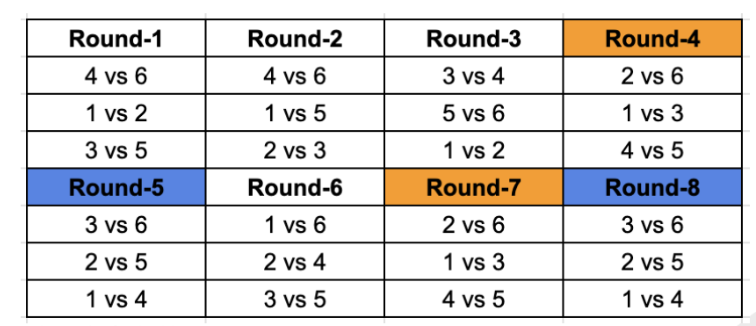
The answer is 8.
Q34TITAGames & Tournaments
What is the number of the team that played Team 1 in Round 5?
Type in your answer (TITA). No negative mark for a wrong answer.
Answer and solution
Answer: 4
By fact 6, Round 8 has Team 3 vs Team 6 and Team 2 vs Team 5. Every team plays exactly one game in each round, so the third game of Round 8 is between the two teams left over: Team 1 vs Team 4.
By fact 2, Round 5 has the same match-ups as Round 8: 3 vs 6, 2 vs 5 and 1 vs 4.
So Team 1 played Team 4 in Round 5.
This agrees with the complete schedule built from all the facts:
The answer is 4.
Q35MCQGames & Tournaments
Which team among the teams numbered 2, 3, 4, and 5 was not part of the same group?
- A5
- B3
- C4
- D2
Answer and solution
Answer: (A) 5
Teams in the same group meet once; teams in different groups meet twice.
Fact 4: Team 1 played Team 5 only once, so 1 and 5 are in the same group.
Fact 3: Team 4 played Team 6 twice (Rounds 1 and 2), so 4 and 6 are in different groups.
Fact 1: every Round 8 game is between the groups. By fact 6, those games include 3 vs 6 and 2 vs 5, so 3 and 6 are in different groups, and so are 2 and 5.
As 3 and 6 are split, exactly one of them joins 1 and 5. If it were 3, the other group would be 2, 4 and 6, putting 4 and 6 together, which is impossible. So 6 joins 1 and 5.
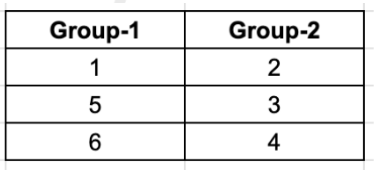
The groups are 1, 5, 6 and 2, 3, 4. Among Teams 2, 3, 4 and 5, Teams 2, 3 and 4 share a group; Team 5 does not.
Hence, option A (5).
Q36TITAGames & Tournaments
What is the number of the team that played Team 1 in Round 7?
Type in your answer (TITA). No negative mark for a wrong answer.
Answer and solution
Answer: 3
Groups first. Team 1 met Team 5 only once, so they share a group; Team 4 met Team 6 twice, so they are in different groups. All Round 8 games are between groups and include 3 vs 6, so exactly one of 3 and 6 joins 1 and 5; if it were 3, 4 and 6 would be left together. So the groups are 1, 5, 6 and 2, 3, 4.
Team 1 therefore plays 5 and 6 once each, and 2, 3 and 4 twice each: 8 games, one per round.
Known games of Team 1: Round 2 vs 5 and Round 6 vs 6. Round 8 has 3 vs 6 and 2 vs 5, so 1 vs 4; Round 5 repeats Round 8, so 1 vs 4 again.
In Round 3, Team 3 plays Team 4, and Team 1 has used up its games against 4, 5 and 6, so Team 1 plays Team 2.
Rounds 1, 4 and 7 remain, for one game against 2 and two against 3. Rounds 4 and 7 have identical match-ups, so Team 1 meets the same team in both; that must be Team 3, as only one game against 2 is left.
The answer is 3.
Q37TITAGames & Tournaments
What is the number of the team that played Team 6 in Round 3?
Type in your answer (TITA). No negative mark for a wrong answer.
Answer and solution
Answer: 5
Groups first. Team 1 met Team 5 only once, so they share a group; Team 4 met Team 6 twice, so they are in different groups. All Round 8 games are between groups and include 3 vs 6, so exactly one of 3 and 6 joins 1 and 5; if it were 3, 4 and 6 would be left together. So the groups are 1, 5, 6 and 2, 3, 4.
Team 6 therefore plays 1 and 5 once each, and 2, 3 and 4 twice each: 8 games, one per round.
Known games of Team 6: Rounds 1 and 2 vs 4, Round 6 vs 1, Round 8 vs 3, and Round 5 (same as Round 8) vs 3.
Rounds 3, 4 and 7 remain, for two games against 2 and one against 5. Rounds 4 and 7 have identical match-ups, so Team 6 meets the same team in both; that must be Team 2, as Team 5 is played only once. So Team 6 plays Team 5 in Round 3, alongside 3 vs 4 from fact 5.
The answer is 5.
Data set
Set for questions 38–42
DIRECTIONS for questions 38-42: Read the information given below and answer the question(s) that follow(s).
Two students, Amiya and Ramya are the only candidates in an election for the position of class representative. Students will vote based on the intensity level of Amiya's and Ramya's campaigns and the type of campaigns they run. Each campaign is said to have a level of 1 if it is a staid campaign and a level of 2 if it is a vigorous campaign. Campaigns can be of two types, they can either focus on issues, or on attacking the other candidate.
If Amiya and Ramya both run campaigns focusing on issues, then
• The percentage of students voting in the election will be 20 times the sum of the levels of campaigning of the two students. For example, if Amiya and Ramya both run vigorous campaigns, then
, that is,
of the students will vote in the election.
• Among voting students, the percentage of votes for each candidate will be proportional to the levels of their campaigns. For example, if Amiya runs a staid (i.e., level 1) campaign while Ramya runs a vigorous (i.e., level 2) campaign, then Amiya will receive
of the votes cast, and Ramya will receive the other
.
The above-mentioned percentages change as follows if at least one of them runs a campaign attacking their opponent.
• If Amiya runs a campaign attacking Ramya and Ramya runs a campaign focusing on issues, then
of the students who would have otherwise voted for Amiya will vote for Ramya, and another
who would have otherwise voted for Amiya, will not vote at all.
• If Ramya runs a campaign attacking Amiya and Amiya runs a campaign focusing on issues, then
of the students who would have otherwise voted for Ramya will vote for Amiya, and another
who would have otherwise voted for Ramya, will not vote at all.
• If both run campaigns attacking each other, then
of the students who would have otherwise voted for them had they run campaigns focusing on issues, will not vote at all.
Q38MCQTables & Caselets
If both of them run staid campaigns attacking the other, then what percentage of students will vote in the election?
- A40%
- B64%
- C60%
- D36%
Answer and solution
Answer: (D) 36%
Both run staid campaigns, so each has level 1.
Had both focused on issues, turnout would be
of the students, split in the ratio
, so each would get
.
Because both attack,
of each candidate's would-be voters do not vote. Each loses
of
, which is
, and keeps
.
Turnout
.
Option A,
, is the turnout for staid campaigns on issues; it ignores the
of students who stop voting when both attack.
Hence, option D (36%).
Q39MCQTables & Caselets
What is the minimum percentage of students who will vote in the election?
- A32%
- B40%
- C38%
- D36%
Answer and solution
Answer: (D) 36%
With issue campaigns at levels
(Amiya) and
(Ramya), turnout is
, split in the ratio
. So Amiya would get
and Ramya
of all students. Every case below grows with the levels, so the minimum needs both staid (
):
each,
in all.
Votes that switch candidates are still cast; only voters who drop out lower turnout. Compare the four campaign types:
Both on issues: nobody drops out, turnout
.
Only Amiya attacks:
of her
drop out, which is
, so turnout is
.
Only Ramya attacks:
of her
drop out, which is
, so turnout is
.
Both attack:
of each candidate's
drop out,
, so turnout is
.
The lowest turnout is
. Option C,
, is the case where only Amiya attacks; it loses
fewer voters than a mutual attack.
Hence, option D (36%).
Q40MCQTables & Caselets
If Amiya runs a campaign focusing on issues, then what is the maximum percentage of votes that she can get?
- A48%
- B44%
- C40%
- D36%
Answer and solution
Answer: (A) 48%
With issue campaigns at levels
(Amiya) and
(Ramya), turnout is
, split in the ratio
, so Amiya would get
and Ramya
of all students.
Amiya focuses on issues. If Ramya also focuses on issues, Amiya gets
, at most
.
If Ramya attacks,
of Ramya's would-be voters switch to Amiya. Amiya then gets
.
This is largest when both are vigorous (
): Amiya's own
plus
of Ramya's
, which is
. Amiya gets
.
Option B,
, is Amiya's share when Ramya's attacking campaign is staid: only
of
, which is
, switches over.
Hence, option A (48%).
Q41MCQTables & Caselets
If Ramya runs a campaign attacking Amiya, then what is the minimum percentage of votes that she is guaranteed to get?
- A12%
- B15%
- C30%
- D18%
Answer and solution
Answer: (B) 15%
With issue campaigns at levels
(Amiya) and
(Ramya), turnout is
, split in the ratio
, so Ramya would get
of all students, whatever Amiya's level.
Ramya attacks, so there are two cases for Amiya's campaign.
Amiya on issues:
of Ramya's would-be voters switch to Amiya and
do not vote, so Ramya keeps
of
, which is
.
Amiya also attacks: only
of Ramya's would-be voters stop voting, so she keeps
of
, which is
.
The worst case is a staid campaign (
) with Amiya on issues:
. Whatever Amiya does, Ramya gets at least
, so that is her guaranteed minimum.
Option D,
, is her share when both attack; she can fall below it when Amiya sticks to issues.
Hence, option B (15%).
Q42MCQTables & Caselets
What is the maximum possible voting margin with which one of the candidates can win?
- A20%
- B29%
- C28%
- D26%
Answer and solution
Answer: (B) 29%
With issue campaigns at levels
(Amiya) and
(Ramya), turnout is
split in the ratio
, so Amiya would get
and Ramya
of all students. For a big margin the winner is vigorous and the loser staid (equal levels give at most
).
Amiya wins (
,
):
Both on issues:
.
Ramya attacks: she keeps
of
, which is
, and
of
, which is
, switches to Amiya, who gets
. Margin
.
Amiya attacks: she keeps
of
, which is
, and Ramya gets
. Margin
.
Both attack:
.
Ramya wins (
,
): her best case is Amiya attacking while Ramya stays on issues. Amiya keeps
of
, which is
, and Ramya gets
, a margin of
(option D). Her other cases give
,
and
.
The largest margin is
.
Hence, option B (29%).
Data set
Set for questions 43–46
DIRECTIONS for questions 43–46: Read the information given below and answer the question(s) that follow(s).
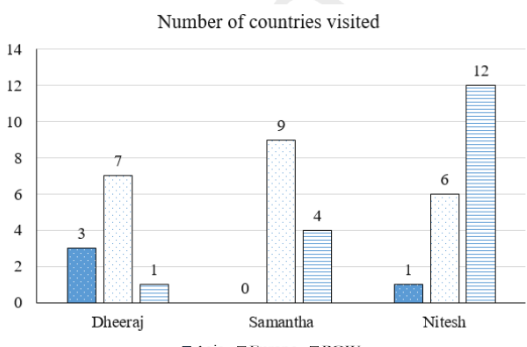
The chart below provides complete information about the number of countries visited by Dheeraj, Samantha and Nitesh, in Asia, Europe and the rest of the world (ROW).
The following additional facts are known about the countries visited by them.
1. 32 countries were visited by at least one of them.
2. USA (in ROW) is the only country that was visited by all three of them.
3. China (in Asia) is the only country that was visited by both Dheeraj and Nitesh, but not by Samantha.
4. France (in Europe) is the only country outside Asia, which was visited by both Dheeraj and Samantha, but not by Nitesh.
5. Half of the countries visited by both Samantha and Nitesh are in Europe.
Q43TITASet Theory
How many countries in Asia were visited by at least one of Dheeraj, Samantha and Nitesh?
Type in your answer (TITA). No negative mark for a wrong answer.
Answer and solution
Answer: 3
From the chart, Dheeraj visited 3, 7 and 1 countries in Asia, Europe and ROW; Samantha 0, 9 and 4; Nitesh 1, 6 and 12. That is 43 visits to 32 distinct countries.
If
,
,
countries were visited by exactly one, two and three people, then
and
, so
. Only USA was visited by all three, so
and
.
Of these 9, China is the only Dheeraj–Nitesh country and France the only Dheeraj–Samantha one (Samantha visited no Asian country). So 7 were visited by Samantha and Nitesh only. With USA they share 8, half of them (4) in Europe; none is in Asia, so the other 3 are in ROW.
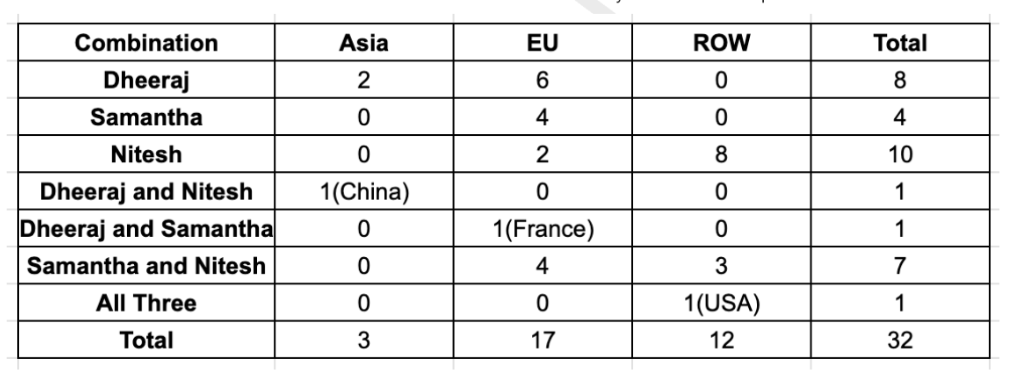
In Asia, Samantha visited none. Dheeraj's 3 are China and
of his own, and Nitesh's only one is China. So
Asian countries were visited.
The answer is 3.
Q44TITASet Theory
How many countries in Europe were visited only by Nitesh?
Type in your answer (TITA). No negative mark for a wrong answer.
Answer and solution
Answer: 2
From the chart, Dheeraj visited 3, 7 and 1 countries in Asia, Europe and ROW; Samantha 0, 9 and 4; Nitesh 1, 6 and 12. That is 43 visits to 32 distinct countries.
If
,
,
countries were visited by exactly one, two and three people, then
and
, so
. Only USA was visited by all three, so
and
.
Of these 9, China is the only Dheeraj–Nitesh country and France the only Dheeraj–Samantha one (Samantha visited no Asian country). So 7 were visited by Samantha and Nitesh only. With USA they share 8, half of them (4) in Europe; none is in Asia, so the other 3 are in ROW.
Nitesh's 6 European countries include the 4 he shares with Samantha; he shares none in Europe with Dheeraj, and USA is in ROW. So
were visited by Nitesh alone.
The answer is 2.
Q45TITASet Theory
How many countries in ROW were visited by both Nitesh and Samantha?
Type in your answer (TITA). No negative mark for a wrong answer.
Answer and solution
Answer: 4
From the chart, Dheeraj visited 3, 7 and 1 countries in Asia, Europe and ROW; Samantha 0, 9 and 4; Nitesh 1, 6 and 12. That is 43 visits to 32 distinct countries.
If
,
,
countries were visited by exactly one, two and three people, then
and
, so
. Only USA was visited by all three, so
and
.
Of these 9, China is the only Dheeraj–Nitesh country and France the only Dheeraj–Samantha one (Samantha visited no Asian country). So 7 were visited by Samantha and Nitesh only. With USA they share 8, half of them (4) in Europe; none is in Asia, so the other 3 are in ROW.
In ROW, Nitesh and Samantha share the 3 countries only the two of them visited, plus USA. That gives
.
The answer is 4.
Q46MCQSet Theory
How many countries in Europe were visited by exactly one of Dheeraj, Samantha and Nitesh?
- A10
- B5
- C14
- D12
Answer and solution
Answer: (D) 12
From the chart, Dheeraj visited 3, 7 and 1 countries in Asia, Europe and ROW; Samantha 0, 9 and 4; Nitesh 1, 6 and 12. That is 43 visits to 32 distinct countries.
If
,
,
countries were visited by exactly one, two and three people, then
and
, so
. Only USA was visited by all three, so
and
.
Of these 9, China is the only Dheeraj–Nitesh country and France the only Dheeraj–Samantha one (Samantha visited no Asian country). So 7 were visited by Samantha and Nitesh only. With USA they share 8, half of them (4) in Europe; none is in Asia, so the other 3 are in ROW.
In Europe, the shared countries are France (Dheeraj–Samantha) and the 4 Samantha–Nitesh ones. Countries with one visitor: Dheeraj
, Samantha
, Nitesh
, in all
. Option A, 10, leaves out Nitesh's 2.
Hence, option D (12).