- CATin
- CAT past papers
- CAT 2023 Slot 3
- QA
CAT 2023 Slot 3 — QA questions with answers
All 22 questions of the Quantitative Ability section (14 MCQs, 8 TITA). Try each one, then open its answer and solution.
CAT 2023 Slot 3, timed like the real exam (120 minutes, 40 a section) and scored the CAT way: +3 right, −1 for a wrong MCQ, 0 for a wrong TITA, with the full post-mock analysis. Free — sign in and you come straight back to this paper.
Sit this paper as a timed mock in CATin — freeQuantitative Ability
CAT 2023 Slot 3 · 40 minutes · +3 for a right answer, −1 for a wrong MCQ, 0 for a wrong TITA
Q45MCQQuadratic & Polynomial Equations
If
is a positive real number such that
, then the value of
is
- A
- B
- C
- D
Answer and solution
Answer: (D)
Let
, so
.
From
:
, so
;
, so
;
, so
(all positive, since
).
Use
:
,
,
,
, and
checks.
.
As a check,
. Adding
instead of subtracting it gives the trap value
, option C.
Hence, option D (
).
Q46MCQIndices & Surds
Let
and
be two positive integers such that there are exactly 41 integers greater than
and less than
, which can be expressed as powers of 2. Then, the smallest possible value of
is
- A42
- B44
- C14
- D16
Answer and solution
Answer: (D) 16
Write both bounds as powers of 2:
and
.
The powers of 2 strictly between them are
, which is
numbers.
So
, which gives
.
With
, the sum
is smallest at
,
, giving
.
C (14) is the difference
, not the sum; it would need
, which is not a positive integer.
Hence, option D (16).
Q47MCQLinear Equations
For some real numbers
and
, the system of equations
and
has infinitely many solutions for
and
. Then, the maximum possible value of
is
- A33
- B25
- C15
- D55
Answer and solution
Answer: (A) 33
Infinitely many solutions means the second equation is a multiple of the first,
. So
.
From
:
, so
and
or
. Also
, so
.
:
,
.
:
,
.
The maximum is 33. B (25) is the value from
, which is smaller.
Hence, option A (33).
Q48MCQLogarithms
For a real number
, if
, and
are in an arithmetic progression, then the common difference is
- A
- B
- C
- D
Answer and solution
Answer: (D)
By change of base,
and
.
In an AP, twice the middle term equals the sum of the other two. Since
:
.
Let
:
, so
and
or
. The log needs
, so
.
The terms are
,
and
. The common difference is
.
B (
) is the middle term itself, not the difference.
Hence, option D (
).
Q49TITAIndices & Surds
Let
be any natural number such that
. Then, the least integer value of
that satisfies
for each such
, is
Type in your answer (TITA). No negative mark for a wrong answer.
Answer and solution
Answer: 5
. Since
and
, this holds exactly for
.
We need
for each of these. The tightest case is
:
, so
needs
, i.e.
(
is too small).
Check
for the rest:
:
;
:
;
:
;
:
. The least
is
.
Q50TITAProperties of Numbers
The sum of the first two natural numbers, each having 15 factors (including 1 and the number itself), is
Type in your answer (TITA). No negative mark for a wrong answer.
Answer and solution
Answer: 468
A number with 15 factors has the form
or
(since
).
The smallest such numbers:
,
,
, ..., and
is far larger.
The first two are
and
; their sum is
.
Q51TITAQuadratic & Polynomial Equations
A quadratic equation
has two real roots. If the difference between the reciprocals of the roots is
, and the sum of the reciprocals of the squares of the roots is
, then the largest possible value of
is
Type in your answer (TITA). No negative mark for a wrong answer.
Answer and solution
Answer: 9
Let
be the reciprocals of the roots. Then
and
.
So
, and
.
For
:
, and
.
The largest
is
(the roots are real, since
).
Q52MCQProfit, Loss & Discount
A merchant purchases a cloth at a rate of Rs.100 per meter and receives 5 cm length of cloth free for every 100 cm length of cloth purchased by him. He sells the same cloth at a rate of Rs.110 per meter but cheats his customers by giving 95 cm length of cloth for every 100 cm length of cloth purchased by the customers. If the merchant provides a 5% discount, the resulting profit earned by him is
- A4.2%
- B9.7%
- C15.5%
- D16%
Answer and solution
Answer: (C) 15.5%
Buying: for every Rs.100 he pays, he receives 105 cm, so 1 m actually costs him
rupees.
Selling: the price is Rs.110 per metre less 5%, so the customer pays Rs.104.50 per metre charged. But he hands over only 95 cm, so he earns
rupees per metre actually given.
Profit
.
B (9.7%) ignores the short measure:
.
Hence, option C (15.5%).
Q53MCQTime & Work
Rahul, Rakshita and Gurmeet, working together, would have taken more than 7 days to finish a job. On the other hand, Rahul and Gurmeet, working together would have taken less than 15 days to finish the job. However, they all worked together for 6 days, followed by Rakshita, who worked alone for 3 more days to finish the job. If Rakshita had worked alone on the job then the number of days she would have taken to finish the job, cannot be
- A20
- B17
- C16
- D21
Answer and solution
Answer: (D) 21
Let Rakshita's daily rate be
and the combined daily rate of Rahul and Gurmeet be
(as fractions of the job).
All three worked 6 days, then Rakshita worked 3 more days:
, so
.
Rahul and Gurmeet together take less than 15 days, so
:
, which gives
.
All three together take more than 7 days, so
:
, so
, which gives
.
So Rakshita alone would take
days, strictly between 15 and 21. The values 20, 17 and 16 all lie in this range, so each is possible. But 21 would need
, and then all three together take exactly 7 days, not more than 7.
Hence, option D (21).
Q54MCQPercentages
The population of a town in 2020 was 100000. The population decreased by
from the year 2020 to 2021, and increased by
from the year 2021 to 2022, where
and
are two natural numbers. If population in 2022 was greater than the population in 2020 and the difference between
and
is 10, then the lowest possible population of the town in 2021 was
- A72000
- B74000
- C73000
- D75000
Answer and solution
Answer: (C) 73000
The 2022 population is
. For it to exceed 100000, the increase must be bigger than the decrease, so
and
.
The condition becomes
, i.e.
, i.e.
.
So
. As
is a natural number,
.
The 2021 population is
, which is lowest when
is largest. At
it is
. Check:
, and
.
Option A (72000) would need
and
, but then the 2022 population is
, less than 100000. Options B and D are larger than 73000, so they are not the lowest.
Hence, option C (73000).
Q55MCQAverages, Mixtures & Alligations
Anil mixes cocoa with sugar in the ratio 3 : 2 to prepare mixture A, and coffee with sugar in the ratio 7 : 3 to prepare mixture B. He combines mixtures A and B in the ratio 2 : 3 to make a new mixture C. If he mixes C with an equal amount of milk to make a drink, then the percentage of sugar in this drink will be
- A17
- B16
- C21
- D24
Answer and solution
Answer: (A) 17
Mixture A is cocoa : sugar
, so it is
sugar. Mixture B is coffee : sugar
, so it is
sugar.
Mixture C takes A and B in the ratio
. In 5 parts of C, the sugar is
parts, so C is
sugar.
Adding an equal amount of milk doubles the volume but adds no sugar, so the drink is
sugar.
The other options fail: 16%, 21% and 24% would need C to be 32%, 42% or 48% sugar, but C is 34% sugar.
Hence, option A (17).
Q56MCQAverages, Mixtures & Alligations
There are three persons A, B and C in a room. If a person D joins the room, the average weight of the persons in the room reduces by
kg. Instead of D, if person E joins the room, the average weight of the persons in the room increases by
kg. If the weight of E is 12 kg more than that of D, then the value of
is
- A2
- B0.5
- C1
- D1.5
Answer and solution
Answer: (C) 1
Let
be the total weight of A, B and C, so their average is
.
When D joins, the average of the four falls by
:
.
When E joins instead, the average rises by
:
.
Subtracting the first equation from the second:
.
With
:
, so
.
Option D (1.5) comes from setting
equal to
only. But one new average is
below the old one and the other is
above it, so the gap between them is
.
Hence, option C (1).
Q57MCQTime, Speed & Distance
A boat takes 2 hours to travel downstream a river from port A to port B, and 3 hours to return to port A. Another boat takes a total of 6 hours to travel from port B to port A and return to port B. If the speeds of the boats and the river are constant, then the time, in hours, taken by the slower boat to travel from port A to port B is
- A
- B
- C
- D
Answer and solution
Answer: (D)
Let the river flow from A to B at speed
, and let
.
First boat (speed
): downstream A to B takes 2 hours and upstream B to A takes 3 hours, so
. This gives
and
.
Second boat (speed
): B to A is upstream and the return is downstream, 6 hours in all, so
.
So
, which is less than
. The second boat is the slower one.
Its time from A to B, downstream, is
hours.
Option C,
hours, is this boat's upstream time from B to A,
, not the downstream trip asked for.
Hence, option D (
).
Q58TITARatios, Proportions & Partnership
The number of coins collected per week by two coin-collectors A and B are in the ratio 3 : 4. If the total number of coins collected by A in 5 weeks is a multiple of 7, and the total number of coins collected by B in 3 weeks is a multiple of 24, then the minimum possible number of coins collected by A in one week is
Type in your answer (TITA). No negative mark for a wrong answer.
Answer and solution
Answer: 42
Let A collect
and B collect
coins per week.
A in 5 weeks:
is a multiple of 7, so
is a multiple of 7.
B in 3 weeks:
is a multiple of 24, so
is even.
The least
is
, so A collects at least
coins a week.
Q59TITAPercentages
A fruit seller has a stock of mangoes, bananas and apples with at least one fruit of each type. At the beginning of a day, the number of mangoes make up 40% of his stock. That day, he sells half of the mangoes, 96 bananas and 40% of the apples. At the end of the day, he ends up selling 50% of the fruits. The smallest possible total number of fruits in the stock at the beginning of the day is
Type in your answer (TITA). No negative mark for a wrong answer.
Answer and solution
Answer: 340
Let the stock be
, with mangoes
, bananas
and apples
(
).
Sold:
, so
.
Whole numbers of fruit: half the mangoes,
, is a whole number, so
;
is a whole number, so
; and
is a whole number, so
. Hence
is a multiple of 20. We also need
and
.
, so the smallest multiple of 20 is
: then
and
. Check: sold
of 340.
Q60TITATime & Work
Gautam and Suhani, working together, can finish a job in 20 days. If Gautam does only 60% of his usual work on a day, Suhani must do 150% of her usual work on that day to exactly make up for it. Then, the number of days required by the faster worker to complete the job working alone is
Type in your answer (TITA). No negative mark for a wrong answer.
Answer and solution
Answer: 36
Let their daily rates be
and
:
.
Making up the shortfall:
.
So
. Gautam is the faster worker and takes
days alone.
Q61MCQTriangles & Lines
Let
be an isosceles triangle such that
and
are of equal length.
is the altitude from
on
and
is the altitude from
on
. If
and
intersect at
such that
, then
equals
- A
- B
- C
- D
Answer and solution
Answer: (C)
is where two altitudes meet, so it is the orthocentre of the triangle.
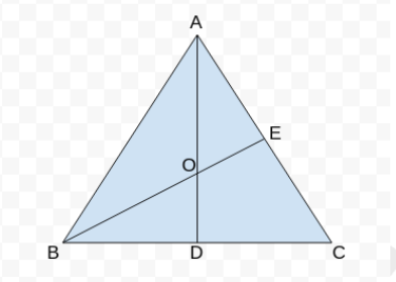
In quadrilateral
, the angles at
and
are right angles, so
.
is vertically opposite
, so
, giving
.
As
,
, so
.
In an isosceles triangle, the altitude
also bisects
. So in right triangle
,
and
.
In right triangle
,
is opposite the
angle at
, so
.
So
.
Option B,
, drops the factor 2: it would need
, but
is only half of
.
Hence, option C (
).
Q62MCQPolygons & Circles
A rectangle with the largest possible area is drawn inside a semicircle of radius 2 cm. Then, the ratio of the lengths of the largest to the smallest side of this rectangle is
- A
- B
- C
- D
Answer and solution
Answer: (A)
Place the rectangle with its base on the diameter, centred at the centre
of the semicircle. Let the half-base be
and the height
. A top corner lies on the arc, so the line from
to it is a radius.
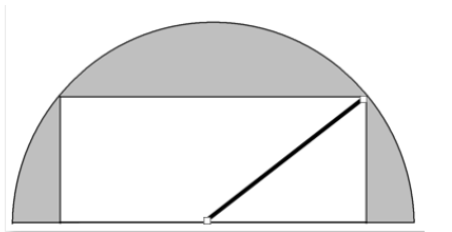
So
, and the area is
.
Since
,
, with equality only when
. So the largest area is 4, when
.
The sides of the rectangle are then the base
and the height
, a ratio of
.
Option B (
) is the ratio of the half-base to the height. The base is the full width
, twice the half-base, so the rectangle is not a square.
Hence, option A (
).
Q63TITAPolygons & Circles
In a regular polygon, any interior angle exceeds the exterior angle by 120 degrees. Then, the number of diagonals of this polygon is
Type in your answer (TITA). No negative mark for a wrong answer.
Answer and solution
Answer: 54
Interior
exterior
and interior
exterior
, so the exterior angle is
and the polygon has
sides.
Number of diagonals
.
Q64MCQSequences & Series
The value of
is
- A
- B
- C
- D
Answer and solution
Answer: (D)
The term with index
(
) is
.
The bracket is a geometric sum:
.
So the term is
.
Summing the two infinite geometric series:
and
.
Sum
.
A quick check on the options: the first two terms are
, so the sum exceeds
, which rules out
. Every bracket is less than
, so the sum is less than
, which rules out
and
.
Hence, option D (
).
Q65MCQSequences & Series
Let
and
be two sequences for natural numbers
. Then, the sum of all terms common to both the sequences is
- A14900
- B14798
- C15000
- D14602
Answer and solution
Answer: (A) 14900
for
gives
: every number from 54 to 846 that leaves remainder 6 on division by 8.
gives
: every number from 102 to 498 that leaves remainder 2 on division by 4.
A number that leaves remainder 6 on division by 8 also leaves remainder 2 on division by 4. So the common terms are the numbers of the form
from 102 to 498:
(498 leaves remainder 2 on division by 8, so the last one is 494).
There are
of them, and their sum is
.
Option B (14798) is this sum without the first common term, 102. But 102 is both
and
, so it must be counted.
Hence, option A (14900).
Q66TITAFunctions & Graphs
Suppose
is a real-valued function such that
, for all real numbers
and
. The value of
for which
, is
Type in your answer (TITA). No negative mark for a wrong answer.
Answer and solution
Answer: 3
Let
and
. Then
.
So
for all real
.
.