- CATin
- CAT past papers
- CAT 2023 Slot 3
- DILR
CAT 2023 Slot 3 — DILR questions with answers
All 20 questions of the Data Interpretation & Logical Reasoning section (12 MCQs, 8 TITA, 4 sets). Try each one, then open its answer and solution.
CAT 2023 Slot 3, timed like the real exam (120 minutes, 40 a section) and scored the CAT way: +3 right, −1 for a wrong MCQ, 0 for a wrong TITA, with the full post-mock analysis. Free — sign in and you come straight back to this paper.
Sit this paper as a timed mock in CATin — freeData Interpretation & Logical Reasoning
CAT 2023 Slot 3 · 40 minutes · +3 for a right answer, −1 for a wrong MCQ, 0 for a wrong TITA
Data set
Set for questions 25–29
DIRECTIONS for questions 25-29: Read the following carefully and answer the questions that follow.
An air conditioner (AC) company has four dealers - D1, D2, D3 and D4 in a city. It is evaluating sales performances of these dealers. The company sells two variants of ACs - Window and Split. Both these variants can be either Inverter type or Non-inverter type. It is known that of the total number of ACs sold in the city, 25% were of Window variant, while the rest were of Split variant. Among the Inverter ACs sold, 20% were of Window variant.
The following information is also known:
1. Every dealer sold at least two window ACs.
2. D1 sold 13 inverter ACs, while D3 sold 5 Non-inverter ACs.
3. A total of six Window Non-inverter ACs and 36 Split Inverter ACs were sold in the city.
4. The number of Split ACs sold by D1 was twice the number of Window ACs sold by it.
5. D3 and D4 sold an equal number of Window ACs and this number was one-third of the number of similar ACs sold by D2.
6. D2 and D3 were the only ones who sold Window Non-inverter ACs. The number of these ACs sold by D2 was twice the number of these ACs sold by D3.
7. D3 and D4 sold an equal number of Split Inverter ACs. This number was half the number of similar ACs sold by D2.
Q25TITATables & Caselets
How many Split Inverter ACs did D2 sell?
Type in your answer (TITA). No negative mark for a wrong answer.
Answer and solution
Answer: 14
Split inverter ACs are 36, which is 80% of inverter ACs, so inverter ACs
and Window inverter
. Window ACs
, which is 25% of the total, so the total is
and Split non-inverter
.
Only D2 and D3 sold Window non-inverter ACs, D2 twice D3: D2
, D3
.
Let D1 sell
Window ACs (all inverter), D3 and D4
each, and D2
. Then
with
, so
,
. D2's 6 Window ACs are 2 inverter and 4 non-inverter; D3's 2 are non-inverter; D4's 2 are inverter.
D1: Split
, of which inverter
and non-inverter
; total
.
Split inverter: D3
D4
and D2
, so
and
.
D3: its 5 non-inverter ACs are 2 Window and 3 Split, so its total is
.
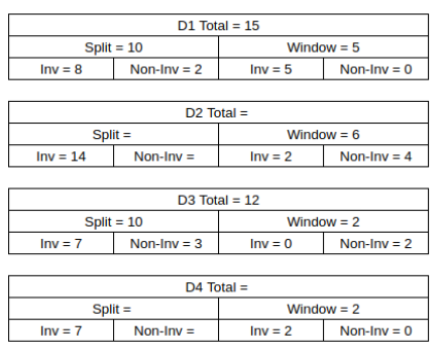
D2 sold
Split inverter ACs.
The answer is 14.
Q26MCQTables & Caselets
What percentage of ACs sold were of Non-inverter type?
- A33.33%
- B75.00%
- C25.00%
- D20.00%
Answer and solution
Answer: (C) 25.00%
Let the total number of ACs be
and the number of inverter ACs be
.
Among inverter ACs, 20% are Window, so 80% are Split:
, which gives
and Window inverter
.
Window ACs
(inverter plus non-inverter). They are 25% of all ACs, so
and Split ACs
.
Split non-inverter
.
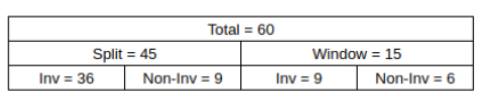
Non-inverter ACs
, which is
of all ACs.
B (75%) is the share of inverter ACs,
, and D (20%) is the Window share among inverter ACs; neither is the non-inverter share.
Hence, option C (25.00%).
Q27TITATables & Caselets
What was the total number of ACs sold by D2 and D4?
Type in your answer (TITA). No negative mark for a wrong answer.
Answer and solution
Answer: 33
Split inverter ACs are 36, which is 80% of inverter ACs, so inverter ACs
and Window inverter
. Window ACs
, which is 25% of the total, so the total is
and Split non-inverter
.
Only D2 and D3 sold Window non-inverter ACs, D2 twice D3: D2
, D3
.
Let D1 sell
Window ACs (all inverter), D3 and D4
each, and D2
. Then
with
, so
,
. D2's 6 Window ACs are 2 inverter and 4 non-inverter; D3's 2 are non-inverter; D4's 2 are inverter.
D1: Split
, of which inverter
and non-inverter
; total
.
Split inverter: D3
D4
and D2
, so
and
.
D3: its 5 non-inverter ACs are 2 Window and 3 Split, so its total is
.
D1 and D3 together sold
, so D2 and D4 together sold
.
The answer is 33.
Q28MCQTables & Caselets
Which of the following statements is necessarily false?
- AD2 sold the highest number of ACs.
- BD4 sold more Split ACs as compared to D3.
- CD1 and D3 sold an equal number of Split ACs.
- DD1 and D3 together sold more ACs as compared to D2 and D4 together.
Answer and solution
Answer: (D) D1 and D3 together sold more ACs as compared to D2 and D4 together.
The 36 Split inverter ACs are 80% of inverter ACs, so inverter ACs
and Window inverter
. Window ACs (
) are 25% of all ACs, so the total is
and Split non-inverter
.
Window non-inverter: only D2 and D3, D2 twice D3, so 4 and 2.
With D1 selling
Window ACs (all inverter), D3 and D4
each, D2
:
and
, so
,
.
D1: Split
, inverter
, non-inverter
, total
.
Split inverter, with D3
D4
and D2
:
, so
and D2 has
. D3: non-inverter
, total
.
The 4 Split non-inverter ACs left go
to D2,
to D4: D2 sold
, D4 sold
.
D1 and D3 sold
, D2 and D4
: D is always false.
A always holds (D2 at least 20, D4 at most 13). B holds when
(D4's Split 11, D3's 10). C holds (10 each).
Hence, option D (D1 and D3 together sold more ACs as compared to D2 and D4 together.).
Q29MCQTables & Caselets
If D3 and D4 sold an equal number of ACs, then what was the number of Non-inverter ACs sold by D2?
- A4
- B5
- C7
- D6
Answer and solution
Answer: (B) 5
Split inverter ACs are 36, which is 80% of inverter ACs, so inverter ACs
and Window inverter
. Window ACs
, which is 25% of the total, so the total is
and Split non-inverter
.
Window non-inverter: D2
, D3
(only they sold these, D2 twice D3).
With D1 selling
Window ACs (all inverter), D3 and D4
each and D2
:
and
, so
,
. D4's 2 Window ACs are inverter.
D1: Split
, of which inverter
and non-inverter
.
Split inverter:
, so
for D3 and D4. D3: non-inverter
, total
.
The 4 Split non-inverter ACs left go
to D2 and
to D4, so D4 sold
. If D4 equals D3's 12, then
.
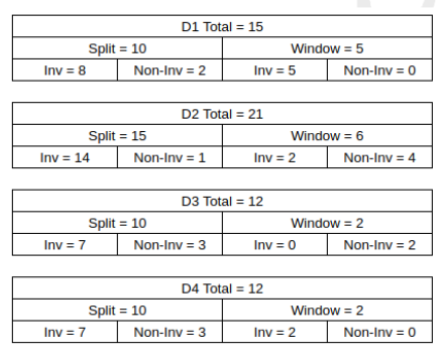
D2's non-inverter ACs
Split
Window
. A (4) counts only the Window non-inverter ACs.
Hence, option B (5).
Data set
Set for questions 30–34
DIRECTIONS for questions 30-34: Read the following carefully and answer the questions that follow.
Comprehension:
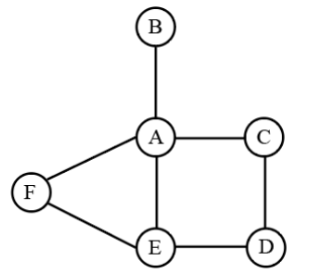
A, B, C, D, E and F are the six police stations in an area, which are connected by streets as shown below. Four teams - Team 1, Team 2, Team 3 and Team 4 - patrol these streets continuously between 09:00 hrs. and 12:00 hrs. each day.
The teams need 30 minutes to cross a street connecting one police station to another. All four teams start from Station A at 09:00 hrs. and must return to Station A by 12:00 hrs. They can also pass via Station A at any point on their journeys.
The following facts are known.
1. None of the streets has more than one team traveling along it in any direction at any point in time.
2. Teams 2 and 3 are the only ones in stations E and D respectively at 10:00 hrs.
3. Teams 1 and 3 are the only ones in station E at 10:30 hrs.
4. Teams 1 and 4 are the only ones in stations B and E respectively at 11:30 hrs.
5. Team 1 and Team 4 are the only teams that patrol the street connecting stations A and E.
6. Team 4 never passes through Stations B, D or F.
Q30MCQNetworks & Routes
Which one among the following stations is visited the largest number of times?
- AStation C
- BStation E
- CStation D
- DStation F
Answer and solution
Answer: (B) Station E
Four streets leave A (to B, C, E, F), and no street holds two teams at once, so at 9:00 each team takes a different one.
Only Teams 1 and 4 use A–E, so Team 2 (at E at 10:00) went A→F→E and Team 3 (at D) went A→C→D. Team 4 avoids B, so Team 4 took A→E and Team 1 took A→B.
At 10:00 Team 1 is back at A; Team 4 must leave E (only Team 2 is there) and avoids D and F, so it is at A.
At 10:30 Teams 1 and 3 reach E (A→E, D→E). Team 2 cannot use E–A or the busy E–D, so it goes to F; Team 4 cannot use the busy A–E, so it goes to C.
To be at B and E at 11:30, Team 1 runs E→A→B→A and Team 4 runs C→A→E→A.
Team 3 can return from E in three steps without A–E only by E→D→C→A. Team 2 ends F→A→F→A or F→E→F→A (F→A→C→A would share C–A with Team 3 after 11:30).
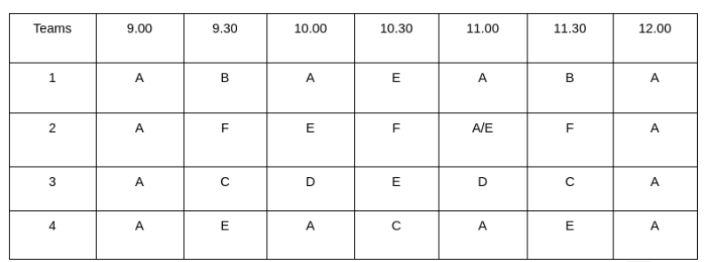
Visits: E gets 5 or 6 (Team 4 twice, Teams 1 and 3 once, Team 2 once or twice); C gets 3, F gets 3 and D gets 2.
Hence, option B (Station E).
Q31TITANetworks & Routes
How many times do the teams pass through Station B in a day?
Type in your answer (TITA). No negative mark for a wrong answer.
Answer and solution
Answer: 2
Four streets leave A (to B, C, E, F), and no street holds two teams at once, so at 9:00 each team takes a different one.
Only Teams 1 and 4 use A–E, so Team 2 (at E at 10:00) went A→F→E and Team 3 (at D) went A→C→D. Team 4 avoids B, so Team 4 took A→E and Team 1 took A→B.
At 10:00 Team 1 is back at A; Team 4 must leave E (only Team 2 is there) and avoids D and F, so it is at A.
At 10:30 Teams 1 and 3 reach E (A→E, D→E). Team 2 cannot use E–A or the busy E–D, so it goes to F; Team 4 cannot use the busy A–E, so it goes to C.
To be at B and E at 11:30, Team 1 runs E→A→B→A and Team 4 runs C→A→E→A.
Team 3 can return from E in three steps without A–E only by E→D→C→A. Team 2 ends F→A→F→A or F→E→F→A (F→A→B→A would share A–B with Team 1).
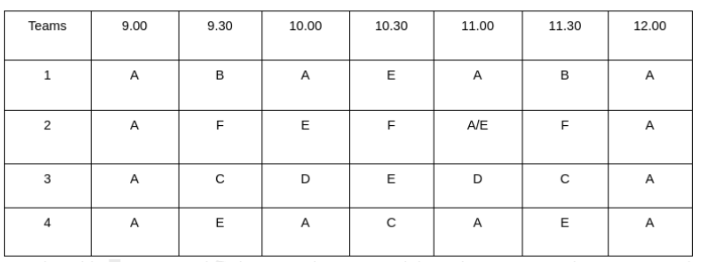
Only Team 1 reaches B, at 9:30 and at 11:30.
The answer is 2.
Q32MCQNetworks & Routes
Which team patrols the street connecting Stations D and E at 10:15 hrs?
- ATeam 4
- BTeam 1
- CTeam 2
- DTeam 3
Answer and solution
Answer: (D) Team 3
Four streets leave A (to B, C, E, F), and no street holds two teams at once, so at 9:00 each team takes a different one.
Only Teams 1 and 4 use A–E, so Team 2 (at E at 10:00) went A→F→E and Team 3 (at D) went A→C→D. Team 4 avoids B, so Team 4 took A→E and Team 1 took A→B.
At 10:00 Team 1 is back at A; Team 4 must leave E (only Team 2 is there) and avoids D and F, so it is at A.
At 10:30 Teams 1 and 3 reach E (A→E, D→E). Team 2 cannot use E–A or the busy E–D, so it goes to F; Team 4 cannot use the busy A–E, so it goes to C.
To be at B and E at 11:30, Team 1 runs E→A→B→A and Team 4 runs C→A→E→A; Team 3 returns by E→D→C→A.
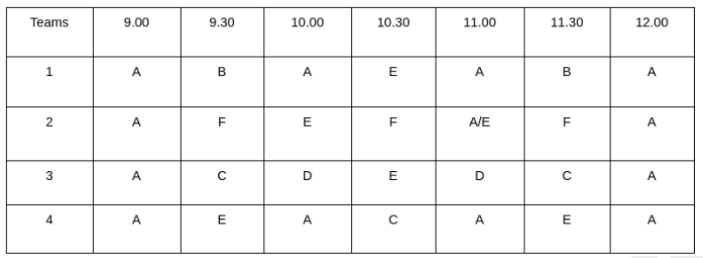
Between 10:00 and 10:30 Team 3 moves from D to E, so it is on street D–E at 10:15. At that time Team 1 is on A–E, Team 2 on E–F and Team 4 on A–C.
Hence, option D (Team 3).
Q33TITANetworks & Routes
How many times does Team 4 pass through Station E in a day?
Type in your answer (TITA). No negative mark for a wrong answer.
Answer and solution
Answer: 2
Four streets leave A (to B, C, E, F), and no street holds two teams at once, so at 9:00 each team takes a different one.
Only Teams 1 and 4 use A–E, so Team 2 (at E at 10:00) went A→F→E and Team 3 (at D) went A→C→D. Team 4 avoids B, so Team 4 took A→E and Team 1 took A→B.
At 10:00 Team 4 must leave E (only Team 2 is there); it avoids D and F, so it returns to A.
At 10:30 Teams 1 and 3 are the only ones at E, and Team 1 is travelling A→E, so Team 4 cannot use that street; it goes to C.
Team 4 must be at E at 11:30 and never enters B, D or F, so it goes C→A at 11:00, A→E at 11:30 and E→A at 12:00.
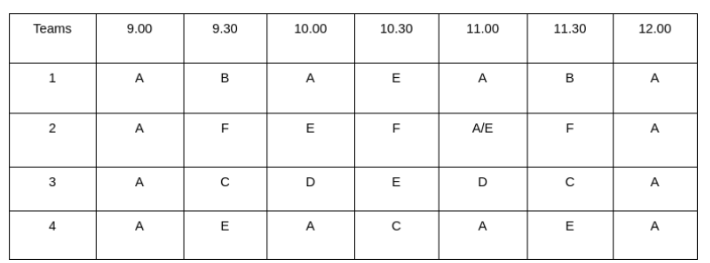
Team 4's route is A→E→A→C→A→E→A, so it is at E at 9:30 and at 11:30.
The answer is 2.
Q34MCQNetworks & Routes
How many teams pass through Station C in a day?
- A4
- B3
- C1
- D2
Answer and solution
Answer: (D) 2
Four streets leave A (to B, C, E, F), and no street holds two teams at once, so at 9:00 each team takes a different one.
Only Teams 1 and 4 use A–E, so Team 2 (at E at 10:00) went A→F→E and Team 3 (at D) went A→C→D. Team 4 avoids B, so Team 4 took A→E and Team 1 took A→B.
At 10:00 Team 1 is back at A; Team 4 must leave E (only Team 2 is there) and avoids D and F, so it is at A.
At 10:30 Teams 1 and 3 reach E (A→E, D→E). Team 2 cannot use E–A or the busy E–D, so it goes to F; Team 4 cannot use the busy A–E, so it goes to C.
To be at B and E at 11:30, Team 1 runs E→A→B→A and Team 4 runs C→A→E→A.
Team 3 can return from E in three steps without A–E only by E→D→C→A.
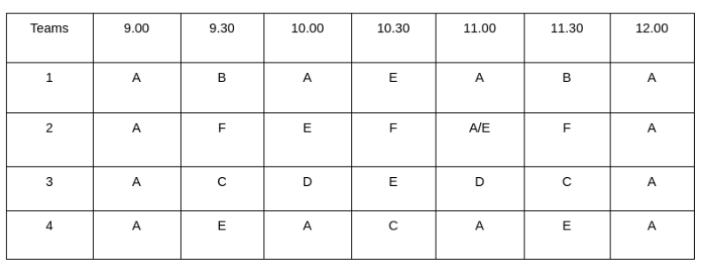
Teams 3 and 4 pass through C. Team 1 never does, and Team 2's only route via C, F→A→C→A, would put it on C–A with Team 3 after 11:30. So B (3) is impossible.
Hence, option D (2).
Data set
Set for questions 35–39
DIRECTIONS for questions 35-39: Read the following carefully and answer the questions that follow.
In a coaching class, some students register online, and some others register offline. No student registers both online and offline; hence the total registration number is the sum of online and offline registrations. The following facts and table pertain to these registration numbers for the five months - January to May of
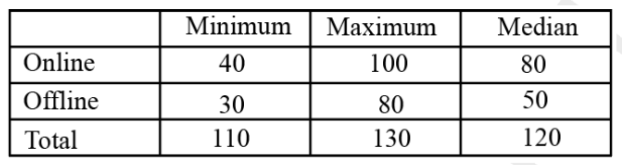
2023. The table shows the minimum, maximum, median registration numbers of these five months, separately for online, offline and total number of registrations. The following additional facts are known.
1. In every month, both online and offline registration numbers were multiples of 10.
2. In January, the number of offline registrations was twice that of online registrations.
3. In April, the number of online registrations was twice that of offline registrations.
4. The number of online registrations in March was the same as the number of offline registrations in February.
5. The number of online registrations was the largest in May.
Q35TITAMissing Value Tables
What was the total number of registrations in April?
Type in your answer (TITA). No negative mark for a wrong answer.
Answer and solution
Answer: 120
All numbers are multiples of 10, and every total is between 110 and 130.
January: offline is twice online, so the total is 3 times online, a multiple of 30: 120. January is 40 online, 80 offline. April likewise: 80 online, 40 offline, total 120.
May has the largest online number, 100. With a total of at most 130, its offline is at most 30, the minimum: May is 100 and 30, total 130.
Let February be
online,
offline; March online is also
, March offline
.
The online median 80 (values 40, 80, 100,
,
) needs
or
to be at least 80. If
, the offline median 50 forces
, March totals 130, and February must be the minimum 110, so
, below the online minimum. So
, and
gives
. Offline values 30, 40, 80,
,
then have median 50 only if
. So
, and March must be the minimum:
,
.
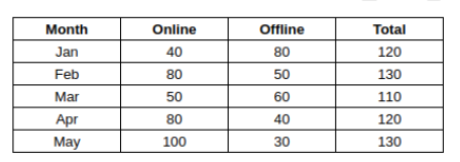
April's total is
.
The answer is 120.
Q36TITAMissing Value Tables
What was the number of online registrations in January?
Type in your answer (TITA). No negative mark for a wrong answer.
Answer and solution
Answer: 40
All numbers are multiples of 10, and every total is between 110 and 130.
January: offline is twice online, so the total is 3 times online. It must be a multiple of 30 between 110 and 130, so it is 120, and January's online figure is
, with 80 offline.
April likewise: 80 online, 40 offline, total 120. May has the largest online number, 100; with a total of at most 130, its offline is the minimum 30.
Let February be
online,
offline; March online is also
, March offline
. The online median 80 needs
or
to be at least 80. If
, the offline median forces
, March totals 130, and February must be the minimum 110, giving
, below the online minimum. So
and
; the offline median 50 then forces
, so
, and March gives the minimum:
.
January had 40 online registrations.
The answer is 40.
Q37MCQMissing Value Tables
Which of the following statements can be true?
I. The number of offline registrations was the smallest in May.
II. The total number of registrations was the smallest in February.
- ABoth I and II
- BOnly II
- CNeither I nor II
- DOnly I
Answer and solution
Answer: (D) Only I
All numbers are multiples of 10, and every total is between 110 and 130.
January: offline is twice online, so the total is 3 times online, a multiple of 30: 120. January is 40 online, 80 offline. April likewise: 80 online, 40 offline, total 120.
May has the largest online number, 100. With a total of at most 130, its offline is at most 30, the minimum: May is 100 and 30, total 130.
Let February be
online,
offline; March online is also
, March offline
.
The online median 80 (values 40, 80, 100,
,
) needs
or
to be at least 80. If
, the offline median 50 forces
, March totals 130, and February must be the minimum 110, so
, below the online minimum. So
, and
gives
. Offline values 30, 40, 80,
,
then have median 50 only if
. So
, and March must be the minimum:
,
.
I is true: May's 30 offline is the smallest. II is false: February totals 130, March 110.
Hence, option D (Only I).
Q38MCQMissing Value Tables
What best can be concluded about the number of offline registrations in February?
- A80
- B50 or 80
- C30 or 50 or 80
- D50
Answer and solution
Answer: (D) 50
All numbers are multiples of 10, and every total is between 110 and 130.
January: offline is twice online, so the total is 3 times online, a multiple of 30: 120. January is 40 online, 80 offline. April likewise: 80 online, 40 offline, total 120.
May has the largest online number, 100. With a total of at most 130, its offline is at most 30, the minimum: May is 100 and 30, total 130.
Let February be
online,
offline; March online is also
, March offline
.
The online median 80 (values 40, 80, 100,
,
) needs
or
to be at least 80. If
, the offline median 50 forces
, March totals 130, and February must be the minimum 110, so
, below the online minimum. So
, and
gives
. Offline values 30, 40, 80,
,
then have median 50 only if
(30 or 40 would make the median 40 or less).
So February's offline figure is exactly 50; 80 and 30 are both ruled out, so B and C fail.
Hence, option D (50).
Q39MCQMissing Value Tables
Which pair of months definitely had the same total number of registrations?
I. January and April II. February and May
- ABoth I and II
- BOnly II
- COnly I
- DNeither I nor II
Answer and solution
Answer: (A) Both I and II
All numbers are multiples of 10, and every total is between 110 and 130.
January: offline is twice online, so the total is 3 times online, a multiple of 30: 120. January is 40 online, 80 offline. April likewise: 80 online, 40 offline, total 120.
May has the largest online number, 100. With a total of at most 130, its offline is at most 30, the minimum: May is 100 and 30, total 130.
Let February be
online,
offline; March online is also
, March offline
.
The online median 80 (values 40, 80, 100,
,
) needs
or
to be at least 80. If
, the offline median 50 forces
, March totals 130, and February must be the minimum 110, so
, below the online minimum. So
, and
gives
. Offline values 30, 40, 80,
,
then have median 50 only if
. So
(February totals 130), and March gives the minimum:
.
The table is unique: January and April total 120, February and May 130.
Hence, option A (Both I and II).
Data set
Set for questions 40–44
DIRECTIONS for questions 40-44: Read the following carefully and answer the questions that follow.
There are only three female students - Amala, Koli and Rini - and only three male students - Biman, Mathew and Shyamal - in a course. The course has two evaluation components, a project and a test. The aggregate score in the course is a weighted average of the two components, with the weights being positive and adding to 1.
The projects are done in groups of two, with each group consisting of a female and a male student. Both the group members obtain the same score in the project.
The following additional facts are known about the scores in the project and the test.
1. The minimum, maximum and the average of both project and test scores were identical - 40, 80 and 60, respectively.
2. The test scores of the students were all multiples of 10; four of them were distinct and the remaining two were equal to the average test scores.
3. Amala’s score in the project was double that of Koli in the same, but Koli scored 20 more than Amala in the test. Yet Amala had the highest aggregate score.
4. Shyamal scored the second highest in the test. He scored two more than Koli, but two less than Amala in the aggregate.
5. Biman scored the second lowest in the test and the lowest in the aggregate.
6. Mathew scored more than Rini in the project, but less than her in the test.
Q40TITALogical Puzzles
What was Rini’s score in the project?
Type in your answer (TITA). No negative mark for a wrong answer.
Answer and solution
Answer: 60
Project: the three pair scores have minimum 40, maximum 80 and average 60, so they are 40, 60 and 80. Amala's is double Koli's: Amala 80, Koli 40, so Rini 60.
Test: the scores total
; two are 60, and the four distinct ones include 40 and 80, so the other two sum to 120: 50 and 70.
Shyamal is second in the test: 70. Koli is 20 above Amala, so (Amala, Koli) is (40, 60) or (60, 80). Shyamal is 2 below Amala and 2 above Koli, so Amala exceeds Koli by 4. Let
be the project weight.
(40, 60):
gives
and Amala 56, but Shyamal gets at least
. Rejected.
(60, 80):
gives
: Amala 68, Koli 64, Shyamal 66, so Shyamal's project is
, with Rini.
Mathew beats Rini in the project: Mathew 80 (with Amala), Biman 40 (with Koli). Biman is second lowest in the test (50); Mathew is below Rini: Mathew 40, Rini 60.
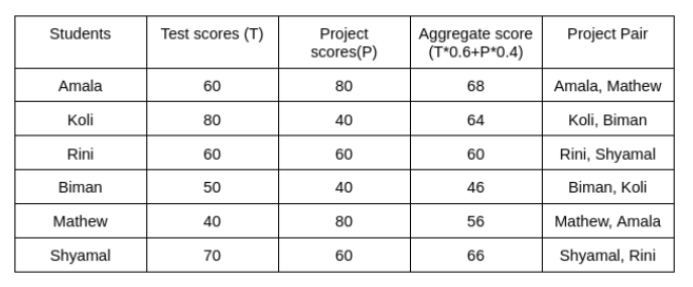
Rini's project score is 60.
The answer is 60.
Q41MCQLogical Puzzles
What was the weight of the test component?
- A0.60
- B0.50
- C0.75
- D0.40
Answer and solution
Answer: (A) 0.60
Project: the three pair scores have minimum 40, maximum 80 and average 60, so they are 40, 60 and 80. Amala's is double Koli's: Amala 80, Koli 40, so Rini 60.
Test: the scores total
; two are 60, and the four distinct ones include 40 and 80, so the other two sum to 120: 50 and 70.
Shyamal is second in the test: 70. Koli is 20 above Amala, so (Amala, Koli) is (40, 60) or (60, 80). Shyamal is 2 below Amala and 2 above Koli, so Amala exceeds Koli by 4. Let
be the project weight.
(40, 60):
gives
and Amala 56, but Shyamal gets at least
, beating Amala. Rejected.
(60, 80):
gives
, so
: Amala 68, Koli 64, Shyamal 66, and the rest of the table follows.
The project weight is 0.4, so the test weight is
. D (0.40) is the project weight, not the test weight.
Hence, option A (0.60).
Q42MCQLogical Puzzles
What was the maximum aggregate score obtained by the students?
- A68
- B80
- C62
- D66
Answer and solution
Answer: (A) 68
Project: the three pair scores have minimum 40, maximum 80 and average 60, so they are 40, 60 and 80. Amala's is double Koli's: Amala 80, Koli 40, so Rini 60.
Test: the scores total
; two are 60, and the four distinct ones include 40 and 80, so the other two sum to 120: 50 and 70.
Shyamal is second in the test: 70. Koli is 20 above Amala, so (Amala, Koli) is (40, 60) or (60, 80). Shyamal is 2 below Amala and 2 above Koli, so Amala exceeds Koli by 4. Let
be the project weight.
(40, 60):
gives
and Amala 56, but Shyamal gets at least
. Rejected.
(60, 80):
gives
: Amala 68, Koli 64, Shyamal 66 (project 60, with Rini). Mathew beats Rini in the project, so Mathew 80, Biman 40; Biman's test is 50, Mathew's 40, Rini's 60.
Aggregates: Amala 68, Shyamal 66, Koli 64, Rini 60, Mathew 56, Biman 46. The maximum is Amala's 68; 66 is second, and 80 is only a top component score.
Hence, option A (68).
Q43TITALogical Puzzles
What was Mathew’s score in the test?
Type in your answer (TITA). No negative mark for a wrong answer.
Answer and solution
Answer: 40
Project: the pairs share scores with minimum 40, maximum 80 and average 60, so the three pair scores are 40, 60 and 80. Amala's is double Koli's, so Amala has 80, Koli 40 and Rini 60.
Test: the scores are multiples of 10 adding to
. Two are 60, and the four distinct ones include 40 and 80, so the other two add to 120 and must be 50 and 70. Shyamal (second highest) has 70 and Biman (second lowest) has 50.
Let the project weight be
. Koli's test score is Amala's plus 20, and Amala's aggregate is 4 more than Koli's, since Shyamal is 2 above Koli and 2 below Amala. So
, giving
.
If Amala had scored 40 in the test, her aggregate would be
and Shyamal's
, giving
, which is not a project score. So Amala scored 60 and Koli 80.
That leaves test scores 40 and 60 for Rini and Mathew. Mathew scored less than Rini, so Mathew scored 40.
The answer is 40.
Q44MCQLogical Puzzles
Which of the following pairs of students were part of the same project team?
i) Amala and Biman
ii) Koli and Mathew
- AOnly ii)
- BOnly i)
- CNeither i) nor ii)
- DBoth i) and ii)
Answer and solution
Answer: (C) Neither i) nor ii)
Project: the three pair scores have minimum 40, maximum 80 and average 60, so they are 40, 60 and 80. Amala's is double Koli's: Amala 80, Koli 40, so Rini 60.
Test: the scores total
; two are 60, and the four distinct ones include 40 and 80, so the other two sum to 120: 50 and 70.
Shyamal is second in the test: 70. Koli is 20 above Amala, so (Amala, Koli) is (40, 60) or (60, 80). Shyamal is 2 below Amala and 2 above Koli, so Amala exceeds Koli by 4. Let
be the project weight.
(40, 60):
gives
and Amala 56, but Shyamal gets at least
. Rejected.
(60, 80):
gives
: Amala 68, Shyamal 66, so Shyamal's project is
, with Rini.
Mathew beats Rini in the project, so Mathew has 80 (with Amala) and Biman 40 (with Koli).
The teams are Amala–Mathew, Koli–Biman and Rini–Shyamal. Neither Amala–Biman nor Koli–Mathew is a team; D swaps the male partners.
Hence, option C (Neither i) nor ii)).