- CATin
- CAT past papers
- CAT 2023 Slot 2
- QA
CAT 2023 Slot 2 — QA questions with answers
All 22 questions of the Quantitative Ability section (14 MCQs, 8 TITA). Try each one, then open its answer and solution.
CAT 2023 Slot 2, timed like the real exam (120 minutes, 40 a section) and scored the CAT way: +3 right, −1 for a wrong MCQ, 0 for a wrong TITA, with the full post-mock analysis. Free — sign in and you come straight back to this paper.
Sit this paper as a timed mock in CATin — freeQuantitative Ability
CAT 2023 Slot 2 · 40 minutes · +3 for a right answer, −1 for a wrong MCQ, 0 for a wrong TITA
Q45MCQIndices & Surds
Let
,
,
and
be natural numbers such that
and
. If
, then the largest possible value of
is
- A580
- B290
- C289
- D579
Answer and solution
Answer: (D) 579
Since
, we have
.
To make
as large as possible, make
large and
small.
How large can
be? If
is even,
divides
, which divides
, so
. If
is odd, it is a power of 3, so
divides
, which divides
, so
. So
, with
only when
.
The smallest natural number
is 1.
Both extremes can happen together: take
,
,
,
. Then
, with
and
.
So the largest value of
is
.
Option A (580) would need
, but
is a natural number, so
.
Hence, option D (579).
Q46MCQInequalities & Modulus
Any non-zero real numbers
,
such that
and
, will satisfy the condition:
- A
- BIf , then
- CIf , then
- DIf , then
Answer and solution
Answer: (B) If , then
Bring everything to one side:
.
Dividing by
reverses the sign:
.
If
, then
and
are both negative, so
. The inequality then needs
, that is,
. So option B always holds.
Option D fails: take
,
. Then
, so the condition holds, but
.
Option C fails: if
, then
, so again
, which gives
, the opposite of C.
Option A fails:
,
satisfies the condition (
), but
is false.
Hence, option B (If
, then
).
Q47MCQProperties of Numbers
For any natural numbers
,
, and
, such that
divides both
and
,
must be a common divisor of
- A and
- B and
- C and
- D and
Answer and solution
Answer: (C) and
If
divides two numbers, it divides any integer combination of them.
divides
, so it divides
. It also divides
, so it divides the difference
.
Likewise,
divides
, so it divides
.
So
is always a common divisor of
and
.
The other options need not hold. Take
and
: then
and
, so
divides both. But
does not divide
(options A and D) or
(option B).
Hence, option C (
and
).
Q48MCQIndices & Surds
The sum of all possible values of
satisfying the equation
, is
- A3
- B
- C
- D
Answer and solution
Answer: (D)
Let
and
. Then
,
and
.
So the equation is
, that is,
, so
:
.
Factorising,
, so
or
. Both satisfy the original equation, since every step can be reversed.
The sum of the values is
.
Option A (3) counts only the root
and misses
.
Hence, option D (
).
Q49TITAProperties of Numbers
The number of positive integers less than 50, having exactly two distinct factors other than 1 and itself, is
Type in your answer (TITA). No negative mark for a wrong answer.
Answer and solution
Answer: 15
A number with exactly two factors other than 1 and itself has exactly 4 factors in all. A number has exactly 4 factors only in two forms:
for a prime
(factors
), or
for distinct primes
and
(factors
).
Cubes of primes below 50:
and
(
is too big). That is 2 numbers.
Products of two distinct primes below 50:
With 2:
, which is 8 numbers.
With 3 and a larger prime:
, which is 4 numbers (
is too big).
With 5 and a larger prime: only
, which is 1 number.
That gives
products.
Total:
.
The answer is 15.
Q50TITALogarithms
For some positive real number
, if
, then the value of
is
Type in your answer (TITA). No negative mark for a wrong answer.
Answer and solution
Answer: 7
.
(as
).
So
, which gives
.
.
Q51TITAQuadratic & Polynomial Equations
Let
be the largest integer such that the equation
has no real roots. If
is a positive real number, then the least possible value of
is
Type in your answer (TITA). No negative mark for a wrong answer.
Answer and solution
Answer: 6
Expand:
.
No real roots means the discriminant is negative:
.
Since
is an integer,
, so
. The largest
is 4 (
gives
).
Then
.
For
, by AM-GM:
.
Equality holds when
, that is,
, which is a positive real number. Check:
.
So the least value is 6.
The answer is 6.
Q52MCQTime & Work
Pipes A and C are fill pipes while Pipe B is a drain pipe of a tank. Pipe B empties the full tank in one hour less than the time taken by Pipe A to fill the empty tank. When pipes A, B and C are turned on together, the empty tank is filled in two hours. If pipes B and C are turned on together when the tank is empty and Pipe B is turned off after one hour, then Pipe C takes another one hour and 15 minutes to fill the remaining tank. If Pipe A can fill the empty tank in less than five hours, then the time taken, in minutes, by Pipe C to fill the empty tank is
- A90
- B120
- C75
- D60
Answer and solution
Answer: (A) 90
Let Pipe A fill the tank in
hours, so Pipe B empties it in
hours, and let Pipe C fill it in
hours.
All three together fill it in 2 hours:
(1)
B runs for 1 hour and C for
hours:
(2)
Subtracting (2) from (1):
, so
.
Putting this into (2):
. Multiplying by
:
, so
and
or
.
A takes less than 5 hours, so
. Then (2) gives
, so
hours
minutes.
Check (1):
.
Option B (120 minutes,
) would make (2) give
, breaking both (1) and the 5-hour limit.
Hence, option A (90).
Q53MCQSimple & Compound Interest
Anil borrows Rs 2 lakhs at an interest rate of 8% per annum, compounded half-yearly. He repays Rs 10320 at the end of the first year and closes the loan by paying the outstanding amount at the end of the third year. Then, the total interest, in rupees, paid over the three years is nearest to
- A45311
- B51311
- C33130
- D40991
Answer and solution
Answer: (B) 51311
8% a year compounded half-yearly is 4% per half-year, a factor of
each half-year.
After the first year (two half-years):
. Interest so far: Rs 16320.
He repays Rs 10320, so
is outstanding.
This grows for two more years (four half-years):
. Interest in these two years:
.
Total interest:
.
Check: he pays
in all on a loan of 200000, which is the same Rs 51310.86 of interest.
Option D (40991) is
: it leaves out the Rs 10320 paid after the first year.
Hence, option B (51311).
Q54MCQTime, Speed & Distance
Ravi is driving at a speed of 40 km/h on a road. Vijay is 54 meters behind Ravi and driving in the same direction as Ravi. Ashok is driving along the same road from the opposite direction at a speed of 50 km/h and is 225 meters away from Ravi. The speed, in km/h, at which Vijay should drive so that all the three cross each other at the same time, is
- A58.8
- B67.2
- C61.6
- D64.4
Answer and solution
Answer: (C) 61.6
Convert to m/s by multiplying by
: Ravi goes at
m/s and Ashok at
m/s.
Ravi and Ashok approach each other, so their relative speed is
m/s. They meet after
seconds.
In those 9 seconds Ravi covers
m. Vijay starts 54 m behind Ravi, so to reach the same point at the same moment he must cover
m in 9 seconds.
Vijay's speed is
m/s
km/h.
Check: Vijay must gain 54 m on Ravi in 9 s, which is 6 m/s or 21.6 km/h, and
.
Option A (58.8 km/h) is too slow: it covers only
m in 9 seconds, 7 m short.
Hence, option C (61.6).
Q55MCQProfit, Loss & Discount
Minu purchases a pair of sunglasses at Rs.1000 and sells to Kanu at 20% profit. Then, Kanu sells it back to Minu at 20% loss. Finally, Minu sells the same pair of sunglasses to Tanu. If the total profit made by Minu from all her transactions is Rs.500, then the percentage of profit made by Minu when she sold the pair of sunglasses to Tanu is
- A35.42%
- B52%
- C31.25%
- D26%
Answer and solution
Answer: (C) 31.25%
Minu buys the sunglasses for Rs 1000 and sells them to Kanu at 20% profit:
. Her profit on this sale is Rs 200.
Kanu sells them back to Minu at a 20% loss on his cost of Rs 1200:
. So Minu's new cost is Rs 960.
Her total profit is Rs 500, so the sale to Tanu must bring
. She sells to Tanu for
.
Profit percentage on this sale:
.
Check: she paid
and received
, a profit of Rs 500.
Option B (52%) credits the whole Rs 500 to the last sale (
), but Rs 200 of it was earned from Kanu.
Hence, option C (31.25%).
Q56MCQRatios, Proportions & Partnership
The price of a precious stone is directly proportional to the square of its weight. Sita has a precious stone weighing 18 units. If she breaks it into four pieces with each piece having distinct integer weight, then the difference between the highest and lowest possible values of the total price of the four pieces will be 288000. Then, the price of the original precious stone is
- A1944000
- B972000
- C1620000
- D1296000
Answer and solution
Answer: (D) 1296000
Let price
. The original stone costs
.
The four pieces have distinct positive integer weights summing to 18, and their total price is
times the sum of their squares.
Lowest total: the sum of squares is smallest when the weights are as equal as possible. Four distinct integers closest to
are 3, 4, 5, 6, giving
, so the price is
.
Highest total: make one piece as large as possible by keeping the other three as small as possible: 1, 2, 3 and 12. This gives
, so the price is
.
Difference:
, so
.
Original price:
.
Option A (1944000) would need
, making the difference
, not 288000.
Hence, option D (1296000).
Q57MCQAverages, Mixtures & Alligations
In a company, 20% of the employees work in the manufacturing department. If the total salary obtained by all the manufacturing employees is one-sixth of the total salary obtained by all the employees in the company, then the ratio of the average salary obtained by the manufacturing employees to the average salary obtained by the nonmanufacturing employees is
- A6:5
- B4:5
- C5:4
- D5:6
Answer and solution
Answer: (B) 4:5
Let the company have
employees and a total salary of
.
Manufacturing:
employees share
, so their average salary is
.
Non-manufacturing:
employees share
, so their average salary is
.
Ratio:
.
Check: manufacturing staff are 20% of the employees but receive only about 16.7% of the salary, so their average must be lower, as
shows.
Option C (5:4) is the same ratio reversed; it would make manufacturing employees earn more on average.
Hence, option B (4:5).
Q58TITALinear Equations
If a certain amount of money is divided equally among
persons, each one receives Rs 352. However, if two persons receive Rs 506 each and the remaining amount is divided equally among the other persons, each of them receive less than or equal to Rs 330. Then, the maximum possible value of
is
Type in your answer (TITA). No negative mark for a wrong answer.
Answer and solution
Answer: 16
The total amount is
.
If two persons get Rs 506 each, the remaining
is shared equally by the other
persons, and each gets at most Rs 330:
, so
.
Check
: the total is
. After Rs 1012 for the two persons, Rs 4620 is left for 14 persons, exactly Rs 330 each. That is allowed, since each may receive less than or equal to Rs 330.
So the maximum possible value of
is 16.
The answer is 16.
Q59TITAProfit, Loss & Discount
Jayant bought a certain number of white shirts at the rate of Rs 1000 per piece and a certain number of blue shirts at the rate of Rs 1125 per piece. For each shirt, he then set a fixed market price which was 25% higher than the average cost of all the shirts. He sold all the shirts at a discount of 10% and made a total profit of Rs.51000. If he bought both colors of shirts, then the maximum possible total number of shirts that he could have bought is
Type in your answer (TITA). No negative mark for a wrong answer.
Answer and solution
Answer: 407
Let him buy
white and
blue shirts. Total cost
.
The marked price is
times the average cost, and a 10% discount leaves
times the average cost. So every shirt sells for
more than the average cost, and the total profit is
of the total cost:
.
Dividing by 125:
.
Then
, which is largest when
is smallest.
For
to be a whole number,
must be divisible by 8. Since
,
must be divisible by 8, so
is a multiple of 8. He bought both colours, so
, and the least value is
.
Then
, and
.
The answer is 407.
Q60TITAAverages, Mixtures & Alligations
A container has 40 liters of milk. Then, 4 liters are removed from the container and replaced with 4 liters of water. This process of replacing 4 liters of the liquid in the container with an equal volume of water is continued repeatedly. The smallest number of times of doing this process, after which the volume of milk in the container becomes less than that of water, is
Type in your answer (TITA). No negative mark for a wrong answer.
Answer and solution
Answer: 7
Each time, 4 litres of the 40-litre mixture, one tenth of it, is removed, so one tenth of the milk goes and
of it remains.
After
replacements the milk is
litres. The total stays 40 litres, so milk is less than water when milk is below 20 litres:
.
Powers of 0.9:
,
,
,
,
,
.
After 6 replacements the milk is about
litres, still more than the water. After 7 it is about
litres, less than the water.
The answer is 7.
Q61MCQPolygons & Circles
A triangle is drawn with its vertices on the circle
such that one of its sides is a diameter of
and the other two sides have their lengths in the ratio
. If the radius of the circle is
, then the area of the triangle is
- A
- B
- C
- D
Answer and solution
Answer: (B)
A triangle with a diameter as one side has a right angle opposite it (the angle in a semicircle). Let BC be the diameter, so
and
.
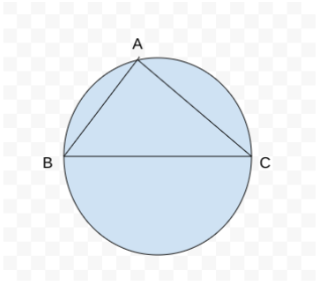
The other two sides are in the ratio
, so let
and
for some
.
By Pythagoras,
:
, so
.
The area of a right triangle is half the product of its legs:
Area
.
Check with
: the triangle is right-angled and isosceles on a hypotenuse
with height
, so its area is
, and the formula gives
. Option C would give
, twice too much.
Hence, option B (
).
Q62MCQPolygons & Circles
In a rectangle
,
cm and
cm.
and
are two points on
such that the areas of the figures
,
, and
are in geometric progression. If the area of the figure
is four times the area of triangle
, then
is
- A1:2:4
- B1:2:1
- C2:4:1
- D1:1:2
Answer and solution
Answer: (C) 2:4:1
The areas of ABP, APQ and AQCD are in GP, and the third is 4 times the first, so the common ratio is
. Let the areas be
,
and
.
Join AC.
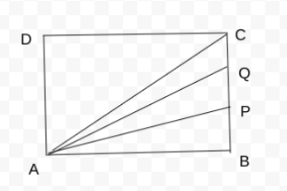
Triangles ABP, APQ and AQC have their bases on BC and the same height AB, so their areas are in the ratio
.
The diagonal AC halves the rectangle, so triangles ABC and ACD have equal areas. Let the area of triangle AQC be
. Then
area of ABC
, and area of ACD
area of AQCD
.
Setting them equal:
, so
.
So
.
Check: the rectangle's area is
, so
,
and
, which add up to
.
Option A (1:2:4) copies the ratio of the three areas, but AQCD is a quadrilateral, not a triangle on QC.
Hence, option C (2:4:1).
Q63TITACoordinate Geometry
The area of the quadrilateral bounded by the Y-axis, the line
, and the lines
, is
Type in your answer (TITA). No negative mark for a wrong answer.
Answer and solution
Answer: 45
The region lies between the Y-axis (
) and
, so take
. There
, and the equation becomes
.
So
or
, which gives two lines:
and
.
At
they give
and
; at
they give
and
. So the quadrilateral has vertices A
, B
, D
and E
.
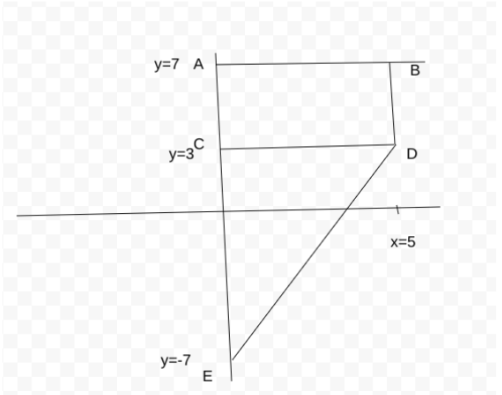
Split it along
, with C at
:
Rectangle ABDC:
.
Triangle CDE: base CE
along the Y-axis and height 5, so its area is
.
Total area
.
Equivalently, it is a trapezium with parallel sides 14 and 4, a distance 5 apart:
.
The answer is 45.
Q64MCQSequences & Series
Let both the series
and
be in arithmetic progression such that the common differences of both the series are prime numbers. If
,
and
, then
equals
- A86
- B79
- C83
- D84
Answer and solution
Answer: (B) 79
Let the first terms be
and
, and the common differences
and
, both prime.
, so
.
:
.
:
.
Subtracting the first from the second:
, i.e.
. So
divides
, hence
divides
; as
is prime,
and then
.
Then
, and
.
Check:
and
.
Option D (84) is
, which is
, one term too far.
Hence, option B (79).
Q65MCQQuadratic & Polynomial Equations
If
, then the difference between the maximum and minimum possible value of
is
- A243
- B486
- C378
- D189
Answer and solution
Answer: (C) 378
From
:
, so
.
From
:
.
Then
, so
or
.
Now
.
So
is
or
. Both occur:
,
gives 189, and
,
gives
.
The difference between the maximum and the minimum is
.
Option D (189) is the maximum value alone, not the difference.
Hence, option C (378).
Q66TITASequences & Series
Let
and
be two sequences such that
and
for all natural numbers
. Then, the largest three digit integer that is common to both these sequences, is
Type in your answer (TITA). No negative mark for a wrong answer.
Answer and solution
Answer: 967
gives 13, 19, 25, 31, 37, 43, …, and
gives 15, 22, 29, 36, 43, …
The first common term is 43. From there, a number stays in both sequences only if the step is a multiple of both 6 and 7, so the common terms rise in steps of
:
common terms
, for
For the largest three-digit one:
, so
.
The term is
.
Check:
and
, so it lies in both sequences. The next common term,
, has four digits.
The answer is 967.