CATin
  1. CATin
  2. CAT past papers
  3. CAT 2023 Slot 2
  4. DILR

CAT 2023 Slot 2 — DILR questions with answers

All 20 questions of the Data Interpretation & Logical Reasoning section (12 MCQs, 8 TITA, 4 sets). Try each one, then open its answer and solution.

CAT 2023 Slot 2, timed like the real exam (120 minutes, 40 a section) and scored the CAT way: +3 right, −1 for a wrong MCQ, 0 for a wrong TITA, with the full post-mock analysis. Free — sign in and you come straight back to this paper.

Sit this paper as a timed mock in CATin — free

Data Interpretation & Logical Reasoning

CAT 2023 Slot 2 · 40 minutes · +3 for a right answer, −1 for a wrong MCQ, 0 for a wrong TITA

Data set

Set for questions 25–29

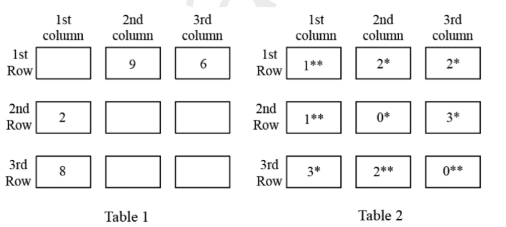
DIRECTIONS for questions 25-29: Read the following carefully and answer the questions that follow. There are nine boxes arranged in a 3×3 array as shown in Tables 1 and 2. Each box contains three sacks. Each sack has a certain number of coins, between 1 and 9, both inclusive.
DILR Set 25-29 Diagram
The average number of coins per sack in the boxes are all distinct integers. The total number of coins in each row is the same. The total number of coins in each column is also the same. Table 1 gives information regarding the median of the numbers of coins in the three sacks in a box for some of the boxes. In Table 2 each box has a number which represents the number of sacks in that box having more than 5 coins. That number is followed by a * if the sacks in that box satisfy exactly one among the following three conditions, and it is followed by ** if two or more of these conditions are satisfied. i) The minimum among the numbers of coins in the three sacks in the box is 1. ii) The median of the numbers of coins in the three sacks is 1. iii) The maximum among the numbers of coins in the three sacks in the box is 9.

Q25MCQLogical Puzzles

What is the total number of coins in all the boxes in the 3rd row?
  1. 36
  2. 30
  3. 15
  4. 45
Answer and solution

Answer: (D) 45

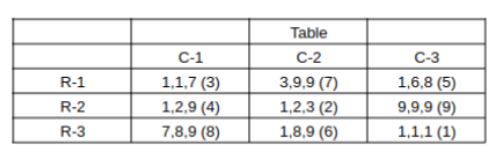
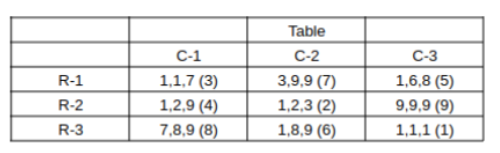
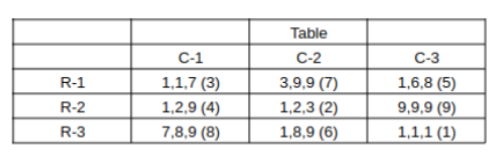
The nine box averages are distinct integers from 1 to 9, so they are exactly 1, 2, …, 9. A box holds 3 times its average, so all the boxes together hold 3×(1+2+⋯+9)=3×45=1353 \times (1 + 2 + \dots + 9) = 3 \times 45 = 135 coins. The three rows have equal totals, so each row, including the 3rd, holds 135÷3=45135 \div 3 = 45 coins. The completed grid confirms this: Solution figure for question 25, CAT 2023 Slot 2 Row 3 has boxes of 7, 8, 9; 1, 8, 9; and 1, 1, 1 coins, which total 24+18+3=4524 + 18 + 3 = 45. Option C (15) is the sum of the three box averages in a row, not the number of coins; each box holds three sacks, so the coins are 3 times that. Hence, option D (45).
Q26MCQLogical Puzzles

How many boxes have at least one sack containing 9 coins?
  1. 3
  2. 4
  3. 5
  4. 8
Answer and solution

Answer: (C) 5

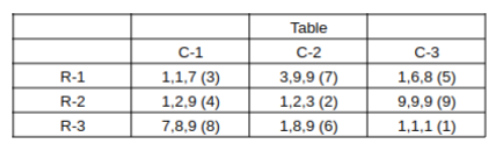
The nine averages are distinct integers from 1 to 9, so exactly 1 to 9; equal row and column totals make each row's and column's averages sum to 15. (r,c) is row r, column c. (3,1): median 8, all sacks above 5, one star, so only 'maximum 9' holds; divisibility by 3 gives 7, 8, 9 (average 8). (2,1): median 2, two stars, so minimum 1 and maximum 9: 1, 2, 9 (average 4). (1,2): median 9 and only two sacks above 5, so 9, 9 and one of 2 to 5 (one star rules out 1); divisibility by 3 gives 3, 9, 9 (average 7). So (1,1) = 3 and (1,3) = 5. Rows 2 and 3 need pairs from 1, 2, 6, 9 summing to 11 and 7; column 2 needs 8: (2,2) = 2, (2,3) = 9, (3,2) = 6, (3,3) = 1. Table 2 gives (1,1) 1, 1, 7 (a 9 cannot fit); (1,3) 1, 6, 8 (a 9 leaves 0); (2,2) 1, 2, 3 (1, 1, 4 earns two stars); (2,3) 9, 9, 9; (3,2) 1, 8, 9; (3,3) 1, 1, 1. Solution figure for question 26, CAT 2023 Slot 2 Boxes with a 9-coin sack: (1,2), (2,1), (2,3), (3,1), (3,2). The other four top out at 7, 8, 3 and 1; option B (4) misses one. Hence, option C (5).
Q27TITALogical Puzzles

For how many boxes are the average and median of the numbers of coins contained in the three sacks in that box the same?

Type in your answer (TITA). No negative mark for a wrong answer.

Answer and solution

Answer: 4

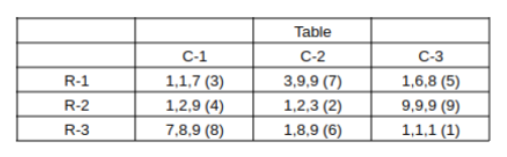
The nine averages are distinct integers from 1 to 9, so exactly 1 to 9; equal row and column totals make each row's and column's averages sum to 15. (r,c) is row r, column c. (3,1): median 8, all sacks above 5, one star, so only 'maximum 9' holds; divisibility by 3 gives 7, 8, 9 (average 8). (2,1): median 2, two stars, so minimum 1 and maximum 9: 1, 2, 9 (average 4). (1,2): median 9 and only two sacks above 5, so 9, 9 and one of 2 to 5 (one star rules out 1); divisibility by 3 gives 3, 9, 9 (average 7). So (1,1) = 3 and (1,3) = 5. Rows 2 and 3 need pairs from 1, 2, 6, 9 summing to 11 and 7; column 2 needs 8: (2,2) = 2, (2,3) = 9, (3,2) = 6, (3,3) = 1. Table 2 gives (1,1) 1, 1, 7 (a 9 cannot fit); (1,3) 1, 6, 8 (a 9 leaves 0); (2,2) 1, 2, 3 (1, 1, 4 earns two stars); (2,3) 9, 9, 9; (3,2) 1, 8, 9; (3,3) 1, 1, 1. Solution figure for question 27, CAT 2023 Slot 2 Average equals median in (2,2), (2,3), (3,1) and (3,3): 2 and 2, 9 and 9, 8 and 8, 1 and 1. The other five differ. The answer is 4.
Q28TITALogical Puzzles

How many sacks have exactly one coin?

Type in your answer (TITA). No negative mark for a wrong answer.

Answer and solution

Answer: 9

The nine averages are distinct integers from 1 to 9, so exactly 1 to 9; equal row and column totals make each row's and column's averages sum to 15. (r,c) is row r, column c. (3,1): median 8, all sacks above 5, one star, so only 'maximum 9' holds; divisibility by 3 gives 7, 8, 9 (average 8). (2,1): median 2, two stars, so minimum 1 and maximum 9: 1, 2, 9 (average 4). (1,2): median 9 and only two sacks above 5, so 9, 9 and one of 2 to 5 (one star rules out 1); divisibility by 3 gives 3, 9, 9 (average 7). So (1,1) = 3 and (1,3) = 5. Rows 2 and 3 need pairs from 1, 2, 6, 9 summing to 11 and 7; column 2 needs 8: (2,2) = 2, (2,3) = 9, (3,2) = 6, (3,3) = 1. Table 2 gives (1,1) 1, 1, 7 (a 9 cannot fit); (1,3) 1, 6, 8 (a 9 leaves 0); (2,2) 1, 2, 3 (1, 1, 4 earns two stars); (2,3) 9, 9, 9; (3,2) 1, 8, 9; (3,3) 1, 1, 1. Solution figure for question 28, CAT 2023 Slot 2 One-coin sacks: 2 in (1,1), one each in (1,3), (2,1), (2,2) and (3,2), and 3 in (3,3): 2+4+3=92 + 4 + 3 = 9. The answer is 9.

Q29TITALogical Puzzles

In how many boxes do all three sacks contain different numbers of coins?

Type in your answer (TITA). No negative mark for a wrong answer.

Answer and solution

Answer: 5

The nine averages are distinct integers from 1 to 9, so exactly 1 to 9; equal row and column totals make each row's and column's averages sum to 15. (r,c) is row r, column c. (3,1): median 8, all sacks above 5, one star, so only 'maximum 9' holds; divisibility by 3 gives 7, 8, 9 (average 8). (2,1): median 2, two stars, so minimum 1 and maximum 9: 1, 2, 9 (average 4). (1,2): median 9 and only two sacks above 5, so 9, 9 and one of 2 to 5 (one star rules out 1); divisibility by 3 gives 3, 9, 9 (average 7). So (1,1) = 3 and (1,3) = 5. Rows 2 and 3 need pairs from 1, 2, 6, 9 summing to 11 and 7; column 2 needs 8: (2,2) = 2, (2,3) = 9, (3,2) = 6, (3,3) = 1. Table 2 gives (1,1) 1, 1, 7 (a 9 cannot fit); (1,3) 1, 6, 8 (a 9 leaves 0); (2,2) 1, 2, 3 (1, 1, 4 earns two stars); (2,3) 9, 9, 9; (3,2) 1, 8, 9; (3,3) 1, 1, 1. Solution figure for question 29, CAT 2023 Slot 2 All three sacks differ in (1,3), (2,1), (2,2), (3,1) and (3,2); (1,1), (1,2), (2,3) and (3,3) repeat a number. The answer is 5.
Data set

Set for questions 30–34

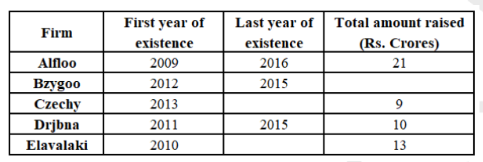
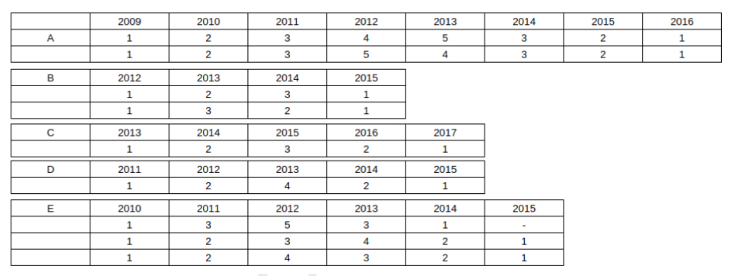
DIRECTIONS for questions 30-34: Read the following carefully and answer the questions that follow. Odsville has five firms - Alfloo, Bzygoo, Czechy, Drjbna and Elavalaki. Each of these firms was founded in some year and also closed down a few years later.
DILR Set 30-34 Diagram
Each firm raised Rs. 1 crore in its first and last year of existence. The amount each firm raised every year increased until it reached a maximum, and then decreased until the firm closed down. No firm raised the same amount of money in two consecutive years. Each annual increase and decrease was either by Rs. 1 crore or by Rs. 2 crores. The table below provides partial information about the five firms.

Q30MCQMissing Value Tables

For which firm(s) can the amounts raised by them be concluded with certainty in each year?
  1. Only Bzygoo and Czechy and Drjbna
  2. Only Czechy and Drjbna
  3. Only Drjbna
  4. Only Czechy
Answer and solution

Answer: (B) Only Czechy and Drjbna

Amounts start and end at 1, rise strictly to a peak and then fall strictly, in steps of 1 or 2. Alfloo (2009–2016, 21 crores): the six middle years total 19, with 2 or 3 at each end. A 3 at either end leaves 13 or 14 for the four between, which need at least 16 (such as 4–5–4–3). So both ends are 2 and the four total 15: 3–4–5–3 or 3–5–4–3. Bzygoo (2012–2015): 1–2–3–1 or 1–3–2–1. Czechy (from 2013, total 9): only five years work, 1–2–3–2–1 (four or fewer give at most 7, six or more at least 13). Drjbna (2011–2015, total 10): the middle three total 8 with ends 2 or 3: 2–4–2. Elavalaki (from 2010, total 13): 1–3–5–3–1 (to 2014), or 1–2–3–4–2–1 or 1–2–4–3–2–1 (to 2015); four years or fewer give at most 7, seven at least 16. Solution figure for question 30, CAT 2023 Slot 2 Only Czechy and Drjbna have a single sequence. Bzygoo can raise 2 then 3 or 3 then 2, so option A fails. Hence, option B (Only Czechy and Drjbna).

Q31MCQMissing Value Tables

What best can be concluded about the total amount of money raised in 2015?
  1. It is either Rs. 7 crores or Rs. 8 crores or Rs. 9 crores.
  2. It is exactly Rs. 8 crores.
  3. It is either Rs. 7 crores or Rs. 8 crores.
  4. It is either Rs. 8 crores or Rs. 9 crores.
Answer and solution

Answer: (C) It is either Rs. 7 crores or Rs. 8 crores.

Amounts start and end at 1, rise strictly to a peak and then fall strictly, in steps of 1 or 2. Alfloo (2009–2016, 21 crores): the six middle years total 19, with 2 or 3 at each end. A 3 at either end leaves 13 or 14 for the four between, which need at least 16 (such as 4–5–4–3). So both ends are 2 and the four total 15: 3–4–5–3 or 3–5–4–3. Bzygoo (2012–2015): 1–2–3–1 or 1–3–2–1. Czechy (from 2013, total 9): only five years work, 1–2–3–2–1 (four or fewer give at most 7, six or more at least 13). Drjbna (2011–2015, total 10): the middle three total 8 with ends 2 or 3: 2–4–2. Elavalaki (from 2010, total 13): 1–3–5–3–1 (to 2014), or 1–2–3–4–2–1 or 1–2–4–3–2–1 (to 2015); four years or fewer give at most 7, seven at least 16. Solution figure for question 31, CAT 2023 Slot 2 2015: Alfloo 2, Bzygoo 1, Czechy 3, Drjbna 1, Elavalaki 1 or 0 (closed). Total 8 or 7; 9 is impossible. Hence, option C (It is either Rs. 7 crores or Rs. 8 crores.).

Q32TITAMissing Value Tables

What is the largest possible total amount of money (in Rs. crores) that could have been raised in 2013?

Type in your answer (TITA). No negative mark for a wrong answer.

Answer and solution

Answer: 17

Amounts start and end at 1, rise strictly to a peak and then fall strictly, in steps of 1 or 2. Alfloo (2009–2016, 21 crores): the six middle years total 19, with 2 or 3 at each end. A 3 at either end leaves 13 or 14 for the four between, which need at least 16 (such as 4–5–4–3). So both ends are 2 and the four total 15: 3–4–5–3 or 3–5–4–3. Bzygoo (2012–2015): 1–2–3–1 or 1–3–2–1. Czechy (from 2013, total 9): only five years work, 1–2–3–2–1 (four or fewer give at most 7, six or more at least 13). Drjbna (2011–2015, total 10): the middle three total 8 with ends 2 or 3: 2–4–2. Elavalaki (from 2010, total 13): 1–3–5–3–1 (to 2014), or 1–2–3–4–2–1 or 1–2–4–3–2–1 (to 2015); four years or fewer give at most 7, seven at least 16. Solution figure for question 32, CAT 2023 Slot 2 Largest 2013 amounts: Alfloo 5, Bzygoo 3, Czechy 1, Drjbna 4, Elavalaki 4 (the 1–2–3–4–2–1 case). The firms are independent, so the total is 5+3+1+4+4=175 + 3 + 1 + 4 + 4 = 17. The answer is 17.

Q33MCQMissing Value Tables

If Elavalaki raised Rs. 3 crores in 2013, then what is the smallest possible total amount of money (in Rs. crores) that could have been raised by all the companies in 2012?
  1. 12
  2. 9
  3. 11
  4. 10
Answer and solution

Answer: (C) 11

Amounts start and end at 1, rise strictly to a peak and then fall strictly, in steps of 1 or 2. Alfloo (2009–2016, 21 crores): the six middle years total 19, with 2 or 3 at each end. A 3 at either end leaves 13 or 14 for the four between, which need at least 16 (such as 4–5–4–3). So both ends are 2 and the four total 15: 3–4–5–3 or 3–5–4–3. Bzygoo (2012–2015): 1–2–3–1 or 1–3–2–1. Czechy (from 2013, total 9): only five years work, 1–2–3–2–1 (four or fewer give at most 7, six or more at least 13). Drjbna (2011–2015, total 10): the middle three total 8 with ends 2 or 3: 2–4–2. Elavalaki (from 2010, total 13): 1–3–5–3–1 (to 2014), or 1–2–3–4–2–1 or 1–2–4–3–2–1 (to 2015); four years or fewer give at most 7, seven at least 16. Solution figure for question 33, CAT 2023 Slot 2 Elavalaki's 3 in 2013 means 5 or 4 in 2012. Take 4, with Alfloo's smaller 4, Bzygoo 1, Czechy 0 (not founded) and Drjbna 2: 4+1+0+2+4=114 + 1 + 0 + 2 + 4 = 11. Option D (10) needs Elavalaki at 3 in 2012, which comes with 4 in 2013. Hence, option C (11).

Q34MCQMissing Value Tables

If the total amount of money raised in 2014 is Rs. 12 crores, then which of the following is not possible?
  1. Bzygoo raised the same amount of money as Elavalaki in 2013.
  2. Alfloo raised the same amount of money as Drjbna in 2013.
  3. Alfloo raised the same amount of money as Bzygoo in 2014.
  4. Bzygoo raised more money than Elavalaki in 2014.
Answer and solution

Answer: (A) Bzygoo raised the same amount of money as Elavalaki in 2013.

Amounts start and end at 1, rise strictly to a peak and then fall strictly, in steps of 1 or 2. Alfloo (2009–2016, 21 crores): the six middle years total 19, with 2 or 3 at each end. A 3 at either end leaves 13 or 14 for the four between, which need at least 16 (such as 4–5–4–3). So both ends are 2 and the four total 15: 3–4–5–3 or 3–5–4–3. Bzygoo (2012–2015): 1–2–3–1 or 1–3–2–1. Czechy (from 2013, total 9): only five years work, 1–2–3–2–1 (four or fewer give at most 7, six or more at least 13). Drjbna (2011–2015, total 10): the middle three total 8 with ends 2 or 3: 2–4–2. Elavalaki (from 2010, total 13): 1–3–5–3–1 (to 2014), or 1–2–3–4–2–1 or 1–2–4–3–2–1 (to 2015); four years or fewer give at most 7, seven at least 16. Solution figure for question 34, CAT 2023 Slot 2 In 2014 Alfloo, Czechy and Drjbna raised 3+2+2=73 + 2 + 2 = 7, so Bzygoo and Elavalaki raised 5: 3 and 2. Then in 2013 Bzygoo raised 2 and Elavalaki 4 or 3, so A is impossible. B can hold (both 4); C and D hold. Hence, option A (Bzygoo raised the same amount of money as Elavalaki in 2013.).

Data set

Set for questions 35–39

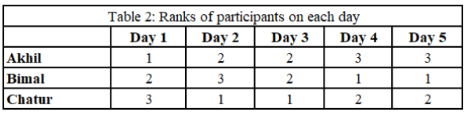
DIRECTIONS for questions 35-39: Read the following carefully and answer the questions that follow. Three participants - Akhil, Bimal and Chatur participate in a random draw competition for five days. Every day, each participant randomly picks up a ball numbered between 1 and 9. The number on the ball determines his score on that day. The total score of a participant is the sum of his scores attained in the five days. The total score of a day is the sum of participants’ scores on that day. The 2-day average on a day, except on Day 1, is the average of the total scores of that day and of the previous day. For example, if the total scores of Day 1 and Day 2 are 25 and 20, then the 2-day average on Day 2 is calculated as 22.5.
DILR Set 35-39 Diagram
DILR Set 35-39 Diagram 2
Table 1 gives the 2-day averages for Days 2 through 5. Participants are ranked each day, with the person having the maximum score being awarded the minimum rank (1) on that day. If there is a tie, all participants with the tied score are awarded the best available rank. For example, if on a day Akhil, Bimal, and Chatur score 8, 7 and 7 respectively, then their ranks will be 1, 2 and 2 respectively on that day. These ranks are given in Table 2. The following information is also known. 1. Chatur always scores in multiples of 3. His score on Day 2 is the unique highest score in the competition. His minimum score is observed only on Day 1, and it matches Akhil’s score on Day 4. 2. The total score on Day 3 is the same as the total score on Day 4. 3. Bimal’s scores are the same on Day 1 and Day 3.

Q35MCQLogical Puzzles

What is Akhil's score on Day 1?
  1. 5
  2. 7
  3. 6
  4. 8
Answer and solution

Answer: (B) 7

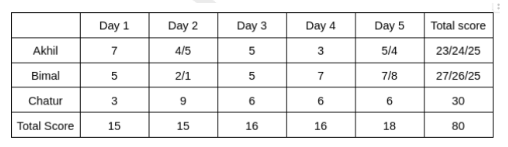
From Table 1, consecutive day totals sum to 30, 31, 32 and 34. Days 3 and 4 are equal, so each is 16; then Days 1, 2 and 5 are 15, 15 and 18. Chatur scores multiples of 3. His Day 2 score, the unique highest, is 9 (at 6, his other days would all be 3, yet his minimum is only on Day 1); no one else scores 9. His Day 1 score, his unique minimum, is 3 (at 6, his other days would need 9), so Days 3 to 5 are 6, and Akhil's Day 4 is 3. Day 4: Bimal =16−3−6=7= 16 - 3 - 6 = 7. Day 3: Akhil and Bimal tie at rank 2, so each has (16−6)÷2=5(16 - 6) \div 2 = 5. Day 1: Bimal repeats his 5, so Akhil =15−3−5=7= 15 - 3 - 5 = 7. Day 2: Akhil and Bimal share 6, Akhil ahead: 5 and 1, or 4 and 2. Day 5: they share 12, Bimal above 6 but below 9, Akhil below 6: 5 and 7, or 4 and 8. Solution figure for question 35, CAT 2023 Slot 2 So Akhil scored 7 on Day 1; option A (5) is Bimal's score. Hence, option B (7).
Q36MCQLogical Puzzles

Who attains the maximum total score?
  1. Cannot be determined
  2. Akhil
  3. Bimal
  4. Chatur
Answer and solution

Answer: (D) Chatur

From Table 1, consecutive day totals sum to 30, 31, 32 and 34. Days 3 and 4 are equal, so each is 16; then Days 1, 2 and 5 are 15, 15 and 18. Chatur scores multiples of 3. His Day 2 score, the unique highest, is 9 (at 6, his other days would all be 3, yet his minimum is only on Day 1); no one else scores 9. His Day 1 score, his unique minimum, is 3 (at 6, his other days would need 9), so Days 3 to 5 are 6, and Akhil's Day 4 is 3. Day 4: Bimal =16−3−6=7= 16 - 3 - 6 = 7. Day 3: Akhil and Bimal tie at rank 2, so each has (16−6)÷2=5(16 - 6) \div 2 = 5. Day 1: Bimal repeats his 5, so Akhil =15−3−5=7= 15 - 3 - 5 = 7. Day 2: Akhil and Bimal share 6, Akhil ahead: 5 and 1, or 4 and 2. Day 5: they share 12, Bimal above 6 but below 9, Akhil below 6: 5 and 7, or 4 and 8. Solution figure for question 36, CAT 2023 Slot 2 Chatur totals 3+9+6+6+6=303 + 9 + 6 + 6 + 6 = 30, Akhil 23 to 25 and Bimal 25 to 27, so Chatur always leads; option A fails. Hence, option D (Chatur).

Q37TITALogical Puzzles

What is the minimum possible total score of Bimal?

Type in your answer (TITA). No negative mark for a wrong answer.

Answer and solution

Answer: 25

From Table 1, consecutive day totals sum to 30, 31, 32 and 34. Days 3 and 4 are equal, so each is 16; then Days 1, 2 and 5 are 15, 15 and 18. Chatur scores multiples of 3. His Day 2 score, the unique highest, is 9 (at 6, his other days would all be 3, yet his minimum is only on Day 1); no one else scores 9. His Day 1 score, his unique minimum, is 3 (at 6, his other days would need 9), so Days 3 to 5 are 6, and Akhil's Day 4 is 3. Day 4: Bimal =16−3−6=7= 16 - 3 - 6 = 7. Day 3: Akhil and Bimal tie at rank 2, so each has (16−6)÷2=5(16 - 6) \div 2 = 5. Day 1: Bimal repeats his 5, so Akhil =15−3−5=7= 15 - 3 - 5 = 7. Day 2: Akhil and Bimal share 6, Akhil ahead: 5 and 1, or 4 and 2. Day 5: they share 12, Bimal above 6 but below 9, Akhil below 6: 5 and 7, or 4 and 8. Solution figure for question 37, CAT 2023 Slot 2 Bimal's lowest choices, 1 and 7, are both allowed: 5+1+5+7+7=255 + 1 + 5 + 7 + 7 = 25. The answer is 25.

Q38MCQLogical Puzzles

If the total score of Bimal is a multiple of 3, what is the score of Akhil on Day 2?
  1. Cannot be determined
  2. 5
  3. 6
  4. 4
Answer and solution

Answer: (D) 4

From Table 1, consecutive day totals add to 30,31,3230, 31, 32 and 3434. Days 3 and 4 are equal, so each is 1616, and Day 2 =15= 15, Day 1 =15= 15, Day 5 =18= 18. Chatur scores only 3, 6 or 9. His Day-2 score, the unique highest, is 9; nobody else scores 9. His minimum comes only on Day 1, so he scores 3 on Day 1 and 6 on Days 3, 4 and 5. So Akhil's Day-4 score is 3. Day 3: Akhil and Bimal tie in Table 2, so each scores (16−6)/2=5(16 - 6)/2 = 5. Bimal's Day 1 is also 5 (fact 3). Day 4: Bimal =16−6−3=7= 16 - 6 - 3 = 7. Day 2: Akhil ranks above Bimal and they total 15−9=615 - 9 = 6, so Bimal scores 1 or 2. Day 5: Bimal >6>> 6 > Akhil and they total 12, so Bimal scores 7 or 8. Solution figure for question 38, CAT 2023 Slot 2 Bimal's total is 5+b2+5+7+b55 + b_2 + 5 + 7 + b_5, with b2b_2 and b5b_5 his Day-2 and Day-5 scores: 25, 26 or 27. Only 27 is a multiple of 3, so b2=2b_2 = 2, and Akhil's Day-2 score is 6−2=46 - 2 = 4. Option B (5) needs b2=1b_2 = 1, giving Bimal 25 or 26. Hence, option D (4).

Q39TITALogical Puzzles

If Akhil attains a total score of 24, then what is the total score of Bimal?

Type in your answer (TITA). No negative mark for a wrong answer.

Answer and solution

Answer: 26

From Table 1, consecutive day totals sum to 30, 31, 32 and 34. Days 3 and 4 are equal, so each is 16; then Days 1, 2 and 5 are 15, 15 and 18. Chatur scores multiples of 3. His Day 2 score, the unique highest, is 9 (at 6, his other days would all be 3, yet his minimum is only on Day 1); no one else scores 9. His Day 1 score, his unique minimum, is 3 (at 6, his other days would need 9), so Days 3 to 5 are 6, and Akhil's Day 4 is 3. Day 4: Bimal =16−3−6=7= 16 - 3 - 6 = 7. Day 3: Akhil and Bimal tie at rank 2, so each has (16−6)÷2=5(16 - 6) \div 2 = 5. Day 1: Bimal repeats his 5, so Akhil =15−3−5=7= 15 - 3 - 5 = 7. Day 2: Akhil and Bimal share 6, Akhil ahead: 5 and 1, or 4 and 2. Day 5: they share 12, Bimal above 6 but below 9, Akhil below 6: 5 and 7, or 4 and 8. Solution figure for question 39, CAT 2023 Slot 2 All days total 80 and Chatur has 30, so Akhil and Bimal always total 50; Bimal has 50−24=2650 - 24 = 26. The answer is 26.

Data set

Set for questions 40–44

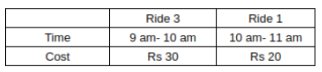
DIRECTIONS for questions 40-44: Read the following carefully and answer the questions that follow. Anjali, Bipasha, and Chitra visited an entertainment park that has four rides. Each ride lasts one hour and can accommodate one visitor at one point. All rides begin at 9 am and must be completed by 5 pm except for Ride-3, for which the last ride has to be completed by 1 pm. Ride gates open every 30 minutes, e.g. 10 am, 10:30 am, and so on. Whenever a ride gate opens, and there is no visitor inside, the first visitor waiting in the queue buys the ticket just before taking the ride. The ticket prices are Rs. 20, Rs. 50, Rs. 30 and Rs. 40 for Rides 1 to 4, respectively. Each of the three visitors took at least one ride and did not necessarily take all rides. None of them took the same ride more than once. The movement time from one ride to another is negligible, and a visitor leaves the ride immediately after the completion of the ride. No one takes a break inside the park unless mentioned explicitly. The following information is also known. 1. Chitra never waited in the queue and completed her visit by 11 am after spending Rs. 50 to pay for the ticket(s). 2. Anjali took Ride-1 at 11 am after waiting for 30 mins for Chitra to complete it. It was the only ride where Anjali waited. 3. Bipasha began her first of three rides at 11:30 am. All three visitors incurred the same amount of ticket expense by 12:15 pm. 4. The last ride taken by Anjali and Bipasha was the same, where Bipasha waited 30 mins for Anjali to complete her ride. Before standing in the queue for that ride, Bipasha took a 1-hour coffee break after completing her previous ride.

Q40MCQTeam Selection & Scheduling

What was the total amount spent on tickets (in Rs.) by Bipasha?
  1. 90
  2. 120
  3. 110
  4. 100
Answer and solution

Answer: (C) 110

Anjali waited from 10:30 for Chitra to finish Ride-1, so Chitra rode it 10 to 11 am (Rs 20). Her other Rs 30 was Ride-3, 9 to 10 am. Solution figure for question 40, CAT 2023 Slot 2 Anjali rode Ride-1 from 11 am to 12 pm and, taking no break, started another ride at 12 pm. She had spent Rs 50 by 12:15, so that ride cost Rs 30: Ride-3, 12 to 1 pm. Bipasha's first ride, at 11:30, must cost Rs 50 by 12:15: Ride-2, until 12:30. Their shared last ride is not Ride-1 or Ride-3 (Anjali's) or Ride-2 (Bipasha's first), so it is Ride-4. If Anjali rode it at 1 pm, Bipasha would queue at 1:30 after a break from 12:30, leaving her only two rides. So Anjali rode Ride-2 from 1 to 2 pm and Ride-4 from 2 to 3 pm. Solution figure for question 40, CAT 2023 Slot 2 Bipasha queued at 2:30 after a break from 1:30, so her middle ride ran 12:30 to 1:30. Ride-3 closes at 1 pm, so it was Ride-1. She rode Ride-4 from 3 to 4 pm. Solution figure for question 40, CAT 2023 Slot 2 Bipasha paid 50+20+40=11050 + 20 + 40 = 110. Option B (120) takes Ride-3 as her middle ride, which Ride-3's 1 pm closing rules out. Hence, option C (110).


Q41MCQTeam Selection & Scheduling

Which were all the rides that Anjali completed by 2:00 pm?
  1. Ride-1 and Ride-3
  2. Ride-1, Ride-2, and Ride-3
  3. Ride-1, Ride-2, and Ride-4
  4. Ride-1 and Ride-4
Answer and solution

Answer: (B) Ride-1, Ride-2, and Ride-3

Anjali waited from 10:30 for Chitra to finish Ride-1, so Chitra rode it 10 to 11 am (Rs 20). Her other Rs 30 was Ride-3, 9 to 10 am. Solution figure for question 41, CAT 2023 Slot 2 Anjali rode Ride-1 from 11 am to 12 pm and, taking no break, started another ride at 12 pm. She had spent Rs 50 by 12:15, so that ride cost Rs 30: Ride-3, 12 to 1 pm. Bipasha's first ride, at 11:30, must cost Rs 50 by 12:15: Ride-2, until 12:30. Their shared last ride is not Ride-1 or Ride-3 (Anjali's) or Ride-2 (Bipasha's first), so it is Ride-4. If Anjali rode it at 1 pm, Bipasha would queue at 1:30 after a break from 12:30, leaving her only two rides. So Anjali rode Ride-2 from 1 to 2 pm and Ride-4 from 2 to 3 pm. Solution figure for question 41, CAT 2023 Slot 2 Bipasha queued at 2:30 after a break from 1:30, so her middle ride ran 12:30 to 1:30. Ride-3 closes at 1 pm, so it was Ride-1. She rode Ride-4 from 3 to 4 pm. Solution figure for question 41, CAT 2023 Slot 2 By 2 pm Anjali had finished Ride-1 (12 pm), Ride-3 (1 pm) and Ride-2 (2 pm). Option A misses Ride-2, which ends exactly at 2 pm. Hence, option B (Ride-1, Ride-2, and Ride-3).

Q42MCQTeam Selection & Scheduling

Which ride was taken by all three visitors?
  1. Ride-1
  2. Ride-4
  3. Ride-3
  4. Ride-2
Answer and solution

Answer: (A) Ride-1

Anjali waited from 10:30 for Chitra to finish Ride-1, so Chitra rode it 10 to 11 am (Rs 20). Her other Rs 30 was Ride-3, 9 to 10 am. Solution figure for question 42, CAT 2023 Slot 2 Anjali rode Ride-1 from 11 am to 12 pm and, taking no break, started another ride at 12 pm. She had spent Rs 50 by 12:15, so that ride cost Rs 30: Ride-3, 12 to 1 pm. Bipasha's first ride, at 11:30, must cost Rs 50 by 12:15: Ride-2, until 12:30. Their shared last ride is not Ride-1 or Ride-3 (Anjali's) or Ride-2 (Bipasha's first), so it is Ride-4. If Anjali rode it at 1 pm, Bipasha would queue at 1:30 after a break from 12:30, leaving her only two rides. So Anjali rode Ride-2 from 1 to 2 pm and Ride-4 from 2 to 3 pm. Solution figure for question 42, CAT 2023 Slot 2 Bipasha queued at 2:30 after a break from 1:30, so her middle ride ran 12:30 to 1:30. Ride-3 closes at 1 pm, so it was Ride-1. She rode Ride-4 from 3 to 4 pm. Solution figure for question 42, CAT 2023 Slot 2 Ride-1 was taken by Chitra, Anjali and Bipasha. Chitra rode only Rides 1 and 3, and Bipasha never rode Ride-3, so Rides 2, 3 and 4 each miss someone. Hence, option A (Ride-1).

Q43TITATeam Selection & Scheduling

How many rides did Anjali and Chitra take in total?

Type in your answer (TITA). No negative mark for a wrong answer.

Answer and solution

Answer: 6

Anjali waited from 10:30 for Chitra to finish Ride-1, so Chitra rode it 10 to 11 am (Rs 20). Her other Rs 30 was Ride-3, 9 to 10 am. Solution figure for question 43, CAT 2023 Slot 2 Anjali rode Ride-1 from 11 am to 12 pm and, taking no break, started another ride at 12 pm. She had spent Rs 50 by 12:15, so that ride cost Rs 30: Ride-3, 12 to 1 pm. Bipasha's first ride, at 11:30, must cost Rs 50 by 12:15: Ride-2, until 12:30. Their shared last ride is not Ride-1 or Ride-3 (Anjali's) or Ride-2 (Bipasha's first), so it is Ride-4. If Anjali rode it at 1 pm, Bipasha would queue at 1:30 after a break from 12:30, leaving her only two rides. So Anjali rode Ride-2 from 1 to 2 pm and Ride-4 from 2 to 3 pm. Solution figure for question 43, CAT 2023 Slot 2 Bipasha queued at 2:30 after a break from 1:30, so her middle ride ran 12:30 to 1:30. Ride-3 closes at 1 pm, so it was Ride-1. She rode Ride-4 from 3 to 4 pm. Solution figure for question 43, CAT 2023 Slot 2 Anjali took 4 rides and Chitra 2, so together 4+2=64 + 2 = 6. The answer is 6.

Q44TITATeam Selection & Scheduling

What was the total amount spent on tickets (in Rs.) by Anjali?

Type in your answer (TITA). No negative mark for a wrong answer.

Answer and solution

Answer: 140

Anjali waited from 10:30 for Chitra to finish Ride-1, so Chitra rode it 10 to 11 am (Rs 20). Her other Rs 30 was Ride-3, 9 to 10 am. Solution figure for question 44, CAT 2023 Slot 2 Anjali rode Ride-1 from 11 am to 12 pm and, taking no break, started another ride at 12 pm. She had spent Rs 50 by 12:15, so that ride cost Rs 30: Ride-3, 12 to 1 pm. Bipasha's first ride, at 11:30, must cost Rs 50 by 12:15: Ride-2, until 12:30. Their shared last ride is not Ride-1 or Ride-3 (Anjali's) or Ride-2 (Bipasha's first), so it is Ride-4. If Anjali rode it at 1 pm, Bipasha would queue at 1:30 after a break from 12:30, leaving her only two rides. So Anjali rode Ride-2 from 1 to 2 pm and Ride-4 from 2 to 3 pm. Solution figure for question 44, CAT 2023 Slot 2 Bipasha queued at 2:30 after a break from 1:30, so her middle ride ran 12:30 to 1:30. Ride-3 closes at 1 pm, so it was Ride-1. She rode Ride-4 from 3 to 4 pm. Solution figure for question 44, CAT 2023 Slot 2 Anjali paid 20+30+50+40=14020 + 30 + 50 + 40 = 140. The answer is 140.