- CATin
- CAT past papers
- CAT 2022 Slot 3
- QA
CAT 2022 Slot 3 — QA questions with answers
All 22 questions of the Quantitative Ability section (14 MCQs, 8 TITA). Try each one, then open its answer and solution.
CAT 2022 Slot 3, timed like the real exam (120 minutes, 40 a section) and scored the CAT way: +3 right, −1 for a wrong MCQ, 0 for a wrong TITA, with the full post-mock analysis. Older official papers are in CATin Pro, with 80+ mocks and the full planner. The last three years of papers are free.
Sit this paper as a timed mock with CATin ProQuantitative Ability
CAT 2022 Slot 3 · 40 minutes · +3 for a right answer, −1 for a wrong MCQ, 0 for a wrong TITA
Q45MCQInequalities & Modulus
If
for some non-zero real numbers
and
, then
cannot take the value
- A60
- B-50
- C-70
- D-60
Answer and solution
Answer: (B) -50
Let
, which can be any non-zero real number. Then
.
If
, by AM–GM:
.
If
, write
with
:
.
Both bounds are reached, at
, and every value beyond them is possible too. So
can take any value in
, but nothing strictly between
and
.
Of the options, 60,
and
lie in this range, while
does not.
Hence, option B (
).
Q46MCQQuadratic & Polynomial Equations
Suppose
is any integer such that the equation
has no real roots and the equation
has two distinct real roots for
. Then, the number of possible values of
is
- A9
- B7
- C8
- D13
Answer and solution
Answer: (A) 9
For
to have no real roots, its discriminant must be negative:
, so
. As
, the integer values are
.
For
to have two distinct real roots, its discriminant must be positive:
, that is,
, or
. So
or
.
Both conditions hold for
, which is 9 values.
Option D (13) counts every integer from
to
and ignores the second condition, which rules out 3, 4, 5 and 6.
Hence, option A (9).
Q47TITAIndices & Surds
If
and
, for all non-zero real values of
and
, then the value of
is
Type in your answer (TITA). No negative mark for a wrong answer.
Answer and solution
Answer: 14
First equation. The left side is
.
The right side is
.
So
, giving
.
Second equation. Let
. Then
, so
. This must hold for every non-zero
and
, which is possible only if
. So
.
Substituting,
, so
and
.
Therefore
.
The answer is 14.
Q48MCQAverages, Mixtures & Alligations
Consider six distinct natural numbers such that the average of the two smallest numbers is 14, and the average of the two largest numbers is 28. Then, the maximum possible value of the average of these six numbers is
- A23
- B24
- C23.5
- D22.5
Answer and solution
Answer: (D) 22.5
Let the six numbers in increasing order be
. Then
and
.
The total is
, so
and
should be as large as possible. Both are less than
, so
should be as large as possible too.
Since
and
,
cannot be 28 (then
would also be 28). The largest choice is
,
.
Then
and
are distinct and below 27, so at best
and
. The two smallest can be, say, 13 and 15, which stay below 25.
Maximum total
, so the maximum average is
.
Option A (23) would need a total of 138, that is
, which is impossible when
.
Hence, option D (22.5).
Q49TITATriangles & Lines
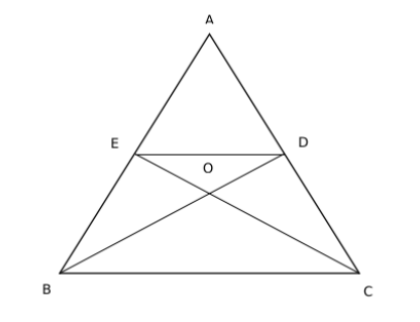
Suppose the medians
and
of a triangle
intersect at a point
. If area of triangle
is 108 sq. cm., then, the area of the triangle
, in sq. cm., is
Type in your answer (TITA). No negative mark for a wrong answer.
Answer and solution
Answer: 9
Area of ABD : Area of BDC = 1:1
Therefore, area of ABD = 54
Area of ADE : Area of EDB = 1:1
Therefore, area of ADE = 27
O is the centroid and it divides the medians in the ratio of 2:1
Area of BEO : Area of EOD = 2:1
Area of EOD = 9
Q50MCQQuadratic & Polynomial Equations
If
is a root of the equation
and
is a root of the equation
where
,
,
,
and
are integers, then the value of
is
- A0
- B1
- C3
- D4
Answer and solution
Answer: (D) 4
The coefficients are integers, so the irrational roots come in conjugate pairs.
First equation: the roots are
and
. Their sum is 6 and their product is
. So
and
, giving
and
.
Second equation: the roots are
and
. Their sum is 8 and their product is
. So
and
.
Now
and
.
Adding,
.
Option B (1) is what you get if the
term is dropped:
.
Hence, option D (4).
Q51MCQTime & Work
A group of
people worked on a project. They finished 35% of the project by working 7 hours a day for 10 days. Thereafter, 10 people left the group and the remaining people finished the rest of the project in 14 days by working 10 hours a day. Then the value of
is
- A150
- B23
- C36
- D140
Answer and solution
Answer: (D) 140
Take the work one person does in one hour as 1 unit.
In the first phase,
people work 7 hours a day for 10 days, doing
units. This is 35% of the project, so the total work is
units, and the work left is
units.
In the second phase,
people work 10 hours a day for 14 days, doing
units. So
, which gives
, so
and
.
Check: the first phase does
units, which is 35% of 28000. The second does
units, the remaining 65%.
Option A (150) does not fit: 140 people working 140 hours would do 19600 units, but only
would be left.
Hence, option D (140).
Q52MCQAverages, Mixtures & Alligations
A glass contains 500 cc of milk and a cup contains 500 cc of water. From the glass, 150 cc of milk is transferred to the cup and mixed thoroughly. Next, 150 cc of this mixture is transferred from the cup to the glass. Now, the amount of water in the glass and the amount of milk in the cup are in the ratio
- A1 : 1
- B10 : 13
- C3 : 10
- D10 : 3
Answer and solution
Answer: (A) 1 : 1
After the first transfer, the glass has 350 cc of milk, and the cup has 150 cc of milk and 500 cc of water, 650 cc in all. Milk and water in the cup are in the ratio
.
The 150 cc taken back from the cup keeps this ratio. It carries
cc of water into the glass, along with
cc of milk.
Water in the glass
cc.
Milk left in the cup
cc.
These are equal, so the ratio is
. This is expected: each container ends with 500 cc, so the water that entered the glass is exactly matched by the milk that stayed in the cup.
Option D (10 : 3) is the ratio of water to milk inside the cup's mixture, not the ratio asked for.
Hence, option A (1 : 1).
Q53MCQSimple & Compound Interest
Nitu has an initial capital of ₹20,000. Out of this, she invests ₹8,000 at 5.5% in bank A, ₹5,000 at 5.6% in bank B and the remaining amount at
% in bank C, each rate being simple interest per annum. Her combined annual interest income from these investments is equal to 5% of the initial capital. If she had invested her entire initial capital in bank C alone, then her annual interest income, in rupees, would have been
- A700
- B800
- C900
- D1000
Answer and solution
Answer: (B) 800
Interest from bank A
.
Interest from bank B
.
The rest,
, is in bank C and earns
.
The total interest is 5% of 20000, which is 1000. So
, giving
and
.
If all ₹20,000 were in bank C at 4%, the annual interest would be
rupees.
Option D (1000) is her actual income from the three investments together, not the income from bank C alone.
Hence, option B (800).
Q54MCQTime, Speed & Distance
Two cars travel from different locations at constant speeds. To meet each other after starting at the same time, they take 1.5 hours if they travel towards each other, but 10.5 hours if they travel in the same direction. If the speed of the slower car is 60 km/hr, then the distance traveled, in km, by the slower car when it meets the other car while traveling towards each other, is
- A100
- B90
- C120
- D150
Answer and solution
Answer: (B) 90
When the cars travel towards each other, they meet after 1.5 hours. The slower car moves at 60 km/hr throughout, so it covers
km before they meet.
The 10.5-hour figure is needed only to find the faster car's speed. Let it be
km/hr. The gap between the cars is
, which gives
, so
and the gap is 210 km.
Option C (120) is the distance covered by the faster car,
km. Together,
km, which checks the gap.
Hence, option B (90).
Q55MCQAverages, Mixtures & Alligations
The arithmetic mean of all the distinct numbers that can be obtained by rearranging the digits in 1421, including itself, is
- A2222
- B2442
- C2592
- D3333
Answer and solution
Answer: (A) 2222
The digits are 1, 1, 2 and 4. The number of distinct arrangements is
.
In any one place, each digit appears in proportion to how often it occurs among the four digits, that is, 2 : 1 : 1 for 1, 2 and 4. So in the units place, 1 appears 6 times, 2 appears 3 times and 4 appears 3 times, and the units digits add up to
.
The same holds for the tens, hundreds and thousands places. So the sum of all 12 numbers is
.
Mean
.
A quicker view: the average digit in every place is
, so the mean is 2222. Every other option would need an average digit other than 2 in some place, which cannot happen.
Hence, option A (2222).
Q56MCQPolygons & Circles
The lengths of all four sides of a quadrilateral are integer valued. If three of its sides are of length 1 cm, 2 cm and 4 cm, then the total number of possible lengths of the fourth side is
- A3
- B4
- C6
- D5
Answer and solution
Answer: (D) 5
In any quadrilateral, each side must be shorter than the sum of the other three. Let the fourth side be
cm, a positive integer.
For side
:
.
For the side of 4 cm:
, so
.
The conditions for the sides of 1 cm and 2 cm hold automatically, since
is already larger than either.
So
, giving
: five possible lengths.
Option C (6) wrongly includes
. Then
only equals the longest side, so the four sides would lie flat along a line instead of forming a quadrilateral.
Hence, option D (5).
Q57TITASequences & Series
The average of all 3-digit terms in the arithmetic progression 38, 55, 72, ... is
Type in your answer (TITA). No negative mark for a wrong answer.
Answer and solution
Answer: 548
The progression has first term 38 and common difference 17. Its
th term is
, so every term has the form
.
Smallest 3-digit term:
needs
, giving
.
Largest 3-digit term:
needs
, giving
.
So the 3-digit terms are
, and there are
of them.
In an arithmetic progression, the average of the terms equals the average of the first and last terms:
.
The answer is 548.
Q58TITAAverages, Mixtures & Alligations
In an examination, the average marks of students in sections A and B are 32 and 60, respectively. The number of students in section A is 10 less than that in section B. If the average marks of all the students across both the sections combined is an integer, then the difference between the maximum and minimum possible number of students in section A is
Type in your answer (TITA). No negative mark for a wrong answer.
Answer and solution
Answer: 63
Let section A have
students, so section B has
.
Combined average
.
Since
, this equals
.
It is an integer only when
divides 70. The divisors of 70 are 1, 2, 5, 7, 10, 14, 35 and 70. As
,
, so
can be 7, 10, 14, 35 or 70, giving
.
The maximum is 65 and the minimum is 2, so the difference is
.
The answer is 63.
Q59MCQFunctions & Graphs
Let
be a real number and
. Then, the equation
holds for all real values of
where
- A
- B
- C
- D
Answer and solution
Answer: (B)
Check the two parts of the definition separately.
If
:
. Then
, and since
,
. So
, and the equation holds for every
.
If
:
. Since
,
, so
. The equation
gives
. So among
, it holds only at
.
Together, the equation holds exactly when
.
Option D (
) fails because for any
,
is larger than
. Option A (
) fails for the same reason.
Hence, option B (
).
Q60MCQPolygons & Circles
In a triangle
,
cm. A circle drawn with
as diameter passes through
. Another circle drawn with center at
passes through
and
. Then the area, in sq. cm, of the overlapping region between the two circles is
- A
- B
- C
- D
Answer and solution
Answer: (C)
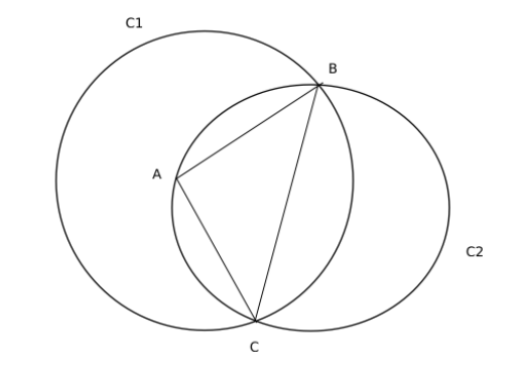
Call the circle with diameter
C2, and the circle centred at
C1. Since
lies on C2,
(angle in a semicircle). With
,
, so C2 has radius
and area
.
C1 passes through
and
, so its radius is
.
is a common chord of the two circles and splits the overlap into two parts.
On
's side of
: the half of C2 there lies wholly inside C1, since none of its points is more than 8 from
. Its area is
.
On the other side: the overlap is the segment of C1 cut off by chord
, which lies inside C2's other half. As
, it equals a quarter of C1 minus triangle
:
.
Overlap
.
Option A (
) counts only the half of C2 and misses the segment of C1.
Hence, option C (
).
Q61TITAHCF & LCM
A school has less than 5000 students and if the students are divided equally into teams of either 9 or 10 or 12 or 25 each, exactly 4 are always left out. However, if they are divided into teams of 11 each, no one is left out. The maximum number of teams of 12 each that can be formed out of the students in the school is
Type in your answer (TITA). No negative mark for a wrong answer.
Answer and solution
Answer: 150
Leaving 4 students over when divided by 9, 10, 12 or 25 means the number of students minus 4 is a multiple of each of them, and so of
. So the number of students is
.
It is less than 5000, so
can be 0 to 5, giving 4, 904, 1804, 2704, 3604 or 4504.
It must also be divisible by 11. Checking: 4 is not;
;
;
;
;
. Only 1804 works.
With 1804 students,
, so at most 150 teams of 12 can be formed, with 4 students left out.
The answer is 150.
Q62MCQInequalities & Modulus
The minimum possible value of
, for
, is
- A
- B2
- C
- D-2
Answer and solution
Answer: (B) 2
Since
, put
, so
.
The numerator is
.
So the expression becomes
.
For
, AM–GM gives
, with equality when
, that is, at
.
Check: at
, the expression is
.
Option D (−2) is the value at
, where
. That is outside the range
, and for
the expression is always positive.
Hence, option B (2).
Q63TITALinear Equations
A donation box can receive only cheques of ₹100, ₹250, and ₹500. On one good day, the donation box was found to contain exactly 100 cheques amounting to a total sum of ₹15250. Then, the maximum possible number of cheques of ₹500 that the donation box may have contained, is
Type in your answer (TITA). No negative mark for a wrong answer.
Answer and solution
Answer: 12
Let the numbers of ₹100, ₹250 and ₹500 cheques be
,
and
.
Count:
.
Amount:
. Dividing by 50,
.
Subtracting twice the first equation:
.
So
. For
to be a whole number,
must be a multiple of 3, so
is a multiple of 3. Also
, so
.
The largest multiple of 3 up to 13 is 12. Then
, so
and
.
Check:
.
fails because
is not a multiple of 3.
The answer is 12.
Q64TITATime, Speed & Distance
Moody takes 30 seconds to finish riding an escalator if he walks on it at his normal speed in the same direction. He takes 20 seconds to finish riding the escalator if he walks at twice his normal speed in the same direction. If Moody decides to stand still on the escalator, then the time, in seconds, needed to finish riding the escalator is
Type in your answer (TITA). No negative mark for a wrong answer.
Answer and solution
Answer: 60
Let the speed of Moody be 'x' steps/sec and that of the escalator be 'y' steps/sec.
In 30 seconds, Moody will finish riding the escalator when going in the same direction.
Thus, total steps = 30(x+y)
If Moody's speed becomes twice, the time becomes 20 seconds.
Thus, total steps = 20(2x+y)
Or 30x + 30y = 40x + 20y
Or x = y
So, total steps = 60y.
Time taken by only escalator= 60y/y = 60s.
Q65MCQTime, Speed & Distance
Two ships are approaching a port along straight routes at constant speeds. Initially, the two ships and the port formed an equilateral triangle with sides of length 24 km. When the slower ship travelled 8 km, the triangle formed by the new positions of the two ships and the port became right-angled. When the faster ship reaches the port, the distance, in km, between the other ship and the port will be
- A4
- B12
- C8
- D6
Answer and solution
Answer: (B) 12
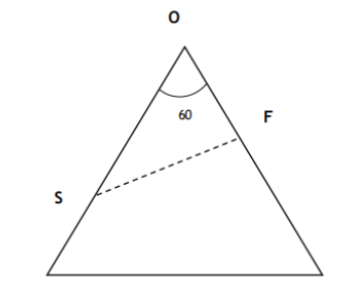
Let O be the port, S the slower ship and F the faster one. They start at the corners of an equilateral triangle of side 24 km and sail straight along the sides SO and FO, so the angle at O stays
.
When S has travelled 8 km,
km. The triangle OSF is now right-angled, so the right angle is at S or at F.
If it were at S, then
, so
km, more than the starting 24 km. That is impossible.
So the right angle is at F, and
km. F has travelled
km.
In the same time S covers 8 km and F covers 16 km, so F is twice as fast.
F reaches the port after 24 km. In that time S covers
km, so it is
km from the port.
Option C (8) is F's distance from the port at the right-angle moment, not S's distance at the end.
Hence, option B (12).
Q66TITATime & Work
Bob can finish a job in 40 days, if he works alone. Alex is twice as fast as Bob and thrice as fast as Cole in the same job. Suppose Alex and Bob work together on the first day, Bob and Cole work together on the second day, Cole and Alex work together on the third day, and then, they continue the work by repeating this three-day roster, with Alex and Bob working together on the fourth day, and so on. Then, the total number of days Alex would have worked when the job gets finished, is
Type in your answer (TITA). No negative mark for a wrong answer.
Answer and solution
Answer: 11
Let Bob do 3 units of work a day. Alex is twice as fast as Bob, so he does 6 units a day. Alex is thrice as fast as Cole, so Cole does 2 units a day.
Bob alone takes 40 days, so the job is
units.
The roster does
units on day 1 (Alex and Bob),
units on day 2 (Bob and Cole) and
units on day 3 (Cole and Alex). Each 3-day cycle therefore does 22 units.
Five cycles, 15 days, do
units, leaving 10. Day 16 (Alex and Bob) does 9 units, leaving 1, and day 17 (Bob and Cole) finishes the job.
Alex works 2 days in every cycle, so 10 days in the first 15. He also works on day 16 but not on day 17.
Alex works
days.
The answer is 11.