- CATin
- CAT past papers
- CAT 2022 Slot 3
- DILR
CAT 2022 Slot 3 — DILR questions with answers
All 19 questions of the Data Interpretation & Logical Reasoning section (14 MCQs, 5 TITA, 4 sets). Try each one, then open its answer and solution. 1 question of the original section is left out while its answer key is checked.
CAT 2022 Slot 3, timed like the real exam (120 minutes, 40 a section) and scored the CAT way: +3 right, −1 for a wrong MCQ, 0 for a wrong TITA, with the full post-mock analysis. Older official papers are in CATin Pro, with 80+ mocks and the full planner. The last three years of papers are free.
Sit this paper as a timed mock with CATin ProData Interpretation & Logical Reasoning
CAT 2022 Slot 3 · 40 minutes · +3 for a right answer, −1 for a wrong MCQ, 0 for a wrong TITA
Data set
Set for questions 25–28
DIRECTIONS for questions 25-29:
In the following, a year corresponds to 1st of January of that year.
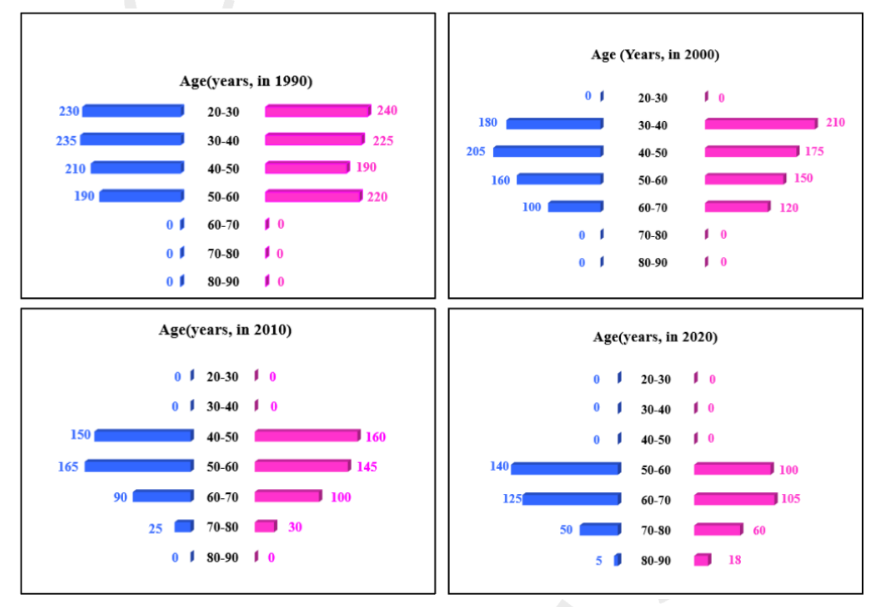
A study to determine the mortality rate for a disease began in 1980. The study chose 1000 males and 1000 females and followed them for forty years or until they died, whichever came first. The 1000 males chosen in 1980 consisted of 250 each of ages 10 to less than 20, 20 to less than 30, 30 to less than 40, and 40 to less than 50. The 1000 females chosen in 1980 also consisted of 250 each of ages 10 to less than 20, 20 to less than 30, 30 to less than 40,and 40 to less than 50.
The four figures below depict the age profile of those among the 2000 individuals who were still alive in 1990, 2000, 2010, and 2020. The blue bars in each figure represent the number of males in each age group at that point in time, while the pink bars represent the number of females in each age group at that point in time. The numbers next to the bars give the exact numbers being represented by the bars. For example, we know that 230 males among those tracked and who were alive in 1990 were aged between 20 and 30.
Q25MCQBar & Line Charts
In 2000, what was the ratio of the number of dead males to dead females among those being tracked?
- A71 : 69
- B41 : 43
- C129 : 131
- D109 : 107
Answer and solution
Answer: (A) 71 : 69
Each group of 1000 was chosen in 1980, so the number who had died by 2000 is 1000 minus the number still alive in 2000. The table below regroups the charts by age group in 1980.
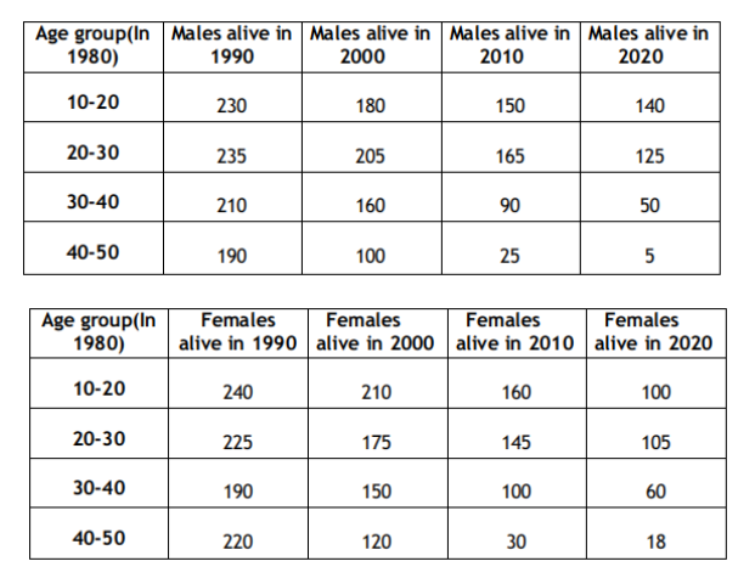
Males alive in 2000 (aged 30–40, 40–50, 50–60 and 60–70):
. Dead males
.
Females alive in 2000:
. Dead females
.
Ratio of dead males to dead females
.
Option C (129 : 131) is the trap: it is
, the ratio of those still alive, not of those who died.
Hence, option A (71 : 69).
Q26MCQBar & Line Charts
How many people who were being tracked and who were between 30 and 40 years of age in 1980 survived until 2010?
- A110
- B90
- C190
- D310
Answer and solution
Answer: (C) 190
Everyone is 30 years older in 2010 than in 1980, and only the original 2000 people are tracked. So the people who were 30 to 40 in 1980 are exactly the 60–70 age group in the 2010 figure.
In the 2010 figure, the 60–70 group has 90 males and 100 females. The tables below follow each 1980 age group through the later figures; the 30–40 row shows the same 90 males and 100 females alive in 2010.
Survivors
.
The usual slips are reading the 30–40 row of the 2010 figure (it is empty) or counting only the males (90, option B). The 40–50 row of the 2010 figure gives
(option D), but those people were 10 to 20 in 1980. Option A (110) is
, the survivors of this group in 2020, not 2010.
Hence, option C (190).
Q27MCQBar & Line Charts
How many individuals who were being tracked and who were less than 30 years of age in 1980 survived until 2020?
- A240
- B580
- C470
- D230
Answer and solution
Answer: (C) 470
Those under 30 in 1980 are the 10–20 and 20–30 groups. Forty years later, in 2020, the survivors of these groups are aged 50–60 and 60–70.
From the 2020 chart, males aged 50–60 and 60–70 number
, and females in the same groups number
.
Survivors
.
Option A (240) counts only the 10–20 group (
), and option D (230) counts only the 20–30 group (
).
Hence, option C (470).
Q28TITABar & Line Charts
How many of the males who were being tracked and who were between 20 and 30 years of age in 1980 died in the period 2000 to 2010?
Type in your answer (TITA). No negative mark for a wrong answer.
Answer and solution
Answer: 40
Males aged 20–30 in 1980 are aged 40–50 in 2000 and 50–60 in 2010. The charts count only people still alive, and nobody joins a group after 1980, so any drop between two charts is the number who died in between.
Males of this group alive in 2000 (aged 40–50): 205.
Males of this group alive in 2010 (aged 50–60): 165.
Died between 2000 and 2010:
.
The answer is 40.
Data set
Set for questions 30–34
DIRECTIONS for questions 30-34:
There are only four neighbourhoods in a city - Levmisto, Tyhrmisto, Pesmisto and Kitmisto.During the onset of a pandemic, the number of new cases of a disease in each of these neighbourhoods was recorded over a period of five days. On each day, the number of newcases recorded in any of the neighbourhoods was either 0, 1, 2 or 3.
The following facts are also known:
1.There was at least one new case in every neighbourhood on Day 1.
2.On each of the five days, there were more new cases in Kitmisto than in Pesmisto.
3.The number of new cases in the city in a day kept increasing during the five-day period. The number of new cases on Day 3 was exactly one more than that on Day 2.
4.The maximum number of new cases in a day in Pesmisto was 2, and this happened only once during the five-day period.
5.Kitmisto is the only place to have 3 new cases on Day 2.
6.The total numbers of new cases in Levmisto, Tyhrmisto, Pesmisto and Kitmisto over the five-day period were 12, 12, 5 and 14 respectively.
Q30MCQLogical Puzzles
What BEST can be concluded about the total number of new cases in the city on Day2?
- AEither 7 or 8
- BExactly 7
- CEither 6 or 7
- DExactly 8
Answer and solution
Answer: (D) Exactly 8
A day has at most
new cases, since each neighbourhood records at most 3 and Pesmisto at most 2 (fact 4). The five-day total is
, and the daily totals rise every day (fact 3).
If Day 5 had 10 or fewer, the five totals would add up to at most
. So Day 5 has 11.
If Day 4 had 9 or fewer, the sum would be at most
. So Day 4 has 10.
If Day 3 had 8 or fewer, the sum would be at most
. So Day 3 has 9.
By fact 3, Day 2 has exactly one case fewer than Day 3, so 8, and Day 1 has
. The full table, filled in from the other facts, is:
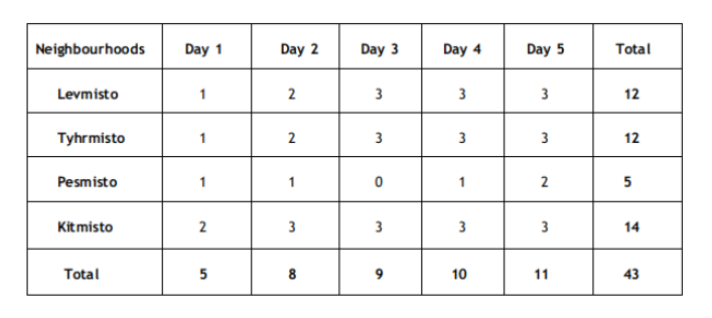
Option A (either 7 or 8) fails: 7 cases on Day 2 would mean 8 on Day 3, and the five totals could then reach only 42.
Hence, option D (Exactly 8).
Q31MCQLogical Puzzles
What BEST can be concluded about the number of new cases in Levmisto on Day 3?
- AEither 2 or 3
- BExactly 2
- CExactly 3
- DEither 0 or 1
Answer and solution
Answer: (C) Exactly 3
Write L, T, P, K for Levmisto, Tyhrmisto, Pesmisto, Kitmisto.
Day totals: a day has at most
cases (fact 4 caps P at 2). The totals rise daily and sum to
. Day 5 must be 11, else the sum is at most
. Likewise Day 4 is 10 (else at most 41) and Day 3 is 9 (else at most 42). By fact 3, Day 2 is 8, leaving 5 for Day 1.
Neighbourhoods: Day 5 needs every maximum: 3, 3, 2, 3. On Day 1 each has at least 1 and K beats P, so 1, 1, 1, 2. K's 14 then needs 3 on Days 2 to 4. On Day 2 only K has 3, and P's single 2 is on Day 5, so 8 needs
and
. P has one case left for Days 3 and 4; Day 4 needs 7 from L, T and P, impossible with
. So Day 4 is 3, 3, 1, 3 and Day 3 is 3, 3, 0, 3.
So Levmisto had exactly 3 cases on Day 3. Option A (either 2 or 3) fails: with P at 0 and K at 3, Day 3's 9 cases need 6 from L and T, and each can have at most 3.
Hence, option C (Exactly 3).
Q32MCQLogical Puzzles
On which day(s) did Pesmisto not have any new case?
- AOnly Day 3
- BOnly Day 2
- CBoth Day 2 and Day 3
- DBoth Day 2 and Day 4
Answer and solution
Answer: (A) Only Day 3
Write L, T, P, K for Levmisto, Tyhrmisto, Pesmisto, Kitmisto.
Day totals: a day has at most
cases (fact 4 caps P at 2). The totals rise daily and sum to
. Day 5 must be 11, else the sum is at most
. Likewise Day 4 is 10 (else at most 41) and Day 3 is 9 (else at most 42). By fact 3, Day 2 is 8, leaving 5 for Day 1.
Neighbourhoods: Day 5 needs every maximum: 3, 3, 2, 3. On Day 1 each has at least 1 and K beats P, so 1, 1, 1, 2. K's 14 then needs 3 on Days 2 to 4. On Day 2 only K has 3, and P's single 2 is on Day 5, so 8 needs
and
. P has one case left for Days 3 and 4; Day 4 needs 7 from L, T and P, impossible with
. So Day 4 is 3, 3, 1, 3 and Day 3 is 3, 3, 0, 3.
Pesmisto's cases were 1, 1, 0, 1, 2, so Day 3 was its only day without a new case. Option C (both Day 2 and Day 3) fails: Day 2 needs Pesmisto's 1 case to reach 8.
Hence, option A (Only Day 3).
Q33MCQLogical Puzzles
Which of the two statements below is/are necessarily false?
Statement A: There were 2 new cases in Tyhrmisto on Day 3.
Statement B: There were no new cases in Pesmisto on Day 2.
- AStatement A only
- BNeither Statement A nor Statement B
- CStatement B only
- DBoth Statement A and Statement B
Answer and solution
Answer: (D) Both Statement A and Statement B
Write L, T, P, K for Levmisto, Tyhrmisto, Pesmisto, Kitmisto.
Day totals: a day has at most
cases (fact 4 caps P at 2). The totals rise daily and sum to
. Day 5 must be 11, else the sum is at most
. Likewise Day 4 is 10 (else at most 41) and Day 3 is 9 (else at most 42). By fact 3, Day 2 is 8, leaving 5 for Day 1.
Neighbourhoods: Day 5 needs every maximum: 3, 3, 2, 3. On Day 1 each has at least 1 and K beats P, so 1, 1, 1, 2. K's 14 then needs 3 on Days 2 to 4. On Day 2 only K has 3, and P's single 2 is on Day 5, so 8 needs
and
. P has one case left for Days 3 and 4; Day 4 needs 7 from L, T and P, impossible with
. So Day 4 is 3, 3, 1, 3 and Day 3 is 3, 3, 0, 3.
Tyhrmisto had 3 cases on Day 3, not 2, and Pesmisto had 1 on Day 2, not 0. The table is forced, so both statements are necessarily false; options A and C each miss one.
Hence, option D (Both Statement A and Statement B).
Q34MCQLogical Puzzles
On how many days did Levmisto and Tyhrmisto have the same number of new cases?
- A2
- B3
- C4
- D5
Answer and solution
Answer: (D) 5
Write L, T, P, K for Levmisto, Tyhrmisto, Pesmisto, Kitmisto.
Day totals: a day has at most
cases (fact 4 caps P at 2). The totals rise daily and sum to
. Day 5 must be 11, else the sum is at most
. Likewise Day 4 is 10 (else at most 41) and Day 3 is 9 (else at most 42). By fact 3, Day 2 is 8, leaving 5 for Day 1.
Neighbourhoods: Day 5 needs every maximum: 3, 3, 2, 3. On Day 1 each has at least 1 and K beats P, so 1, 1, 1, 2. K's 14 then needs 3 on Days 2 to 4. On Day 2 only K has 3, and P's single 2 is on Day 5, so 8 needs
and
. P has one case left for Days 3 and 4; Day 4 needs 7 from L, T and P, impossible with
. So Day 4 is 3, 3, 1, 3 and Day 3 is 3, 3, 0, 3.
Levmisto had 1, 2, 3, 3, 3 and Tyhrmisto had 1, 2, 3, 3, 3, so they match on all five days. Option C (4) would need a day on which they differ, but every day's split is forced.
Hence, option D (5).
Data set
Set for questions 35–39
DIRECTIONS for questions 35-39:
All the first-year students in the computer science (CS) department in a university take both the courses (i) AI and (ii) ML. Students from other departments (non-CS students) can also take one of these two courses, but not both. Students who fail in a course get an F grade;others pass and are awarded A or B or C grades depending on their performance. The following are some additional facts about the number of students who took these two courses this year and the grades they obtained.
1.The numbers of non-CS students who took AI and ML were in the ratio 2 : 5.
2.The number of non-CS students who took either AI or ML was equal to the number of CS students.
3.The numbers of non-CS students who failed in the two courses were the same and their total is equal to the number of CS students who got a C grade in ML.
4. In both the courses, 50% of the students who passed got a B grade. But, while the numbers of students who got A and C grades were the same for AI, they were in the ratio 3 :2 for ML.
5. No CS student failed in AI, while no non-CS student got an A grade in AI.
6.The numbers of CS students who got A, B and C grades respectively in AI were in the ratio 3 : 5 : 2, while in ML the ratio was 4 : 5 : 2.
7.The ratio of the total number of non-CS students failing in one of the two courses to the number of CS students failing in one of the two courses was 3 : 1.
8. 30 students failed in ML.
Q35MCQTables & Caselets
How many students took AI?
- A60
- B210
- C90
- D270
Answer and solution
Answer: (D) 270
Let the non-CS students in AI and ML be
and
(fact 1). By fact 2 there are
CS students, each taking both courses.
CS grades: in AI
,
,
with no fails (facts 5 and 6), so there are
CS students; in ML
,
,
for A, B and C.
By fact 3, non-CS fails are equal in both courses and total the
CS students with C in ML, so there are
in each. By fact 8, CS fails in ML are
. By fact 7,
, so
and CS fails in ML are 12.
CS students:
, so
and
. So 60 non-CS students took AI and 150 took ML.
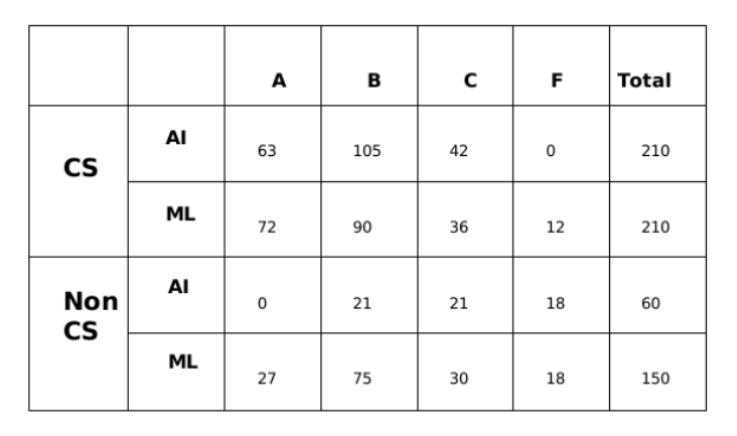
AI was taken by all 210 CS students and by 60 non-CS students, so
students took AI.
Option B (210) counts only the CS students, and option A (60) only the non-CS students.
Hence, option D (270).
Q36TITATables & Caselets
How many CS students failed in ML?
Type in your answer (TITA). No negative mark for a wrong answer.
Answer and solution
Answer: 12
Let the non-CS students in AI and ML be
and
(fact 1). By fact 2 there are
CS students, each taking both courses.
CS grades: in AI
,
,
with no fails (facts 5 and 6), so there are
CS students; in ML
,
,
for A, B and C.
By fact 3, non-CS fails are equal in both courses and total the
CS students with C in ML, so there are
in each. By fact 8, CS fails in ML are
. By fact 7,
, so
and CS fails in ML are 12.
CS students:
, so
and
. So 60 non-CS students took AI and 150 took ML.
So the number of CS students who failed in ML is
.
The answer is 12.
Q37TITATables & Caselets
How many non-CS students got A grade in ML?
Type in your answer (TITA). No negative mark for a wrong answer.
Answer and solution
Answer: 27
Let the non-CS students in AI and ML be
and
(fact 1). By fact 2 there are
CS students, each taking both courses.
CS grades: in AI
,
,
with no fails (facts 5 and 6), so there are
CS students; in ML
,
,
for A, B and C.
By fact 3, non-CS fails are equal in both courses and total the
CS students with C in ML, so there are
in each. By fact 8, CS fails in ML are
. By fact 7,
, so
and CS fails in ML are 12.
CS students:
, so
and
. So 60 non-CS students took AI and 150 took ML.
ML:
students, 30 fail, 330 pass. By fact 4, 165 get B, and the other 165 split A : C = 3 : 2, so 99 get A.
CS students got
of these A grades, so non-CS students got
.
The answer is 27.
Q38MCQTables & Caselets
How many students got A grade in AI?
- A99
- B42
- C84
- D63
Answer and solution
Answer: (D) 63
Let the non-CS students in AI and ML be
and
(fact 1). By fact 2 there are
CS students, each taking both courses.
CS grades: in AI
,
,
with no fails (facts 5 and 6), so there are
CS students; in ML
,
,
for A, B and C.
By fact 3, non-CS fails are equal in both courses and total the
CS students with C in ML, so there are
in each. By fact 8, CS fails in ML are
. By fact 7,
, so
and CS fails in ML are 12.
CS students:
, so
and
. So 60 non-CS students took AI and 150 took ML.
AI:
students, 18 fail, 252 pass. By fact 4, 126 get B, and A and C share the other 126 equally, so 63 get A.
This matches
: every A in AI went to a CS student, since no non-CS student got an A in AI (fact 5).
Option A (99) is the number of A grades in ML, not AI.
Hence, option D (63).
Q39MCQTables & Caselets
How many non-CS students got B grade in ML?
- A165
- B75
- C25
- D90
Answer and solution
Answer: (B) 75
Let the non-CS students in AI and ML be
and
(fact 1). By fact 2 there are
CS students, each taking both courses.
CS grades: in AI
,
,
with no fails (facts 5 and 6), so there are
CS students; in ML
,
,
for A, B and C.
By fact 3, non-CS fails are equal in both courses and total the
CS students with C in ML, so there are
in each. By fact 8, CS fails in ML are
. By fact 7,
, so
and CS fails in ML are 12.
CS students:
, so
and
. So 60 non-CS students took AI and 150 took ML.
ML:
students, 30 fail, 330 pass. By fact 4, 165 get B.
CS students got
of these B grades, so non-CS students got
.
Option A (165) counts every B in ML, and option D (90) counts only the CS students.
Hence, option B (75).
Data set
Set for questions 40–44
DIRECTIONS for questions 40-44:
Pulak, Qasim, Ritesh, and Suresh participated in a tournament comprising of eight rounds. In each round, they formed two pairs, with each of them being in exactly one pair. The only restriction in the pairing was that the pairs would change in successive rounds. For example, if Pulak formed a pair with Qasim in the first round, then he would have to form a pair with Ritesh or Suresh in the second round. He would be free to pair with Qasim again in the third round. In each round, each pair decided whether to play the game in that round or not. If they decided not to play, then no money was exchanged between them. If they decided to play, they had to bet either ₹1 or ₹2 in that round. For example, if they chose to bet ₹2, then the player winning the game got ₹2 from the one losing the game.
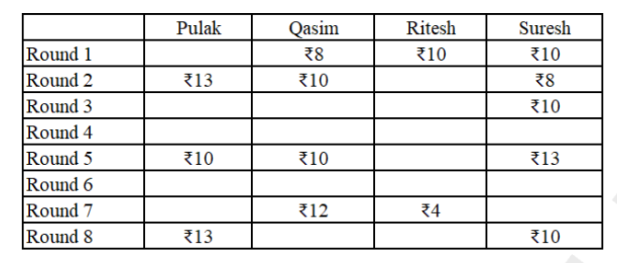
At the beginning of the tournament, the players had ₹10 each. The following table shows partial information about the amounts that the players had at the end of each of the eightrounds. It shows every time a player had ₹10 at the end of a round, as well as every time, at the end of a round, a player had either the minimum or the maximum amount that he would have had across the eight rounds. For example, Suresh had ₹10 at the end of Rounds 1, 3 and 8 and not after any of the other rounds. The maximum amount that he had at the end of any round was ₹13 (at the end of Round 5), and the minimum amount he had at the end of any round was ₹8 (at the end of Round 2). At the end of all other rounds, he must have had either ₹9, ₹11, or ₹12.
It was also known that Pulak and Qasim had the same amount of money with them at the end of Round 4.
Q40MCQGames & Tournaments
What BEST can be said about the amount of money that Ritesh had with him at the end of Round 8?
- A₹4 or ₹5
- BExactly ₹5
- C₹5 or ₹6
- DExactly ₹6
Answer and solution
Answer: (D) Exactly ₹6
Every ₹10 and every minimum and maximum is shown in the table, so an unshown amount is never one of these. Qasim's shown amounts run from ₹8 to ₹12, so his unshown ones are ₹9 or ₹11. Ritesh's run from ₹4 to ₹10, so his unshown ones are ₹5 to ₹9.
The four players always hold ₹40 in total, and in one round a player's amount changes by at most ₹2.
End of Round 8: Pulak has ₹13 and Suresh ₹10, so Qasim and Ritesh together have
.
If Qasim had ₹9, Ritesh would have ₹8, a rise of ₹4 from his ₹4 after Round 7, which is impossible. So Qasim has ₹11 and Ritesh has ₹6, a rise of ₹2.
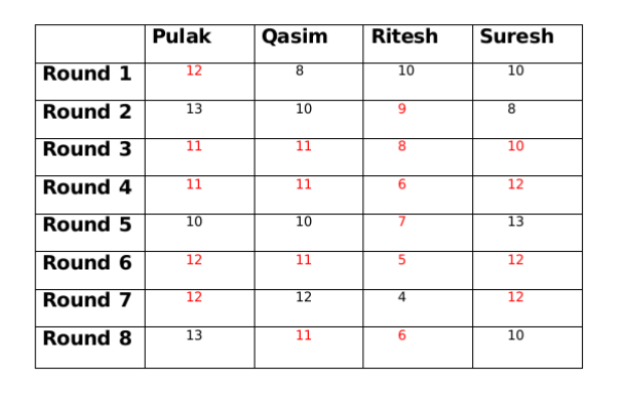
Option C (₹5 or ₹6) fails: Ritesh on ₹5 would need Qasim on ₹12, but ₹12 is Qasim's maximum and the table shows it only after Round 7.
Hence, option D (Exactly ₹6).
Q41MCQGames & Tournaments
What BEST can be said about the amount of money that Pulak had with him at the end of Round 6?
- AExactly ₹12
- BExactly ₹11
- C₹12 or ₹13
- D₹11 or ₹12
Answer and solution
Answer: (A) Exactly ₹12
Every ₹10 and every minimum and maximum is shown in the table, so unshown amounts are: Pulak ₹11 or ₹12, Qasim ₹9 or ₹11, Ritesh ₹5 to ₹9, Suresh ₹9, ₹11 or ₹12. The total is always ₹40, a round changes an amount by at most ₹2, and partners' changes cancel.
Round 7: Qasim has ₹12 and Ritesh ₹4, so Pulak and Suresh share ₹24. Neither can exceed ₹12, so both have ₹12.
Round 6: Qasim has ₹11, as ₹9 is too far from his ₹12 in Round 7. Ritesh falls to ₹4 in Round 7, so he had ₹5 or ₹6.
If Ritesh had ₹6, he lost ₹2 in Round 7, so his partner gained ₹2. But Qasim gained ₹1, and Pulak and Suresh, on ₹11 or ₹12 in Round 6 (Suresh's ₹9 is too far from ₹12), gained at most ₹1. So Ritesh had ₹5, and Pulak and Suresh shared
, giving ₹12 each.
Option D (₹11 or ₹12) fails because Pulak on ₹11 is the case just ruled out.
Hence, option A (Exactly ₹12).
Q42TITAGames & Tournaments
How much money (in ₹) did Ritesh have at the end of Round 4?
Type in your answer (TITA). No negative mark for a wrong answer.
Answer and solution
Answer: 6
Every ₹10 and every minimum and maximum is shown in the table, so an unshown amount is never one of these. Pulak's shown amounts run from ₹10 to ₹13, so his unshown ones are ₹11 or ₹12. Qasim's run from ₹8 to ₹12, so his are ₹9 or ₹11.
After Round 4, Pulak and Qasim have the same amount, so both have ₹11.
After Round 5, both have ₹10, so each lost ₹1 in Round 5. They could not have been partners, since partners' changes cancel. So each lost ₹1 to a different partner: Ritesh and Suresh each gained ₹1.
The total is always ₹40, so after Round 5 Ritesh has
. After Round 4 he had
.
Check: Suresh had
, and
.
The answer is 6.
Q43TITAGames & Tournaments
How many games were played with a bet of ₹2?
Type in your answer (TITA). No negative mark for a wrong answer.
Answer and solution
Answer: 6
Unshown amounts are never ₹10 or a player's minimum or maximum: Pulak ₹11–12, Qasim ₹9 or ₹11, Ritesh ₹5–9, Suresh ₹9, ₹11 or ₹12. The total stays ₹40; partners' changes cancel and are at most ₹2.
Totals give Pulak ₹12 (Round 1), Ritesh ₹9 (Round 2) and ₹7 (Round 5). Pulak and Qasim tie at ₹11 after Round 4, and each loses ₹1 in Round 5, so Ritesh and Suresh then had ₹6 and ₹12. In Round 3 Suresh gains ₹2, so Pulak drops to ₹11 (Qasim ₹11, Ritesh ₹8) or Ritesh to ₹7; the second leaves Suresh's ₹2 gain in Round 4 unmatched. Round 8 forces Qasim ₹11 and Ritesh ₹6 (Qasim ₹9 would need Ritesh to jump ₹4). Round 7 forces Pulak and Suresh ₹12, as they share ₹24. Round 6 is ₹12, ₹11, ₹5, ₹12, since Ritesh on ₹6 would leave his ₹2 loss in Round 7 unmatched.
A ₹2 game shows as one partner gaining ₹2 and the other losing ₹2: Round 1 Pulak–Qasim, Round 2 Qasim–Suresh, Round 3 Pulak–Suresh, Round 4 Ritesh–Suresh, Round 6 Pulak–Ritesh, Round 8 Ritesh–Suresh. Rounds 5 and 7 have only ₹1 changes or none.
The answer is 6.
Q44MCQGames & Tournaments
Which of the following pairings was made in Round 5?
- AQasim and Suresh
- BPulak and Ritesh
- CPulak and Qasim
- DPulak and Suresh
Answer and solution
Answer: (D) Pulak and Suresh
Unshown amounts are never ₹10 or a player's minimum or maximum: Pulak ₹11 or ₹12, Qasim ₹9 or ₹11, Ritesh ₹5 to ₹9, Suresh ₹9, ₹11 or ₹12. The total is always ₹40, and partners' changes cancel.
Round 5: Pulak and Qasim tie after Round 4, so both had ₹11. Both fall to ₹10, so they were not partners.
Round 6: Qasim has ₹11 (₹9 is too far from his ₹12 in Round 7). In Round 7 Pulak and Suresh share
, so both have ₹12, and Ritesh had ₹5 or ₹6 in Round 6. At ₹6, his ₹2 loss in Round 7 would need a partner gaining ₹2, but Qasim gains ₹1 and Pulak and Suresh reach ₹12 from at least ₹11. So Ritesh had ₹5, and Pulak and Suresh ₹12 each.
After Round 5 Ritesh had
. So in Round 6 Pulak gains ₹2, Qasim ₹1, Ritesh loses ₹2 and Suresh ₹1: the pairs were Pulak–Ritesh and Qasim–Suresh.
Pairs change between rounds, so Round 5 was neither Pulak–Ritesh (option B) nor Qasim–Suresh (option A), and Pulak–Qasim (option C) is already ruled out because both lost ₹1 in Round 5. So Pulak's partner was Suresh.
Hence, option D (Pulak and Suresh).