- CATin
- CAT past papers
- CAT 2022 Slot 2
- QA
CAT 2022 Slot 2 — QA questions with answers
All 22 questions of the Quantitative Ability section (14 MCQs, 8 TITA). Try each one, then open its answer and solution.
CAT 2022 Slot 2, timed like the real exam (120 minutes, 40 a section) and scored the CAT way: +3 right, −1 for a wrong MCQ, 0 for a wrong TITA, with the full post-mock analysis. Older official papers are in CATin Pro, with 80+ mocks and the full planner. The last three years of papers are free.
Sit this paper as a timed mock with CATin ProQuantitative Ability
CAT 2022 Slot 2 · 40 minutes · +3 for a right answer, −1 for a wrong MCQ, 0 for a wrong TITA
Q45TITASimple & Compound Interest
Mr. Pinto invests one-fifth of his capital at 6%, one-third at 10% and the remaining at 1%, each rate being simple interest per annum. Then, the minimum number of years required for the cumulative interest income from these investments to equal or exceed his initial capital is
Type in your answer (TITA). No negative mark for a wrong answer.
Answer and solution
Answer: 20
Take the capital as
, so that each part is a whole multiple of
.
One-fifth,
, earns 6%; one-third,
, earns 10%; the remaining
earns 1%.
Simple interest each year:
.
After
years the interest is
. We need
, so
.
After 19 years the interest is only
, less than the capital, so at least 20 years are needed.
The answer is 20.
Q46TITAAverages, Mixtures & Alligations
The average of a non-decreasing sequence of
numbers
is 300. If
is replaced by
, the new average becomes 400. Then, the number of possible values of
is
Type in your answer (TITA). No negative mark for a wrong answer.
Answer and solution
Answer: 14
The sum of the
numbers is
.
Replacing
by
adds
to the sum, and the new sum is
. So
, which gives
.
Upper limit: the sequence is non-decreasing, so
is the smallest number and cannot exceed the average. Hence
, so
. (At
,
and every term is 300.)
Lower limit: if
, the only number equals the average, so
, but
gives 20. So
.
Every
from 2 to 15 works: take
and each of the other
numbers equal to
, which is at least
exactly when
.
So
can be
, which is 14 values.
The answer is 14.
Q47TITAIndices & Surds
The number of integer solutions of the equation
is
Type in your answer (TITA). No negative mark for a wrong answer.
Answer and solution
Answer: 4
A power
equals 1 in three cases: the exponent is 0 (with
), the base is 1, or the base is
with an even exponent.
Case 1, exponent 0:
gives
, so
or
. The bases are
and
, both non-zero, so both work.
Case 2, base 1:
gives
, which has no integer solution.
Case 3, base
:
gives
, so
or
.
For
the exponent is
, and
.
For
the exponent is
, and
.
Both work, so the integer solutions are
: four in all.
The answer is 4.
Q48MCQAverages, Mixtures & Alligations
Manu earns ₹4000 per month and wants to save an average of ₹550 per month in a year. In the first nine months, his monthly expense was ₹3500, and he foresees that, tenth month onward, his monthly expense will increase to ₹3700. In order to meet his yearly savings target, his monthly earnings, in rupees, from the tenth month onward should be
- A4400
- B4200
- C4300
- D4350
Answer and solution
Answer: (A) 4400
Yearly savings target:
rupees.
Savings in the first nine months:
rupees.
So the last three months must save
rupees, i.e.
rupees a month.
From the tenth month his expense is ₹3700 a month, so his monthly earnings must be
rupees.
The nearest option, ₹4350, would save only ₹650 a month, or ₹1950 over three months, which is ₹150 short of the target.
Hence, option A (4400).
Q49MCQTriangles & Lines
In triangle
, altitudes
and
are drawn to the corresponding bases. If
and
, then
equals
- A
- B
- C1
- D
Answer and solution
Answer: (D)
Draw the triangle with both altitudes:
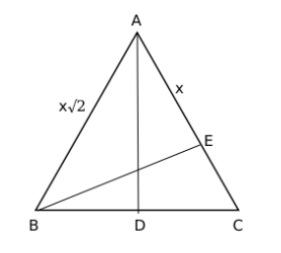
Since
, triangle
is right-angled at
, and
. So it is an isosceles right triangle: let
; then
.
Since
, triangle
is right-angled at
, with
. The side
is opposite
, so
.
Therefore
.
Option A,
, would come from using the side next to
,
, instead of the opposite side
.
Hence, option D (
).
Q50MCQFunctions & Graphs
Let
be a quadratic polynomial in
such that
for all real numbers
. If
and
, then
is equal to
- A12
- B24
- C6
- D36
Answer and solution
Answer: (B) 24
Since
for every real
and
, the graph touches the x-axis at
without crossing it. If 2 were a simple root,
would change sign there and take negative values. So 2 is a repeated root, and
with
.
From
:
, so
.
Then
.
Option A, 12, doubles
because
is twice as far from 2 as 4 is. But
grows with the square of that distance, so the factor is
, giving
.
Hence, option B (24).
Q51MCQQuadratic & Polynomial Equations
Let
and
be real numbers. If
and
are roots of
, then
equals
- A
- B
- C
- D
Answer and solution
Answer: (A)
Since
and
are both roots, substitute each:
...(1)
...(2)
Adding (1) and (2):
, so
.
Subtracting (2) from (1):
, so
.
If
, equation (1) would give
, which is false. So
.
Then
, so
.
Check with the roots: the third root is
, since
and
cancel in the sum, and the product
, as required.
Option B,
, has the wrong sign: it would make
, not
.
Hence, option A (
).
Q52MCQTime, Speed & Distance
Two ships meet mid-ocean, and then, one ship goes south and the other ship goes west, both travelling at constant speeds. Two hours later, they are 60 km apart. If the speed of one of the ships is 6 km per hour more than the other one, then the speed, in km per hour, of the slower ship is
- A20
- B12
- C18
- D24
Answer and solution
Answer: (C) 18
The ships move south and west from the meeting point, at right angles, so their paths and the line joining them form a right triangle.
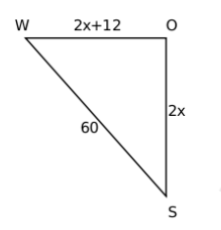
Let the slower speed be
km/h and the faster
km/h. In 2 hours they cover
and
km. By Pythagoras:
.
Dividing by 4:
, so
, i.e.
.
This factors as
. Speed is positive, so
.
Check:
.
Option D, 24, is the faster ship's speed,
, not the slower one's.
Hence, option C (18).
Q53TITAFunctions & Graphs
Suppose for all integers
, there are two functions
and
such that
and
. If
, then the value of the sum
is
Type in your answer (TITA). No negative mark for a wrong answer.
Answer and solution
Answer: 12
The rule
gives
for every integer
.
Put
in
:
.
Then
,
,
, and so on. The values alternate:
for even
and
for odd
. This agrees with
, since
is always even.
Now
, which is odd, so
.
Also
, since 5 is odd, so
.
Sum:
.
The answer is 12.
Q54TITALinear Equations
In an examination, there were 75 questions. 3 marks were awarded for each correct answer, 1 mark was deducted for each wrong answer and 1 mark was awarded for each unattempted question. Rayan scored a total of 97 marks in the examination. If the number of unattempted questions was higher than the number of attempted questions, then the maximum number of correct answers that Rayan could have given in the examination is
Type in your answer (TITA). No negative mark for a wrong answer.
Answer and solution
Answer: 24
Let the number of questions attempted be x+y out of which x are correct and y are incorrect and the number of questions unattempted be z.
It is given, x + y + z = 75 ...... (1)
3x - y + z = 97 ...... (2)
(2)-(1) -> x - y = 11
(1)+(2) -> 2x + z = 86
z > x + y
z > 75 - z
z > 37.5
Minimum possible value of z is 38
2x + 38 = 86
2x = 48
x = 24
The maximum number of correct answers is 24.
Q55TITAPolygons & Circles
Regular polygons
and
have number of sides in the ratio 1 : 2 and interior angles in the ratio 3 : 4. Then the number of sides of
equals
Type in your answer (TITA). No negative mark for a wrong answer.
Answer and solution
Answer: 10
Let
have
sides and
have
sides.
Each interior angle of a regular polygon with
sides is
.
So the angle of
is
, and the angle of
is
.
Their ratio is
.
Cross-multiplying:
, so
.
Check: a regular pentagon's angle is
and a regular decagon's is
, and
.
So
has
sides.
The answer is 10.
Q56MCQRatios, Proportions & Partnership
In an election, there were four candidates and 80% of the registered voters casted their votes. One of the candidates received 30% of the casted votes while the other three candidates received the remaining casted votes in the proportion 1 : 2 : 3. If the winner of the election received 2512 votes more than the candidate with the second highest votes, then the number of registered voters was
- A50240
- B40192
- C60288
- D62800
Answer and solution
Answer: (D) 62800
Let there be
registered voters. Votes cast:
.
One candidate gets 30% of the votes cast:
.
The remaining
votes are shared in the ratio 1 : 2 : 3, i.e.
,
and
. The first two are about
and
.
So the winner has
votes and the runner-up has
.
, so
.
Registered voters:
.
Option A, 50240, is the number of votes cast,
, not the number of registered voters.
Hence, option D (62800).
Q57MCQSequences & Series
On day one, there are 100 particles in a laboratory experiment. On day
, where
, one out of every
particles produces another particle. If the total number of particles in the laboratory experiment increases to 1000 on day
, then
equals
- A19
- B16
- C18
- D17
Answer and solution
Answer: (A) 19
On day
, one particle in every
produces a new one, so the count is multiplied by
.
Day 1: 100.
Day 2:
(50 new).
Day 3:
(50 new).
Day 4:
(50 new).
The pattern holds every day: if the count on day
is
, then on day
one in
of them produces, adding
.
So the count on day
is
.
Setting
gives
, so
.
Option C, 18, is one day short: on day 18 there are only
particles.
Hence, option A (19).
Q58MCQPermutations & Combinations
The number of integers greater than 2000 that can be formed with the digits 0, 1, 2, 3, 4, 5, using each digit at most once, is
- A1440
- B1200
- C1480
- D1420
Answer and solution
Answer: (A) 1440
Numbers with 1, 2 or 3 digits are below 2000, so only 4-, 5- and 6-digit numbers count. No digit repeats, and the first digit cannot be 0.
4-digit numbers: to exceed 2000 the first digit must be 2, 3, 4 or 5 (4 choices). The other three places are filled from the remaining 5 digits in
ways. Total
. (2000 itself cannot be formed, as it repeats 0.)
5-digit numbers: the first digit is 1 to 5 (5 choices), and the rest can be filled in
ways. Total
.
6-digit numbers: 5 choices for the first digit, then
ways for the rest. Total 600.
Every 5- and 6-digit number exceeds 2000.
Sum:
.
Option B, 1200, counts only the 5- and 6-digit numbers and misses the 240 four-digit ones.
Hence, option A (1440).
Q59MCQProperties of Numbers
For some natural number
, assume that
is divisible by
. The largest possible value of
is
- A4
- B7
- C6
- D5
Answer and solution
Answer: (B) 7
To find the largest possible value of n, we need to find the value of n such that n! is less than 15000.
7! = 5040
8! = 40320 > 15000
This implies 15000! is not divisible by 40320!
Therefore, maximum value n can take is 7.
The answer is option B.
Q60TITATime & Work
Working alone, the times taken by Anu, Tanu and Manu to complete any job are in the ratio 5 : 8 : 10. They accept a job which they can finish in 4 days if they all work together for 8 hours per day. However, Anu and Tanu work together for the first 6 days, working 6 hours 40 minutes per day. Then, the number of hours that Manu will take to complete the remaining job working alone is
Type in your answer (TITA). No negative mark for a wrong answer.
Answer and solution
Answer: 6
The times are in the ratio 5 : 8 : 10, so the work rates are in the ratio
. Let Anu, Tanu and Manu do
,
and
units of work per hour.
Together they finish in 4 days of 8 hours, i.e. 32 hours. So the job is
units.
Anu and Tanu work for 6 days at 6 hours 40 minutes a day:
hours. They do
units.
Remaining work:
units.
Manu does
units an hour, so he needs
hours.
The answer is 6.
Q61MCQAverages, Mixtures & Alligations
There are two containers of the same volume, first container half-filled with sugar syrup and the second container half-filled with milk. Half the content of the first container is transferred to the second container, and then the half of this mixture is transferred back to the first container. Next, half the content of the first container is transferred back to the second container. Then the ratio of sugar syrup and milk in the second container is
- A4 : 5
- B6 : 5
- C5 : 4
- D5 : 6
Answer and solution
Answer: (D) 5 : 6
Take each container to hold 200 L, so the first starts with 100 L of sugar syrup and the second with 100 L of milk.
Step 1: half of the first container (50 L of syrup) goes to the second. First: 50 L syrup. Second: 50 L syrup and 100 L milk.
Step 2: half of the second container (75 L) goes back. It carries 25 L syrup and 50 L milk. First: 75 L syrup and 50 L milk. Second: 25 L syrup and 50 L milk.
Step 3: half of the first container (62.5 L) goes to the second. It carries 37.5 L syrup and 25 L milk. Second:
L syrup and
L milk.
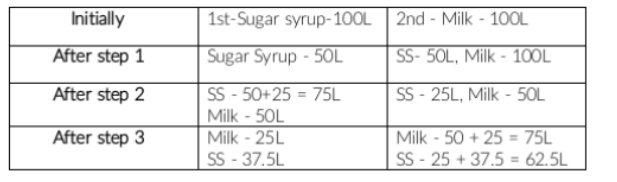
Syrup : milk in the second container
.
Option B (6 : 5) is the same ratio turned round: it is milk to syrup, not syrup to milk.
Hence, option D (5 : 6).
Q62MCQSequences & Series
Consider the arithmetic progression 3, 7, 11, ... and let
denote the sum of the first
terms of this progression. Then the value of
is
- A455
- B442
- C415
- D404
Answer and solution
Answer: (A) 455
The progression has first term
and common difference
, so
.
Add these for
to
, using
and
:
.
Divide by 25:
.
Option B (442) is the trap. It is only the
part divided by 25,
; it leaves out the
that comes from
.
Hence, option A (455).
Q63TITALogarithms
The number of distinct integer values of
satisfying
, is
Type in your answer (TITA). No negative mark for a wrong answer.
Answer and solution
Answer: 47
The logarithms need
. Let
. Then
, and the inequality becomes
, that is,
.
A fraction is negative when its top and bottom have opposite signs. For
both
and
are positive, and for
both are negative. So the fraction is negative only when
(at
the fraction is undefined, and at
it is zero).
So
, which gives
, that is,
.
The integers in this range are
, which is
values.
The answer is 47.
Q64MCQLinear Equations
If
and
are non-negative real numbers such that
, then the average of the maximum and minimum possible values of
is
- A3
- B4
- C3.5
- D4.5
Answer and solution
Answer: (D) 4.5
From
with
,
can run from
(when
) up to
(when
).
Write
. So
gets smaller as
gets larger.
Maximum: at
,
and
.
Minimum: at
,
and
.
Average of the maximum and minimum
.
Option A (3) is only the minimum value of
, not the average of the two extremes.
Hence, option D (4.5).
Q65MCQAverages, Mixtures & Alligations
Five students, including Amit, appear for an examination in which possible marks are integers between 0 and 50, both inclusive. The average marks for all the students is 38 and exactly three students got more than 32. If no two students got the same marks and Amit got the least marks among the five students, then the difference between the highest and lowest possible marks of Amit is
- A22
- B21
- C24
- D20
Answer and solution
Answer: (D) 20
The five marks add up to
, and no two are equal.
Exactly three students scored more than 32, so the other two, Amit and one more student, scored 32 or less.
Amit's lowest mark: make the other four as high as possible. The three above 32 can be at most 50, 49 and 48, and the fourth student at most 32. They total
, so Amit scores at least
.
Amit's highest mark: he has the least marks, so he must be below the other student who scored 32 or less. That student has at most 32, so Amit has at most 31. This works: with Amit on 31 and the fourth student on 32, the top three need
, for example 50, 44 and 33.
Difference
.
Option B (21) comes from taking Amit's highest mark as 32, which would leave no mark for the fourth student between Amit and 33.
Hence, option D (20).
Q66MCQTriangles & Lines
The length of each side of an equilateral triangle
is 3 cm. Let
be a point on
such that the area of triangle
is half the area of triangle
. Then the length of
, in cm, is
- A
- B
- C
- D
Answer and solution
Answer: (C)
Triangles ABD and ADC have the same height from A to BC, so their areas are in the ratio of their bases,
. Area ADC is half of area ABD, so
. Since
, we get
and
.
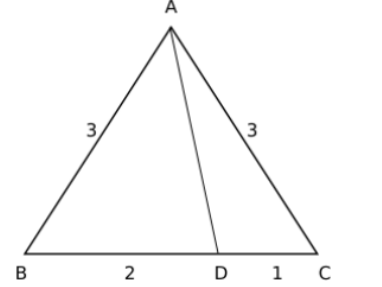
In triangle ADC,
,
and
. By the cosine rule,
,
so
.
Options B (
) and D (
) are impossible for any point D on BC: they are shorter than the altitude
, the shortest distance from A to BC. Option A (
) would need D about 0.38 cm from an end of BC, not 1 cm from C.
Hence, option C (
).