- CATin
- CAT past papers
- CAT 2022 Slot 2
- DILR
CAT 2022 Slot 2 — DILR questions with answers
All 19 questions of the Data Interpretation & Logical Reasoning section (14 MCQs, 5 TITA, 4 sets). Try each one, then open its answer and solution. 1 question of the original section is left out while its answer key is checked.
CAT 2022 Slot 2, timed like the real exam (120 minutes, 40 a section) and scored the CAT way: +3 right, −1 for a wrong MCQ, 0 for a wrong TITA, with the full post-mock analysis. Older official papers are in CATin Pro, with 80+ mocks and the full planner. The last three years of papers are free.
Sit this paper as a timed mock with CATin ProData Interpretation & Logical Reasoning
CAT 2022 Slot 2 · 40 minutes · +3 for a right answer, −1 for a wrong MCQ, 0 for a wrong TITA
Data set
Set for questions 25–29
DIRECTIONS for questions 25-29:
A few salesmen are employed to sell a product called TRICCEK among households in various housing complexes. On each day, a salesman is assigned to visit one housing complex. Once a salesman enters a housing complex, he can meet any number of households in the time available. However, if a household makes a complaint against the salesman, then he must leave the housing complex immediately and cannot meet any other household on that day. A household may buy any number of TRICCEK items or may not buy any item. The salesman needs to record the total number of TRICCEK items sold as well as the number of households met in each day. The success rate of a salesman for a day is defined as the ratio of the number of items sold to the number of households met on that day. Some details about the performances of three salesmen - Tohri, Hokli and Lahur, on two particular days are given below.
1. Over the two days, all three of them met the same total number of households, and each of them sold a total of 100 items.
2. On both days, Lahur met the same number of households and sold the same number of items.
3. Hokli could not sell any item on the second day because the first household he met on that day complained against him.
4. Tohri met 30 more households on the second day than on the first day.
5. Tohri’s success rate was twice that of Lahur’s on the first day, and it was 75% of Lahur’s on the second day.
Q25TITATables & Caselets
What was the total number of households met by Tohri, Hokli and Lahur on the first day?
Type in your answer (TITA). No negative mark for a wrong answer.
Answer and solution
Answer: 84
Lahur met the same number of households, say
, on each day and sold the same number of items; his total is 100, so he sold 50 each day. By statement 1, each salesman met
households in all.
Hokli: the first household on day 2 complained, so on day 2 he met 1 household and sold 0. On day 1 he met
households and sold 100.
Tohri: if he met
on day 1, then
, so he met
on day 1 and
on day 2. Let him sell
items on day 1 and
on day 2.
Statement 5, day 1:
, so
.
Day 2:
, so
.
Adding:
, so
and
.
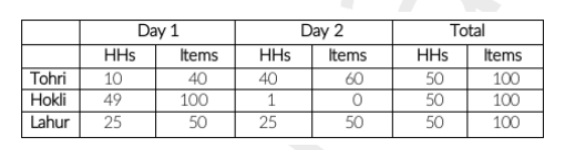
Day 1: Tohri 10 households, 40 items; Hokli 49, 100; Lahur 25, 50. Day 2: Tohri 40, 60; Hokli 1, 0; Lahur 25, 50.
Households met on day 1:
.
The answer is 84.
Q26TITATables & Caselets
How many TRICCEK items were sold by Tohri on the first day?
Type in your answer (TITA). No negative mark for a wrong answer.
Answer and solution
Answer: 40
Lahur met the same number of households, say
, on each day and sold the same number of items; his total is 100, so he sold 50 each day. By statement 1, each salesman met
households in all.
Hokli: the first household on day 2 complained, so on day 2 he met 1 household and sold 0. On day 1 he met
households and sold 100.
Tohri: if he met
on day 1, then
, so he met
on day 1 and
on day 2. Let him sell
items on day 1 and
on day 2.
Statement 5, day 1:
, so
.
Day 2:
, so
.
Adding:
, so
and
.
Then
. Check day 2: Tohri sold 60 to 40 households, a rate of 1.5, which is
of Lahur's 2.
Day 1: Tohri 10 households, 40 items; Hokli 49, 100; Lahur 25, 50. Day 2: Tohri 40, 60; Hokli 1, 0; Lahur 25, 50.
The answer is 40.
Q27MCQTables & Caselets
How many households did Lahur meet on the second day?
- Abetween 21 and 29
- B20 or less
- Cmore than 35
- Dbetween 30 and 35
Answer and solution
Answer: (A) between 21 and 29
Lahur met the same number of households, say
, on each day and sold the same number of items; his total is 100, so he sold 50 each day. By statement 1, each salesman met
households in all.
Hokli: the first household on day 2 complained, so on day 2 he met 1 household and sold 0. On day 1 he met
households and sold 100.
Tohri: if he met
on day 1, then
, so he met
on day 1 and
on day 2. Let him sell
items on day 1 and
on day 2.
Statement 5, day 1:
, so
.
Day 2:
, so
.
Adding:
, so
and
. Then
.
Day 1: Tohri 10 households, 40 items; Hokli 49, 100; Lahur 25, 50. Day 2: Tohri 40, 60; Hokli 1, 0; Lahur 25, 50.
Lahur met
households on day 2. That lies between 21 and 29; none of the other ranges (20 or less, 30 to 35, more than 35) contains 25.
Hence, option A (between 21 and 29).
Q28MCQTables & Caselets
How many households did Tohri meet on the first day?
- Abetween 21 and 40
- Bbetween 11 and 20
- Cmore than 40
- D10 or less
Answer and solution
Answer: (D) 10 or less
Lahur met the same number of households, say
, on each day and sold the same number of items; his total is 100, so he sold 50 each day. By statement 1, each salesman met
households in all.
Hokli: the first household on day 2 complained, so on day 2 he met 1 household and sold 0. On day 1 he met
households and sold 100.
Tohri: if he met
on day 1, then
, so he met
on day 1 and
on day 2. Let him sell
items on day 1 and
on day 2.
Statement 5, day 1:
, so
.
Day 2:
, so
.
Adding:
, so
and
. Then
.
Day 1: Tohri 10 households, 40 items; Hokli 49, 100; Lahur 25, 50. Day 2: Tohri 40, 60; Hokli 1, 0; Lahur 25, 50.
Tohri met
households on day 1. That is '10 or less'; option B's range begins at 11.
Hence, option D (10 or less).
Q29MCQTables & Caselets
Which of the following statements is FALSE?
- AAmong the three, Tohri had the highest success rate on the second day.
- BTohri had a higher success rate on the first day compared to the second day.
- CAmong the three, Tohri had the highest success rate on the first day.
- DAmong the three, Lahur had the lowest success rate on the first day.
Answer and solution
Answer: (A) Among the three, Tohri had the highest success rate on the second day.
Lahur met
households each day and sold 50 each day (equal days, total 100). Each salesman met
in all.
Hokli's first household on day 2 complained, so he met 1 and sold 0 that day; on day 1 he met
and sold 100.
Tohri met
on day 1 and
on day 2 (30 more, total
). Let him sell
on day 1 and
on day 2.
Statement 5:
and
.
Adding
and
:
, so
and
.
Success rate = items ÷ households.
Day 1: Tohri
, Hokli
, Lahur
.
Day 2: Tohri
, Hokli
, Lahur 2.
A: on day 2 Lahur's 2 beats Tohri's 1.5, so A is false.
B: Tohri's 4 on day 1 exceeds his 1.5 on day 2, so B is true.
C: Tohri's 4 is the highest on day 1, so C is true.
D: Lahur's 2 is just below Hokli's 2.04, so D is true.
Hence, option A (Among the three, Tohri had the highest success rate on the second day.).
Data set
Set for questions 31–34
DIRECTIONS for questions 30-34:
Every day a widget supplier supplies widgets from the warehouse (W) to four locations - Ahmednagar (A), Bikrampore (B), Chitrachak (C), and Deccan Park (D).
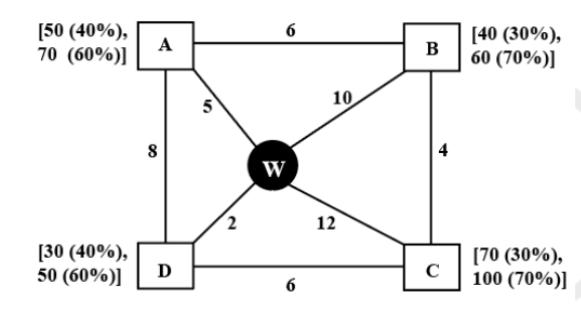
The daily demand for widgets in each location is uncertain and independent of each other. Demands and corresponding probability values (in parenthesis) are given against each location (A, B, C, and D) in the figure below. For example, there is a 40% chance that the demand in Ahmednagar will be 50 units and a 60% chance that the demand will be 70 units. The lines in the figure connecting the locations and warehouse represent two-way roads connecting those places with the distances (in km) shown beside the line. The distances in both the directions along a road are equal. For example, the road from Ahmednagar to Bikrampore and the road from Bikrampore to Ahmednagar are both 6 km long.
Every day the supplier gets the information about the demand values of the four locations and creates the travel route that starts from the warehouse and ends at a location after visiting all the locations exactly once. While making the route plan, the supplier goes to the locations in decreasing order of demand. If there is a tie for the choice of the next location, the supplier will go to the location closest to the current location. Also, while creating the route, the supplier can either follow the direct path (if available) from one location to another or can take the path via the warehouse. If both paths are available (direct and via warehouse), the supplier will choose the path with minimum distance.
Q31TITANetworks & Routes
If the total number of widgets delivered in a day is 250 units, then what is the total distance covered in the route (in km)?
Type in your answer (TITA). No negative mark for a wrong answer.
Answer and solution
Answer: 38
Shortest distances between locations, using the direct road or the path via W, whichever is shorter: A–B 6, A–C
(no direct road), A–D 7 (via W, shorter than the direct 8), B–C 4, B–D
(no direct road), C–D 6. From W: A 5, B 10, C 12, D 2.
The largest possible total demand is
. A total of 250 is 30 less. The possible drops are A 20, B 20, C 30 and D 20; no combination of 20s makes 30, so only C drops. The demands are A 70, B 60, C 70, D 50.
Order by decreasing demand: A and C tie at 70. The tie goes to the location closer to the current point, W: A is 5 km away and C is 12 km, so A comes first, then C, then B (60), then D (50).
Route W–A–C–B–D:
km.
The answer is 38.
Q32MCQNetworks & Routes
What is the chance that the total number of widgets delivered in a day is 260 units and the route ends at Bikrampore?
- A33.33%
- B10.80%
- C17.64%
- D7.56%
Answer and solution
Answer: (D) 7.56%
The maximum total demand is
. A total of 260 means exactly one location drops by 20 from its higher value. C can only drop by 30, so C = 100 and C is visited first. The drop is at A, B or D.
The route ends at B only if B comes last:
If A drops (A 50, B 60, D 50), the order is C, B, then A and D, so the route ends at A or D.
If D drops (A 70, B 60, D 30), the order is C, A, B, D, ending at D.
If B drops (A 70, B 40, D 50), the order is C, A, D, B, ending at B.
So the only case is C 100, A 70, D 50, B 40. The demands are independent, so the probability is
.
Option B, 10.80%, is
: it leaves out the 0.7 chance that C's demand is 100.
Hence, option D (7.56%).
Q33MCQNetworks & Routes
If the first location visited from the warehouse is Ahmednagar, then what is the chance that the total distance covered in the route is 40 km?
- A18%
- B5.4%
- C3.24%
- D30%
Answer and solution
Answer: (A) 18%
Shortest distances: W–A 5, A–C 17 (via W, no direct road), C–B 4, C–D 6, B–D 12 (via W, no direct road).
A is visited first only if its demand is the highest. If A = 50, C (at least 70) would come first, so A = 70. C must not exceed A, so C = 70; in the tie A wins because it is closer to W (5 km against 12 km). So the condition means A = 70 and C = 70, and the route starts W–A–C:
km. A total of 40 km needs 18 km more.
C–B–D:
km, total 38.
C–D–B:
km, total 40.
D comes before B only when D's demand exceeds B's, i.e. D = 50 and B = 40. The probability is
.
This is a chance given that A is first, so the chances of A = 70 and C = 70 are not multiplied in. Option C, 3.24%, is
, the chance without that condition.
Hence, option A (18%).
Q34MCQNetworks & Routes
If Ahmednagar is not the first location to be visited in a route and the total route distance is 29 km, then which of the following is a possible number of widgets delivered on that day?
- A210
- B220
- C200
- D250
Answer and solution
Answer: (A) 210
Shortest distances: W–C 12; C–B 4, C–D 6, C–A 17 (via W); A–B 6, A–D 7 (via W, shorter than the direct 8); B–D 12 (via W).
The first location has the highest demand. A is not first, and B (at most 60) and D (at most 50) are always below C (at least 70), so C is first. W to C is 12 km, leaving
km for the other three.
Orders from C: C–B–A–D is
; C–B–D–A is 23; C–D–A–B is 19; C–D–B–A is 24; going from C straight to A already costs 17. So the order is C, B, A, D.
B before A needs B ≥ A. If A = 70 it would beat B, so A = 50, and then B = 60 (40 would fall below A). D after A: D = 30, or D = 50, a tie that A wins because it is closer to B (6 km against 12 km). C is 70 or 100.
Possible totals:
, then 230, 240 and 260.
Only 210 is among the options; 220, 200 and 250 cannot occur.
Hence, option A (210).
Data set
Set for questions 35–39
DIRECTIONS for questions 35-39:
The two plots below show data for four companies code-named A, B, C, and D over three years - 2019, 2020, and 2021.
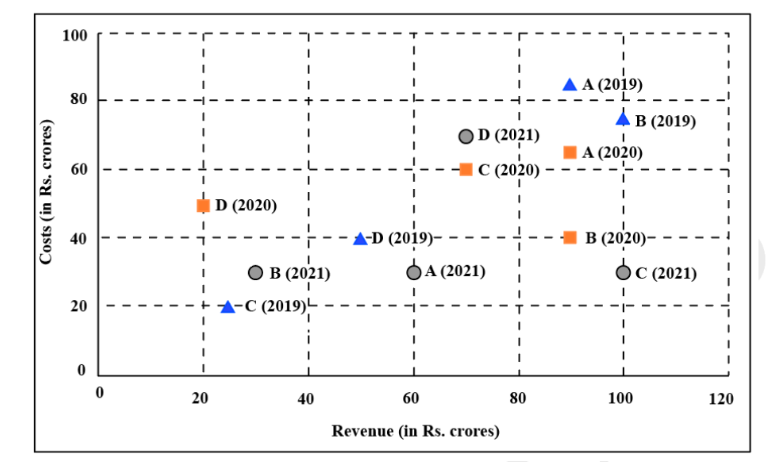
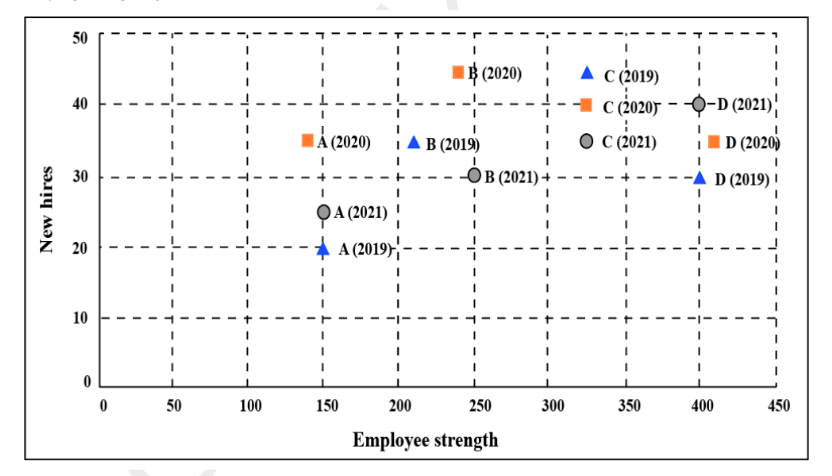
The first plot shows the revenues and costs incurred by the companies during these years. For example, in 2021, company C earned Rs.100 crores in revenue and spent Rs.30 crores. The profit of a company is defined as its revenue minus its costs The second plot shows the number of employees employed by the company (employee strength) at the start of each of these three years, as well as the number of new employees hired each year (new hires). For example, Company B had 250 employees at the start of 2021, and 30 new employees joined the company during the year.
Q35MCQPie & Scatter Charts
Considering all three years, which company had the highest annual profit?
- ACompany A
- BCompany D
- CCompany B
- DCompany C
Answer and solution
Answer: (D) Company C
Profit = revenue − cost. The values read from the first plot (Rs. crores) are:
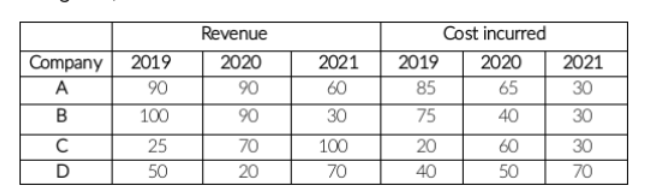
Annual profits:
A:
(2019),
(2020),
(2021).
B:
,
,
.
C:
,
,
.
D:
,
,
.
The highest profit in any single year is C's 70 crores in 2021. The nearest rival is B, whose best year, 2020, gives only 50.
Reading the question as total profit over the three years gives the same answer: C 85, B 75, A 60, D −20.
Hence, option D (Company C).
Q36MCQPie & Scatter Charts
Which of the four companies experienced the highest annual loss in any of the years?
- ACompany C
- BCompany A
- CCompany B
- DCompany D
Answer and solution
Answer: (D) Company D
Profit = revenue − cost. The values read from the first plot (Rs. crores) are:
A company makes a loss only when its cost exceeds its revenue. In 2019 every company's cost is below its revenue. In 2020 only D's is above: revenue 20, cost 50. In 2021 the costs of B (30, 30) and D (70, 70) equal their revenues, so their profit is zero, not a loss.
So the only loss in any year is D's loss of
crores in 2020. Companies A, B and C never make a loss in any of the three years.
Hence, option D (Company D).
Q37MCQPie & Scatter Charts
The ratio of a company's annual profit to its annual costs is a measure of its performance. Which of the four companies had the lowest value of this ratio in 2019?
- ACompany A
- BCompany D
- CCompany B
- DCompany C
Answer and solution
Answer: (A) Company A
The ratio is profit ÷ cost = (revenue − cost) ÷ cost. The values read from the first plot (Rs. crores) are:
For 2019:
A:
B:
C:
D:
A has the lowest ratio. C also made a profit of only 5 crores, but on a cost of 20 rather than 85, so its ratio is much higher.
Hence, option A (Company A).
Q38MCQPie & Scatter Charts
The total number of employees lost in 2019 and 2020 was the least for:
- ACompany B
- BCompany D
- CCompany A
- DCompany C
Answer and solution
Answer: (A) Company B
The employee strengths and new hires read from the second plot are:
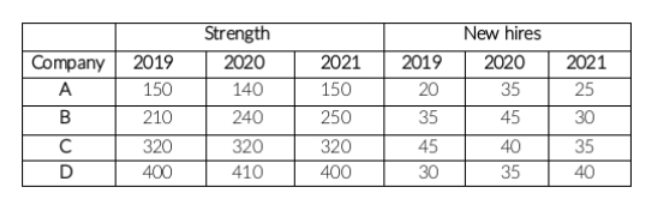
Employees lost in a year = strength at the start of the year + new hires − strength at the start of the next year.
A: 2019:
; 2020:
; total 55.
B: 2019:
; 2020:
; total 40.
C: 2019:
; 2020:
; total 85.
D: 2019:
; 2020:
; total 65.
B lost the fewest, 40. The closest is A, with 55.
Hence, option A (Company B).
Q39MCQPie & Scatter Charts
Profit per employee is the ratio of a company's profit to its employee strength. For this purpose, the employee strength in a year is the average of the employee strength at the beginning of that year and the beginning of the next year. In 2020, which of the four companies had the highest profit per employee?
- ACompany D
- BCompany C
- CCompany B
- DCompany A
Answer and solution
Answer: (C) Company B
Profit comes from the first plot and employee strength from the second:
2020 profit (Rs. crores): A
, B
, C
, D
.
Employee strength for 2020 = (start of 2020 + start of 2021) ÷ 2: A
, B
, C 320, D
.
Profit per employee:
A:
B:
C:
D: negative, since it made a loss.
B is the highest. A is the closest:
, which is less than
.
Hence, option C (Company B).
Data set
Set for questions 40–44
DIRECTIONS for questions 40-44:
A speciality supermarket sells 320 products. Each of these products was either a cosmetic product or a nutrition product. Each of these products was also either a foreign product or a domestic product. Each of these products had at least one of the two approvals - FDA or EU.
The following facts are also known:
1. There were equal numbers of domestic and foreign products.
2. Half of the domestic products were FDA approved cosmetic products.
3. None of the foreign products had both the approvals, while 60 domestic products had both the approvals.
4. There were 140 nutrition products, half of them were foreign products.
5. There were 200 FDA approved products. 70 of them were foreign products and 120 of them were cosmetic products.
Q40TITASet Theory
How many foreign products were FDA approved cosmetic products?
Type in your answer (TITA). No negative mark for a wrong answer.
Answer and solution
Answer: 40
Statement 1: there are 320 products, so domestic and foreign products are 160 each.
Statement 2: half of the 160 domestic products, i.e. 80, are FDA-approved cosmetic products.
Statement 5: 120 of the 200 FDA-approved products are cosmetic products. Each of these 120 is either domestic or foreign.
So the foreign FDA-approved cosmetic products number
.
Check: statement 5 also says 70 FDA-approved products are foreign, so the remaining
foreign FDA-approved products are nutrition products. That fits statement 4, which gives 70 foreign nutrition products.
The answer is 40.
Q41MCQSet Theory
How many cosmetic products did not have FDA approval?
- A10
- BCannot be determined
- C50
- D60
Answer and solution
Answer: (D) 60
Statement 1: domestic and foreign products are 160 each. Statement 4: of the 140 nutrition products, 70 are foreign and 70 domestic, so there are
foreign and 90 domestic cosmetic products.
Domestic cosmetics: statement 2 says 80 of them are FDA-approved, so
have no FDA approval.
Foreign cosmetics: statement 5 gives 120 FDA-approved cosmetics, 80 of them domestic, so
foreign cosmetics are FDA-approved and
are not.
Every product has at least one approval, so these products have EU approval only.
Cosmetic products without FDA approval:
.
Option A, 10, counts only the domestic ones, and option C, 50, only the foreign ones. The count is fully determined, so option B is also wrong.
Hence, option D (60).
Q42MCQSet Theory
Which among the following options best represents the number of domestic cosmetic products that had both the approvals?
- AAt least 10 and at most 60
- BAt least 10 and at most 80
- CAt least 20 and at most 70
- DAt least 20 and at most 50
Answer and solution
Answer: (A) At least 10 and at most 60
Domestic and foreign products are 160 each (statement 1). The 140 nutrition products split 70 foreign and 70 domestic (statement 4), so there are 90 domestic cosmetics, 80 of them FDA-approved (statement 2).
FDA products number 200, of which 70 are foreign, so 130 are domestic. Domestic FDA nutrition products:
.
Among domestic products, let
= cosmetics with both approvals,
= cosmetics with FDA only,
= nutrition with both,
= nutrition with FDA only.
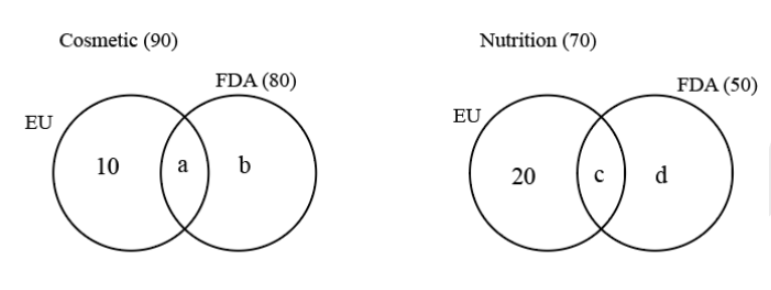
Then
,
and, by statement 3,
.
Least
:
is at most 50, so
.
Greatest
:
can be 0, so
, with
.
The top pair shows
; the bottom pair shows
:
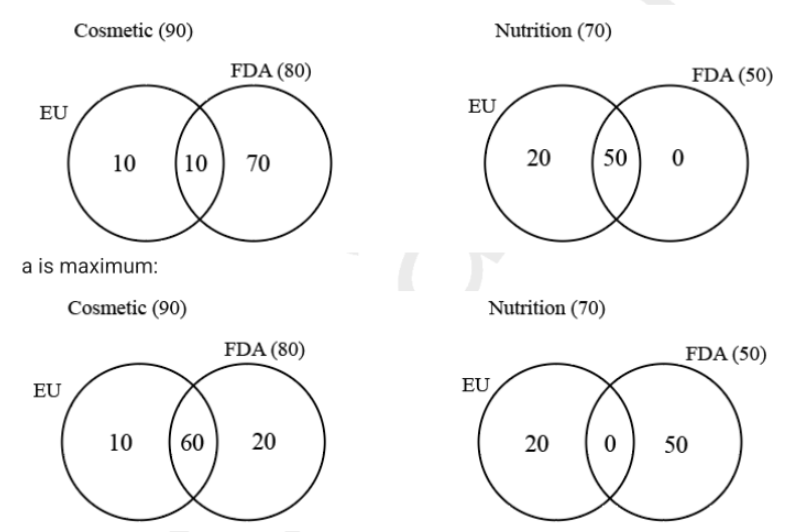
So
is at least 10 and at most 60. Option B's upper limit of 80 would need
.
Hence, option A (At least 10 and at most 60).
Q43MCQSet Theory
If 70 cosmetic products did not have EU approval, then how many nutrition products had both the approvals?
- A50
- B30
- C10
- D20
Answer and solution
Answer: (C) 10
Domestic and foreign products are 160 each, with 90 cosmetic and 70 nutrition products in each group (statements 1 and 4). 80 domestic cosmetics are FDA-approved (statement 2). Of the 120 FDA cosmetics,
are foreign, and they have FDA only, since no foreign product has both approvals (statement 3).
Among domestic products, let
= cosmetics with both approvals,
= cosmetics with FDA only,
= nutrition with both,
= nutrition with FDA only. Domestic FDA products number
, so
,
, and
(statement 3).
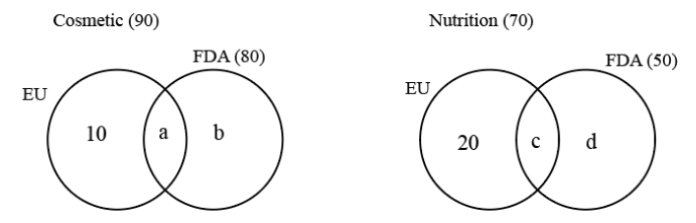
Cosmetics without EU approval are those with FDA only:
, so
. Then
and
.
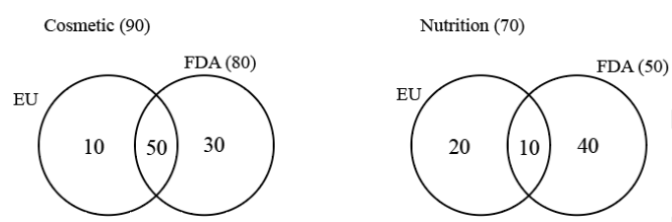
Foreign products never have both approvals, so the nutrition products with both are just
.
Option A, 50, is
, the domestic cosmetics with both approvals, not nutrition products.
Hence, option C (10).
Q44TITASet Theory
If 50 nutrition products did not have EU approval, then how many domestic cosmetic products did not have EU approval?
Type in your answer (TITA). No negative mark for a wrong answer.
Answer and solution
Answer: 50
Domestic and foreign products are 160 each, with 90 cosmetic and 70 nutrition products in each group (statements 1 and 4). 80 domestic cosmetics are FDA-approved (statement 2). Of the 200 FDA products, 70 are foreign and 130 domestic, so
domestic nutrition products are FDA-approved. Of the 120 FDA cosmetics,
are foreign, so
foreign nutrition products are FDA-approved, and they have FDA only, since no foreign product has both approvals.
Among domestic products, let
= cosmetics with both approvals,
= cosmetics with FDA only,
= nutrition with both,
= nutrition with FDA only. Then
,
and
(statement 3).
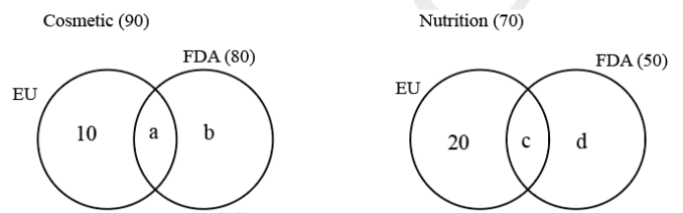
Nutrition products without EU approval have FDA only:
, so
. Then
,
and
.
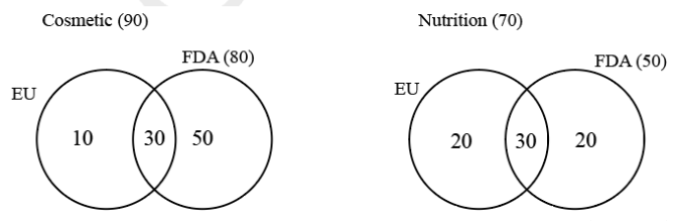
Domestic cosmetic products without EU approval are those with FDA only:
.
The answer is 50.