- CATin
- CAT past papers
- CAT 2021 Slot 3
- QA
CAT 2021 Slot 3 — QA questions with answers
All 22 questions of the Quantitative Ability section (14 MCQs, 8 TITA). Try each one, then open its answer and solution.
CAT 2021 Slot 3, timed like the real exam (120 minutes, 40 a section) and scored the CAT way: +3 right, −1 for a wrong MCQ, 0 for a wrong TITA, with the full post-mock analysis. Older official papers are in CATin Pro, with 80+ mocks and the full planner. The last three years of papers are free.
Sit this paper as a timed mock with CATin ProQuantitative Ability
CAT 2021 Slot 3 · 40 minutes · +3 for a right answer, −1 for a wrong MCQ, 0 for a wrong TITA
Q45MCQLinear Equations
A shop owner bought a total of 64 shirts from a wholesale market that came in two sizes, small and large. The price of a small shirt was INR 50 less than
that of a large shirt. She paid a total of INR 5000 for the large shirts, and a total of INR 1800 for the small shirts. Then, the price of a large shirt and a small
shirt together, in INR, is
- A175
- B150
- C200
- D225
Answer and solution
Answer: (C) 200
Let a small shirt cost
, so a large one costs
. She bought
small and
large shirts, 64 in all:
Multiply by
:
, so
.
This gives
, or
, which factorises as
. A price is positive, so
.
So a small shirt costs 75 and a large one 125. Check:
.
Together they cost
.
Option B (150) fails: it makes the prices 50 and 100, giving
shirts, not 64. Options A and D make the small price 62.5 or 87.5, and neither divides 1800 into a whole number of shirts.
Hence, option C (200).
Q46MCQTime & Work
One day, Rahul started a work at 9 AM and Gautam joined him two hours later. They then worked together and completed the work at 5 PM the same day. If
both had started at 9 AM and worked together, the work would have been completed 30 minutes earlier. Working alone, the time Rahul would have taken, in
hours, to complete the work is
- A11.5
- B10
- C12.5
- D12
Answer and solution
Answer: (B) 10
Rahul works from 9 AM to 5 PM, which is 8 hours. Gautam joins at 11 AM, so he works 6 hours. Had both started at 9 AM, the work would have ended 30 minutes earlier, at 4:30 PM, so each would have worked 7.5 hours.
Let Rahul do
units of work per hour and Gautam
. The work is the same either way:
, so
and
.
Total work
.
Rahul alone would take
hours.
Option D (12) fails: Rahul's rate would be
and Gautam's
of the work per hour, so on the actual day they would finish only
of the work by 5 PM.
Hence, option B (10).
Q47MCQPercentages
In a tournament, a team has played 40 matches so far and won 30% of them. If they win 60% of the remaining matches, their overall win percentage will be
50%. Suppose they win 90% of the remaining matches, then the total number of matches won by the team in the tournament will be
- A80
- B78
- C84
- D86
Answer and solution
Answer: (C) 84
So far the team has won 30% of 40 matches, that is 12. Let
matches remain.
Winning 60% of them would make the overall win rate 50%:
, so
and
.
If instead they win 90% of the remaining 80 matches, they win
more.
Total matches won
.
Option A (80) would need 68 wins from the remaining 80 matches, which is 85%, not 90%.
Hence, option C (84).
Q48TITAInequalities & Modulus
The number of distinct pairs of integers (m,n), satisfying ∣1+mn∣<∣m+n∣<5 is:
Type in your answer (TITA). No negative mark for a wrong answer.
Answer and solution
Answer: 12
Both sides of
are non-negative, so it is the same as
, i.e.
.
This simplifies to
, i.e.
.
So one factor is positive and the other negative: one of
,
is below
and the other above
. These are the shaded bands:
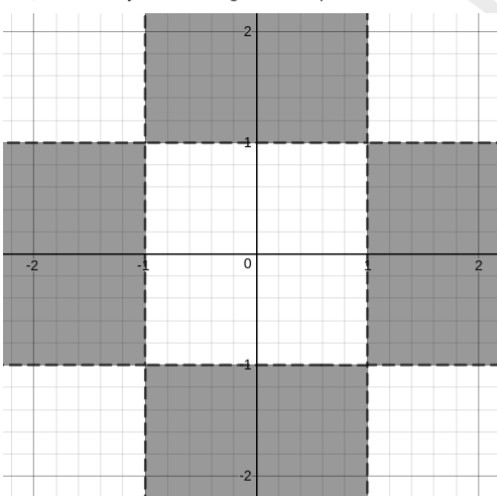
For integers,
only when
, and
when
(
makes the factor
).
If
:
with
gives
, which is 6 pairs. In each,
.
By symmetry,
with
gives 6 more pairs.
Total:
pairs.
The answer is 12.
Q49MCQLogarithms
For a real number
, if
, then
must lie in the range
- A
- B
- C
- D
Answer and solution
Answer: (C)
Split the fraction into two parts:
Since
, this equals
.
So
, which means
.
Now
and
. Since
and
must be positive for the logarithms to exist,
.
Option D (
) fails because it would make
. Option B fails because
would make
.
Hence, option C (
).
Q50MCQPercentages
The total of male and female populations in a city increased by 25% from 1970 to 1980. During the same period, the male population increased by 40%
while the female population increased by 20%. From 1980 to 1990, the female population increased by 25%. In 1990, if the female population is twice the
male population, then the percentage increase in the total of male and female populations in the city from 1970 to 1990 is
- A68.25
- B68.75
- C68.50
- D69.25
Answer and solution
Answer: (B) 68.75
Only ratios matter, so take convenient numbers. In 1990 the female population is twice the male population: let them be 200 and 100.
Females rose 25% from 1980 to 1990, so in 1980 there were
. They rose 20% from 1970 to 1980, so in 1970 there were
.
Let the male population be
in 1970, so it was
in 1980.
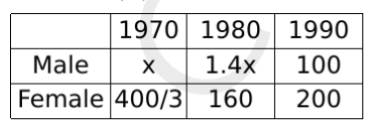
The total rose 25% from 1970 to 1980:
, so
and
.
Total in 1970
. Total in 1990
.
Increase
.
Percentage increase
.
The options are close together, so the exact fraction matters:
is exactly 68.75, not 68.50 (option C).
Hence, option B (68.75).
Q51MCQSequences & Series
Consider a sequence of real numbers
such that
for all
. If
then
is equal to
- A4849
- B4949
- C4950
- D4850
Answer and solution
Answer: (D) 4850
The rule
means that step
adds
.
Going from
to
takes the 99 steps
, which add
.
So
.
Check on the first terms:
,
,
.
Option B (4949) comes from adding
, one step too many: the last step (
) adds
, not
.
Hence, option D (4850).
Q52TITAAverages, Mixtures & Alligations
The arithmetic mean of scores of 25 students in an examination is 50. Five of these students top the examination with the same score. If the scores of the
other students are distinct integers with the lowest being 30, then the maximum possible score of the toppers is
Type in your answer (TITA). No negative mark for a wrong answer.
Answer and solution
Answer: 92
The total of all 25 scores is
.
To make the toppers' common score as large as possible, make the other 20 scores as small as possible. They are distinct integers and the lowest is 30, so the smallest they can be is
.
Their sum is
.
Let each topper score
. Then
, so
and
.
This is consistent: 92 is above 49, the highest of the other scores, so the five really are the toppers.
The answer is 92.
Q53MCQLinear Equations
One part of a hostel’s monthly expenses is fixed, and the other part is proportional to the number of its boarders. The hostel collects ₹ 1600 per month from
each boarder. When the number of boarders is 50, the profit of the hostel is ₹ 200 per boarder, and when the number of boarders is 75, the profit of the
hostel is ₹ 250 per boarder. When the number of boarders is 80, the total profit of the hostel, in INR, will be
- A20200
- B20500
- C20800
- D20000
Answer and solution
Answer: (B) 20500
Let the fixed monthly cost be
and the cost per boarder be
. With
boarders the total cost is
, so the profit per boarder is
.
With 50 boarders:
, so
.
With 75 boarders:
, so
.
Subtracting:
, so
and
. Then
.
With 80 boarders, total profit
.
Option D (20000) keeps the profit per boarder at 250, as with 75 boarders. But the profit per boarder rises as the fixed cost is shared among more boarders.
Hence, option B (20500).
Q54MCQInequalities & Modulus
The cost of fencing a rectangular plot is ₹ 200 per ft along one side, and ₹ 100 per ft along the three other sides. If the area of the rectangular plot is 60000
sq. ft, then the lowest possible cost of fencing all four sides, in INR, is
- A120000
- B90000
- C100000
- D160000
Answer and solution
Answer: (A) 120000
Let the side fenced at 200 per ft have length
, and let the other pair of sides have length
.
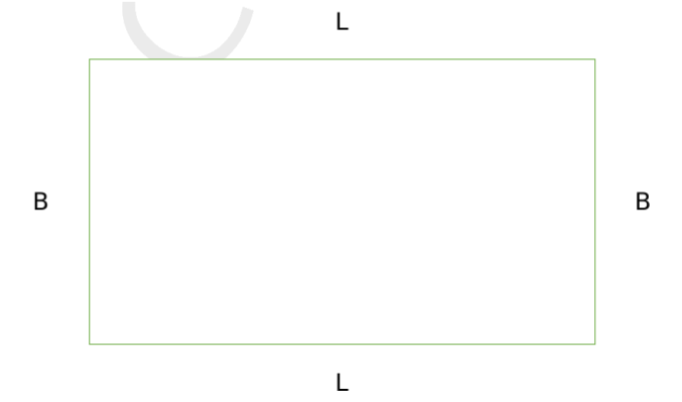
The costly side and the side opposite it cost
. The two sides of length
cost
.
Total cost
, with
.
By AM–GM,
.
Equality holds when
; with
this gives
ft and
ft. Check:
.
So the lowest cost is 120000, with the costly fencing on a 200 ft side.
Options B (90000) and C (100000) are below this lower bound, so no rectangle of area 60000 sq ft can be fenced that cheaply.
Hence, option A (120000).
Q55TITAPolygons & Circles
A park is shaped like a rhombus and has area 96 sq m. If 40 m of fencing is needed to enclose the park, the cost, in INR, of laying electric wires along its
two diagonals, at the rate of ₹125 per m, is
Type in your answer (TITA). No negative mark for a wrong answer.
Answer and solution
Answer: 3500
The 40 m of fencing is the perimeter, so each side of the rhombus is
m.
Let the diagonals be
and
.
Area:
, so
.
The diagonals of a rhombus bisect each other at right angles, so each side is the hypotenuse of a right triangle with legs
and
:
, so
.
Then
, so
m. (The diagonals are 12 m and 16 m.)
The cost of laying wire along both diagonals is
.
The answer is 3500.
Q56TITAQuadratic & Polynomial Equations
A tea shop offers tea in cups of three different sizes. The product of the prices, in INR, of three different sizes is equal to 800. The prices of the smallest
size and the medium size are in the ratio 2 : 5. If the shop owner decides to increase the prices of the smallest and the medium ones by INR 6 keeping the
price of the largest size unchanged, the product then changes to 3200. The sum of the original prices of three different sizes, in INR, is
Type in your answer (TITA). No negative mark for a wrong answer.
Answer and solution
Answer: 34
Let the small and medium prices be
and
, and the large price
.
Original product:
, so
.
After the increase:
.
Divide the second equation by the first:
, so
.
Expanding:
, so
, that is,
.
This factorises as
. A price is positive, so
.
Small
, medium
, and
, which is indeed the largest.
Check:
and
.
Sum of the original prices
.
The answer is 34.
Q57TITATime, Speed & Distance
Mira and Amal walk along a circular track, starting from the same point at the same time. If they walk in the same direction, then in 45 minutes, Amal
completes exactly 3 more rounds than Mira. If they walk in opposite directions, then they meet for the first time exactly after 3 minutes. The number of
rounds Mira walks in one hour is
Type in your answer (TITA). No negative mark for a wrong answer.
Answer and solution
Answer: 8
Let the track length be
, and let Mira and Amal cover
and
per minute.
Opposite directions: they first meet when together they have covered one round, so
, i.e.
.
Same direction: in 45 minutes Amal gains 3 rounds on Mira, so
, i.e.
.
Subtracting:
, so
per minute.
In one hour Mira walks
, which is 8 rounds.
The answer is 8.
Q58MCQAverages, Mixtures & Alligations
If a certain weight of an alloy of silver and copper is mixed with 3 kg of pure silver, the resulting alloy will have 90% silver by weight. If the same weight of
the initial alloy is mixed with 2 kg of another alloy which has 90% silver by weight, the resulting alloy will have 84% silver by weight. Then, the weight of the
initial alloy, in kg, is
- A3.5
- B2.5
- C3
- D4
Answer and solution
Answer: (C) 3
Let the initial alloy weigh
kg and contain
kg of silver.
Adding 3 kg of pure silver gives 90% silver:
.
Adding 2 kg of a 90% alloy adds
kg of silver and gives 84% silver:
.
Subtract the second equation from the first:
So
and
kg, with
kg.
Check:
and
.
Option D (4) fails: the first mixture would need
kg of silver, but the second would need
kg, and one alloy cannot have both.
Hence, option C (3).
Q59MCQTriangles & Lines
In a triangle ABC, ∠BCA = 50°. D and E are points on AB and AC, respectively, such that AD=DE. If F is a point on BC such that BD=DF,
then ∠FDE, in degrees, is equal to
- A72
- B80
- C100
- D96
Answer and solution
Answer: (B) 80
Let
.
Since
, triangle ADE is isosceles, so
. Call this
; it is also
of triangle ABC. Then
.
Since
, triangle BDF is isosceles, so
, which is
of triangle ABC. Then
.
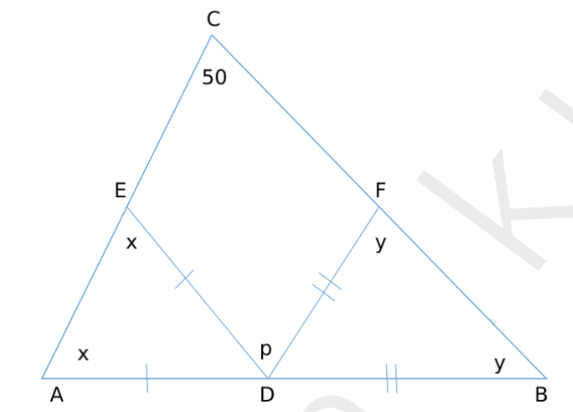
D lies on the straight line AB, so
:
, so
.
In triangle ABC,
, so
.
So
.
The result depends only on
:
. Option C (100) would need
.
Hence, option B (80).
Q60MCQSimple & Compound Interest
Bank A offers 6% interest rate per annum compounded half-yearly. Bank B and Bank C offer simple interest but the annual interest rate offered by Bank C is
twice that of Bank B. Raju invests a certain amount in Bank B for a certain period and Rupa invests ₹ 10,000 in Bank C for twice that period. The interest that
would accrue to Raju during that period is equal to the interest that would have accrued had he invested the same amount in Bank A for one year. The
interest accrued, in INR, to Rupa is
- A3436
- B2436
- C2346
- D1436
Answer and solution
Answer: (B) 2436
Bank A pays 6% a year compounded half-yearly, which is 3% every six months. In one year, 1 rupee grows to
, so a year's interest is 6.09% of the amount.
Let Bank B pay
simple interest, so Bank C pays
. Raju invests
in Bank B for
years, and his interest equals one year's interest at Bank A:
, so
.
Rupa invests 10,000 in Bank C at
for
years:
Interest
.
Raju's amount
cancels, so it is not needed.
Taking Bank A's rate as a plain 6% would give
; the half-yearly compounding adds the extra 36. Options A, C and D are look-alike numbers, and none equals
.
Hence, option B (2436).
Q61MCQFunctions & Graphs
If
and
, then the minimum value of
is
- A-12
- B-15
- C-16
- D-20
Answer and solution
Answer: (C) -16
Substitute
into
:
.
So the expression to minimise is
.
A square is never negative, so the smallest value is
, reached at
. Check:
,
, and
.
Option A (
) is only the value at
, not the minimum. Option D (
) is never reached, since
.
Hence, option C (-16).
Q62TITATime & Work
Anil can paint a house in 12 days while Barun can paint it in 16 days. Anil, Barun, and Chandu undertake to paint the house for ₹ 24000 and the three of
them together complete the painting in 6 days. If Chandu is paid in proportion to the work done by him, then the amount in INR received by him is
Type in your answer (TITA). No negative mark for a wrong answer.
Answer and solution
Answer: 3000
Anil paints the house in 12 days, so in 6 days he does
of the work.
Barun paints it in 16 days, so in 6 days he does
of the work.
The three finish together in 6 days, so Chandu does the rest:
.
He is paid in proportion to his work, so his share is
.
As a check, Anil gets 12000 and Barun 9000, which with Chandu's 3000 make 24000.
The answer is 3000.
Q63TITAIndices & Surds
If
is a positive integer such that
, then the smallest value of
is
Type in your answer (TITA). No negative mark for a wrong answer.
Answer and solution
Answer: 6
Every factor is a power of
, so the product is
.
We need
.
For
, the exponent is
, and
, far below 999. Smaller values of
give smaller products, so they fail too.
For
, the exponent is
, and
.
So the smallest such
is 6.
The answer is 6.
Q64TITAPermutations & Combinations
A four-digit number is formed by using only the digits 1, 2 and 3 such that both 2 and 3 appear at least once. The number of all such four-digit numbers is
Type in your answer (TITA). No negative mark for a wrong answer.
Answer and solution
Answer: 50
Count all four-digit numbers made only of 1, 2 and 3, then remove those missing a 2 or missing a 3.
All such numbers: each of the 4 places has 3 choices, so
.
Numbers with no 2 use only 1 and 3:
. Numbers with no 3 use only 1 and 2:
. The number 1111 has neither, so it was removed twice; add it back once.
Required count
.
Check by counting the 1s:
Two 1s with one 2 and one 3:
.
One 1 with 2, 2, 3 or with 2, 3, 3:
each, 24 in all.
No 1s: 2, 2, 2, 3 and 2, 3, 3, 3 give 4 each, and 2, 2, 3, 3 gives
, 14 in all.
Total
.
The answer is 50.
Q65MCQPolygons & Circles
Let ABCD be a parallelogram. The lengths of the side AD and the diagonal AC are 10 cm and 20 cm, respectively. If the angle
then the area of the parallelogram, in sq. cm is
- A
- B
- C
- D
Answer and solution
Answer: (B)
In triangle ACD,
, the diagonal
and
. Let
. (The sketch is not to scale.)
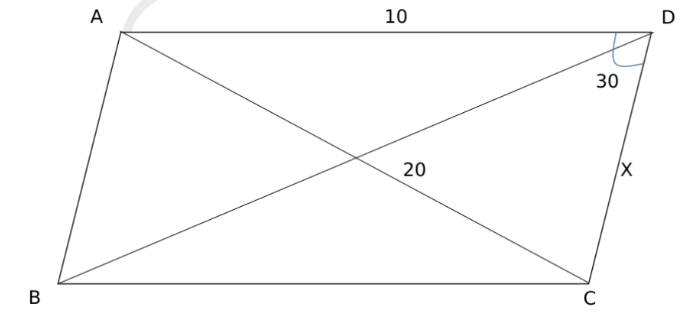
By the cosine rule,
:
, so
.
. A length is positive, so
.
Area of the parallelogram
.
Option C is half of this. It is the area of triangle ACD alone, but the diagonal AC splits the parallelogram into two such triangles.
Hence, option B (
).
Q66MCQInequalities & Modulus
If
and
, then
is
- A
- B
- C
- D
Answer and solution
Answer: (C)
Work case by case on the signs of
and
.
If
: the second equation becomes
, so
. The first then gives
, so
, which contradicts
. No solution.
So
, and the second equation is
.
If
: the first equation is
. Subtracting,
and
, which contradicts
.
If
: the first equation is
, that is,
, so
. Then
gives
, so
and
. Both signs fit.
So
.
Option A (
) comes from the rejected case
,
, which breaks
.
Hence, option C (
).