- CATin
- CAT past papers
- CAT 2021 Slot 3
- DILR
CAT 2021 Slot 3 — DILR questions with answers
All 20 questions of the Data Interpretation & Logical Reasoning section (15 MCQs, 5 TITA, 4 sets). Try each one, then open its answer and solution.
CAT 2021 Slot 3, timed like the real exam (120 minutes, 40 a section) and scored the CAT way: +3 right, −1 for a wrong MCQ, 0 for a wrong TITA, with the full post-mock analysis. Older official papers are in CATin Pro, with 80+ mocks and the full planner. The last three years of papers are free.
Sit this paper as a timed mock with CATin ProData Interpretation & Logical Reasoning
CAT 2021 Slot 3 · 40 minutes · +3 for a right answer, −1 for a wrong MCQ, 0 for a wrong TITA
Data set
Set for questions 25–28
Instructions [25 - 28 ]
Each of the bottles mentioned in this question contains 50 ml of liquid. The liquid in any bottle can be 100% pure content (P) or can have certain amount of impurity (I). Visually it is not possible to distinguish between P and I. There is a testing device which detects impurity, as long as the percentage of impurity in the content tested is 10% or more.
For example, suppose bottle 1 contains only P, and bottle 2 contains 80% P and 20% I. If content from bottle 1 is tested, it will be found out that it contains only
P. If content of bottle 2 is tested, the test will reveal that it contains some amount of I. If 10 ml of content from bottle 1 is mixed with 20 ml content from bottle 2, the test will show that the mixture has impurity, and hence we can conclude that at least one of the two bottles has I. However, if 10 ml of content from bottle 1 is mixed with 5 ml of content from bottle 2. the test will not detect any impurity in the resultant mixture.
Q25MCQLogical Puzzles
5 ml of content from bottle A is mixed with 5 ml of content from bottle B. The resultant mixture, when tested, detects the presence of I. If it is known that
bottle A contains only P, what BEST can be concluded about the volume of I in bottle B?
- A1 ml
- BLess than 1 ml
- C10 ml
- D10 ml or more
Answer and solution
Answer: (D) 10 ml or more
Bottle A has no impurity, so all the impurity in the mixture comes from the 5 ml taken from bottle B.
The mixture is
ml, and the device detects impurity only if it is at least 10%, that is, at least
ml of I.
So the 5 ml from bottle B contains at least 1 ml of I, which means bottle B is at least
impurity. Bottle B holds 50 ml, so it contains at least
ml of I.
The test gives only this lower bound; the impurity could be more than 10 ml. So option C (exactly 10 ml) claims more than we know, and options A and B are below the bound.
Hence, option D (10 ml or more).
Q26TITALogical Puzzles
There are four bottles. Each bottle is known to contain only P or only I. They will be considered to be “collectively ready for despatch” if all of them contain
only P. In minimum how many tests, is it possible to ascertain whether these four bottles are “collectively ready for despatch”?
Type in your answer (TITA). No negative mark for a wrong answer.
Answer and solution
Answer: 1
Each bottle holds either only P or only I. Take equal volumes, say 10 ml, from all four bottles, mix them and test the 40 ml once.
If all four bottles hold P, the mixture has no impurity and the test shows none.
If even one bottle holds I, the mixture has at least 10 ml of I in 40 ml, that is, at least 25% impurity. This is above the 10% threshold, so the test detects it.
So a single test tells us whether all four bottles hold only P, which is exactly what 'collectively ready for despatch' means. We do not need to know which bottle is impure. At least one test is needed, so the minimum is one.
The answer is 1.
Q27TITALogical Puzzles
There are four bottles. It is known that three of these bottles contain only P, while the remaining one contains 80% P and 20% I. What is the minimum
number of tests required to definitely identify the bottle containing some amount of I?
Type in your answer (TITA). No negative mark for a wrong answer.
Answer and solution
Answer: 2
The impure bottle is 20% I, and the device needs at least 10% to detect impurity.
If equal volumes of two bottles are mixed and one of them is the impure bottle, the mixture is 10% I, which is detected. Mixing three or four bottles in equal volumes dilutes it to about 6.7% or 5%, which is not detected. A single bottle tested alone shows impurity only if it is the impure one.
One test is not enough: it has only two outcomes, but any of the four bottles could be the impure one.
Two tests are enough. Test 1: mix equal volumes of bottles 1 and 2. If impurity is detected, the impure bottle is 1 or 2, so test bottle 1 alone. If not, it is 3 or 4, so test bottle 3 alone. Either way, test 2 identifies the bottle.
The answer is 2.
Q28MCQLogical Puzzles
There are four bottles. It is known that either one or two of these bottles contain(s) only P, while the remaining ones contain 85% P and 15% I. What is the
minimum number of tests required to ascertain the exact number of bottles containing only P?
- A4
- B2
- C3
- D1
Answer and solution
Answer: (D) 1
There are two possibilities: one P bottle and three impure bottles, or two P bottles and two impure bottles. Each impure bottle is 15% I.
Take 10 ml from each of the four bottles and test the 40 ml mixture once.
With three impure bottles, the mixture has
ml of I in 40 ml, that is,
. This is at least 10%, so impurity is detected.
With two impure bottles, it has
ml of I in 40 ml, that is,
. This is below 10%, so impurity is not detected.
So this single test separates the two cases: detection means exactly one bottle has only P, and no detection means two do. At least one test is needed, so the minimum is one. Option B (2) would also work, but it is not the minimum.
Hence, option D (1).
Data set
Set for questions 29–32
Instructions [29 - 32 ]
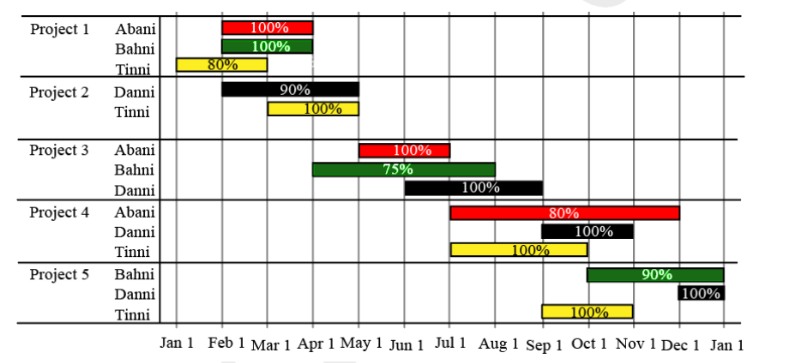
The figure above shows the schedule of four employees - Abani, Bahni, Danni, and Tinni - whom Dhoni supervised in 2020. Altogether there were five projects which started and concluded in 2020 in which they were involved. For each of these projects and for each employee, the starting day was at the beginning of a month and the concluding day was the end of a month, and these are indicated by the left and right end points of the corresponding horizontal bars. The number within each bar indicates the percentage of assigned work completed by the employee for that project, as assessed by Dhoni.
For each employee, his/her total project-month (in 2020) is the sum of the number of months (s)he worked across the five projects, while his/her annual completion index is the weightage average of the completion percentage assigned from the different projects, with the weights being the corresponding number of months (s)he worked in these projects. For each project, the total employee-month is the sum of the number of months four employees worked in this project, while its completion index is the weightage average of the completion percentage assigned for the employees who worked in this project, with the weights being the corresponding number of months they worked in this project.
Q29MCQBar & Line Charts
Which of the following statements is/are true?
I: The total project-month was the same for the four employees.
II: The total employee-month was the same for the five projects.
- AOnly II
- BBoth I and II
- CNeither I nor II
- DOnly I
Answer and solution
Answer: (D) Only I
Read the length of each bar, in months, from the chart.
Total project-month for each employee: Abani
(Projects 1, 3, 4); Bahni
(Projects 1, 3, 5); Danni
(Projects 2, 3, 4, 5); Tinni
(Projects 1, 2, 4, 5). All four are equal, so statement I is true.
Total employee-month for each project: Project 1
; Project 2
; Project 3
; Project 4
; Project 5
. These are not all equal, so statement II is false.
Option B (both) fails because statement II is false.
Hence, option D (Only I).
Q30MCQBar & Line Charts
Which employees did not work in multiple projects for any of the months in 2020?
- AOnly Abani, Bahni and Danni
- BOnly Abani and Bahni
- CAll four of them
- DOnly Tinni
Answer and solution
Answer: (A) Only Abani, Bahni and Danni
From the chart, list the months each employee worked on each project.
Abani: Project 1 in Feb-Mar, Project 3 in May-Jun, Project 4 in Jul-Nov. No two overlap.
Bahni: Project 1 in Feb-Mar, Project 3 in Apr-Jul, Project 5 in Oct-Dec. No overlap.
Danni: Project 2 in Feb-Apr, Project 3 in Jun-Aug, Project 4 in Sep-Oct, Project 5 in Dec. No overlap.
Tinni: Project 1 in Jan-Feb, Project 2 in Mar-Apr, Project 4 in Jul-Sep, Project 5 in Sep-Oct. Projects 4 and 5 both include September, so Tinni worked on two projects that month.
So only Abani, Bahni and Danni never worked on more than one project in the same month. Option D (Only Tinni) names the one employee who did, the opposite of what is asked.
Hence, option A (Only Abani, Bahni and Danni).
Q31MCQBar & Line Charts
The project duration, measured in terms of the number of months, is the time during which at least one employee worked in the project. Which of the
following pairs of the projects had the same duration?
- AProject 1, Project 5
- BProject 4, Project 5
- CProject 3, Project 5
- DProject 3, Project 4
Answer and solution
Answer: (D) Project 3, Project 4
Considering the information provided :
For project 1 : 3 months.
Project - 2: 3 months.
Project - 3: 5 months.
Project - 4: 5 months.
Project - 5: 4 months.
Among the given options option D is true which is project 3, project 4.
Q32MCQBar & Line Charts
The list of employees in decreasing order of annual completion index is:
- ADanni, Tinni, Bahni, Abani
- BBahni, Abani, Tinni, Danni
- CDanni, Tinni, Abani, Bahni
- DTinni, Danni, Abani, Bahni
Answer and solution
Answer: (C) Danni, Tinni, Abani, Bahni
The annual completion index for different people is :
The weightage average of the completion percentage assigned from the different projects, with the weights being the corresponding number of months (s)he worked in these projects.
For Abani :
For Bahni :
For Danni :
For Tinni :
The descending order for the four people is :
Danni, Tinni, Abani, Bahni.
Data set
Set for questions 33–38
Instructions [33 - 38 ]
10 players - P1, P2, … , P10 - competed in an international javelin throw event. The number (after P) of a player reflects his rank at the beginning of the event, with rank 1 going to the topmost player. There were two phases in the event with the first phase consisting of rounds 1, 2, and 3, and the second phase consisting of rounds 4, 5, and 6. A throw is measured in terms of the distance it covers (in meters, up to one decimal point accuracy), only if the throw is a ‘valid’ one. For an invalid throw, the distance is taken as zero. A player’s score at the end of a round is the maximum distance of all his throws up to that round. Players are re-ranked after every round based on their current scores. In case of a tie in scores, the player with a prevailing higher rank retains the higher rank. This ranking determines the order in which the players go for their throws in the next round.
In each of the rounds in the first phase, the players throw in increasing order of their latest rank, i.e. the player ranked 1 at that point throws first, followed by the player ranked 2 at that point and so on. The top six players at the end of the first phase qualify for the second phase. In each of the rounds in the second phase, the players throw in decreasing order of their latest rank i.e. the player ranked 6 at that point throws first, followed by the player ranked 5 at that point and so on.
The players ranked 1, 2, and 3 at the end of the sixth round receive gold, silver, and bronze medals respectively.
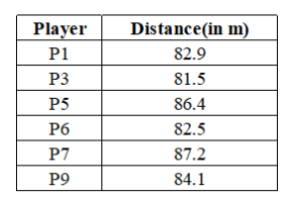
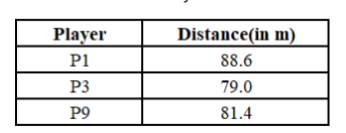
All the valid throws of the event were of distinct distances (as per stated measurement accuracy). The tables below show distances (in meters) covered by all valid throws in the first and the third round in the event.
Distances covered by all the valid throws in the first round
Distances covered by all the valid throws in the third round
The following facts are also known.
i. Among the throws in the second round, only the last two were valid. Both the throws enabled these players to qualify for the second phase, with one of them qualifying with the least score. None of these players won any medal.
ii. If a player throws first in a round AND he was also the last (among the players in the current round) to throw in the previous round, then the player is said to get a double. Two players got a double.
iii. In each round of the second phase, exactly one player improved his score. Each of these improvements was by the same amount.
iv. The gold and bronze medalists improved their scores in the fifth and the sixth rounds respectively. One medal winner improved his score in the fourth round.
v. The difference between the final scores of the gold medalist and the silver medalist, as well as the difference between the final scores of the silver medalist and the bronze medalist was 1.0 m.
Q33MCQGames & Tournaments
Which two players got the double?
- AP1, P8
- BP2, P4
- CP8, P10
- DP1, P10
Answer and solution
Answer: (C) P8, P10
After round 1 (first table) the ranking is P7 (87.2), P5 (86.4), P9 (84.1), P1 (82.9), P6 (82.5), P3 (81.5), then P2, P4, P8 and P10, who had no valid throw and keep their old order. Round 2 follows this order, so P8 and P10 threw last, and theirs were the only valid throws (fact i).
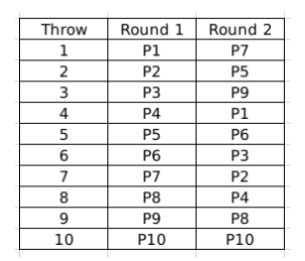
A double needs the last thrower of one round to throw first in the next.
Round 2: P10 was last in round 1, but P7 threw first. No double.
Rounds 5 and 6: the leader throws last, and in the next round the 6th-ranked player throws first. With one improvement per round, a leader can fall at most one place, so no double.
So the two doubles are in rounds 3 and 4. In round 3, P10 (last in round 2) throws first, so P10 led after round 2 with more than 87.2. In round 4, the 6th-ranked qualifier throws first. By fact i, P8 or P10 qualified with the least score; P10 is above 87.2, so it is P8, who gets the second double.
So the doubles went to P10 and P8. Options A, B and D each name a player, P1, P2 or P4, who got no double.
Hence, option C (P8, P10).
Q34MCQGames & Tournaments
Who won the silver medal?
- AP5
- BP7
- CP9
- DP1
Answer and solution
Answer: (D) P1
Scores after round 3 (tables and fact i): P1 88.6, P7 87.2, P5 86.4, P9 84.1, plus P8 and P10, qualified by their round-2 throws. Doubles can only fall in rounds 3 and 4 (not round 2, where P7 threw first, nor rounds 5 or 6, where the leader would have to drop to sixth). So P10, last in round 2, threw first in round 3: he led after round 2 with more than 87.2.
In phase 2 one player improves per round, always by the same amount
, and by fact iv all three improvements go to medallists, who come from P1, P7, P5 and P9 (P8 and P10 win nothing).
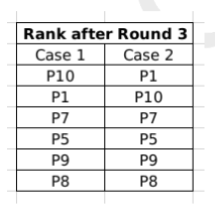
If each medallist improved once, their round-3 scores would be 1.0 apart; no three of 88.6, 87.2, 86.4, 84.1 are. So the round-4 improver was gold or bronze, and silver never improved. He must still beat P10, who is above 87.2, so silver is P1 at 88.6, and Case 1 (P10 above P1) cannot happen. Gold is 89.6 and bronze 87.6: P7 improving twice (
) and P5 once (
) fit.
Option B (P7) is the gold medallist.
Hence, option D (P1).
Q35MCQGames & Tournaments
Who threw the last javelin in the event?
- AP7
- BP1
- CP9
- DP10
Answer and solution
Answer: (A) P7
In phase 2 players throw from rank 6 up to rank 1, so the last javelin is thrown in round 6 by the leader after round 5.
After round 1 the order is P7 (87.2), P5 (86.4), P9 (84.1), P1 (82.9), P6, P3, then P2, P4, P8 and P10, with no valid throw. In round 2 only P8 and P10, the last two throwers, are valid.
No double is possible in round 2 (P7 throws first) or in rounds 5 and 6 (the leader would have to drop to sixth), so the doubles fall in rounds 3 and 4: P10 leads after round 2 (above 87.2), and P8 qualifies sixth. In round 3 only P1 improves, to 88.6.
Phase 2 has three equal improvements, all by medallists (fact iv). If each improved once, three of 88.6, 87.2, 86.4 and 84.1 would be exactly 1.0 m apart; none are. So the round-4 improver was gold or bronze; silver never improves and, to stay above P10, is P1 (88.6). Gold is 89.6 and bronze 87.6. The only fit is P7 improving by 1.2 in rounds 4 and 5 (
) and P5 by 1.2 in round 6 (
).
So P7 leads after round 5 and throws last. P1 (option B), second, throws just before him.
Hence, option A (P7).
Q36MCQGames & Tournaments
What was the final score (in m) of the silver-medalist?
- A89.6
- B88.4
- C88.6
- D87.2
Answer and solution
Answer: (C) 88.6
Scores after round 3 (tables and fact i): P1 88.6, P7 87.2, P5 86.4, P9 84.1, plus P8 and P10, qualified by their round-2 throws. Doubles can only fall in rounds 3 and 4 (not round 2, where P7 threw first, nor rounds 5 or 6, where the leader would have to drop to sixth). So P10, last in round 2, threw first in round 3: he led after round 2 with more than 87.2.
In phase 2 one player improves per round, always by the same amount
, and by fact iv all three improvements go to medallists, who come from P1, P7, P5 and P9 (P8 and P10 win nothing).
If each medallist improved once, their round-3 scores would be 1.0 apart; no three of 88.6, 87.2, 86.4, 84.1 are. So the round-4 improver was gold or bronze, and silver never improved. He must still beat P10, who is above 87.2, so silver is P1, still at 88.6. Gold is P7 with
and bronze is P5 with
.
Option A (89.6) is the gold medallist's score, and option B (88.4) is P7's score after his first improvement.
Hence, option C (88.6).
Q37MCQGames & Tournaments
Which of the following can be the final score (in m) of P8?
- A81.9
- B0
- C82.7
- D85.1
Answer and solution
Answer: (C) 82.7
By fact i, only P8 and P10 threw validly in round 2, and both qualified. After round 3 the others' scores are P1 88.6, P7 87.2, P5 86.4, P9 84.1, P6 82.5 and P3 81.5, so P8 must beat P6: his score is above 82.5. This rules out 0 and 81.9.
The two doubles can only fall in rounds 3 and 4 (not round 2, where P7 throws first, nor rounds 5 or 6, where the leader would have to drop to sixth). In round 3, P10 threw first, so he led after round 2 with more than 87.2. Hence P8 is the qualifier with the least score. In round 4 he throws first, so for the double he must have been the last qualifier to throw in round 3, below P1's 82.9 at that time. So P8's score is between 82.5 and 82.9.
P8 never improves in phase 2: by fact iv all three improvements go to medallists, and P8 wins no medal. So his final score stays between 82.5 and 82.9, which rules out 85.1.
Hence, option C (82.7).
Q38MCQGames & Tournaments
By how much did the gold medalist improve his score (in m) in the second phase?
- A1.0
- B2.0
- C2.4
- D1.2
Answer and solution
Answer: (C) 2.4
Scores after round 3 (tables and fact i): P1 88.6, P7 87.2, P5 86.4, P9 84.1, plus P8 and P10, qualified by their round-2 throws. Doubles can only fall in rounds 3 and 4 (not round 2, where P7 threw first, nor rounds 5 or 6, where the leader would have to drop to sixth). So P10, last in round 2, threw first in round 3: he led after round 2 with more than 87.2.
In phase 2 one player improves per round, always by the same amount
, and by fact iv all three improvements go to medallists, who come from P1, P7, P5 and P9 (P8 and P10 win nothing).
If each medallist improved once, their round-3 scores would be 1.0 apart; no three of 88.6, 87.2, 86.4, 84.1 are. So the round-4 improver was gold or bronze, and silver never improved. Silver must beat P10, so it is P1 (88.6); gold 89.6, bronze 87.6.
If gold improved twice and bronze once, their round-3 scores
,
satisfy
and
. Only P7 (
) and P5 (
) fit, with
; bronze improving twice fits nothing. So P7 gained
.
Option D (1.2) is only one improvement.
Hence, option C (2.4).
Data set
Set for questions 39–44
Instructions [39 - 44 ]
Three reviewers Amal, Bimal, and Komal are tasked with selecting questions from a pool of 13 questions (Q01 to Q13). Questions can be created by external “subject matter experts” (SMEs) or by one of the three reviewers. Each of the reviewers either approves or disapproves a question that is shown to them. Their decisions lead to eventual acceptance or rejection of the question in the manner described below.
If a question is created by an SME, it is reviewed first by Amal, and then by Bimal. If both of them approve the question, then the question is accepted and is not reviewed by Komal. If both disapprove the question, it is rejected and is not reviewed by Komal. If one of them approves the question and the other disapproves it, then the question is reviewed by Komal. Then the question is accepted only if she approves it.
A question created by one of the reviewers is decided upon by the other two. If a question is created by Amal, then it is first reviewed by Bimal. If Bimal approves the question, then it is accepted. Otherwise, it is reviewed by Komal. The question is then accepted only if Komal approves it. A similar process is followed for questions created by Bimal, whose questions are first reviewed by Komal, and then by Amal only if Komal disapproves it. Questions created by Komal are first reviewed by Amal, and then, if required, by Bimal.
The following facts are known about the review process after its completion.
1. Q02, Q06, Q09, Q11, and Q12 were rejected and the other questions were accepted.
2. Amal reviewed only Q02, Q03, Q04, Q06, Q08, Q10, Q11, and Q13.
3. Bimal reviewed only Q02, Q04, Q06 through Q09, Q12, and Q13.
4. Komal reviewed only Q01 through Q05, Q07, Q08, Q09, Q11, and Q12.
Q39TITALogical Puzzles
How many questions were DEFINITELY created by Amal?
Type in your answer (TITA). No negative mark for a wrong answer.
Answer and solution
Answer: 3
The reviewers of a question show who created it. An SME's question goes to Amal and Bimal, and to Komal only if they split. Amal's goes to Bimal, then to Komal if Bimal disapproves. Bimal's goes to Komal, then to Amal. Komal's goes to Amal, then to Bimal.
Only Komal (Q01, Q05): created by Bimal. Only Amal (Q10): created by Komal.
Bimal and Komal (Q07, Q09, Q12): only an Amal question goes to Bimal first and then to Komal, so Amal created all three.
Amal and Komal (Q03, Q11): created by Bimal. All three reviewers (Q02, Q04, Q08): SME questions, on which Amal and Bimal split.
Amal and Bimal only (Q06, Q13): either an SME question decided by both, or a Komal question passed from Amal to Bimal, so the creator is not fixed.
No other question can be Amal's, because Amal never reviews her own questions and they always reach Bimal first. So Amal definitely created Q07, Q09 and Q12.
The answer is 3.
Q40TITALogical Puzzles
How many questions were DEFINITELY created by Komal?
Type in your answer (TITA). No negative mark for a wrong answer.
Answer and solution
Answer: 1
The reviewers of a question show who created it. An SME's question goes to Amal and Bimal, and to Komal only if they split. Amal's goes to Bimal, then to Komal if Bimal disapproves. Bimal's goes to Komal, then to Amal. Komal's goes to Amal, then to Bimal.
Only Komal (Q01, Q05): created by Bimal. Only Amal (Q10): created by Komal, since only Komal's questions go to Amal first, and Amal approved it.
Bimal and Komal (Q07, Q09, Q12): created by Amal. Amal and Komal (Q03, Q11): created by Bimal. All three reviewers (Q02, Q04, Q08): SME questions.
Amal and Bimal only (Q06, Q13): an SME question goes to exactly these two when they agree, and a Komal question reaches both when Amal disapproves. Both readings fit Q06 (rejected) and Q13 (accepted), so neither is definitely Komal's.
So Komal definitely created only Q10.
The answer is 1.
Q41TITALogical Puzzles
How many questions were DEFINITELY created by the SMEs?
Type in your answer (TITA). No negative mark for a wrong answer.
Answer and solution
Answer: 3
The reviewers of a question show who created it. An SME's question goes to Amal and Bimal, and to Komal only if they split. Amal's goes to Bimal, then to Komal if Bimal disapproves. Bimal's goes to Komal, then to Amal. Komal's goes to Amal, then to Bimal.
A reviewer's own question is seen by at most the other two reviewers. So a question reviewed by all three must be an SME's. That gives Q02, Q04 and Q08, on which Amal and Bimal split and Komal decided.
The rest are fixed or open as follows. Only Komal (Q01, Q05): Bimal's. Only Amal (Q10): Komal's. Bimal and Komal (Q07, Q09, Q12): Amal's. Amal and Komal (Q03, Q11): Bimal's.
Amal and Bimal only (Q06, Q13): an SME question on which the two agreed, or a Komal question that Amal disapproved and passed to Bimal. These may be SME questions, but not definitely.
So SMEs definitely created Q02, Q04 and Q08.
The answer is 3.
Q42MCQLogical Puzzles
How many questions were DEFINITELY disapproved by Bimal?
- A3
- B4
- C7
- D5
Answer and solution
Answer: (B) 4
The reviewers show the creator. An SME's question goes to Amal and Bimal, and to Komal only if they split. Amal's goes to Bimal, then Komal. Bimal's goes to Komal, then Amal. Komal's goes to Amal, then Bimal.
So Q07, Q09 and Q12 (reviewed by Bimal and Komal) are Amal's; Q02, Q04 and Q08 (all three) are SME questions; Q06 and Q13 (Amal and Bimal only) are an SME's or Komal's.
Bimal definitely disapproved:
Q07, Q09 and Q12: an Amal question reaches Komal only after Bimal disapproves it.
Q06: rejected with only Amal and Bimal reviewing. As an SME question, both disapproved; as Komal's, Amal disapproved and Bimal then rejected it. Either way Bimal disapproved.
Not definite: on Q02, Q04 and Q08 Amal and Bimal split, and we cannot tell which of them disapproved. On Q13, Bimal approved in both readings.
That makes 4. Option D (5) would count one of the split SME questions, where Bimal may have been the approver; option A (3) misses Q06.
Hence, option B (4).
Q43MCQLogical Puzzles
The approval ratio of a reviewer is the ratio of the number of questions (s)he approved to the number of questions (s)he reviewed. Which option best
describes Amal’s approval ratio?
- Aeither 0.25 or 0.75
- B0.25
- Clies between 0.25 and 0.50
- Dlies between 0.25 and 0.75
Answer and solution
Answer: (D) lies between 0.25 and 0.75
The reviewers show the creator. An SME's question goes to Amal and Bimal, and to Komal only if they split. Bimal's goes to Komal, then Amal. Komal's goes to Amal, then Bimal. So Q10 is Komal's, Q03 and Q11 are Bimal's, Q02, Q04 and Q08 are SME questions, and Q06 and Q13 are an SME's or Komal's.
Amal reviewed 8 questions: Q02, Q03, Q04, Q06, Q08, Q10, Q11 and Q13.
Definitely approved: Q10 (accepted with Amal as the only reviewer) and Q03 (Komal disapproved it, yet it was accepted, so Amal approved).
Definitely disapproved: Q11 (Amal made the final call and it was rejected) and Q06 (rejected with only Amal and Bimal reviewing, so Amal disapproved in either reading).
Either way: Q02, Q04 and Q08 (Amal may be either side of the split) and Q13 (approved if an SME's, disapproved if Komal's).
So Amal approved anywhere from 2 to 6 of the 8, and each count in between is possible. The ratio runs from
to
.
Option A fails because middle values such as 0.5 are possible; option C fails because 0.625 and 0.75 are possible.
Hence, option D (lies between 0.25 and 0.75).
Q44MCQLogical Puzzles
How many questions created by Amal or Bimal were disapproved by at least one of the other reviewers?
- A7
- B4
- C5
- D2
Answer and solution
Answer: (C) 5
The reviewers show the creator. An SME's question goes to Amal and Bimal, and to Komal only if they split. Amal's goes to Bimal, then to Komal if Bimal disapproves. Bimal's goes to Komal, then to Amal if Komal disapproves. Komal's goes to Amal, then Bimal.
Amal's questions are those reviewed by Bimal and Komal only: Q07, Q09 and Q12. Bimal's are those reviewed by Komal alone or by Komal and Amal: Q01, Q05, Q03 and Q11. Every other question was reviewed by all three, by Amal and Bimal, or by Amal alone, so it is an SME's or Komal's.
Amal's questions: Q07, Q09 and Q12 all reached Komal, which happens only after Bimal disapproves. That is 3.
Bimal's questions: Q01 and Q05 were approved by Komal at once, with no disapproval. Q03 and Q11 reached Amal, so Komal disapproved both (Amal also disapproved Q11). That is 2.
Total
.
Option A (7) counts all seven questions by Amal or Bimal, but Q01 and Q05 were never disapproved.
Hence, option C (5).