- CATin
- CAT past papers
- CAT 2021 Slot 2
- QA
CAT 2021 Slot 2 — QA questions with answers
All 22 questions of the Quantitative Ability section (14 MCQs, 8 TITA). Try each one, then open its answer and solution.
CAT 2021 Slot 2, timed like the real exam (120 minutes, 40 a section) and scored the CAT way: +3 right, −1 for a wrong MCQ, 0 for a wrong TITA, with the full post-mock analysis. Older official papers are in CATin Pro, with 80+ mocks and the full planner. The last three years of papers are free.
Sit this paper as a timed mock with CATin ProQuantitative Ability
CAT 2021 Slot 2 · 40 minutes · +3 for a right answer, −1 for a wrong MCQ, 0 for a wrong TITA
Q45TITAIndices & Surds
For all possible integers
satisfying
, then the number of integer values of
is
Type in your answer (TITA). No negative mark for a wrong answer.
Answer and solution
Answer: 7
Subtract 2 throughout:
.
Since
and
, the integer
runs from
to
. So
runs from
to
, which is 10 integers.
Now
is an integer only when
, that is,
. For
,
is a fraction such as
or
.
So
can be
. These give values from
up to
, seven different integers.
The answer is 7.
Q46MCQSequences & Series
Three positive integers x, y and z are in arithmetic progression. If y−x>2 and xyz=5(x+y+z), then z-x equals
- A8
- B12
- C14
- D10
Answer and solution
Answer: (C) 14
Let
,
and
, with
.
Then
, so
becomes
.
Since
, divide by it:
.
With positive integers and
, the factor pairs are
and
.
,
gives
, which satisfies
.
,
gives
, which fails
.
So
,
,
. Check:
and
.
So
. No other valid progression exists; for example,
would need
and
, which has no positive integer solution.
Hence, option C (14).
Q47TITADigits & Base Systems
For a 4-digit number, the sum of its digits in the thousands, hundreds and tens places is 14, the sum of its digits in the hundreds, tens and units places is 15,
and the tens place digit is 4 more than the units place digit. Then the highest possible 4-digit number satisfying the above conditions is
Type in your answer (TITA). No negative mark for a wrong answer.
Answer and solution
Answer: 4195
Let the digits be
(thousands),
(hundreds),
(tens) and
(units).
The conditions are
(1),
(2) and
(3).
Subtracting (1) from (2) gives
, so
.
Then
. Since
is a digit,
, so
.
To make the number as large as possible, take the largest thousands digit,
. Then
,
, and from (1),
.
Check:
,
and
.
The answer is 4195.
Q48MCQPercentages
Raj invested ₹ 10000 in a fund. At the end of first year, he incurred a loss but his balance was more than ₹ 5000. This balance, when invested for another
year, grew and the percentage of growth in the second year was five times the percentage of loss in the first year. If the gain of Raj from the initial
investment over the two year period is 35%, then the percentage of loss in the first year is
- A5
- B15
- C17
- D10
Answer and solution
Answer: (D) 10
Let the loss in the first year be
. After one year the balance is
, and this is more than 5000, so
.
In the second year it grows by
. The overall gain is 35%, so the final amount is 13500:
.
So
or
, and
gives
. Check:
.
Option B (15) fails:
, a gain of about 49%, not 35%.
Hence, option D (10).
Q49TITAPermutations & Combinations
The number of ways of distributing 15 identical balloons, 6 identical pencils and 3 identical erasers among 3 children, such that each child gets at least four
balloons and one pencil, is
Type in your answer (TITA). No negative mark for a wrong answer.
Answer and solution
Answer: 1000
The balloons, pencils and erasers are shared out independently, so multiply the number of ways for each.
The number of ways to share
identical items among 3 children, with no minimum, is
.
Balloons: give each child 4 first, using 12. The remaining 3 balloons can be shared in
ways.
Pencils: give each child 1 first, using 3. The remaining 3 pencils can be shared in
ways.
Erasers: there is no minimum, so the 3 erasers can be shared in
ways.
Total
.
The answer is 1000.
Q50MCQTime, Speed & Distance
Two trains A and B were moving in opposite directions, their speeds being in the ratio 5 : 3. The front end of A crossed the rear end of B 46 seconds after
the front ends of the trains had crossed each other. It took another 69 seconds for the rear ends of the trains to cross each other. The ratio of length of train
A to that of train B is
- A3:2
- B5:3
- C2:3
- D2:1
Answer and solution
Answer: (A) 3:2
Let the speeds be
and
. The trains move in opposite directions, so their relative speed is
. Treat train B as standing still and train A as moving at
.
When the front ends meet, A's front is at B's front. A's front reaches B's rear after covering B's length, which takes 46 s, so
.
The rear ends cross when A's rear passes B's rear. By then A has covered
in relative terms, which takes
s. So
, which gives
.
Therefore
.
The speed ratio 5 : 3 does not affect the answer, because only the relative speed matters. Option C (2:3) is the same ratio inverted, which comes from swapping the two time intervals.
Hence, option A (3:2).
Q51MCQQuadratic & Polynomial Equations
Suppose one of the roots of the equation ax2−bx+c=0 is 2+ 3, Where a,b and c are rational numbers and a=0. If b=c3 then ∣a∣ equals.
- A1
- B2
- C3
- D4
Answer and solution
Answer: (B) 2
The coefficients
,
and
are rational, so an irrational root comes with its conjugate. The roots are
and
.
For
, the sum of the roots is
and the product is
.
Sum:
, so
.
Product:
, so
.
Now
gives
. Since
,
, so
or
, and
.
Option D (4) is the value of
, not of
.
Hence, option B (2).
Q52TITAAverages, Mixtures & Alligations
From a container filled with milk, 9 litres of milk are drawn and replaced with water. Next, from the same container, 9 litres are drawn and again replaced
with water. If the volumes of milk and water in the container are now in the ratio of 16 : 9, then the capacity of the container, in litres, is
Type in your answer (TITA). No negative mark for a wrong answer.
Answer and solution
Answer: 45
Let the capacity be
litres. Each time 9 litres are drawn and replaced with water, the milk left is multiplied by
. After two such operations, milk
.
Milk : water
, so milk is
of the container:
, so
.
The negative root,
, would give
, which is impossible because 9 litres are drawn each time.
So
and
.
The answer is 45.
Q53MCQPolygons & Circles
If a rhombus has area 12 sq cm and side length 5 cm, then the length, in cm, of its longer diagonal is
- A
- B
- C
- D
Answer and solution
Answer: (A)
The diagonals of a rhombus bisect each other at right angles. In the figure they meet at E, with
and
.
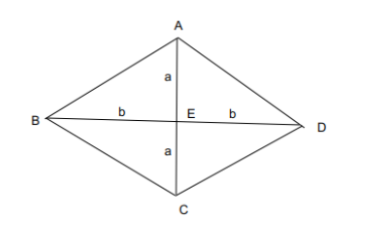
Each side is the hypotenuse of a right triangle such as AEB, so
.
The rhombus is made of four such right triangles, each of area
, so its area is
and
.
Then
, so
, and
, so the two half-diagonals differ by
.
The longer half-diagonal is therefore
, and the longer diagonal is twice that,
.
Check: the shorter diagonal is
, and
, the given area.
Option C is only the half-diagonal, a leg of the right triangle, not the full diagonal.
Hence, option A (
).
Q54TITALogarithms
If
then
equals
Type in your answer (TITA). No negative mark for a wrong answer.
Answer and solution
Answer: 5
Undo the logarithms one layer at a time, from the outside in.
Since
, we get
.
So
, which gives
.
Then
, so
and
. Since
, every logarithm is defined.
Therefore
.
The answer is 5.
Q55MCQPolygons & Circles
The sides AB and CD of a trapezium ABCD are parallel, with AB being the smaller side. P is the midpoint of CD and ABPD is a parallelogram. If the difference
between the areas of the parallelogram ABPD and the triangle BPC is 10 sq cm, then the area, in sq cm, of the trapezium ABCD is
- A30
- B40
- C25
- D20
Answer and solution
Answer: (A) 30
Let
. Since ABPD is a parallelogram,
. P is the midpoint of CD, so
and
.
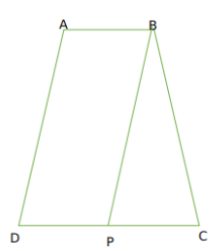
Let
be the height of the trapezium, the distance between AB and CD. The parallelogram ABPD has base
and height
, so its area is
.
Triangle BPC has base
on CD and its vertex B on AB, so its height is also
and its area is
.
Given:
, so
and
.
The trapezium is the parallelogram plus the triangle, so its area is
. As a check,
.
Option D (20) is only the area of the parallelogram ABPD, not of the whole trapezium.
Hence, option A (30).
Q56MCQFunctions & Graphs
For all real values of
, the range of the function
is:
- A
- B
- C
- D
Answer and solution
Answer: (D)
Write
. The numerator is
, so
.
Now
, so
, with
exactly when
.
Lower end:
is smallest when
is smallest. At
,
. This value is reached, so
is included.
Upper end: as
grows large,
and
, so
approaches
. But
is always positive, so
never equals
, and that end is open.
So the range is
. Option C has the right end points but leaves out
, which is reached at
. Option B's upper end
is too large, since
always.
Hence, option D (
).
Q57MCQSequences & Series
For a sequence of real numbers
, if
for all natural numbers
, then the sum
equals
- A200
- B2
- C-200
- D-2
Answer and solution
Answer: (D) -2
Let
.
Subtracting consecutive sums leaves only the last term:
.
For
the sign is
, so
.
For
the sign is
, so
and
.
So
.
Option A (200) comes from ignoring the alternating sign and adding
and
. But
enters the sum with a minus sign, so
itself is
.
Hence, option D (-2).
Q58MCQInequalities & Modulus
For a real number x the condition ∣3x−20∣+∣3x−40∣=20 necessarily holds if
- A10<x<15
- B9<x<14
- C7<x<12
- D6<x<11
Answer and solution
Answer: (C) 7<x<12
The expressions inside the moduli change sign at
and
.
If
:
. The equation holds for every such
.
If
: the sum is
, which equals 20 only at
, so it fails for every larger
.
If
: the sum is
, which equals 20 only at
, so it fails for every smaller
.
So the condition holds exactly when
, that is, about
.
'Necessarily holds' means every
in the option's interval must lie in this range.
lies inside it. Option D fails because it includes values such as
, below
; options A and B include values above 13.33, such as
.
Hence, option C (7<x<12).
Q59MCQTime & Work
Anil can paint a house in 60 days while Bimal can paint it in 84 days. Anil starts painting and after 10 days, Bimal and Charu join him. Together, they
complete the painting in 14 more days. If they are paid a total of ₹ 21000 for the job, then the share of Charu, in INR, proportionate to the work done by him,
is
- A9000
- B9200
- C9100
- D9150
Answer and solution
Answer: (C) 9100
Anil works for all
days; Bimal and Charu work for 14 days each.
Anil does
of the job per day, so in 24 days he does
of it.
Bimal does
per day, so in 14 days he does
.
Charu does the rest:
.
Payment is in proportion to work done, so Charu gets
.
Option A (9000) would mean Charu did
of the work, but his share is exactly
.
Hence, option C (9100).
Q60TITAPercentages
A box has 450 balls, each either white or black, there being as many metallic white balls as metallic black balls. If 40% of the white balls and 50% of the
black balls are metallic, then the number of non-metallic balls in the box is
Type in your answer (TITA). No negative mark for a wrong answer.
Answer and solution
Answer: 250
Let the number of white balls be x and black balls be y
So we get x+y =450 (1)
Now metallic black balls = 0.5y
Metallic white balls = 0.4x
From condition 0.4x=0.5y
we get 4x-5y=0 (2)
Solving (1) and (2) we get
x=250 and y =200
Now number of Non Metallic balls = 0.6x+0.5y = 150+100 = 250
Q61TITAAverages, Mixtures & Alligations
In a football tournament, a player has played a certain number of matches and 10 more matches are to be played. If he scores a total of one goal over the
next 10 matches, his overall average will be 0.15 goals per match. On the other hand, if he scores a total of two goals over the next 10 matches, his overall
average will be 0.2 goals per match. The number of matches he has played is
Type in your answer (TITA). No negative mark for a wrong answer.
Answer and solution
Answer: 10
Let
be the total number of matches after the next 10 are played, so he has played
so far. Let
be the goals he has scored so far.
If he scores 1 goal in the next 10 matches:
, so
. (1)
If he scores 2 goals:
, so
. (2)
Subtracting (1) from (2):
, so
.
Matches already played
. Check:
goals so far, and
.
The answer is 10.
Q62MCQProfit, Loss & Discount
A person buys tea of three different qualities at ₹ 800, ₹ 500, and ₹ 300 per kg, respectively, and the amounts bought are in the proportion 2 : 3 : 5. She
mixes all the tea and sells one-sixth of the mixture at ₹ 700 per kg. The price, in INR per kg, at which she should sell the remaining tea, to make an overall
profit of 50%, is
- A653
- B688
- C692
- D675
Answer and solution
Answer: (B) 688
Take the quantities in the ratio 2 : 3 : 5 as 12 kg, 18 kg and 30 kg, a total of 60 kg, so that one-sixth is a whole number.
Cost price
.
For a 50% overall profit, total revenue must be
.
One-sixth of the mixture, 10 kg, is sold at ₹700 per kg, giving
.
The remaining 50 kg must bring in
, so its price is
per kg.
Option C (692) is close, but it gives
, more than the 41400 needed, so the profit would be above 50%.
Hence, option B (688).
Q63MCQQuadratic & Polynomial Equations
Consider the pair of equations:
and
. If
, then
equals
- A6
- B4
- C7
- D8
Answer and solution
Answer: (D) 8
Add the two equations:
, so
.
This is
. Put
:
, so
and
or
.
Since
,
must be positive, so
is rejected and
.
Check: with
, the first equation
gives
, and the second
gives
; indeed
.
Option C (7) is the size of the rejected root
, which would need
.
Hence, option D (8).
Q64TITATriangles & Lines
Let D and E be points on sides AB and AC, respectively, of a triangle ABC, such that AD : BD = 2 : 1 and AE : CE = 2 : 3. If the area of the triangle ADE is 8 sq
cm, then the area of the triangle ABC, in sq cm, is
Type in your answer (TITA). No negative mark for a wrong answer.
Answer and solution
Answer: 30
Let
and
, so
. Let
and
, so
.
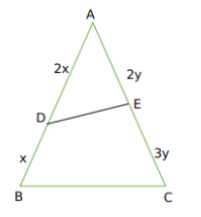
Triangles ADE and ABC share angle A, so each area is
(the two sides at A)
.
Area of ADE
, so
.
Area of ABC
.
Equivalently,
, so
sq cm.
The answer is 30.
Q65MCQRatios, Proportions & Partnership
Anil, Bobby, and Chintu jointly invest in a business and agree to share the overall profit in proportion to their investments. Anil’s share of investment is 70%.
His share of profit decreases by ₹ 420 if the overall profit goes down from 18% to 15%. Chintu’s share of profit increases by ₹ 80 if the overall profit goes up
from 15% to 17%. The amount, in INR, invested by Bobby is
- A2000
- B2400
- C2200
- D1800
Answer and solution
Answer: (A) 2000
Profit is shared in proportion to investment, so when the overall profit rate changes, each person's share changes in the same proportion. Let the total investment be
.
Anil holds 70%. When the profit rate falls from 18% to 15%, the total profit falls by 3% of
, and Anil's share falls by
. So
and
.
When the rate rises from 15% to 17%, the total profit rises by 2% of
, which is 400. Chintu's share rises by 80, that is
of the increase, so Chintu holds 20% of the investment.
Bobby holds the remaining
, which is
.
Option B (2400) would need Bobby to hold 12%, but Anil and Chintu together hold 90%, leaving only 10%.
Hence, option A (2000).
Q66MCQTime & Work
Two pipes A and B are attached to an empty water tank. Pipe A fills the tank while pipe B drains it. If pipe A is opened at 2 pm and pipe B is opened at 3 pm,
then the tank becomes full at 10 pm. Instead, if pipe A is opened at 2 pm and pipe B is opened at 4 pm, then the tank becomes full at 6 pm. If pipe B is not
opened at all, then the time, in minutes, taken to fill the tank is
- A144
- B140
- C264
- D120
Answer and solution
Answer: (A) 144
Let pipe A fill
and pipe B drain
of water per hour, and let the tank hold
.
First case: A runs from 2 pm to 10 pm (8 hours) and B from 3 pm to 10 pm (7 hours), so
.
Second case: A runs from 2 pm to 6 pm (4 hours) and B from 4 pm to 6 pm (2 hours), so
.
Equating:
, so
and
. Then
.
A alone takes
hours
minutes.
Option D (120 minutes, i.e.
) fails: the second case would then give
, and in the first case the tank would get only
, half of it.
Hence, option A (144).