- CATin
- CAT past papers
- CAT 2021 Slot 2
- DILR
CAT 2021 Slot 2 — DILR questions with answers
All 20 questions of the Data Interpretation & Logical Reasoning section (15 MCQs, 5 TITA, 4 sets). Try each one, then open its answer and solution.
CAT 2021 Slot 2, timed like the real exam (120 minutes, 40 a section) and scored the CAT way: +3 right, −1 for a wrong MCQ, 0 for a wrong TITA, with the full post-mock analysis. Older official papers are in CATin Pro, with 80+ mocks and the full planner. The last three years of papers are free.
Sit this paper as a timed mock with CATin ProData Interpretation & Logical Reasoning
CAT 2021 Slot 2 · 40 minutes · +3 for a right answer, −1 for a wrong MCQ, 0 for a wrong TITA
Data set
Set for questions 25–28
Instructions [25 - 28 ]
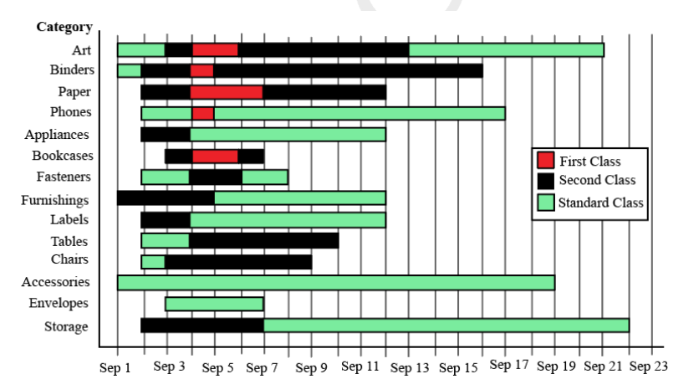
The different bars in the diagram above provide information about different orders in various categories (Art, Binders, ….) that were booked in the first two weeks of September of a store for one client. The colour and pattern of a bar denotes the ship mode (First Class / Second Class / Standard Class). The left end point of a bar indicates the booking day of the order, while the right end point indicates the dispatch day of the order. The difference between the dispatch day and the booking day (measured in terms of the number of days) is called the processing time of the order. For the same category, an order is considered for booking only after the previous order of the same category is dispatched. No two consecutive orders of the same category had identical ship mode during this period.
For example, there were only two orders in the furnishing category during this period. The first one was shipped in the Second Class. It was booked on Sep 1 and dispatched on Sep 5. The second order was shipped in the Standard class. It was booked on Sep 5 (although the order might have been placed before that) and dispatched on Sep 12. So the processing times were 4 and 7 days respectively for these orders.
Q25TITABar & Line Charts
How many days between Sep 1 and Sep 14 (both inclusive) had no booking from this client considering all the above categories?
Type in your answer (TITA). No negative mark for a wrong answer.
Answer and solution
Answer: 6
Read the left end of each bar as a booking day. The bookings are:
Art: Sep 1, 3, 4, 6, 13. Binders: 1, 2, 4, 5. Paper: 2, 4, 7. Phones: 2, 4, 5. Appliances: 2, 4. Bookcases: 3, 4, 6. Fasteners: 2, 4, 6. Furnishings: 1, 5. Labels: 2, 4. Tables: 2, 4. Chairs: 2, 3. Accessories: 1. Envelopes: 3. Storage: 2, 7.
So bookings were made on Sep 1, 2, 3, 4, 5, 6, 7 and 13. After Sep 7 the only new booking is Art's last order on Sep 13, because every other category has either finished or is still processing an order booked earlier.
The days from Sep 1 to Sep 14 with no booking are Sep 8, 9, 10, 11, 12 and 14, which is 6 days.
The answer is 6.
Q26TITABar & Line Charts
What was the average processing time of all orders in the categories which had only one type of ship mode?
Type in your answer (TITA). No negative mark for a wrong answer.
Answer and solution
Answer: 11
A category with only one type of ship mode must have had only one order, because no two consecutive orders of the same category had the same ship mode.
In the chart, two categories have a single bar: Accessories and Envelopes, both Standard Class. Every other category has at least two bars in different colours.
Accessories: booked Sep 1 and dispatched Sep 19, so the processing time is
days.
Envelopes: booked Sep 3 and dispatched Sep 7, so the processing time is
days.
Average processing time
days.
The answer is 11.
Q27MCQBar & Line Charts
The sequence of categories -- Art, Binders, Paper and Phones -- in decreasing order of average processing time of their orders in this period is:
- AArt, Binders, Paper, Phones
- BPhones, Art, Binders, Paper
- CPhones, Binders, Art, Paper
- DPaper, Binders, Art, Phones
Answer and solution
Answer: (B) Phones, Art, Binders, Paper
Processing time is the dispatch day minus the booking day for each bar.
Art has five orders: Sep 1-3, 3-4, 4-6, 6-13 and 13-21, with times 2, 1, 2, 7 and 8. Average
.
Binders has four orders: Sep 1-2, 2-4, 4-5 and 5-16, with times 1, 2, 1 and 11. Average
.
Paper has three orders: Sep 2-4, 4-7 and 7-12, with times 2, 3 and 5. Average
.
Phones has three orders: Sep 2-4, 4-5 and 5-17, with times 2, 1 and 12. Average
.
In decreasing order: Phones (5), Art (4), Binders (3.75), Paper (3.33).
Option C is the closest trap, but it puts Binders ahead of Art, although Art's average of 4 is higher than Binders' 3.75.
Hence, option B (Phones, Art, Binders, Paper).
Q28MCQBar & Line Charts
Approximately what percentage of orders had a processing time of one day during the period Sep 1 to Sep 22 (both dates inclusive)?
- A22%
- B16%
- C20%
- D25%
Answer and solution
Answer: (C) 20%
First count all orders, one per bar: Art 5, Binders 4, Paper 3, Phones 3, Appliances 2, Bookcases 3, Fasteners 3, Furnishings 2, Labels 2, Tables 2, Chairs 2, Accessories 1, Envelopes 1 and Storage 2. That is 35 orders, all within Sep 1 to Sep 22.
The orders with a processing time of one day are Art's Second Class order (Sep 3-4), Binders' Standard Class order (Sep 1-2) and First Class order (Sep 4-5), Phones' First Class order (Sep 4-5), Bookcases' two Second Class orders (Sep 3-4 and Sep 6-7), and Chairs' Standard Class order (Sep 2-3). That is 7 orders.
Percentage
.
Option A (22%) does not fit: 7 out of 35 is exactly 20%, and 22% of 35 orders would be about 7.7 orders, not a whole number.
Hence, option C (20%).
Data set
Set for questions 29–34
Instructions [29 - 34 ]
Ten objects o1, o2, …, o10 were distributed among Amar, Barat, Charles, Disha, and Elise. Each item went to exactly one person. Each person got exactly two of the items, and this pair of objects is called her/his bundle.
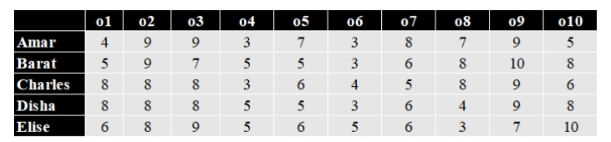
The following table shows how each person values each object.
The value of any bundle by a person is the sum of that person’s values of the objects in that bundle. A person X envies another person Y if X values Y’s bundle more than X’s own bundle.
For example, hypothetically suppose Amar’s bundle consists of o1 and o2, and Barat’s bundle consists of o3 and o4. Then Amar values his own bundle at 4 + 9 = 13 and Barat’s bundle at 9 + 3 = 12. Hence Amar does not envy Barat. On the other hand, Barat values his own bundle at 7 + 5 = 12 and Amar’s bundle at 5 + 9 = 14. Hence Barat envies Amar.
The following facts are known about the actual distribution of the objects among the five people.
1. If someone’s value for an object is 10, then she/he received that object.
2. Objects o1, o2, and o3 were given to three different people.
3. Objects o1 and o8 were given to different people.
4. Three people value their own bundles at 16. No one values her/his own bundle at a number higher than 16.
5. Disha values her own bundle at an odd number. All others value their own bundles at an even number.
6. Some people who value their own bundles less than 16 envy some other people who value their own bundle at 16. No one else envies others.
Q29MCQLogical Puzzles
What BEST can be said about object o8?
- Ao8 was given to Amar, Charles, or Disha
- Bo8 was given to Disha
- Co8 was given to Charles
- Do8 was given to Charles or Disha
Answer and solution
Answer: (C) o8 was given to Charles
By fact 1, Barat gets o9 and Elise gets o10, since each values that object at 10.
Barat's total must be even and at most 16, so his second object must be worth an even amount of at most 6 to him. Only o7 (worth 6) fits, so Barat has o7 and o9, worth 16. In the same way Elise's second object must be o1, o5 or o7, each worth 6 to her, so she is also at 16.
Amar values Barat's bundle at
, more than his own bundle can be worth, so Amar envies Barat. By fact 6 only people below 16 envy, so Amar is below 16. Disha's total is odd. So the third person at 16 is Charles.
Charles can reach 16 only as
, using two of o1, o2, o3 and o8. By fact 2 he cannot hold two of o1, o2 and o3, so one of his objects must be o8.
Option D (Charles or Disha) is true but not the best statement, because o8 is fixed as Charles's.
Hence, option C (o8 was given to Charles).
Q30MCQLogical Puzzles
Who among the following envies someone else?
- ABarat
- BCharles
- CAmar
- DElise
Answer and solution
Answer: (C) Amar
Fact 1: Barat values o9 at 10 and Elise values o10 at 10, so they receive these objects.
Barat's own total must be even (fact 5) and at most 16 (fact 4). With o9 worth 10 to him, his second object must be worth an even amount of at most 6 to him, and the only such object is o7 (worth 6). So Barat holds o9 and o7 and values them at 16.
Amar values Barat's bundle at
. No one values their own bundle above 16, so whatever Amar receives, he values Barat's bundle more: Amar envies Barat.
The other options do not. Elise takes o10 plus o1 or o5 (each worth 6 to her), so she is at 16, and by fact 6 people at 16 envy no one. Amar cannot be at 16 (he would then be a 16-scorer who envies), and Disha's total is odd, so Charles is the third person at 16 and envies no one either.
Hence, option C (Amar).
Q31TITALogical Puzzles
What is Amar’s value for his own bundle?
Type in your answer (TITA). No negative mark for a wrong answer.
Answer and solution
Answer: 12
By fact 1, Barat gets o9 and Elise gets o10. Barat's even total of at most 16 forces his second object to be o7 (worth 6 to him), so he is at 16. Elise's second object must be worth an even 6 to her: o1 or o5. She is at 16 too.
Amar values Barat's bundle at
, so he envies Barat and, by fact 6, is below 16. Disha is odd, so Charles is the third person at 16. That needs
, which by facts 2 and 3 means o8 with o2 or o3.
Suppose Elise had o1. Amar and Disha would share the leftover of o2 and o3, plus o4, o5 and o6. Disha needs an odd total, so she must take the o2/o3 object (worth 8 to her). Amar would then hold two of o4, o5 and o6, worth at most 10, while valuing Disha's bundle at 12 or more. He would envy Disha, who is below 16, which breaks fact 6. So Elise has o5.
Now Amar holds one of o1, o2, o3 (fact 2) and one of o4, o6. With o1 his total would be
, which is odd. So he has o2 or o3 with o4 or o6:
.
The answer is 12.
Q32MCQLogical Puzzles
Object o4 was given to
- AElise
- BBarat
- CCharles
- DDisha
Answer and solution
Answer: (D) Disha
By fact 1, Barat gets o9 and Elise gets o10. Barat's even total of at most 16 forces o7 as his second object. Elise's second object must be worth an even 6 to her: o1 or o5. Both are at 16.
Amar values Barat's bundle at
, so he envies Barat and must be below 16 (fact 6). Disha is odd, so Charles is at 16, which needs
: o8 with o2 or o3 (facts 2 and 3).
If Elise had o1, Disha's odd total would force her to take the leftover of o2 and o3, and Amar, left with two of o4, o5 and o6 (at most 10), would envy Disha, who is below 16. So Elise has o5.
Now Amar, Charles and Disha each hold one of o1, o2 and o3, and Amar and Disha split o4 and o6. Amar cannot take o1, since
is odd, so Disha has o1.
If Amar took o4, Disha would hold o1 and o6 (
) and value Amar's bundle at
, envying someone below 16. So Amar has o6 and Disha has o4.
Elise (o10, o5), Barat (o9, o7) and Charles (o8 and o2 or o3) cannot hold o4.
Hence, option D (Disha).
Q33MCQLogical Puzzles
Object o5 was given to
- ADisha
- BElise
- CAmar
- DCharles
Answer and solution
Answer: (B) Elise
Barat and Elise value o9 and o10 at 10, so they receive them (fact 1).
Barat's total must be even and at most 16, so his second object is o7, worth 6 to him. Elise's second object must likewise be worth an even amount of at most 6 to her, so it is o1 or o5, each worth 6; she is at 16.
Amar values Barat's bundle at
, so he envies Barat and must himself be below 16 (fact 6). Disha is odd, so Charles is the third person at 16. That needs
, so by facts 2 and 3 Charles has o8 with o2 or o3.
Suppose Elise took o1 instead of o5. Amar and Disha would share the leftover of o2 and o3, plus o4, o5 and o6. For an odd total Disha must take the o2/o3 object (worth 8 to her) plus one more, leaving Amar two of o4, o5 and o6, worth at most 10 to him. He would value Disha's bundle at 12 or more and envy her, although she is below 16. That breaks fact 6.
So Elise's second object is o5. Option C (Amar) is the tempting alternative, but o5 could reach Amar only in the case just ruled out.
Hence, option B (Elise).
Q34MCQLogical Puzzles
What BEST can be said about the distribution of object o1?
- Ao1 was given to Disha
- Bo1 was given to Charles
- Co1 was given to Charles, Disha, or Elise
- Do1 was given to Charles or Disha
Answer and solution
Answer: (A) o1 was given to Disha
By fact 1, Barat and Elise receive o9 and o10. Barat's even total of at most 16 forces o7 as his second object. Elise's second object must be worth an even 6 to her, so it is o1 or o5; both are at 16.
Amar values Barat's bundle at
, so he envies Barat and must be below 16 (fact 6). Disha is odd, so Charles is at 16, which needs
. Facts 2 and 3 give Charles o8 with o2 or o3, never o1.
Could Elise have o1? Then Amar and Disha share the leftover of o2 and o3, plus o4, o5 and o6. Disha's odd total forces her to take the o2/o3 object, leaving Amar two of o4, o5 and o6 (at most 10). Amar would value Disha's bundle at 12 or more and envy her, although she is below 16, breaking fact 6. So Elise has o5, not o1.
That leaves o1 with Amar or Disha, each of whom gets one of o1, o2, o3 (fact 2) and one of o4, o6. For Amar, o1 would give
, an odd total. So o1 went to Disha.
Option D (Charles or Disha) fails because Charles holds o8, and fact 3 keeps o1 away from o8.
Hence, option A (o1 was given to Disha).
Data set
Set for questions 35–38
Instructions [35 - 38 ]
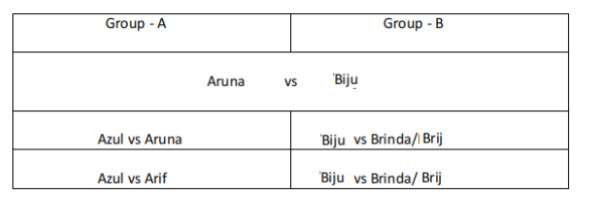
The game of Chango is a game where two people play against each other; one of them wins and the other loses, i.e., there are no drawn Chango games. 12 players participated in a Chango championship. They were divided into four groups: Group A consisted of Aruna, Azul, and Arif; Group B consisted of Brinda, Brij, and Biju; Group C consisted of Chitra, Chetan, and Chhavi; and Group D consisted of Dipen, Donna, and Deb.
Players within each group had a distinct rank going into the championship. The players have NOT been listed necessarily according to their ranks. In the group stage of the game, the second and third ranked players play against each other, and the winner of that game plays against the first ranked player of the group.
The winner of this second game is considered as the winner of the group and enters a semi-final.
The winners from Groups A and B play against each other in one semi-final, while the winners from Groups C and D play against each other in the other semi-final. The winners of the two semi-finals play against each other in the final to decide the winner of the championship.
It is known that:
1. Chitra did not win the championship.
2. Aruna did not play against Arif. Brij did not play against Brinda.
3. Aruna, Biju, Chitra, and Dipen played three games each, Azul and Chetan played two games each, and the remaining players played one game each.
Q35MCQGames & Tournaments
Who among the following was DEFINITELY NOT ranked first in his/her group?
- ADipen
- BAruna
- CBrij
- DChitra
Answer and solution
Answer: (A) Dipen
In each group the players ranked second and third play first, and the winner then plays the top seed. The group winner goes on to a semi-final.
Suppose Dipen were ranked first in Group D. Donna and Deb, ranked second and third, would play each other, and the winner would go on to play Dipen, making 2 games. But Donna and Deb played only one game each. So Dipen was definitely not ranked first. He was ranked second or third, beat both group-mates, and played his third game in the semi-final.
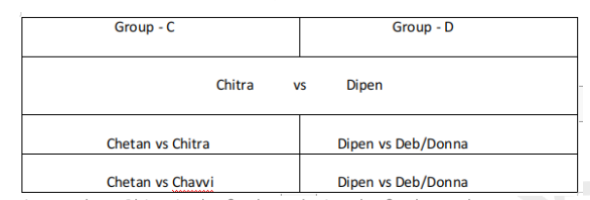
The others can be first. Aruna must be: as a second or third seed, her three games would include both group-mates, yet she never played Arif. Chitra must be too: if Chetan were the top seed, his 2 games would mean he won the group, beating Chitra, who would then have only 2 games. So Chetan won his first game and lost to the top seed, who then played a semi-final; Chhavi played once, so that is Chitra.
Brij is the tempting choice, but Biju (3 games) was a second or third seed who beat both Brij and Brinda, and either of them could be the top seed. So Brij is not definitely excluded.
Hence, option A (Dipen).
Q36MCQGames & Tournaments
Which of the following pairs must have played against each other in the championship?
- ADeb, Donna
- BAzul, Biju
- CDonna, Chetan
- DChitra, Dipen
Answer and solution
Answer: (D) Chitra, Dipen
In each group the players ranked second and third play first, and the winner then plays the top seed.
Group C: Chitra played 3 games, Chetan 2 and Chhavi 1. If Chetan had been the top seed, his 2 games would mean he won the group, so Chitra would have lost to him inside the group and could not reach 3 games. So Chetan was ranked second or third, won his first game and lost to the top seed, who then played a semi-final. Chhavi played only once, so that top seed is Chitra. Chitra won Group C.
Group D: Dipen played 3 games, Donna and Deb 1 each. If Dipen were the top seed, the winner of Donna against Deb would have played twice. So Dipen was ranked second or third, beat both, and won Group D.
The winners of Groups C and D meet in a semi-final, so Chitra and Dipen must have played each other.
Option A fails because Donna and Deb never met: Dipen played each of them. Options B and C fail because Azul, Donna and Chetan all lost inside their groups, so none of them played anyone from another group.
Hence, option D (Chitra, Dipen).
Q37MCQGames & Tournaments
Who won the championship?
- AChitra
- BAruna
- CBrij
- DCannot be determined
Answer and solution
Answer: (B) Aruna
In each group the players ranked second and third play first, and the winner then plays the top seed.
Group A: Aruna played 3 games but never met Arif. As a second or third seed she would have played both group-mates, so she was the top seed. Her 3 games are then the group game, the semi-final and the final.
Group D: if Dipen were the top seed, the winner of Donna against Deb would have played twice, but each played once. So Dipen was ranked second or third, and his 3 games are two group games and a semi-final, which he lost.
So the other finalist came from Group C, and that player played at least 3 games: at least one group game, the semi-final and the final. Chetan (2 games) and Chhavi (1 game) are too few, so Chitra reached the final against Aruna.
Chitra did not win the championship (fact 1), so Aruna won the final. This rules out option A, and option D fails because the winner is fixed. Option C fails because Brij played only one game, so he lost inside Group B.
Hence, option B (Aruna).
Q38MCQGames & Tournaments
Who among the following did NOT play against Chitra in the championship?
- AAruna
- BChetan
- CDipen
- DBiju
Answer and solution
Answer: (D) Biju
A player from Group A or B can meet Chitra only in the final.
Aruna played 3 games but never met Arif. As a second or third seed she would have faced both group-mates, so she was the top seed, and her 3 games were the group game, the semi-final and the final. So Aruna, not Biju, was the finalist from Groups A and B. Biju's 3 games were two group games, as a second or third seed, and the semi-final he lost to Aruna. He never met Chitra.
The other three all played Chitra. Chetan cannot be Group C's top seed: his 2 games would then mean he beat Chitra, leaving her only 2 games. So Chetan won his first game and lost to the top seed, Chitra (Chhavi played once). Dipen was a second or third seed (as top seed, the winner of Donna against Deb would have played twice), so with 3 games he won Group D and met Chitra in the semi-final. Chitra, the top seed with 3 games, won it, reached the final and lost to Aruna (fact 1).
Option A is the tempting one, but Aruna met Chitra in the final.
Hence, option D (Biju).
Data set
Set for questions 39–44
Instructions [39 - 44 ]
Ravi works in an online food-delivery company. After each delivery, customers rate Ravi on each of four parameters - Behaviour, Packaging, Hygiene, and Timeliness, on a scale from 1 to 9. If the total of the four rating points is 25 or more, then Ravi gets a bonus of ₹20 for that delivery. Additionally, a customer may or may not give Ravi a tip. If the customer gives a tip, it is either ₹30 or ₹50.
One day, Ravi made four deliveries - one to each of Atal, Bihari, Chirag, and Deepak, and received a total of ₹120 in bonus and tips. He did not get both a bonus and a tip from the same customer.
The following additional facts are also known.
1. In Timeliness, Ravi received a total of 21 points, and three of the customers gave him the same rating points in this parameter. Atal gave higher rating points than Bihari and Chirag in this parameter.
2. Ravi received distinct rating points in Packaging from the four customers adding up to 29 points. Similarly, Ravi received distinct rating points in Hygiene from the four customers adding up to 26 points.
3. Chirag gave the same rating points for Packaging and Hygiene.
4. Among the four customers, Bihari gave the highest rating points in Packaging, and Chirag gave the highest rating points in Hygiene.
5. Everyone rated Ravi between 5 and 7 in Behaviour. Unique maximum and minimum ratings in this parameter were given by Atal and Deepak respectively.
6. If the customers are ranked based on ratings given by them in individual parameters, then Atal’s rank based on Packaging is the same as that based on Hygiene. This is also true for Deepak.
Q39TITALogical Puzzles
What was the minimum rating that Ravi received from any customer in any parameter?
Type in your answer (TITA). No negative mark for a wrong answer.
Answer and solution
Answer: 5
Timeliness: Atal rated higher than Bihari and Chirag, so Bihari, Chirag and Deepak share a rating
and Atal gave
: (Atal,
) is (9, 4) or (6, 5).
Packaging: four different ratings totalling 29 are 9, 8, 7, 5; Bihari has the 9. Hygiene: four different ratings totalling 26 need a top of at least 8; Chirag's top equals his packaging rating, so he gave 8 in both. Hygiene is 8, 7, 6, 5.
Behaviour: Atal 7, Deepak 5, Bihari and Chirag 6.
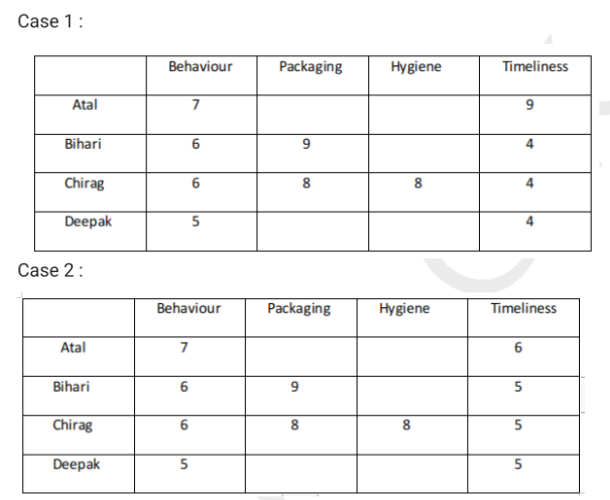
Atal and Deepak hold packaging's 7 and 5 (ranks 3 and 4), so by fact 6 they hold hygiene's 6 and 5 in the same order. Bihari's hygiene is 7.
Bihari and Chirag each total
: bonuses, no tips. So Atal and Deepak gave the other ₹80 as tips of ₹30 and ₹50, and neither reaches 25.
With
, Atal would total at least
, so
. With 7 and 6 in Packaging and Hygiene he would again reach 26 (first table below), so the second table is final.
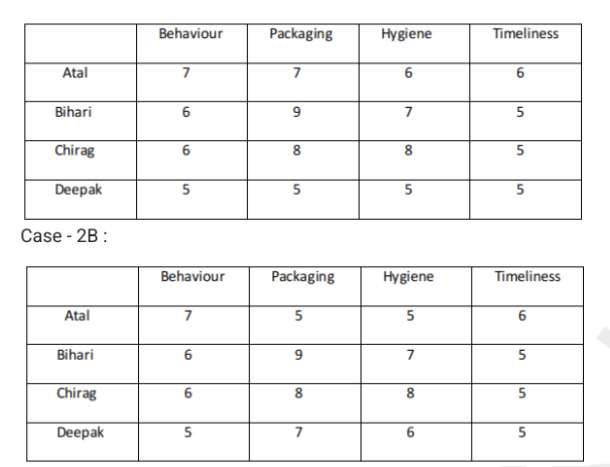
Every parameter's lowest rating is 5: Behaviour 5–7, Packaging 5–9, Hygiene 5–8, Timeliness 5 or 6.
The answer is 5.
Q40MCQLogical Puzzles
The COMPLETE list of customers who gave the maximum total rating points to Ravi is
- AAtal
- BBihari
- CBihari and Chirag
- DAtal and Bihari
Answer and solution
Answer: (C) Bihari and Chirag
Behaviour (5 to 7; Atal unique top, Deepak unique bottom): Atal 7, Bihari 6, Chirag 6, Deepak 5.
Packaging: four distinct ratings totalling 29 must be 9, 8, 7, 5; Bihari has 9. Hygiene totals 26 and Chirag's is highest, equal to his Packaging (8, 7 or 5). A top of 7 allows at most
, so Chirag has 8 in both and Hygiene is 8, 7, 6, 5. Atal and Deepak are 3rd/4th in Packaging (7, 5), so by condition 6 also in Hygiene (6, 5); Bihari has 7.
Timeliness: Atal beats Bihari and Chirag, so the three equal ratings
are theirs and Deepak's; Atal gives
, so
(Atal 9) or
(Atal 6).
If
: Atal totals at least 26, Bihari and Chirag 26 each, so three bonuses make ₹60 and Deepak's one tip cannot add ₹60.
If
: Bihari and Chirag total 27 (₹40 in bonuses), so Atal and Deepak tip ₹30 and ₹50 and stay below 25. Atal with Packaging 7, Hygiene 6 would total 26 (upper table), so Atal has 5 and 5 (lower table).
Totals: Atal 23, Bihari 27, Chirag 27, Deepak 23. Atal's 23 rules out options A and D.
Hence, option C (Bihari and Chirag).
Q41TITALogical Puzzles
What rating did Atal give on Timeliness?
Type in your answer (TITA). No negative mark for a wrong answer.
Answer and solution
Answer: 6
Timeliness: Atal rated higher than Bihari and Chirag, so Bihari, Chirag and Deepak share a rating
and Atal gave
: (Atal,
) is (9, 4) or (6, 5).
Packaging: four different ratings totalling 29 are 9, 8, 7, 5; Bihari has the 9. Hygiene: four different ratings totalling 26 need a top of at least 8; Chirag's top equals his packaging rating, so he gave 8 in both. Hygiene is 8, 7, 6, 5.
Behaviour: Atal 7, Deepak 5, Bihari and Chirag 6.
Atal and Deepak hold packaging's 7 and 5 (ranks 3 and 4), so by fact 6 they hold hygiene's 6 and 5 in the same order. Bihari's hygiene is 7.
Bihari and Chirag each total
: bonuses, no tips. So Atal and Deepak gave the other ₹80 as tips of ₹30 and ₹50, and neither reaches 25.
If Atal gave 9 in Timeliness (
), his total would be at least
and he would earn a bonus instead of a tip. So
: Atal gave 6, and the other three gave 5.
The answer is 6.
Q42MCQLogical Puzzles
What BEST can be concluded about the tip amount given by Deepak?
- AEither ₹0 or ₹30 or ₹50
- BEither ₹30 or ₹50
- C₹50
- D₹30
Answer and solution
Answer: (B) Either ₹30 or ₹50
Timeliness: Atal rated higher than Bihari and Chirag, so Bihari, Chirag and Deepak share a rating
and Atal gave
: (Atal,
) is (9, 4) or (6, 5).
Packaging: four different ratings totalling 29 are 9, 8, 7, 5; Bihari has the 9. Hygiene: four different ratings totalling 26 need a top of at least 8; Chirag's top equals his packaging rating, so he gave 8 in both. Hygiene is 8, 7, 6, 5.
Behaviour: Atal 7, Deepak 5, Bihari and Chirag 6.
Atal and Deepak hold packaging's 7 and 5 (ranks 3 and 4), so by fact 6 they hold hygiene's 6 and 5 in the same order. Bihari's hygiene is 7.
Bihari and Chirag each total
, so each earns the ₹20 bonus and gives no tip. That leaves ₹80 from Atal and Deepak. Each gives ₹0, ₹20 (a bonus), ₹30 or ₹50, and only
makes 80. So both tip, one ₹30 and the other ₹50, and no fact says which gave which.
Option A fails because Deepak must tip. Options C and D each fix an amount the data cannot decide.
Hence, option B (Either ₹30 or ₹50).
Q43MCQLogical Puzzles
In which parameter did Atal give the maximum rating points to Ravi?
- AHygiene
- BBehaviour
- CTimeliness
- DPackaging
Answer and solution
Answer: (B) Behaviour
Timeliness: Atal rated higher than Bihari and Chirag, so Bihari, Chirag and Deepak share a rating
and Atal gave
: (Atal,
) is (9, 4) or (6, 5).
Packaging: four different ratings totalling 29 are 9, 8, 7, 5; Bihari has the 9. Hygiene: four different ratings totalling 26 need a top of at least 8; Chirag's top equals his packaging rating, so he gave 8 in both. Hygiene is 8, 7, 6, 5.
Behaviour: Atal 7, Deepak 5, Bihari and Chirag 6.
Atal and Deepak hold packaging's 7 and 5 (ranks 3 and 4), so by fact 6 they hold hygiene's 6 and 5 in the same order. Bihari's hygiene is 7.
Bihari and Chirag each total
: bonuses, no tips. So Atal and Deepak gave the other ₹80 as tips of ₹30 and ₹50, and neither reaches 25.
With
, Atal would total at least
, so he gave 6 in Timeliness. With 7 and 6 in Packaging and Hygiene he would reach 26 (first table below), so he gave 5 and 5.
Atal gave Behaviour 7, Packaging 5, Hygiene 5, Timeliness 6. Option C fails: his Timeliness 6 is below his Behaviour 7.
Hence, option B (Behaviour).
Q44MCQLogical Puzzles
What rating did Deepak give on Packaging?
- A7
- B8
- C5
- D6
Answer and solution
Answer: (A) 7
Timeliness: Atal rated higher than Bihari and Chirag, so Bihari, Chirag and Deepak share a rating
and Atal gave
: (Atal,
) is (9, 4) or (6, 5).
Packaging: four different ratings totalling 29 are 9, 8, 7, 5; Bihari has the 9. Hygiene: four different ratings totalling 26 need a top of at least 8; Chirag's top equals his packaging rating, so he gave 8 in both. Hygiene is 8, 7, 6, 5.
Behaviour: Atal 7, Deepak 5, Bihari and Chirag 6.
Atal and Deepak hold packaging's 7 and 5 (ranks 3 and 4), so by fact 6 they hold hygiene's 6 and 5 in the same order. Bihari's hygiene is 7.
Bihari and Chirag each total
: bonuses, no tips. So Atal and Deepak gave the other ₹80 as tips of ₹30 and ₹50, and neither reaches 25.
With
, Atal would total at least
, so
and Atal gave 6.
If Deepak gave 5 in Packaging, Atal would have 7 and 6 and total
(first table below). So Deepak gave 7.
Option C (5) is exactly that rejected case.
Hence, option A (7).