- CATin
- CAT past papers
- CAT 2021 Slot 1
- QA
CAT 2021 Slot 1 — QA questions with answers
All 22 questions of the Quantitative Ability section (14 MCQs, 8 TITA). Try each one, then open its answer and solution.
CAT 2021 Slot 1, timed like the real exam (120 minutes, 40 a section) and scored the CAT way: +3 right, −1 for a wrong MCQ, 0 for a wrong TITA, with the full post-mock analysis. Older official papers are in CATin Pro, with 80+ mocks and the full planner. The last three years of papers are free.
Sit this paper as a timed mock with CATin ProQuantitative Ability
CAT 2021 Slot 1 · 40 minutes · +3 for a right answer, −1 for a wrong MCQ, 0 for a wrong TITA
Q45MCQTime, Speed & Distance
Two trains cross each other in 14 seconds when running in opposite directions along parallel tracks. The faster train is 160 m long and crosses a lamp post
in 12 seconds. If the speed of the other train is 6 km/hr less than the faster one, its length, in m, is
- A184
- B192
- C190
- D180
Answer and solution
Answer: (C) 190
The faster train passes a lamp post by covering its own length, so its speed is
m/s.
6 km/hr is
m/s, so the slower train runs at
m/s.
In opposite directions, the relative speed is
m/s.
To cross each other, the trains cover the sum of their lengths:
, so
m.
Each other option would need a different combined length (180 gives 340 m, 184 gives 344 m, 192 gives 352 m), so none fits the 14 seconds.
Hence, option C (190).
Q46MCQPolygons & Circles
If the area of a regular hexagon is equal to the area of an equilateral triangle of side 12 cm, then the length, in cm, of each side of the hexagon is
- A
- B
- C
- D
Answer and solution
Answer: (D)
Let the side of the hexagon be
. A regular hexagon is six equilateral triangles of side
, so its area is
.
The equilateral triangle of side 12 has area
.
Equating the areas:
, so
and
.
Option A (
) would give
, a hexagon four times the triangle's area; options B and C give
and
.
Hence, option D (
).
Q47MCQPolygons & Circles
Suppose the length of each side of a regular hexagon ABCDEF is 2 cm. If T is the mid point of CD, then the length of AT, in cm, is
- A
- B
- C
- D
Answer and solution
Answer: (A)
A regular hexagon splits into six equilateral triangles of side 2 cm that meet at the centre. So the long diagonal AD passes through the centre and
cm.
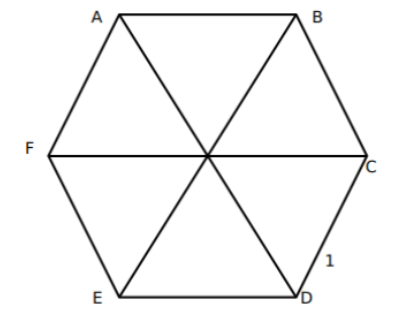
AD is an axis of symmetry, so it bisects the
interior angle at D. Hence
. T is the midpoint of CD, so
cm.
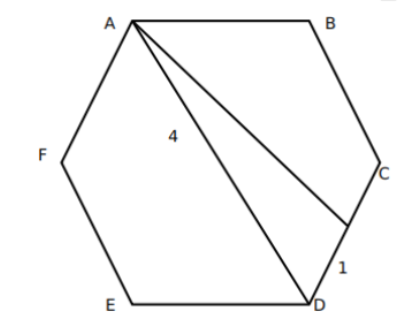
In triangle ADT, by the cosine rule:
So
cm.
Option C (
) is the trap: using C instead of T, that is
, gives
.
Hence, option A (
).
Q48MCQTime & Work
Anu, Vinu and Manu can complete a work alone in 15 days, 12 days and 20 days, respectively. Vinu works everyday. Anu works only on alternate days
starting from the first day while Manu works only on alternate days starting from the second day. Then, the number of days needed to complete the work is
- A5
- B8
- C6
- D7
Answer and solution
Answer: (D) 7
Let the total amount of work be 60 units.
Then Anu, Vinu, and Manu do 4, 5, and 3 units of work per day respectively.
On the 1st day, Anu and Vinu work. Work done on the 1st day = 9 units
On the 2nd day, Manu and Vinu work. Work done on the 2nd day = 8 units
This cycle goes on. And in 6 days, the work completed is 9+8+9+8+9+8 = 51 units.
On the 7th day, again Anu and Vinu work and complete the remaining 9 units of work. Thus, the number of days taken is 7 days.
Q49MCQLinear Equations
The amount Neeta and Geeta together earn in a day equals what Sita alone earns in 6 days. The amount Sita and Neeta together earn in a day equals what
Geeta alone earns in 2 days. The ratio of the daily earnings of the one who earns the most to that of the one who earns the least is
- A3:2
- B11:7
- C11:3
- D7:3
Answer and solution
Answer: (C) 11:3
Let Neeta, Geeta and Sita earn
,
and
a day.
Given:
(i) and
(ii).
Subtracting (i) from (ii):
, so
.
Take
and
. From (i),
. Check (ii):
.
So Neeta earns the most (
) and Sita the least (
), and the ratio is
. Option D (
) is the trap: it compares Geeta with Sita, but Geeta is not the top earner.
Hence, option C (11:3).
Q50MCQAverages, Mixtures & Alligations
Onion is sold for 5 consecutive months at the rate of Rs 10, 20, 25, 25, and 50 per kg, respectively. A family spends a fixed amount of money on onion for
each of the first three months, and then spends half that amount on onion for each of the next two months. The average expense for onion, in rupees per kg,
for the family over these 5 months is closest to
- A26
- B18
- C16
- D20
Answer and solution
Answer: (B) 18
Take the fixed amount as ₹100 for each of the first three months, so ₹50 for each of the last two.
Onion bought:
,
,
,
and
kg, a total of 22 kg.
Money spent:
.
Average expense per kg
, closest to 18.
Option A (26) is the trap: it is the simple average of the five prices,
, which ignores that more onion is bought when the price is low.
Hence, option B (18).
Q51TITAPermutations & Combinations
The number of groups of three or more distinct numbers that can be chosen from 1, 2, 3, 4, 5, 6, 7 and 8 so that the groups always include 3 and 5, while 7
and 8 are never included together is
Type in your answer (TITA). No negative mark for a wrong answer.
Answer and solution
Answer: 47
Every group contains 3 and 5, so the other members come from 1, 2, 4, 6, 7 and 8, and at least one is needed to reach three numbers. Split by 7 and 8, which cannot both appear.
Neither 7 nor 8: any non-empty subset of
, so
groups.
7 but not 8: the group already has three numbers (3, 5, 7), and any subset of
may be added, so
groups.
8 but not 7: likewise, 16 groups.
Total
.
Check by size: adding
of the six other numbers and removing the choices with both 7 and 8 gives
.
The answer is 47.
Q52TITAProfit, Loss & Discount
Amal purchases some pens at ₹ 8 each. To sell these, he hires an employee at a fixed wage. He sells 100 of these pens at ₹ 12 each. If the remaining pens
are sold at ₹ 11 each, then he makes a net profit of ₹ 300, while he makes a net loss of ₹ 300 if the remaining pens are sold at ₹ 9 each. The wage of the
employee, in INR, is
Type in your answer (TITA). No negative mark for a wrong answer.
Answer and solution
Answer: 1000
Let the number of pens purchased be n. Then the cost price is 8n. The total expenses incurred would be 8n+W, where W refers to the wage.
Then SP in the first case = 12× 100+11× (n−100)
Given profit is 300 in this case: 1200+11n-1100-8n-W=300 =>3n-W = 200
In second case: 1200+9n-900-8n-W=-300 (Loss). => W-n = 600.
Adding the two equations: 2n = 800
n = 400.
Thus W = 600 + 400 = 1000
Q53MCQLinear Equations
A basket of 2 apples, 4 oranges and 6 mangoes costs the same as a basket of 1 apple, 4 oranges and 8 mangoes, or a basket of 8 oranges and 7 mangoes.
Then the number of mangoes in a basket of mangoes that has the same cost as the other baskets is
- A11
- B13
- C10
- D12
Answer and solution
Answer: (B) 13
Let an apple, an orange and a mango cost
,
and
.
First two baskets:
, so
.
Second and third baskets:
. With
this is
, so
.
Cost of the first basket:
. The third basket agrees:
.
So a basket of 13 mangoes costs the same as each of the other baskets; 12 mangoes would cost only
, and 11 or 10 even less.
Hence, option B (13).
Q54MCQInequalities & Modulus
The number of integers n that satisfy the inequalities ∣n−60∣<∣n−100∣<∣n−20∣ is
- A21
- B19
- C18
- D20
Answer and solution
Answer: (B) 19
is the distance from
to
on the number line.
:
is closer to 100 than to 20, so
, the midpoint of 20 and 100.
:
is closer to 60 than to 100, so
, the midpoint of 60 and 100.
Both hold for
, that is
: 19 integers.
The endpoints fail: at
,
, and at
,
. Counting either one gives the trap answer 20 (option D).
Hence, option B (19).
Q55TITADigits & Base Systems
How many three-digit numbers are greater than 100 and increase by 198 when the three digits are arranged in the reverse order?
Type in your answer (TITA). No negative mark for a wrong answer.
Answer and solution
Answer: 70
Let the numbers be of the form 100a+10b+c, where a, b, and c represent single digits.
Then (100c+10b+a)-(100a+10b+c)=198
99c-99a=198
c-a = 2.
Now, a can take the values 1-7. a cannot be zero as the initial number has 3 digits and cannot be 8 or 9 as then c would not be a single-digit number.
Thus, there can be 7 cases.
B can take the value of any digit from 0-9, as it does not affect the answer. Hence, the total cases will be 7× 10=70.
Q56MCQSimple & Compound Interest
Anil invests some money at a fixed rate of interest, compounded annually. If the interests accrued during the second and third year are ₹ 806.25 and ₹
866.72, respectively, the interest accrued, in INR, during the fourth year is nearest to
- A929.48
- B934.65
- C931.72
- D926.84
Answer and solution
Answer: (C) 931.72
Let the principal be
and the rate
. The interest in any year is
times the amount at the start of that year.
Year 2 interest
and year 3 interest
.
Dividing:
, so
.
Each year's interest is 1.075 times the previous year's, so year 4 interest
.
Adding the same rupee increase again (
) is the trap: compound interest grows by a fixed ratio, not a fixed amount.
Hence, option C (931.72).
Q57TITAAverages, Mixtures & Alligations
Suppose hospital A admitted 21 less Covid infected patients than hospital B, and all eventually recovered. The sum of recovery days for patients in
hospitals A and B were 200 and 152, respectively. If the average recovery days for patients admitted in hospital A was 3 more than the average in hospital B
then the number admitted in hospital A was
Type in your answer (TITA). No negative mark for a wrong answer.
Answer and solution
Answer: 35
Let hospital A admit
patients, so hospital B admits
.
Average recovery days: A
and B
, with
.
Multiplying by
:
, so
.
This gives
, or
, so
. As
,
.
Check: A's average is
days and B's is
days, which differ by 3.
The answer is 35.
Q58TITATriangles & Lines
A circle of diameter 8 inches is inscribed in a triangle ABC where
. If BC = 10 inches then the area of the triangle in square inches is
Type in your answer (TITA). No negative mark for a wrong answer.
Answer and solution
Answer: 120
The incircle has diameter
, so its radius is
inches.
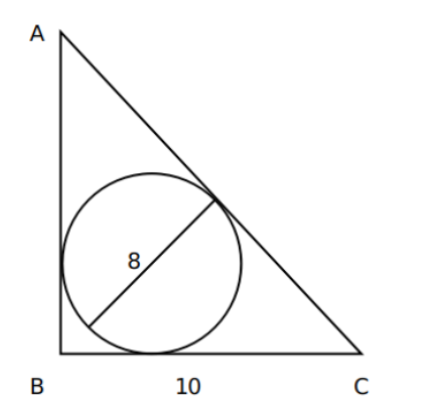
For a triangle right-angled at B, the two tangent lengths from B both equal
, which gives
. So
, i.e.
.
By Pythagoras,
. So
, giving
inches and
inches.
Area
square inches.
Check: the semi-perimeter is
, and
, as required.
The answer is 120.
Q59MCQInequalities & Modulus
is negative if and only if
- A or
- B or
- C or
- D or
Answer and solution
Answer: (A) or
Factorise:
. The sign can change only at
,
,
and
, and
and
are excluded.
: all four factors are positive, so
.
: only
is negative, so
.
:
and
are negative, so
.
: three factors are negative, so
.
: all four are negative, so
.
So
exactly when
or
. Option D fails because for
the four negative factors make
positive.
Hence, option A (
or
).
Q60TITALogarithms
If
, then
equals
Type in your answer (TITA). No negative mark for a wrong answer.
Answer and solution
Answer: 99
Write
and
.
The right side is
.
So the equation is
, which gives
, so
.
Then
, so
and
.
This keeps
and
positive, so every logarithm is defined, and
.
The answer is 99.
Q61TITATime & Work
Amar, Akbar and Anthony are working on a project. Working together Amar and Akbar can complete the project in 1 year, Akbar and Anthony can complete
in 16 months, Anthony and Amar can complete in 2 years. If the person who is neither the fastest nor the slowest works alone, the time in months he will
take to complete the project is
Type in your answer (TITA). No negative mark for a wrong answer.
Answer and solution
Answer: 32
Take the project as 48 units (the LCM of 12, 16 and 24 months). Let Amar, Akbar and Anthony do
,
and
units a month.
Amar and Akbar:
.
Akbar and Anthony:
.
Anthony and Amar:
.
Adding:
, so
. Then
,
and
.
Akbar is the fastest and Anthony the slowest, so Amar is neither. Alone he needs
months.
The answer is 32.
Q62MCQSequences & Series
If
,
, and
,
, then
is equal to
- A4
- B1
- C3
- D2
Answer and solution
Answer: (D) 2
Compute terms with
:
,
,
,
,
.
Since
and
, and each term depends only on the two before it, the sequence repeats every 5 terms:
, so
.
Option B (1) is the off-by-one trap: it is
. The value 4 never occurs.
Hence, option D (2).
Q63TITAAverages, Mixtures & Alligations
The strength of an indigo solution in percentage is equal to the amount of indigo in grams per 100 cc of water. Two 800 cc bottles are filled with indigo
solutions of strengths 33% and 17%, respectively. A part of the solution from the first bottle is thrown away and replaced by an equal volume of the solution
from the second bottle. If the strength of the indigo solution in the first bottle has now changed to 21% then the volume, in cc, of the solution left in the
second bottle is
Type in your answer (TITA). No negative mark for a wrong answer.
Answer and solution
Answer: 200
Bottle 1 holds 800 cc at 33% and bottle 2 holds 800 cc at 17%. Some solution from bottle 1 is replaced by the same volume from bottle 2, so bottle 1 still holds 800 cc, now at 21%.
By alligation, the 33% and 17% solutions are in the ratio
.
So of the 800 cc in bottle 1,
(200 cc) is the original solution and
(600 cc) came from bottle 2.
Check:
, as required.
Bottle 2 gave away 600 cc of its 800 cc, so
cc is left.
The answer is 200.
Q64MCQPercentages
Identical chocolate pieces are sold in boxes of two sizes, small and large. The large box is sold for twice the price of the small box. If the selling price per
gram of chocolate in the large box is 12% less than that in the small box, then the percentage by which the weight of chocolate in the large box exceeds that
in the small box is nearest to
- A144
- B127
- C135
- D124
Answer and solution
Answer: (B) 127
Let the small box cost ₹100 and hold
grams; the large box then costs ₹200 and holds
grams.
The large box's price per gram is 12% less:
.
So
.
The large box holds more by
, nearest to 127.
Option D (124) is the trap: it treats a 12% lower price per gram as 12% more grams per rupee, giving
, a 124% excess.
Hence, option B (127).
Q65MCQSequences & Series
The natural numbers are divided into groups as (1), (2, 3, 4), (5, 6, 7, 8, 9), ….. and so on. Then, the sum of the numbers in the 15th group is equal to
- A6119
- B6090
- C4941
- D7471
Answer and solution
Answer: (A) 6119
Group
has
numbers: 1, 3, 5, and so on. The first
groups hold
numbers, so group
ends at
.
Group 14 ends at
, so group 15 runs from 197 to
, which is
numbers.
Sum
.
Option B (6090) is the off-by-one trap: it is
, the sum of 196 to 224, starting the group at
instead of
.
Hence, option A (6119).
Q66MCQQuadratic & Polynomial Equations
If
is a constant such that
has exactly three distinct real roots, then the value of
is
- A17
- B21
- C15
- D18
Answer and solution
Answer: (A) 17
Let
. Its minimum is
at
, and it is negative between its two roots.
Taking
reflects that negative part upward, so between the roots the graph rises to a peak of 17 at
. In the figure, C is the minimum of
and C' is the peak of
.
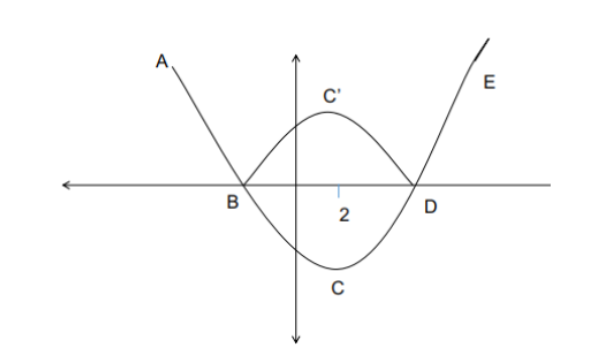
A horizontal line
with
meets this graph four times if
, three times if
(twice on the outer arms, once at the peak) and twice if
.
Algebraically,
gives
, which always has two roots, and
gives
, which has a single root only when
.
So only
gives exactly three roots. Options B and D (21 and 18) give only 2 roots, and option C (15) gives 4.
Hence, option A (17).