- CATin
- CAT past papers
- CAT 2021 Slot 1
- DILR
CAT 2021 Slot 1 — DILR questions with answers
All 20 questions of the Data Interpretation & Logical Reasoning section (15 MCQs, 5 TITA, 4 sets). Try each one, then open its answer and solution.
CAT 2021 Slot 1, timed like the real exam (120 minutes, 40 a section) and scored the CAT way: +3 right, −1 for a wrong MCQ, 0 for a wrong TITA, with the full post-mock analysis. Older official papers are in CATin Pro, with 80+ mocks and the full planner. The last three years of papers are free.
Sit this paper as a timed mock with CATin ProData Interpretation & Logical Reasoning
CAT 2021 Slot 1 · 40 minutes · +3 for a right answer, −1 for a wrong MCQ, 0 for a wrong TITA
Data set
Set for questions 25–30
Instructions [25 - 30 ]
A journal plans to publish 18 research papers, written by eight authors (A, B, C, D, E, F, G, and H) in four issues of the journal scheduled in January, April, July and October. Each of the research papers was written by exactly one of the eight authors. Five papers were scheduled in each of the first two issues, while four were scheduled in each of the last two issues. Every author wrote at least one paper and at most three papers. The total number of papers written by A, D, G and H was double the total number of papers written by the other four authors. Four of the authors were from India and two each were from Japan and China. Each author belonged to exactly one of the three areas — Manufacturing, Automation, and Logistics. Four of the authors were from the Logistics area and two were from the Automation area. As per the journal policy, none of the authors could have more than one paper in any issue of the journal.
The following facts are also known.
1. F, an Indian author from the Logistics area, wrote only one paper. It was scheduled in the October issue.
2. A was from the Automation area and did not have a paper scheduled in the October issue.
3. None of the Indian authors were from the Manufacturing area and none of the Japanese or Chinese authors were from the Automation area.
4. A and H were from different countries, but had their papers scheduled in exactly the same issues.
5. C and E, both Chinese authors from different areas, had the same number of papers scheduled. Further, E had papers scheduled in consecutive issues of the journal but C did not.
6. B, from the Logistics area, had a paper scheduled in the April issue of the journal.
7. B and G belonged to the same country. None of their papers were scheduled in the same issue of the journal.
8. D, a Japanese author from the Manufacturing area, did not have a paper scheduled in the July issue.
9. C and H belonged to different areas.
Q25MCQTeam Selection & Scheduling
What is the correct sequence of number of papers written by B, C, E and G, respectively?
- A1, 2, 2, 3
- B1, 3, 3, 1
- C3, 1, 1, 3
- D1, 2, 2, 1
Answer and solution
Answer: (A) 1, 2, 2, 3
A, D, G and H wrote twice as many papers as B, C, E and F, so they wrote
of the
papers and the other four wrote
. No author wrote more than
, so A, D, G and H wrote exactly
each.
F wrote
paper (fact 1), so
. E had papers in consecutive issues, so E wrote at least
, and C wrote the same number as E (fact 5).
would exceed 5, so
and
.
As a check, B's one paper is in April (fact 6) and G shares no issue with B (fact 7), so G's three papers are in January, July and October. The completed table:
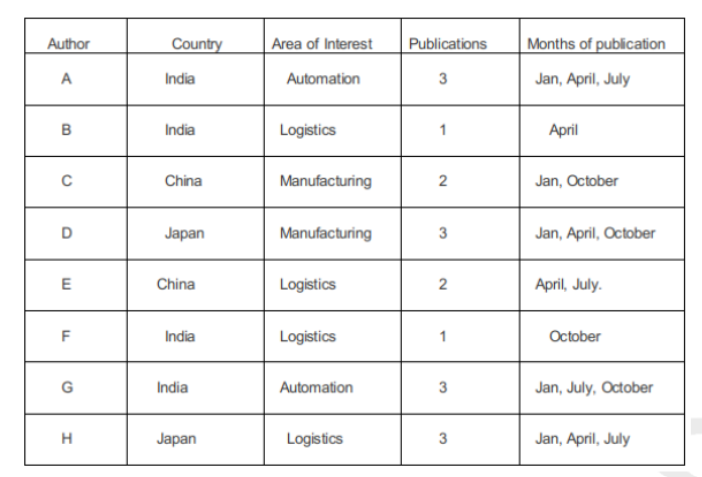
So B, C, E and G wrote
papers. Option D (1, 2, 2, 1) fails because G, like A, D and H, must have written 3 papers.
Hence, option A (1, 2, 2, 3).
Q26TITATeam Selection & Scheduling
How many papers were written by Indian authors?
Type in your answer (TITA). No negative mark for a wrong answer.
Answer and solution
Answer: 8
A, D, G and H wrote 12 of the 18 papers (twice the other four's 6), so 3 each. F wrote 1 and E at least 2 (consecutive issues), with
, so
and
.
A, in Automation, is Indian (fact 3). H is from another country and C, E are the Chinese, so H is Japanese like D, and B, G are Indian. As B and F are Logistics, G is the other Automation author. C and E, in different areas, are one Manufacturing and one Logistics, so H is Logistics; fact 9 makes C Manufacturing, E Logistics.
The completed table:
Indian authors are A (3), G (3), B (1) and F (1), so they wrote
papers.
The answer is 8.
Q27MCQTeam Selection & Scheduling
Which of the following statement(s) MUST be true?
Statement A: Every issue had at least one paper by author(s) from each country.
Statement B: Every issue had at most two papers by author(s) from each area.
- ABoth the statements
- BOnly Statement B
- COnly Statement A
- DNeither of the statements
Answer and solution
Answer: (C) Only Statement A
A, D, G and H wrote 12 of the 18 papers (twice the other four's 6), so 3 each. F wrote 1 and E at least 2 (consecutive issues), with
, so
and
.
A, in Automation, is Indian (fact 3). H is from another country and C, E are the Chinese, so H is Japanese like D, and B, G are Indian. As B and F are Logistics, G is the other Automation author. C and E, in different areas, are one Manufacturing and one Logistics, so H is Logistics; fact 9 makes C Manufacturing, E Logistics.
A and H have no October paper (facts 2, 4), D none in July and G none in B's April, so A and H take Jan, Apr, Jul; D Jan, Apr, Oct; G Jan, Jul, Oct. One slot is left per issue: E takes consecutive Apr, Jul and C non-consecutive Jan, Oct.
Statement A: every issue has an Indian (A or G), a Japanese (D or H) and a Chinese author (C or E), so it is true.
Statement B: April has three Logistics papers (H, B, E), so it is false, and option A fails.
Hence, option C (Only Statement A).
Q28MCQTeam Selection & Scheduling
Which of the following statements is FALSE?
- AEvery issue had at least one paper by author(s) from Automation area.
- BEvery issue had exactly one paper by a Chinese author.
- CEvery issue had exactly two papers by authors from Logistics area.
- DEvery issue had exactly two papers by Indian authors.
Answer and solution
Answer: (C) Every issue had exactly two papers by authors from Logistics area.
A, D, G and H wrote 12 of the 18 papers (twice the other four's 6), so 3 each. F wrote 1 and E at least 2 (consecutive issues), with
, so
and
.
A, in Automation, is Indian (fact 3). H is from another country and C, E are the Chinese, so H is Japanese like D, and B, G are Indian. As B and F are Logistics, G is the other Automation author. C and E, in different areas, are one Manufacturing and one Logistics, so H is Logistics; fact 9 makes C Manufacturing, E Logistics.
A and H have no October paper (facts 2, 4), D none in July and G none in B's April, so A and H take Jan, Apr, Jul; D Jan, Apr, Oct; G Jan, Jul, Oct. One slot is left per issue: E takes consecutive Apr, Jul and C non-consecutive Jan, Oct.
Each issue has A or G (Automation), C or E (Chinese) and two Indians, so A, B and D are true. January has one Logistics paper (H) and April three (H, B, E), so C is false.
Hence, option C (Every issue had exactly two papers by authors from Logistics area.).
Q29MCQTeam Selection & Scheduling
Which of the following statements is FALSE?
- AThere were exactly two papers by authors from Manufacturing area in the January issue.
- BThere was exactly one paper by an author from Manufacturing area in the April issue.
- CThere was exactly one paper by an author from Logistics area in the October issue.
- DThere were exactly two papers by authors from Manufacturing area in the July issue.
Answer and solution
Answer: (D) There were exactly two papers by authors from Manufacturing area in the July issue.
A, D, G and H wrote 12 of the 18 papers (twice the other four's 6), so 3 each. F wrote 1 and E at least 2 (consecutive issues), with
, so
and
.
A, in Automation, is Indian (fact 3). H is from another country and C, E are the Chinese, so H is Japanese like D, and B, G are Indian. As B and F are Logistics, G is the other Automation author. C and E, in different areas, are one Manufacturing and one Logistics, so H is Logistics; fact 9 makes C Manufacturing, E Logistics.
A and H have no October paper (facts 2, 4), D none in July and G none in B's April, so A and H take Jan, Apr, Jul; D Jan, Apr, Oct; G Jan, Jul, Oct. One slot is left per issue: E takes consecutive Apr, Jul and C non-consecutive Jan, Oct.
Manufacturing (D, C) has two January papers and one April paper, so A and B are true. F has October's only Logistics paper, so C is true. July (A, G, H, E) has no Manufacturing paper, so D is false.
Hence, option D (There were exactly two papers by authors from Manufacturing area in the July issue.).
Q30MCQTeam Selection & Scheduling
Which of the following is the correct sequence of number of papers by authors from Automation, Manufacturing and Logistics areas, respectively?
- A6, 5, 7
- B6, 6, 6
- C6, 7, 5
- D5, 6, 7
Answer and solution
Answer: (A) 6, 5, 7
A, D, G and H wrote 12 of the 18 papers (twice the other four's 6), so 3 each. F wrote 1 and E at least 2 (consecutive issues), with
, so
and
.
A, in Automation, is Indian (fact 3). H is from another country and C, E are the Chinese, so H is Japanese like D, and B, G are Indian. As B and F are Logistics, G is the other Automation author. C and E, in different areas, are one Manufacturing and one Logistics, so H is Logistics; fact 9 makes C Manufacturing, E Logistics.
The completed table:
Automation (A, G):
. Manufacturing (D, C):
. Logistics (H, E, B, F):
. Option D (5, 6, 7) swaps the first two counts.
Hence, option A (6, 5, 7).
Data set
Set for questions 31–34
Instructions [31 - 34 ]
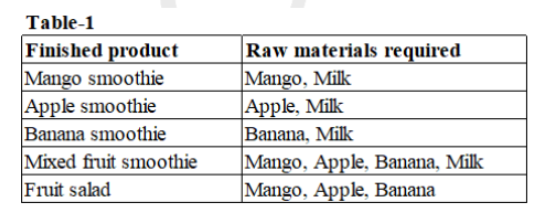
Ganga, Kaveri, and Narmada are three women who buy four raw materials (Mango, Apple, Banana and Milk) and sell five finished products (Mango smoothie, Apple smoothie, Banana smoothie, Mixed fruit smoothie and Fruit salad). Table-1 gives information about the raw materials required to produce the five finished products. One unit of a finished product requires one unit of each of the raw materials mentioned in the second column of the table.
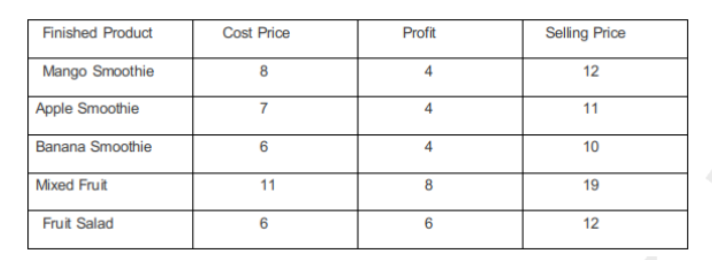
One unit of milk, mango, apple, and banana cost ₹5, ₹3, ₹2, and ₹1 respectively. Each unit of a finished product is sold for a profit equal to two times the number of raw materials used to make that product. For example, apple smoothie is made with two raw materials (apple and milk) and will be sold for a profit of ₹4 per unit. Leftover raw materials are sold during the last business hour of the day for a loss of ₹1 per unit.
The amount, in rupees, received from sales (revenue) for each woman in each of the four business hours of the day is given in Table-2.
The following additional facts are known.
1. No one except possibly Ganga sold any Mango smoothie.
2. Each woman sold either zero or one unit of any single finished product in any hour.
3. Each woman had exactly one unit each of two different raw materials as leftovers.
4. No one had any banana leftover.
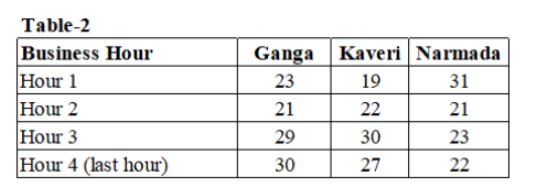
Q31MCQLogical Puzzles
What BEST can be concluded about the number of units of fruit salad sold in the first hour?
- AEither 1 or 2.
- BEither 0 or 1 or 2.
- CExactly 2.
- DExactly 1.
Answer and solution
Answer: (A) Either 1 or 2.
A price is the raw-material cost plus twice the number of raw materials: mango smoothie
, apple smoothie
, banana smoothie
, mixed fruit smoothie
, fruit salad
.
Leftovers are sold only in the last hour, so hour-1 revenue comes from products alone, at most one of each per woman (fact 2), with mango smoothies only from Ganga (fact 1).
Kaveri's 19 can only be one mixed fruit smoothie, so no fruit salad.
Narmada's 31 can only be
: a mixed fruit smoothie and a fruit salad.
Ganga's 23 can only be
: an apple smoothie plus a 12, which is a fruit salad or a mango smoothie. Nothing in the data decides which.
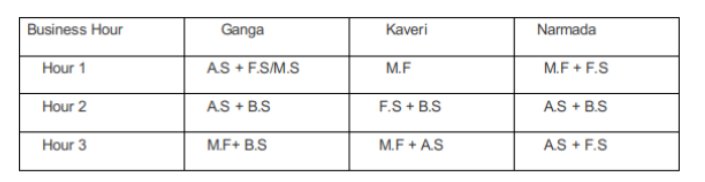
So 1 or 2 fruit salads were sold in hour 1. Option B, which allows 0, fails because Narmada's fruit salad is certain; options C and D each fix one value that the data leaves open.
Hence, option A (Either 1 or 2.).
Q32MCQLogical Puzzles
Which of the following is NECESSARILY true?
- AGanga did not sell any leftover mangoes.
- BGanga did not sell any leftover apples.
- CNarmada sold one unit of leftover milk.
- DKaveri sold one unit of leftover mangoes.
Answer and solution
Answer: (B) Ganga did not sell any leftover apples.
Prices (raw-material cost plus twice the number of raw materials): mango smoothie 12, apple smoothie 11, banana smoothie 10, mixed fruit smoothie 19, fruit salad 12. Leftovers sell at cost minus 1: milk 4, mango 2, apple 1, and no banana is left over. So two leftovers bring 6 (milk, mango), 5 (milk, apple) or 3 (mango, apple), all in hour 4.
Ganga's 30: products must make 24, 25 or 27. Only
works (mango smoothie and fruit salad), so her leftovers are milk and mango.
Kaveri's 27:
with milk and mango, or
with milk and apple. 24 would need a mango smoothie, which only Ganga sells.
Narmada's 22: 16 and 17 cannot be made, so it is
, with mango and apple left over.
Below are Kaveri's two cases (the first table is milk and mango left).
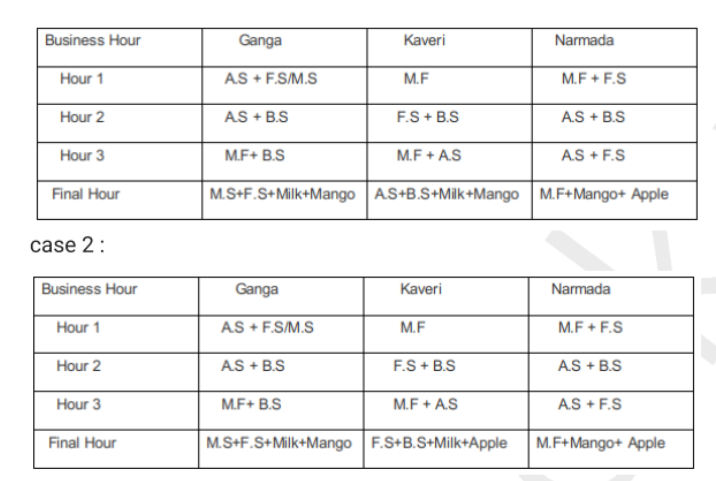
Ganga sold no leftover apple, so B must be true. A is false, as Ganga sold a leftover mango. C is false, as Narmada had no leftover milk. D holds only in Kaveri's first case, so it is not necessary.
Hence, option B (Ganga did not sell any leftover apples.).
Q33MCQLogical Puzzles
What BEST can be concluded about the total number of units of milk the three women had in the beginning?
- AEither 19 or 20 units.
- BEither 18 or 19 or 20 units.
- CEither 18 or 19 units.
- DEither 17 or 18 or 19 units.
Answer and solution
Answer: (B) Either 18 or 19 or 20 units.
Prices: mango smoothie 12, apple smoothie 11, banana smoothie 10, mixed fruit smoothie 19, fruit salad 12. Leftovers (hour 4): milk 4, mango 2, apple 1. Every product except fruit salad uses one unit of milk.
Ganga:
,
,
,
(mango smoothie, fruit salad, leftover milk and mango). Milk: 1 or 2 (her hour-1 12 may be a mango smoothie), then 2, 2, 1, plus 1 left over: 7 or 8.
Kaveri:
,
,
, and
(leftover milk, mango) or
(leftover milk, apple). Milk: 1, 1, 2, then 3 or 2: 7 or 6.
Narmada:
,
,
,
(leftover mango, apple). Milk: 1, 2, 1, 1: 5.
The total runs from
to
, with 19 also possible. Option A misses 18: Ganga's hour-1 fruit salad plus Kaveri's milk-and-apple case.
Hence, option B (Either 18 or 19 or 20 units.).
Q34TITALogical Puzzles
If it is known that three leftover units of mangoes were sold during the last business hour of the day, how many apple smoothies were sold during the day?
Type in your answer (TITA). No negative mark for a wrong answer.
Answer and solution
Answer: 6
Prices: apple smoothie 11, banana smoothie 10, fruit salad 12, mixed fruit smoothie 19, mango smoothie 12 (Ganga only). Leftovers sell at milk 4, mango 2, apple 1.
Last hour: Ganga's 30 is
, with leftover milk and mango. Narmada's 22 is
, with leftover mango and apple. Kaveri's 27 is either
(banana and apple smoothies; leftover milk and mango) or
(banana smoothie and fruit salad; leftover milk and apple).
Ganga and Narmada supply two leftover mangoes, so a third means Kaveri's first case: she sold an apple smoothie in hour 4. That is the first table below.
Apple smoothies, from the only possible splits: Ganga,
and
, so 2. Kaveri,
plus hour 4, so 2. Narmada,
and
, so 2.
In total,
apple smoothies were sold.
The answer is 6.
Data set
Set for questions 35–40
Instructions [35 - 40 ]
Amudha, Bharatan, Chandran, Dhinesh, Ezhil, Fani and Gowtham are seven people in a town. Any pair of them could either be strangers, acquaintances, or friends. All relationships are mutual. For example, if Amudha is a friend of Bharatan, then Bharatan is also a friend of Amudha. Similarly, if Amudha is a stranger to Bharatan, then Bharatan is also a stranger to Amudha.
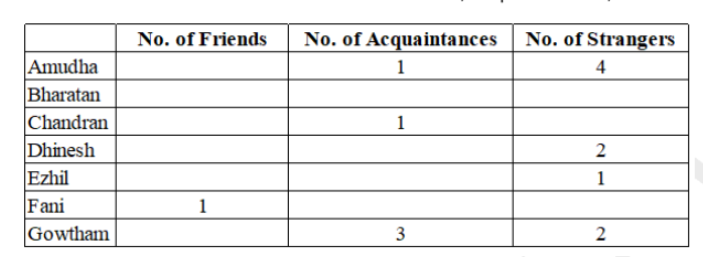
Partial information about the number of friends, acquaintances, and strangers of each of these people among them is given in the table below.
The following additional facts are also known.
1. Amudha, Bharatan, and Chandran are mutual strangers.
2. Amudha, Dhinesh, and Fani are Ezil's friends.
3. Chandran and Gowtham are friends.
4. Every friend of Amudha is an acquaintance of Bharatan, and every acquaintance of Bharatan is a friend of Amudha.
5. Every friend of Bharatan is an acquaintance of Amudha, and every acquaintance of Amudha is a friend of Bharatan.
Q35MCQLogical Puzzles
Who are Gowtham’s acquaintances?
- ADhinesh, Ezhil and Fani
- BAmudha, Dhinesh and Fani
- CBharatan, Dhinesh and Ezhil
- DAmudha, Bharatan and Fani
Answer and solution
Answer: (A) Dhinesh, Ezhil and Fani
From the table, Amudha has
friend and Gowtham
. By facts 2 and 3, Ezhil is the only friend of Amudha and of Fani, and Chandran is Gowtham's only friend.
Fact 4 makes Ezhil Bharatan's only acquaintance. Fact 5 makes Amudha's one acquaintance a friend of Bharatan. Bharatan and Chandran are strangers to Amudha (fact 1), so that acquaintance is Dhinesh, Fani or Gowtham. Fani and Gowtham already have their one friend, so it is Dhinesh, who is Bharatan's friend. Fani and Gowtham are then strangers to both Amudha and Bharatan.
Gowtham has 2 strangers, Amudha and Bharatan, and one friend, Chandran. His three acquaintances are the rest: Dhinesh, Ezhil and Fani.
The completed table:
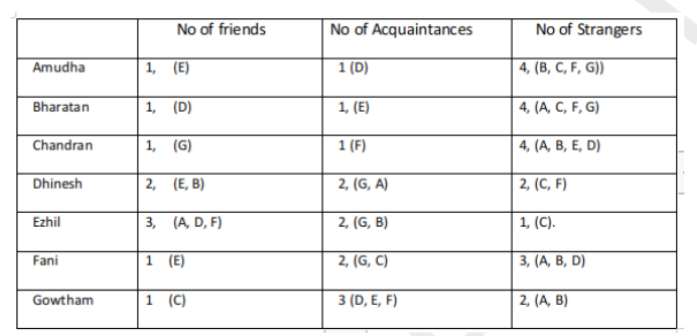
Options B, C and D each include Amudha or Bharatan, who are strangers to Gowtham.
Hence, option A (Dhinesh, Ezhil and Fani).
Q36MCQLogical Puzzles
Which of these pairs share the same type of relationship?
- A(Amudha, Gowtham) and (Ezhil, Fani)
- B(Bharatan, Chandran) and (Dhinesh, Ezhil)
- C(Chandran, Ezhil) and (Dhinesh, Gowtham)
- D(Bharatan, Ezhil) and (Fani, Gowtham)
Answer and solution
Answer: (D) (Bharatan, Ezhil) and (Fani, Gowtham)
From the table, Amudha has
friend and Gowtham
. By facts 2 and 3, Ezhil is the only friend of Amudha and of Fani, and Chandran is Gowtham's only friend.
Fact 4 makes Ezhil Bharatan's only acquaintance. Fact 5 makes Amudha's one acquaintance a friend of Bharatan. Bharatan and Chandran are strangers to Amudha (fact 1), so that acquaintance is Dhinesh, Fani or Gowtham. Fani and Gowtham already have their one friend, so it is Dhinesh, who is Bharatan's friend. Fani and Gowtham are then strangers to both Amudha and Bharatan.
With friend Chandran and strangers Amudha and Bharatan, Gowtham's acquaintances are Dhinesh, Ezhil and Fani. Ezhil has friends Amudha, Dhinesh, Fani and acquaintances Bharatan, Gowtham, so his one stranger is Chandran.
The completed table:
A: Amudha-Gowtham strangers, Ezhil-Fani friends. B: Bharatan-Chandran strangers, Dhinesh-Ezhil friends. C: Chandran-Ezhil strangers, Dhinesh-Gowtham acquaintances. D: Bharatan-Ezhil and Fani-Gowtham are both acquaintances.
Hence, option D ((Bharatan, Ezhil) and (Fani, Gowtham)).
Q37MCQLogical Puzzles
Who is an acquaintance of Amudha?
- ADhinesh
- BFani
- CGowtham
- DEzhil
Answer and solution
Answer: (A) Dhinesh
From the table, Amudha has
friend and Gowtham
. By facts 2 and 3, Ezhil is the only friend of Amudha and of Fani, and Chandran is Gowtham's only friend.
Fact 4 makes Ezhil Bharatan's only acquaintance. Fact 5 makes Amudha's one acquaintance a friend of Bharatan. Bharatan and Chandran are strangers to Amudha (fact 1), so that acquaintance is Dhinesh, Fani or Gowtham. Fani and Gowtham already have their one friend, so it is Dhinesh, who is Bharatan's friend. Fani and Gowtham are then strangers to both Amudha and Bharatan.
The completed table:
So Amudha's acquaintance is Dhinesh. Fani and Gowtham fail because either would have to be Bharatan's friend, and each already has their only friend. Ezhil is Amudha's friend, not an acquaintance.
Hence, option A (Dhinesh).
Q38MCQLogical Puzzles
Who is an acquaintance of Chandran?
- ADhinesh
- BFani
- CEzhil
- DBharatan
Answer and solution
Answer: (B) Fani
From the table, Amudha has
friend and Gowtham
. By facts 2 and 3, Ezhil is the only friend of Amudha and of Fani, and Chandran is Gowtham's only friend.
Fact 4 makes Ezhil Bharatan's only acquaintance. Fact 5 makes Amudha's one acquaintance a friend of Bharatan. Bharatan and Chandran are strangers to Amudha (fact 1), so that acquaintance is Dhinesh, Fani or Gowtham. Fani and Gowtham already have their one friend, so it is Dhinesh, who is Bharatan's friend. Fani and Gowtham are then strangers to both Amudha and Bharatan.
Gowtham, with friend Chandran and strangers Amudha and Bharatan, has acquaintances Dhinesh, Ezhil and Fani. Ezhil, with friends Amudha, Dhinesh, Fani and acquaintances Bharatan, Gowtham, has Chandran as his one stranger. Dhinesh has friends Ezhil, Bharatan and acquaintances Amudha, Gowtham, so his two strangers are Chandran and Fani.
The completed table:
Chandran is a stranger to Amudha, Bharatan, Dhinesh and Ezhil, and a friend of Gowtham, so his one acquaintance is Fani.
Hence, option B (Fani).
Q39TITALogical Puzzles
How many friends does Ezhil have?
Type in your answer (TITA). No negative mark for a wrong answer.
Answer and solution
Answer: 3
From the table, Amudha has
friend and Gowtham
. By facts 2 and 3, Ezhil is the only friend of Amudha and of Fani, and Chandran is Gowtham's only friend.
Fact 4 makes Ezhil Bharatan's only acquaintance. Fact 5 makes Amudha's one acquaintance a friend of Bharatan. Bharatan and Chandran are strangers to Amudha (fact 1), so that acquaintance is Dhinesh, Fani or Gowtham. Fani and Gowtham already have their one friend, so it is Dhinesh, who is Bharatan's friend. Fani and Gowtham are then strangers to both Amudha and Bharatan.
Ezhil is a friend of Amudha, Dhinesh and Fani (fact 2). Bharatan is his acquaintance (fact 4). Gowtham, whose friend is Chandran and whose strangers are Amudha and Bharatan, has Ezhil as an acquaintance. Ezhil has exactly one stranger, and only Chandran is left, so he has no other friend.
The completed table:
The answer is 3.
Q40TITALogical Puzzles
How many people are either a friend or a friend-of-a-friend of Ezhil?
Type in your answer (TITA). No negative mark for a wrong answer.
Answer and solution
Answer: 4
From the table, Amudha has
friend and Gowtham
. By facts 2 and 3, Ezhil is the only friend of Amudha and of Fani, and Chandran is Gowtham's only friend.
Fact 4 makes Ezhil Bharatan's only acquaintance. Fact 5 makes Amudha's one acquaintance a friend of Bharatan. Bharatan and Chandran are strangers to Amudha (fact 1), so that acquaintance is Dhinesh, Fani or Gowtham. Fani and Gowtham already have their one friend, so it is Dhinesh, who is Bharatan's friend. Fani and Gowtham are then strangers to both Amudha and Bharatan.
Gowtham, with friend Chandran and strangers Amudha and Bharatan, has acquaintances Dhinesh, Ezhil and Fani. So Ezhil has friends Amudha, Dhinesh, Fani, acquaintances Bharatan, Gowtham, and his one stranger is Chandran: no other friend.
Amudha and Fani have Ezhil as their only friend. Dhinesh has friends Ezhil and Bharatan, acquaintances Amudha and Gowtham, and strangers Chandran and Fani.
The completed table:
Friends or friends-of-friends of Ezhil: Amudha, Dhinesh, Fani and Bharatan.
The answer is 4.
Data set
Set for questions 41–44
Instructions [41 - 44 ]
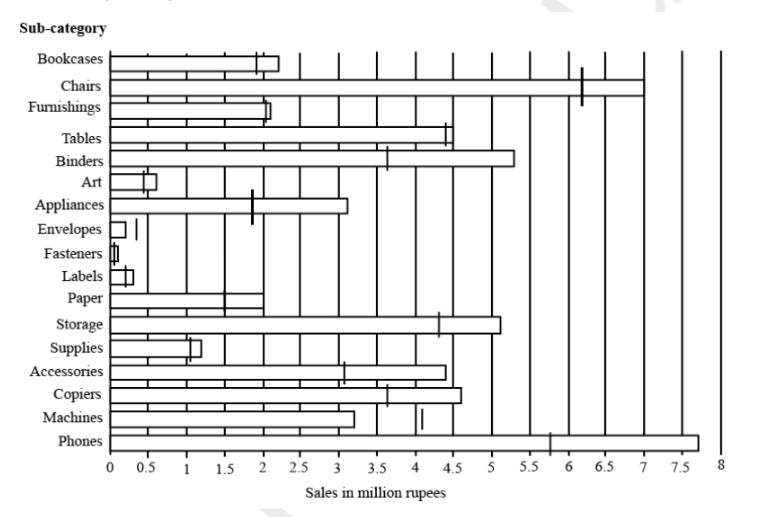
The horizontal bars in the above diagram represent 2020 aggregate sales (in ₹ million) of a company for the different subcategories of its products. The top four product subcategories (Bookcases, Chairs, Furnishings, Tables) belong to furniture product category; the bottom four product subcategories (Accessories, Copiers, Machines, Phones) belong to the technology product category while all other product subcategories belong to the office supply product category. For each of the product subcategories, there is a vertical line indicating the sales of the corresponding subcategory in 2019.
Q41MCQBar & Line Charts
The total sales (in ₹ million) in 2019 from products in office supplies category is closest to
- A18.0
- B16.5
- C13.5
- D12.5
Answer and solution
Answer: (C) 13.5
Office supplies are the nine subcategories between Tables and Accessories. Reading each 2019 vertical line from the chart (in ₹ million):
Binders 3.6, Art 0.45, Appliances 1.85, Envelopes 0.35, Fasteners 0.05, Labels 0.2, Paper 1.5, Storage 4.3, Supplies 1.05.
Total
, closest to 13.5.
Option A (18.0) is the trap: it is roughly the 2020 total, read from the bars instead of the lines (
). Option D (12.5) is almost a full million away.
Hence, option C (13.5).
Q42MCQBar & Line Charts
The percentage increase in sales in Furniture category from 2019 to 2020 is closest to
- A20%
- B8%
- C25%
- D1%
Answer and solution
Answer: (B) 8%
Furniture subcategories, 2019 (vertical line) and 2020 (bar), in ₹ million:
Bookcases 1.9 and 2.2; Chairs 6.2 and 7.0; Furnishings 2.05 and 2.1; Tables 4.4 and 4.5.
2019 total
.
2020 total
.
Percentage increase
, closest to 8%.
Options A and C (20% and 25%) would need a rise of about 3 million or more, but the rise is only 1.25 million. Option D (1%) would mean a rise of about 0.15 million, yet Chairs alone rose by about 0.8 million.
Hence, option B (8%).
Q43TITABar & Line Charts
How many subcategories had sales of ₹ 4 million or more in 2019 and registered an increase in sales in excess of 25% in 2020?
Type in your answer (TITA). No negative mark for a wrong answer.
Answer and solution
Answer: 1
From the chart, the subcategories with 2019 sales (vertical line) of ₹4 million or more are Chairs, Tables, Storage, Machines and Phones. An increase of more than 25% needs 2020 sales above 1.25 times the 2019 value.
Chairs: 6.2 to 7.0; needs more than 7.75. Fails.
Tables: 4.4 to 4.5; needs more than 5.5. Fails.
Storage: 4.3 to 5.1; needs more than about 5.4. Fails.
Machines: about 4.1 to 3.2, a fall. Fails.
Phones: about 5.75 to 7.7, a rise of
. Passes.
Only Phones meets both conditions.
The answer is 1.
Q44MCQBar & Line Charts
The improvement index for a category is the maximum percentage increase in sales from 2019 to 2020 among any of its subcategories. The correct order
of categories in increasing order of this improvement index is
- Afurniture, technology, office supply
- Btechnology, furniture, office supply
- Coffice supply, technology, furniture
- Doffice supply, furniture, technology
Answer and solution
Answer: (A) furniture, technology, office supply
A category's improvement index is the largest percentage rise among its subcategories. Reading 2019 (line) and 2020 (bar) values from the chart, in ₹ million:
Furniture: Bookcases 1.9 to 2.2 (
) is the best; Chairs rose about 13%, Furnishings and Tables under 3%. Index about 16%.
Technology: Accessories 3.1 to 4.4 (
) is the best; Phones rose about 34%, Copiers about 26%, and Machines fell. Index about 42%.
Office supply: Appliances 1.85 to 3.1 (
) alone beats the other two categories; Binders 3.6 to 5.3 is about 47%. Index at least 68%.
So the order is furniture, technology, office supply. Option B fails because furniture's best rise (about 16%) is well below technology's (about 42%).
Hence, option A (furniture, technology, office supply).