- CATin
- CAT past papers
- CAT 2020 Slot 3
- QA
CAT 2020 Slot 3 — QA questions with answers
All 26 questions of the Quantitative Ability section (18 MCQs, 8 TITA). Try each one, then open its answer and solution.
CAT 2020 Slot 3, timed like the real exam (120 minutes, 40 a section) and scored the CAT way: +3 right, −1 for a wrong MCQ, 0 for a wrong TITA, with the full post-mock analysis. Older official papers are in CATin Pro, with 80+ mocks and the full planner. The last three years of papers are free.
Sit this paper as a timed mock with CATin ProQuantitative Ability
CAT 2020 Slot 3 · 40 minutes · +3 for a right answer, −1 for a wrong MCQ, 0 for a wrong TITA
Q51MCQAverages, Mixtures & Alligations
Two alcohol solutions, A and B, are mixed in the proportion 1:3 by volume. The volume of the mixture is then doubled by adding solution A such that the
resulting mixture has 72% alcohol. If solution A has 60% alcohol, then the percentage of alcohol in solution B is
- A90%
- B94%
- C92%
- D89%
Answer and solution
Answer: (C) 92%
Let the volume of the initial mixture of A and B be . Since they are mixed in the proportion 1:3 by volume, the initial volume of A is and B is .
The volume of the mixture is doubled by adding solution A. So we add volume of solution A.
Total volume becomes .
Total volume of solution A in the mixture = .
Total volume of solution B in the mixture = .
Solution A has 60% alcohol.
Let solution B have alcohol.
Amount of alcohol in solution A =
Amount of alcohol in solution B =
The resulting mixture has 72% alcohol.
Total amount of alcohol =
Equating the total amount of alcohol:
Divide by :
So, the percentage of alcohol in solution B is 92%.
Hence, Option C is correct.
Q52MCQAverages, Mixtures & Alligations
A batsman played
innings and got out on all occasions. His average score in these
innings was 29 runs and he scored 38 and 15 runs in the last
two innings. The batsman scored less than 38 runs in each of the first
innings. In these
innings, his average score was 30 runs and lowest score was
runs. The smallest possible value of
is
- A4
- B3
- C2
- D1
Answer and solution
Answer: (C) 2
A batsman played innings and his average score was 29 runs.
Total score in innings = .
He scored 38 and 15 runs in the last two innings.
Total score in the first innings = .
We are given that in the first innings, his average score was 30 runs.
Total score in the first innings = .
Equating the two expressions for the total score in the first innings:
.
So, the batsman played innings initially, and his total score in these 5 innings was .
We are given that he scored less than 38 runs in each of the first innings.
This means his maximum possible score in any of these 5 innings is 37.
Let the lowest score in these 5 innings be .
To find the smallest possible value of , we must maximize the scores in the other 4 innings.
The maximum possible score for the other 4 innings is 37 each.
Sum of the scores in the 5 innings:
.
The smallest possible value of is 2.
Hence, Option C is correct.
Q53MCQQuadratic & Polynomial Equations
Let
and
be positive integers. If
and
have real roots, then the smallest possible value of
is
- A7
- B6
- C8
- D5
Answer and solution
Answer: (B) 6
Both equations have real roots only if their discriminants are not negative.
First equation:
, so
.
Second equation:
, so
.
If
, the second condition gives
, but the first needs
, that is
. So
, and then
gives
. Hence
.
The pair
,
works:
and
. So the smallest value is 6.
Option D (5) is impossible:
breaks
, and
already forces
.
Hence, option B (6).
Q54TITATime & Work
A contractor agreed to construct a 6 km road in 200 days. He employed 140 persons for the work. After 60 days, he realized that only 1.5 km road has been
completed. How many additional people would he need to employ in order to finish the work exactly on time?
Type in your answer (TITA). No negative mark for a wrong answer.
Answer and solution
Answer: 40
Total work to be done = 6 km of road.
Total time allowed = 200 days.
Initial workforce = 140 persons.
After 60 days, work completed = 1.5 km.
Work remaining = km.
Time remaining = days.
Let the work done by 1 person in 1 day be .
Work done by 140 persons in 60 days:
km.
.
Let the total number of persons required to finish the remaining work on time be .
Work done by persons in the remaining 140 days must be equal to 4.5 km.
Substitute the value of :
.
Total 180 persons are needed. Since 140 persons are already employed, the number of additional people required is:
.
Q55MCQSequences & Series
If
and
for every positive integer
, then
equals
- A-5050
- B-5151
- C-5051
- D-5150
Answer and solution
Answer: (A) -5050
We are given and for every positive integer .
We can rewrite the recurrence relation to find the next term:
.
Let's find the first few terms:
For : .
For : .
For : .
We can see a pattern:
By induction, the -th term is:
The sum of the first natural numbers is .
So, .
We need to find :
.
Hence, Option A is correct.
Q56MCQLogarithms
If
and
, then
equals
- A
- B
- C
- D
Answer and solution
Answer: (A)
Given:
--- (1)
--- (2)
From , we can deduce .
Using the properties of logarithms, we can expand equations (1) and (2):
(1)
Substitute :
--- (3)
(2) --- (4)
We have a system of two linear equations (3) and (4) with variables and .
We need to find the value of . Let's first find .
Subtract equation (4) from equation (3):
We need , which is the reciprocal of :
.
Hence, Option A is correct.
Q57TITALinear Equations
Dick is thrice as old as Tom and Harry is twice as old as Dick. If Dick's age is 1 year less than the average age of all three, then Harry's age, in years, is
Type in your answer (TITA). No negative mark for a wrong answer.
Answer and solution
Answer: 18
Let Tom's age be .
Dick is thrice as old as Tom, so Dick's age is .
Harry is twice as old as Dick, so Harry's age is .
The average age of all three is:
.
We are given that Dick's age is 1 year less than the average age:
Solve for :
Multiply by 3:
.
Tom's age is 3 years.
Dick's age is years.
Harry's age is years.
Hence, Harry's age is 18 years.
Q58MCQTime, Speed & Distance
Vimla starts for office every day at 9 am and reaches exactly on time if she drives at her usual speed of 40 km/hr. She is late by 6 minutes if she drives at 35
km/hr. One day, she covers two-thirds of her distance to office in one-third of her usual total time to reach office, and then stops for 8 minutes. The speed,
in km/hr, at which she should drive the remaining distance to reach office exactly on time is
- A29
- B26
- C28
- D27
Answer and solution
Answer: (C) 28
Let the total distance to the office be km.
Usual speed = 40 km/hr. Time taken at usual speed = hours.
If she drives at 35 km/hr, time taken = hours.
She is late by 6 minutes ( hours).
km.
Usual total time to reach the office = hours = minutes.
She covers two-thirds of her distance ( km) in one-third of her usual time ( minutes).
Then she stops for 8 minutes.
Total time spent so far = minutes.
Remaining time to reach exactly on time = minutes = hours.
Remaining distance = km.
Required speed for the remaining distance = km/hr.
Hence, Option C is the correct answer.
Q59MCQProperties of Numbers
Let
and
be natural numbers such that
is even and
. Then
equals
- A3
- B1
- C2
- D4
Answer and solution
Answer: (B) 1
From
:
. As
is an even natural number,
.
From
:
.
From
with
:
. Taking reciprocals reverses the inequalities, so
, i.e.
.
Both ranges for
hold only for
. Check:
,
and
all lie strictly between 0.2 and 0.5.
So
.
Option C (2) would need
, but then
, which is not strictly less than 0.5.
Hence, option B (1).
Q60TITAPermutations & Combinations
How many integers in the set {100, 101, 102, ..., 999} have at least one digit repeated?
Type in your answer (TITA). No negative mark for a wrong answer.
Answer and solution
Answer: 252
The set contains all the 3-digit numbers.
Total number of integers in the set = .
We want to find the number of integers that have at least one digit repeated.
This is equal to (Total number of 3-digit numbers) - (Number of 3-digit numbers with all distinct digits).
Let's calculate the number of 3-digit numbers with all distinct digits.
The first digit (hundreds place) can be any digit from 1 to 9 (9 choices, as it cannot be 0).
The second digit (tens place) can be any digit from 0 to 9 except the digit chosen for the hundreds place (9 choices).
The third digit (units place) can be any digit from 0 to 9 except the two digits already chosen (8 choices).
Total 3-digit numbers with distinct digits = .
Number of integers with at least one digit repeated = .
Q61MCQPercentages
In the final examination, Bishnu scored 52% and Asha scored 64%. The marks obtained by Bishnu is 23 less, and that by Asha is 34 more than the marks
obtained by Ramesh. The marks obtained by Geeta, who scored 84%, is
- A357
- B417
- C439
- D399
Answer and solution
Answer: (D) 399
Let the total maximum marks in the examination be .
Marks obtained by Bishnu = of .
Marks obtained by Asha = of .
Let the marks obtained by Ramesh be .
We are given two conditions about Ramesh's marks:
1. Bishnu's marks is 23 less than Ramesh's marks: .
2. Asha's marks is 34 more than Ramesh's marks: .
Equating the two expressions for :
.
The total marks is 475.
We need to find the marks obtained by Geeta, who scored 84%.
Marks of Geeta = of .
Hence, Option D is the correct answer.
Q62TITALogarithms
If
are non-zero and
, then
is equal to
Type in your answer (TITA). No negative mark for a wrong answer.
Answer and solution
Answer: 3
Let .
Taking log on all sides, or converting to exponential form:
We know that .
Since , we have .
So, can be written in terms of as:
Equating the powers of (since are non-zero, ):
We need to find the value of .
Substitute :
.
The value is 3.
Q63TITASimple & Compound Interest
A person invested a certain amount of money at 10% annual interest, compounded half-yearly. After one and a half years, the interest and principal together
became Rs.18522. The amount, in rupees, that the person had invested is
Type in your answer (TITA). No negative mark for a wrong answer.
Answer and solution
Answer: 16000
Let the principal amount invested be .
Annual rate of interest, .
Since it is compounded half-yearly, the rate per half-year is .
Time period = years.
Number of half-yearly cycles, .
The formula for amount with compound interest is:
Given the amount (principal + interest) is Rs 18522:
Notice that .
.
The amount invested is Rs 16000.
Q64MCQProfit, Loss & Discount
A man buys 35 kg of sugar and sets a marked price in order to make a 20% profit. He sells 5 kg at this price, and 15 kg at a 10% discount. Accidentally, 3 kg
of sugar is wasted. He sells the remaining sugar by raising the marked price by p percent so as to make an overall profit of 15%. Then p is nearest to
- A22
- B35
- C25
- D31
Answer and solution
Answer: (C) 25
Let the cost price (CP) of 1 kg of sugar be Rs 100.
Total CP for 35 kg of sugar = .
He sets a marked price to make a 20% profit.
Marked Price (MP) per kg = .
He sells 5 kg at this marked price:
Revenue from first 5 kg = .
He sells 15 kg at a 10% discount on the marked price.
Selling Price per kg = .
Revenue from next 15 kg = .
3 kg of sugar is wasted. So it generates Rs 0 revenue.
Total sugar accounted for = kg.
Remaining sugar = kg.
He wants to make an overall profit of 15% on his total investment.
Overall target Revenue = Total CP .
Revenue already generated = .
Required revenue from the remaining 12 kg = .
New Selling Price per kg for the remaining 12 kg = .
He raised the original marked price (Rs 120) by .
.
This is nearest to 25%.
Hence, Option C is correct.
Q65MCQCoordinate Geometry
The points (2,1) and (-3,-4) are opposite vertices of a parallelogram.If the other two vertices lie on the line x+9y+c=0, then c is
- A12
- B13
- C15
- D14
Answer and solution
Answer: (D) 14
Let the given opposite vertices of the parallelogram be and .
In a parallelogram, the diagonals bisect each other. Therefore, the midpoint of the diagonal is the same as the midpoint of the diagonal (where and are the other two vertices).
Midpoint of
.
We are given that the other two vertices and lie on the line .
Since both and lie on this line, the entire diagonal lies on this line.
Therefore, the midpoint of must also lie on this line.
Substitute the coordinates of the midpoint into the line equation:
.
Hence, Option D is the correct answer.
Q66MCQTime, Speed & Distance
A and B are two railway stations 90 km apart. A train leaves A at 9:00 am, heading towards B at a speed of 40 km/hr. Another train leaves B at 10:30 am,
heading towards A at a speed of 20 km/hr. The trains meet each other at
- A11 : 45 am
- B11 : 20 am
- C11 : 00 am
- D10 : 45 am
Answer and solution
Answer: (C) 11 : 00 am
Distance between stations A and B is 90 km.
Train 1 leaves A at 9:00 am at a speed of 40 km/hr.
Train 2 leaves B at 10:30 am at a speed of 20 km/hr.
By 10:30 am, Train 1 has been travelling for 1.5 hours (from 9:00 am to 10:30 am).
Distance travelled by Train 1 in this 1.5 hours = km.
At 10:30 am, the remaining distance between the two trains is km.
Now, both trains are moving towards each other.
Relative speed = Speed of Train 1 + Speed of Train 2 = km/hr.
Time taken to meet after 10:30 am = hours = 30 minutes.
So, they will meet 30 minutes after 10:30 am, which is at 11:00 am.
Hence, Option C is the correct answer.
Q67TITAInequalities & Modulus
Let
and
be positive integers such that
and
. If
, then how many distinct values are possible for
?
Type in your answer (TITA). No negative mark for a wrong answer.
Answer and solution
Answer: 6
We are given , where and are positive integers.
The conditions are and .
This means can take integer values from 3 to 9 (inclusive): .
And can take integer values from 15 to 22 (inclusive): .
We are also given . Let's find the possible distinct values of .
subject to is 26.
Let's check if 26 is possible: . To get 26, we could have . (Possible).
Let's find the maximum possible value of :
.
Let's check if all integer values from 26 to 31 are possible:
If : (valid)
If : (valid)
If : (valid)
If : (valid)
If : (valid)
If : (valid)
The possible distinct values for are 26, 27, 28, 29, 30, and 31.
There are 6 distinct values.
Q68MCQLinear Equations
Let
be a constant. The equations
and
have a unique solution if and only if
- A
- B
- C
- D
Answer and solution
Answer: (A)
We have a system of two linear equations:
A system of linear equations and has a unique solution if and only if the lines are intersecting, meaning their slopes are not equal.
The condition for a unique solution is:
Applying this condition to our equations:
Cross-multiplying gives:
This can be written as .
Hence, Option A is correct.
Q69MCQSet Theory
How many of the integers 1, 2, … , 120, are divisible by none of 2, 5 and 7?
- A42
- B41
- C40
- D43
Answer and solution
Answer: (B) 41
We need to find the number of integers from 1 to 120 that are not divisible by 2, 5, or 7.
Let be the set of integers from 1 to 120. .
Let be the set of integers divisible by 2. .
Let be the set of integers divisible by 5. .
Let be the set of integers divisible by 7. .
Now find the intersections:
= multiples of 10 = .
= multiples of 35 = .
= multiples of 14 = .
= multiples of 70 = .
Using the Principle of Inclusion-Exclusion, the number of integers divisible by at least one of 2, 5, or 7 is:
.
The number of integers divisible by none of them is:
.
Hence, Option B is correct.
Q70MCQProperties of Numbers
How many pairs
of positive integers are there such that
and
?
- A2018
- B2019
- C2017
- D2020
Answer and solution
Answer: (A) 2018
Since
, every divisor is
with
, so there are 4035 divisors.
Each pair is
,
, and
means
. So
can be
, which gives 2018 pairs, including
.
Put another way, the 4034 divisors other than
form
pairs with
, and the pair
makes 2018.
Option C (2017) is the count if the pair with
is left out.
Hence, option A (2018).
Q71MCQTime, Speed & Distance
Anil, Sunil, and Ravi run along a circular path of length 3 km, starting from the same point at the same time, and going in the clockwise direction. If they run
at speeds of 15 km/hr, 10 km/hr, and 8 km/hr, respectively, how much distance in km will Ravi have run when Anil and Sunil meet again for the first time at
the starting point?
- A4.8
- B4.6
- C5.2
- D4.2
Answer and solution
Answer: (A) 4.8
The length of the circular track is km.
Speeds are: km/hr, km/hr, km/hr.
They are all running in the same direction.
Time taken by Anil to complete one round hours.
Time taken by Sunil to complete one round hours.
Time taken by Ravi to complete one round hours.
We need to find the time when Anil and Sunil meet again for the first time at the starting point.
This time is the LCM of their individual times to complete one round.
hours.
So Anil and Sunil meet for the first time at the starting point after hours.
In this time, the distance run by Ravi is:
km.
Hence, Option A is correct.
Q72TITAPolygons & Circles
In a trapezium ABCD, AB is parallel to DC, BC is perpendicular to DC and
. If DC = 5cm, BC = 4cm, the area of the trapezium in sq cm is
Type in your answer (TITA). No negative mark for a wrong answer.
Answer and solution
Answer: 28
BC is perpendicular to DC, and so also to AB (as
). So the height of the trapezium is
cm.
Drop a perpendicular from D to AB, meeting it at E.
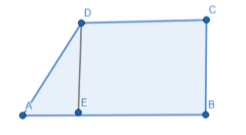
DEBC is a rectangle, so
cm and
cm.
In the right triangle ADE,
, so the triangle is isosceles and
cm.
Hence
cm.
Area
sq cm.
The answer is 28.
Q73MCQCoordinate Geometry
The area, in sq. units, enclosed by the lines
, the X-axis and the Y-axis is equal to
- A10
- B6
- C8
- D12
Answer and solution
Answer: (A) 10
The region lies between the Y-axis (
) and the line
, above the X-axis and below
.
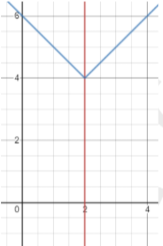
For
,
, so
and the upper boundary is the straight line
.
So the region is a trapezium with parallel vertical sides at
(height
) and
(height
), a distance
apart.
Area
sq. units.
Option C (8) is only the
rectangle below
; it leaves out the triangle of area
above it.
Hence, option A (10).
Q74MCQFunctions & Graphs
If
f(x)
and
, then
is equal to
- A14.0625
- B0
- C15.9375
- D3
Answer and solution
Answer: (C) 15.9375
Use the rule
directly.
Put
,
:
. Since
,
.
Put
:
.
Put
,
:
, so
.
Therefore
.
Option B (0) would need
, but their product must be
.
Hence, option C (15.9375).
Q75TITALogarithms
equals
Type in your answer (TITA). No negative mark for a wrong answer.
Answer and solution
Answer: 24
Numerator: .
The logarithms: , , .
Denominator: .
So the expression is .
Q76MCQCoordinate Geometry
The vertices of a triangle are (0,0), (4,0) and (3,9). The area of the circle passing through these three points is
- A
- B
- C
- D
Answer and solution
Answer: (D)
The vertices of the triangle are , and .
We need to find the area of the circumcircle of this triangle. The circumcircle passes through , and .
Let the equation of the circle be .
Since it passes through , substituting gives .
Since it passes through , substitute :
.
Since it passes through , substitute , , and :
.
The radius of the circle is given by :
.
The area of the circle is :
.
Hence, Option D is correct.