- CATin
- CAT past papers
- CAT 2020 Slot 3
- DILR
CAT 2020 Slot 3 — DILR questions with answers
All 24 questions of the Data Interpretation & Logical Reasoning section (18 MCQs, 6 TITA, 5 sets). Try each one, then open its answer and solution.
CAT 2020 Slot 3, timed like the real exam (120 minutes, 40 a section) and scored the CAT way: +3 right, −1 for a wrong MCQ, 0 for a wrong TITA, with the full post-mock analysis. Older official papers are in CATin Pro, with 80+ mocks and the full planner. The last three years of papers are free.
Sit this paper as a timed mock with CATin ProData Interpretation & Logical Reasoning
CAT 2020 Slot 3 · 40 minutes · +3 for a right answer, −1 for a wrong MCQ, 0 for a wrong TITA
Data set
Set for questions 27–30
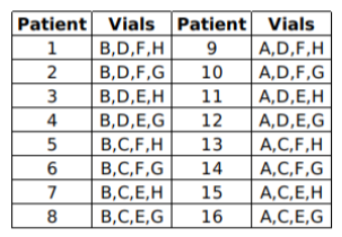
Sixteen patients in a hospital must undergo a blood test for a disease. It is known that exactly one of them has the disease. The hospital has only eight testing kits and has decided to pool blood samples of patients into eight vials for the tests. The patients are numbered 1 through 16, and the vials are labelled A, B, C, D, E, F, G, and H. The following table shows the vials into which each patient’s blood sample is distributed.
If a patient has the disease, then each vial containing his/her blood sample will test positive. If a vial tests positive, one of the patients whose blood samples were mixed in the vial has the disease. If a vial tests negative, then none of the patients whose blood samples were mixed in the vial has the disease.
Q27MCQLogical Puzzles
Suppose vial C tests positive and vials A, E and H test negative. Which patient has the disease?
- APatient 14
- BPatient 8
- CPatient 6
- DPatient 2
Answer and solution
Answer: (C) Patient 6
From the table, every patient's sample goes into exactly one vial of each pair: A or B, C or D, E or F, and G or H.
Vial A is negative, so the patient is in B. Vial E is negative, so the patient is in F. Vial H is negative, so the patient is in G. Vial C is positive, so the patient is in C.
The only patient whose vials are B, C, F and G is patient 6.
The other options fail. Patient 14 (A, C, F, G) is in vial A, which tested negative. Patient 8 (B, C, E, G) is in vial E, which tested negative. Patient 2 (B, D, F, G) is not in vial C, so patient 2 could not make vial C test positive.
Hence, option C (Patient 6).
Q28MCQLogical Puzzles
Suppose vial A tests positive and vials D and G test negative. Which of the following vials should we test next to identify the patient with the disease?
- AVial B
- BVial E
- CVial C
- DVial H
Answer and solution
Answer: (B) Vial E
Each patient is in exactly one vial of each pair: A or B, C or D, E or F, and G or H.
Vial A is positive, so the patient is in A. Vial D is negative, so the patient is in C. Vial G is negative, so the patient is in H. The patients in A, C and H are patient 13 (A, C, F, H) and patient 15 (A, C, E, H).
The next test must tell these two apart, so it needs a vial that holds exactly one of them. Vial E holds patient 15 but not patient 13. If E is positive, patient 15 has the disease; if it is negative, patient 13 does.
The other options cannot separate them. Vial B holds neither patient, so it tests negative either way. Vials C and H hold both, so each tests positive either way.
Hence, option B (Vial E).
Q29MCQLogical Puzzles
Which of the following combinations of test results is NOT possible?
- AVials A and E positive, vials C and D negative
- BVial B positive, vials C, F and H negative
- CVials A and G positive, vials D and E negative
- DVials B and D positive, vials F and H negative
Answer and solution
Answer: (A) Vials A and E positive, vials C and D negative
Exactly one patient has the disease, and every patient's sample is in exactly one of vials C and D. From the table, patients 1 to 4 and 9 to 12 are in D, and patients 5 to 8 and 13 to 16 are in C.
In option A, both C and D test negative. Then no patient can have the disease, which is impossible. So this combination cannot occur.
Each of the other combinations fits a patient:
Option B: B positive and C, F, H negative puts the patient in B, D, E, G, which is patient 4.
Option C: A, G positive and D, E negative puts the patient in A, C, F, G, which is patient 14.
Option D: B, D positive and F, H negative puts the patient in B, D, E, G, which is again patient 4.
Hence, option A (Vials A and E positive, vials C and D negative).
Q30MCQLogical Puzzles
Suppose one of the lab assistants accidentally mixed two patients' blood samples before they were distributed to the vials. Which of the following correctly
represents the set of all possible numbers of positive test results out of the eight vials?
- A{5,6,7,8}
- B{4,5,6,7}
- C{4,5,6,7,8}
- D{4,5}
Answer and solution
Answer: (C) {4,5,6,7,8}
Each patient's sample goes into 4 vials, one from each pair (A/B, C/D, E/F, G/H). If two patients' samples are mixed first, the mixture goes into the vials of both patients.
If the patient with the disease is not one of the mixed pair, only that patient's own 4 vials test positive.
If the patient with the disease is one of the pair, every vial of both patients tests positive. The two patients share the vials in pairs where they agree, so the count is 4 plus the number of pairs where they differ, which can be 1, 2, 3 or 4. All four occur: patients 1 (B,D,F,H) and 9 (A,D,F,H) differ in one pair, giving 5; patients 1 and 7 (B,C,E,H) differ in two, giving 6; patients 2 (B,D,F,G) and 16 (A,C,E,G) differ in three, giving 7; patients 1 and 16 differ in all four, giving 8.
So the possible counts are 4, 5, 6, 7 and 8. Option A misses the case where the mix does not involve the patient with the disease.
Hence, option C ({4,5,6,7,8}).
Data set
Set for questions 31–34
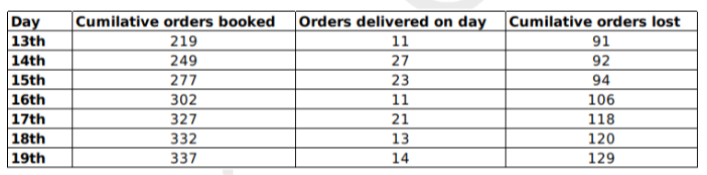
XYZ organization got into the business of delivering groceries to home at the beginning of the last month. They have a two-day delivery promise. However, their deliveries are unreliable. An order booked on a particular day may be delivered the next day or the day after. If the order is not delivered at the end of two days, then the order is declared as lost at the end of the second day. XYZ then does not deliver the order, but informs the customer, marks the order as lost, returns the payment and pays a penalty for non-delivery. The following table provides details about the operations of XYZ for a week of the last month. The first column gives the date, the second gives the cumulative number of orders that were booked up to and including that day. The third column represents the number of orders delivered on that day. The last column gives the cumulative number of orders that were lost up to and including that day. It is known that the numbers of orders that were booked on the 11th, 12th, and 13th of the last month that took two days to deliver were 4, 6, and 8 respectively
Q31MCQTables & Caselets
Among the following days, the largest fraction of orders booked on which day was lost?
- A15th
- B16th
- C13th
- D14th
Answer and solution
Answer: (A) 15th
Orders booked on a day are the rise in cumulative bookings. An order booked on day
that is not delivered is declared lost at the end of day
, so it appears in the rise in cumulative lost on day
.
14th: booked
, lost
.
15th: booked
, lost
.
16th: booked
, lost
.
13th: lost
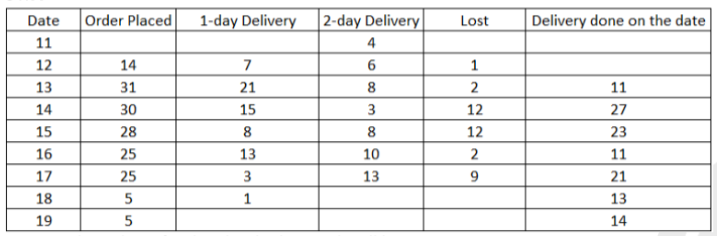
. The table has no 12th row, so find the 13th's bookings from deliveries. The 27 orders delivered on the 14th are the 13th's next-day orders plus the 12th's 6 two-day orders, so 21 of the 13th's orders came the next day. With 8 two-day orders and 2 lost, the 13th had
bookings.
Fractions lost: 13th
; 14th
; 15th
; 16th
.
The 14th is the close runner-up. Both days lost 12 orders, but the 14th had more bookings (30 against 28), so its fraction is smaller.
Hence, option A (15th).
Q32MCQTables & Caselets
On which of the following days was the number of orders booked the highest?
- A12th
- B15th
- C13th
- D14th
Answer and solution
Answer: (C) 13th
The 14th and 15th come straight from the cumulative column:
and
. There is no row before the 13th, so count the 12th's and 13th's bookings as next-day deliveries plus two-day deliveries plus lost orders.
An order booked on day
that is not delivered is lost at the end of day
. So the 12th lost
order (the rise on the 14th), and the 13th lost
(the rise on the 15th).
Deliveries on a day are the previous day's next-day orders plus the two-day orders from two days earlier. The two-day orders of the 11th, 12th and 13th were 4, 6 and 8.
On the 13th, 11 orders were delivered, so the 12th had
next-day orders. On the 14th, 27 were delivered, so the 13th had
.
Bookings: 12th
; 13th
.
So the counts are 14 (12th), 31 (13th), 30 (14th) and 28 (15th). The 14th is closest, one short of the 13th.
Hence, option C (13th).
Q33MCQTables & Caselets
The delivery ratio for a given day is defined as the ratio of the number of orders booked on that day which are delivered on the next day to the number of
orders booked on that day which are delivered on the second day after booking. On which of the following days, was the delivery ratio the highest?
- A15th
- B16th
- C13th
- D14th
Answer and solution
Answer: (D) 14th
Deliveries on a day are the previous day's next-day orders plus the two-day orders from two days earlier. Each day's bookings split into next-day, two-day and lost orders. An order booked on day
that is lost appears in the rise in cumulative lost on day
.
From the table, the 14th, 15th and 16th had 30, 28 and 25 bookings, and lost 12, 12 and 2 orders (
,
,
). Two-day orders for the 12th and 13th are given as 6 and 8.
13th: next-day
(delivered on the 14th), two-day
. Ratio
.
14th: next-day
, two-day
. Ratio
.
15th: next-day
, two-day
. Ratio
.
16th: next-day
, two-day
. Ratio
.
The 13th has the next-highest ratio, but 2.6 is well below the 14th's 5.
Hence, option D (14th).
Q34MCQTables & Caselets
The average time taken to deliver orders booked on a particular day is computed as follows. Let the number of orders delivered the next day be x and the
number of orders delivered the day after be y. Then the average time to deliver order is
. On which of the following days was the average time taken to deliver orders booked the least?
- A15th
- B13th
- C14th
- D16th
Answer and solution
Answer: (C) 14th
First find, for each booking day,
(orders delivered the next day) and
(orders delivered the day after). Deliveries on a day are the previous day's next-day orders plus the two-day orders from two days earlier. Bookings split into
,
and lost orders, and orders booked on day
that are lost appear in the rise in cumulative lost on day
.
13th:
(delivered on the 14th, less the 12th's 6 two-day orders),
(given).
14th:
. It had 30 bookings and lost 12, so
.
15th:
. It had 28 bookings and lost 12, so
.
16th:
. It had 25 bookings and lost 2, so
.
Average time
:
13th
; 14th
; 15th
; 16th
.
The 13th is the runner-up at 1.28. The 14th is lower because only 3 of its 18 delivered orders took two days.
Hence, option C (14th).
Data set
Set for questions 35–40
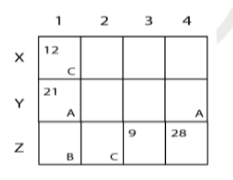
A farmer had a rectangular land containing 205 trees. He distributed that land among his four daughters - Abha, Bina, Chitra and Dipti by dividing the land into twelve plots along three rows (X,Y,Z) and four Columns (1,2,3,4) as shown in the figure below:
The plots in rows X, Y, Z contained mango, teak and pine trees respectively. Each plot had trees in non-zero multiples of 3 or 4 and none of the plots had the same number of trees. Each daughter got an even number of plots. In the figure, the number mentioned in top left corner of a plot is the number of trees in that plot, while the letter in the bottom right corner is the first letter of the name of the daughter who got that plot (For example, Abha got the plot in row Y and column 1 containing 21 trees). Some information in the figure got erased, but the following is known:
1. Abha got 20 trees more than Chitra but 6 trees less than Dipti.
2. The largest number of trees in a plot was 32, but it was not with Abha.
3. The number of teak trees in Column 3 was double of that in Column 2 but was half of that in Column 4.
4. Both Abha and Bina got a higher number of plots than Dipti.
5. Only Bina, Chitra and Dipti got corner plots.
6. Dipti got two adjoining plots in the same row.
7. Bina was the only one who got a plot in each row and each column.
8. Chitra and Dipti did not get plots which were adjacent to each other (either in row / column / diagonal).
9. The number of mango trees was double the number of teak trees.
Q35MCQMissing Value Tables
How many mango trees were there in total?
- A49
- B84
- C98
- D126
Answer and solution
Answer: (C) 98
Row Y holds the teak trees. By clue 3, if Y2 has
trees then Y3 has
and Y4 has
. With Y1
, teak
.
By clue 9, mango
.
The total is 205, so pine
.
Row Z already has 9 and 28, and each of its other two plots needs at least 3 trees, since every plot holds a non-zero multiple of 3 or 4. So
, which gives
.
itself must be a multiple of 3 or 4, so
or
. With
, Y4 would hold 12, the same as X1, but no two plots have the same number of trees. So
.
Teak
, mango
and pine
(check:
).
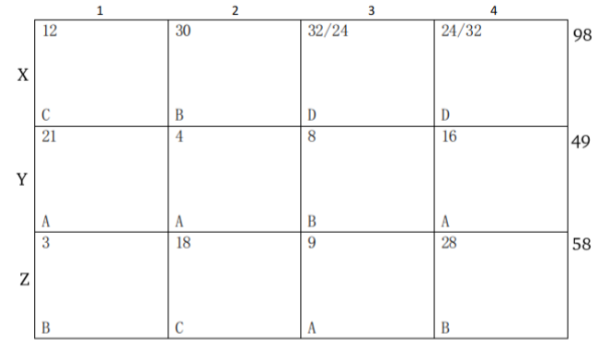
Option A (49) is the number of teak trees, not mango trees.
Hence, option C (98).
Q36MCQMissing Value Tables
Which of the following is the correct sequence of trees received by Abha, Bina, Chitra and Dipti in that order?
- A50, 69, 30, 56
- B54, 57, 34, 60
- C44, 87, 24, 50
- D60, 39, 40, 66
Answer and solution
Answer: (A) 50, 69, 30, 56
Plot counts are even, Dipti has at least 2 (clue 6), Chitra at least 2 (X1, Z2), and Abha and Bina each have more than Dipti. So Abha, Bina, Chitra and Dipti have 4, 4, 2 and 2 of the 12 plots, and Chitra has only X1 and Z2. Dipti's two plots adjoin in one row without touching X1 or Z2, so they are X3 and X4. Corner Z4 is not Abha's (clue 5), so it is Bina's. Bina also needs a plot in row X (X2) and one in column 3 (Y3). Abha has Y1, Y2, Y4 and Z3.
By clue 3, Y2, Y3 and Y4 hold
,
and
, so teak
, mango
(clue 9) and pine
. Row Z holds
plus at least 3 in each other plot, so
. Since
is a multiple of 3 or 4, and
would repeat 12 (Y4 and X1),
.
Abha
. By clue 1, Chitra
and Dipti
. Bina
.
Every option satisfies clue 1 and adds to 205, so the deciding figure is Abha's 50, which only option A has.
Hence, option A (50, 69, 30, 56).
Q37MCQMissing Value Tables
How many pine trees did Chitra receive?
- A18
- B30
- C21
- D15
Answer and solution
Answer: (A) 18
Plot counts are even, Dipti has at least 2 (clue 6), Chitra at least 2 (X1, Z2), and Abha and Bina each have more than Dipti. So Abha, Bina, Chitra and Dipti have 4, 4, 2 and 2 of the 12 plots, and Chitra has only X1 and Z2. Dipti's two plots adjoin in one row without touching X1 or Z2, so they are X3 and X4. Corner Z4 is not Abha's (clue 5), so it is Bina's. Bina also needs a plot in row X (X2) and one in column 3 (Y3). Abha has Y1, Y2, Y4 and Z3.
By clue 3, Y2, Y3 and Y4 hold
,
and
, so teak
, mango
(clue 9) and pine
. Row Z holds
plus at least 3 in each other plot, so
. Since
is a multiple of 3 or 4, and
would repeat 12 (Y4 and X1),
.
Abha
, so by clue 1 Chitra has
trees. Chitra's plots are X1 (12 mango) and Z2, her only pine plot, which holds
.
Option B (30) is Chitra's total, not her pine trees.
Hence, option A (18).
Q38MCQMissing Value Tables
Who got the plot with the smallest number of trees and how many trees did that plot have?
- ADipti, 6 trees
- BBina, 3 trees
- CBina, 4 trees
- DAbha, 4 trees
Answer and solution
Answer: (B) Bina, 3 trees
Plot counts are even, Dipti has at least 2 (clue 6), Chitra at least 2 (X1, Z2), and Abha and Bina each have more than Dipti. So Abha, Bina, Chitra and Dipti have 4, 4, 2 and 2 of the 12 plots, and Chitra has only X1 and Z2. Dipti's two plots adjoin in one row without touching X1 or Z2, so they are X3 and X4. Corner Z4 is not Abha's (clue 5), so it is Bina's. Bina also needs a plot in row X (X2) and one in column 3 (Y3). Abha has Y1, Y2, Y4 and Z3.
By clue 3, Y2, Y3 and Y4 hold
,
and
, so teak
, mango
(clue 9) and pine
. Row Z holds
plus at least 3 in each other plot, so
. Since
is a multiple of 3 or 4, and
would repeat 12 (Y4 and X1),
. So pine
.
Abha
, so Chitra
and Z2
. Then Z1
.
Every plot holds a non-zero multiple of 3 or 4, so 3 is the least possible, and Z1 is Bina's. Options C and D point to a 4-tree plot; the only one is Y2, which is Abha's.
Hence, option B (Bina, 3 trees).
Q39MCQMissing Value Tables
Which of the following statements is NOT true?
- AChitra got 12 mango trees
- BBina got 32 pine trees.
- CAbha got 41 teak trees.
- DDipti got 56 mango trees
Answer and solution
Answer: (B) Bina got 32 pine trees.
Plot counts are even, Dipti has at least 2 (clue 6), Chitra at least 2 (X1, Z2), and Abha and Bina each have more than Dipti. So Abha, Bina, Chitra and Dipti have 4, 4, 2 and 2 of the 12 plots, and Chitra has only X1 and Z2. Dipti's two plots adjoin in one row without touching X1 or Z2, so they are X3 and X4. Corner Z4 is not Abha's (clue 5), so it is Bina's. Bina also needs a plot in row X (X2) and one in column 3 (Y3). Abha has Y1, Y2, Y4 and Z3.
By clue 3, Y2, Y3 and Y4 hold
,
and
, so teak
, mango
(clue 9) and pine
. Row Z holds
plus at least 3 in each other plot, so
. Since
is a multiple of 3 or 4, and
would repeat 12 (Y4 and X1),
. So pine
.
Abha
, so Chitra
, Dipti
, Z2
and Z1
.
Bina's pine plots are Z1 and Z4:
, not 32, so B is false. The others are true: Chitra's mango plot X1 has 12; Abha's teak is
; Dipti's plots are both mango, 56 in all.
Hence, option B (Bina got 32 pine trees.).
Q40MCQMissing Value Tables
Which column had the highest number of trees?
- A4
- B3
- CCannot be determined
- D2
Answer and solution
Answer: (A) 4
Plot counts are even, and Abha and Bina each have more than Dipti, so Abha, Bina, Chitra and Dipti have 4, 4, 2 and 2 plots; Chitra has only X1 and Z2. Dipti's adjoining pair, clear of Chitra's plots, is X3 and X4. Corner Z4 is Bina's (clue 5), and Bina also needs X2 (row X) and Y3 (column 3). Abha has Y1, Y2, Y4 and Z3.
By clue 3, Y2, Y3, Y4 hold
,
,
, so mango
and pine
. Row Z needs at least
pine, so
, and
would repeat 12, so
: mango 98, pine 58.
Abha
, so Chitra
and Dipti
. Then Z2
, Z1
and X2
. X3 and X4 add to 56, and one of them is the 32-tree plot of clue 2, so they are 32 and 24, in an unknown order.
Column 1
and column 2
. Column 3 is X3
and column 4 is X4
: 49 and 68, or 41 and 76. Column 4 is largest either way, so option C fails.
Hence, option A (4).
Data set
Set for questions 41–46
The Hi-Lo game is a four-player game played in six rounds. In every round, each player chooses to bid Hi or Lo. The bids are made simultaneously. If all four bid Hi, then all four lose 1 point each. If three players bid Hi and one bids Lo, then the players bidding Hi gain 1 point each and the player bidding Lo loses 3 points.
If two players bid Hi and two bid Lo, then the players bidding Hi gain 2 points each and the players bidding Lo lose 2 points each. If one player bids Hi and three bid Lo, then the player bidding Hi gains 3 points and the players bidding Lo lose 1 point each. If all four bid Lo, then all four gain 1 point each. Four players Arun, Bankim, Charu, and Dipak played the Hi-Lo game. The following facts are known about their game:
1. At the end of three rounds, Arun had scored 6 points, Dipak had scored 2 points, Bankim and Charu had scored -2 points each.
2. At the end of six rounds, Arun had scored 7 points, Bankim and Dipak had scored -1 point each, and Charu had scored -5 points.
3. Dipak’s score in the third round was less than his score in the first round but was more than his score in the second round.
4. In exactly two out of the six rounds, Arun was the only player who bid Hi.
Q41MCQGames & Tournaments
What were the bids by Arun, Bankim, Charu and Dipak, respectively in the first round?
- AHi, Lo, Lo, Hi
- BHi, Lo, Lo, Lo
- CHi, Hi, Lo, Lo
- DLo, Lo, Lo, Hi
Answer and solution
Answer: (A) Hi, Lo, Lo, Hi
A round's points total
if all bid Hi,
if all bid Lo, and
otherwise.
Arun's 6 points in three rounds, at most 3 a round, mean he gained every round. Dipak's
total 2 with
:
,
or
. A 3 in round 1 makes Dipak the lone Hi, costing Arun 1, so Dipak scored
.
Round 1: Dipak's
means two Hi bids, his and Arun's; Bankim and Charu bid Lo. Round 2: with Dipak on
, Arun gains only as the lone Hi (
). Round 3: all four need
(Bankim:
), so all bid Lo.
Rounds 4–6 give Arun
, Bankim
, Charu and Dipak
each. By clue 4, exactly one of them is Arun's other lone-Hi round (
, others
). The other two give Bankim
and the rest
, total
: one all-Hi round and one with only Bankim on Hi. The table calls rounds 4–6 Rx, Ry, Rz, order unknown.
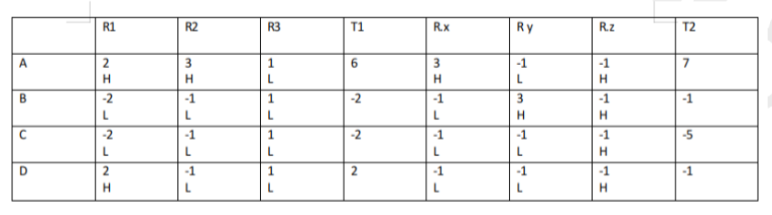
In round 1 Arun and Dipak bid Hi, and Bankim and Charu bid Lo. Option B fails: with Arun alone on Hi, Dipak would lose 1, not gain 2.
Hence, option A (Hi, Lo, Lo, Hi).
Q42TITAGames & Tournaments
In how many rounds did Arun bid Hi?
Type in your answer (TITA). No negative mark for a wrong answer.
Answer and solution
Answer: 4
A round's points total
if all bid Hi,
if all bid Lo, and
otherwise.
Arun's 6 points in three rounds, at most 3 a round, mean he gained every round. Dipak's
total 2 with
:
,
or
. A 3 in round 1 makes Dipak the lone Hi, costing Arun 1, so Dipak scored
.
Round 1: Dipak's
means two Hi bids, his and Arun's; Bankim and Charu bid Lo. Round 2: with Dipak on
, Arun gains only as the lone Hi (
). Round 3: all four need
(Bankim:
), so all bid Lo.
Rounds 4–6 give Arun
, Bankim
, Charu and Dipak
each. By clue 4, exactly one of them is Arun's other lone-Hi round (
, others
). The other two give Bankim
and the rest
, total
: one all-Hi round and one with only Bankim on Hi. The table calls rounds 4–6 Rx, Ry, Rz, order unknown.
Arun bid Hi in rounds 1 and 2, in his later lone-Hi round and in the all-Hi round. He bid Lo in round 3 and in Bankim's lone-Hi round.
The answer is 4.
Q43TITAGames & Tournaments
In how many rounds did Bankim bid Lo?
Type in your answer (TITA). No negative mark for a wrong answer.
Answer and solution
Answer: 4
A round's points total
if all bid Hi,
if all bid Lo, and
otherwise.
Arun's 6 points in three rounds, at most 3 a round, mean he gained every round. Dipak's
total 2 with
:
,
or
. A 3 in round 1 makes Dipak the lone Hi, costing Arun 1, so Dipak scored
.
Round 1: Dipak's
means two Hi bids, his and Arun's; Bankim and Charu bid Lo. Round 2: with Dipak on
, Arun gains only as the lone Hi (
). Round 3: all four need
(Bankim:
), so all bid Lo.
Rounds 4–6 give Arun
, Bankim
, Charu and Dipak
each. By clue 4, exactly one of them is Arun's other lone-Hi round (
, others
). The other two give Bankim
and the rest
, total
: one all-Hi round and one with only Bankim on Hi. The table calls rounds 4–6 Rx, Ry, Rz, order unknown.
Bankim bid Lo in rounds 1, 2 and 3 and in Arun's later lone-Hi round. He bid Hi in the all-Hi round and in his own lone-Hi round.
The answer is 4.
Q44TITAGames & Tournaments
In how many rounds did all four players make identical bids?
Type in your answer (TITA). No negative mark for a wrong answer.
Answer and solution
Answer: 2
A round's points total
if all bid Hi,
if all bid Lo, and
otherwise.
Arun's 6 points in three rounds, at most 3 a round, mean he gained every round. Dipak's
total 2 with
:
,
or
. A 3 in round 1 makes Dipak the lone Hi, costing Arun 1, so Dipak scored
.
Round 1: Dipak's
means two Hi bids, his and Arun's; Bankim and Charu bid Lo. Round 2: with Dipak on
, Arun gains only as the lone Hi (
). Round 3: all four need
(Bankim:
), so all bid Lo.
Rounds 4–6 give Arun
, Bankim
, Charu and Dipak
each. By clue 4, exactly one of them is Arun's other lone-Hi round (
, others
). The other two give Bankim
and the rest
, total
: one all-Hi round and one with only Bankim on Hi. The table calls rounds 4–6 Rx, Ry, Rz, order unknown.
All four bid alike only in round 3 (all Lo) and in the all-Hi round. Every other round mixes Hi and Lo.
The answer is 2.
Q45TITAGames & Tournaments
In how many rounds did Dipak gain exactly 1 point?
Type in your answer (TITA). No negative mark for a wrong answer.
Answer and solution
Answer: 1
A round's points total
if all bid Hi,
if all bid Lo, and
otherwise.
Arun's 6 points in three rounds, at most 3 a round, mean he gained every round. Dipak's
total 2 with
:
,
or
. A 3 in round 1 makes Dipak the lone Hi, costing Arun 1, so Dipak scored
.
Round 1: Dipak's
means two Hi bids, his and Arun's; Bankim and Charu bid Lo. Round 2: with Dipak on
, Arun gains only as the lone Hi (
). Round 3: all four need
(Bankim:
), so all bid Lo.
Rounds 4–6 give Arun
, Bankim
, Charu and Dipak
each. By clue 4, exactly one of them is Arun's other lone-Hi round (
, others
). The other two give Bankim
and the rest
, total
: one all-Hi round and one with only Bankim on Hi. The table calls rounds 4–6 Rx, Ry, Rz, order unknown.
Dipak scored
in rounds 1–3 and
in each of rounds 4–6, so he gained exactly 1 point only in round 3.
The answer is 1.
Q46MCQGames & Tournaments
In which of the following rounds, was Arun DEFINITELY the only player to bid Hi?
- ASecond
- BThird
- CFourth
- DFirst
Answer and solution
Answer: (A) Second
A round's points total
if all bid Hi,
if all bid Lo, and
otherwise.
Arun's 6 points in three rounds, at most 3 a round, mean he gained every round. Dipak's
total 2 with
:
,
or
. A 3 in round 1 makes Dipak the lone Hi, costing Arun 1, so Dipak scored
.
Round 1: Dipak's
means two Hi bids, his and Arun's; Bankim and Charu bid Lo. Round 2: with Dipak on
, Arun gains only as the lone Hi (
). Round 3: all four need
(Bankim:
), so all bid Lo.
Rounds 4–6 give Arun
, Bankim
, Charu and Dipak
each. By clue 4, exactly one of them is Arun's other lone-Hi round (
, others
). The other two give Bankim
and the rest
, total
: one all-Hi round and one with only Bankim on Hi. The table calls rounds 4–6 Rx, Ry, Rz, order unknown.
Arun was surely the lone Hi in round 2. His other lone-Hi round may be any of rounds 4–6, so option C is not definite. In round 1 Dipak also bid Hi; round 3 was all Lo.
Hence, option A (Second).
Data set
Set for questions 47–50
A survey of 600 schools in India was conducted to gather information about their online teaching learning processes (OTLP). The following four facilities were studied.
F1: Own software for OTLP
F2: Trained teachers for OTLP
F3: Training materials for OTLP
F4: All students having Laptops
The following observations were summarized from the survey.
1. 80 schools did not have any of the four facilities - F1, F2, F3, F4.
2. 40 schools had all four facilities.
3. The number of schools with only F1, only F2, only F3, and only F4 was 25, 30, 26 and 20 respectively.
4. The number of schools with exactly three of the facilities was the same irrespective of which three were considered.
5. 313 schools had F2.
6. 26 schools had only F2 and F3 (but neither F1 nor F4).
7. Among the schools having F4, 24 had only F3, and 45 had only F2.
8. 162 schools had both F1 and F2.
9. The number of schools having F1 was the same as the number of schools having F4.
Q47MCQSet Theory
What was the total number of schools having exactly three of the four facilities?
- A64
- B50
- C200
- D80
Answer and solution
Answer: (C) 200
Let each of the four exactly-three regions hold
schools (fact 4), and let only F1 and F2 hold
. From the data: only F2 is 30, only F2 and F3 is 26 (fact 6), only F2 and F4 is 45 (fact 7), and all four is 40.
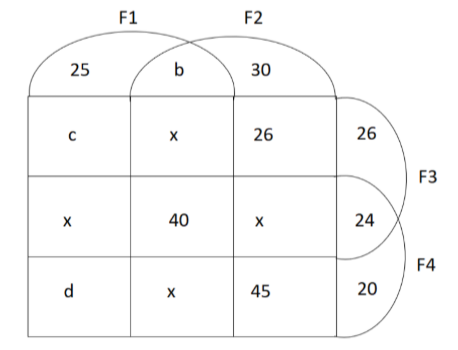
F2 lies in three of the four triples, so
, giving
.
F1 and F2 together lie in two triples, so
, giving
.
Subtracting,
and
.
The fully solved diagram:
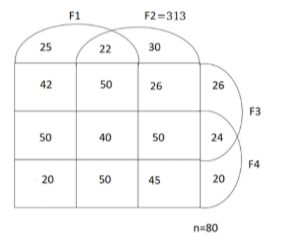
So the schools with exactly three facilities number
. Option B (50) is the count for just one of the four triples, not all four.
Hence, option C (200).
Q48MCQSet Theory
What was the number of schools having facilities F2 and F4?
- A185
- B95
- C45
- D85
Answer and solution
Answer: (A) 185
Let each of the four exactly-three regions hold
schools (fact 4), and let only F1 and F2 hold
. From the data: only F2 is 30, only F2 and F3 is 26 (fact 6), only F2 and F4 is 45 (fact 7), and all four is 40.
F2 lies in three of the four triples, so
, giving
.
F1 and F2 together lie in two triples, so
, giving
.
Subtracting,
and
.
The fully solved diagram:
Schools with both F2 and F4 are: only F2 and F4 (45), the two triples that contain both, F1F2F4 and F2F3F4 (
), and all four (40). That is
. Option D (85) leaves out the two triples.
Hence, option A (185).
Q49TITASet Theory
What was the number of schools having only facilities F1 and F3?
Type in your answer (TITA). No negative mark for a wrong answer.
Answer and solution
Answer: 42
Let each of the four exactly-three regions hold
schools (fact 4), and let only F1 and F2 hold
. From the data: only F2 is 30, only F2 and F3 is 26 (fact 6), only F2 and F4 is 45 (fact 7), and all four is 40.
F2 lies in three of the four triples, so
, giving
.
F1 and F2 together lie in two triples, so
, giving
.
Subtracting,
and
.
Let only F1 and F3 be
and only F1 and F4 be
. Only F1 is 25, only F4 is 20 and only F3 and F4 is 24 (fact 7). F1 and F4 have equal totals (fact 9):
.
Cancelling
and
leaves
, so
.
The answer is 42.
Q50TITASet Theory
What was the number of schools having only facilities F1 and F4?
Type in your answer (TITA). No negative mark for a wrong answer.
Answer and solution
Answer: 20
Let each exactly-three region hold
schools (fact 4) and only F1 and F2 hold
. Only F2 is 30, only F2 and F3 is 26 (fact 6), only F2 and F4 is 45 (fact 7), and all four is 40.
F2 lies in three triples:
, so
. F1 and F2 share two triples:
, so
. Hence
and
.
Let only F1 and F3 be
and only F1 and F4 be
. F1 and F4 have equal totals (fact 9); with only F1 25, only F4 20 and only F3 and F4 24:
, so
and
.
All 600 schools: none 80; one facility
; two facilities
; three 200; four 40. So
and
.
The answer is 20.