- CATin
- CAT past papers
- CAT 2020 Slot 2
- QA
CAT 2020 Slot 2 — QA questions with answers
All 26 questions of the Quantitative Ability section (18 MCQs, 8 TITA). Try each one, then open its answer and solution.
CAT 2020 Slot 2, timed like the real exam (120 minutes, 40 a section) and scored the CAT way: +3 right, −1 for a wrong MCQ, 0 for a wrong TITA, with the full post-mock analysis. Older official papers are in CATin Pro, with 80+ mocks and the full planner. The last three years of papers are free.
Sit this paper as a timed mock with CATin ProQuantitative Ability
CAT 2020 Slot 2 · 40 minutes · +3 for a right answer, −1 for a wrong MCQ, 0 for a wrong TITA
Q51MCQTime, Speed & Distance
The distance from B to C is thrice that from A to B. Two trains travel from A to C via B. The speed of train 2 is double that of train 1 while traveling from A to B and their speeds are interchanged while traveling from B to C. The ratio of the time taken by train 1 to that taken by train 2 in travelling from A to C is
- A5:7
- B4:1
- C1:4
- D7:5
Answer and solution
Answer: (A) 5:7
Let the distance from A to B be . Then the distance from B to C is .
From A to B:
Speed of Train 1 =
Speed of Train 2 is double that of Train 1 =
Time taken by Train 1 to travel from A to B =
Time taken by Train 2 to travel from A to B =
From B to C:
The speeds are interchanged.
Speed of Train 1 =
Speed of Train 2 =
Time taken by Train 1 to travel from B to C =
Time taken by Train 2 to travel from B to C =
Total Time from A to C:
Total time taken by Train 1 =
Total time taken by Train 2 =
Ratio of Time Taken:
Hence, the required ratio is . Option A is correct.
Q52TITATime & Work
John takes twice as much time as Jack to finish a job. Jack and Jim together take one-third of the time to finish the job than John takes working alone.
Moreover, in order to finish the job, John takes three days more than that taken by three of them working together. In how many days will Jim finish the job
working alone?
Type in your answer (TITA). No negative mark for a wrong answer.
Answer and solution
Answer: 4
Let Jack take days to complete the work alone. Then John takes days to complete the work alone.
Work done by Jack in 1 day = .
Work done by John in 1 day = .
Let Jim take days to complete the work alone. Work done by Jim in 1 day = .
Jack and Jim together take one-third of the time John takes alone.
Time taken by John alone = .
Time taken by Jack and Jim together = .
Therefore, the combined work done by Jack and Jim in 1 day is .
So Jim takes days to complete the work alone.
Now, John takes 3 days more than the time taken by all three working together.
Let the three of them complete the work together in days.
Work done by all three in 1 day = .
So, time taken by all three together, days.
We are given that John takes 3 days more than all three together:
Since Jim takes days to finish the job alone, the time taken by Jim is days.
Q53MCQQuadratic & Polynomial Equations
Let
and
. If
for all real
, and
, then the smallest possible value of
is
- A16
- B4
- C1
- D0
Answer and solution
Answer: (B) 4
Expanding,
and
, so
.
Then
gives
, so
.
For
for all real
, the discriminant must not be positive:
, so
. Equivalently,
, whose minimum value
must be at least
.
So the smallest possible value of
is
. Options C (1) and D (0) are below 4 and would make
negative, while option A (16) is allowed but not the smallest.
Hence, option B (4).
Q54TITASimple & Compound Interest
For the same principal amount, the compound interest for two years at 5% per annum exceeds the simple interest for three years at 3% per annum by Rs
1125. Then the principal amount in rupees is
Type in your answer (TITA). No negative mark for a wrong answer.
Answer and solution
Answer: 90000
Let the principal amount be .
The compound interest for 2 years at 5% per annum is:
The simple interest for 3 years at 3% per annum is:
The difference between the compound interest and the simple interest is Rs 1125.
The principal amount is Rs 90000.
Q55MCQPolygons & Circles
Let C be a circle of radius 5 meters having center at O. Let PQ be a chord of C that passes through points A and B where A is located 4 meters north of O
and B is located 3 meters east of O. Then, the length of PQ, in meters, is nearest to
- A8.8
- B7.8
- C6.6
- D7.2
Answer and solution
Answer: (A) 8.8
Place
at the origin with north along the
-axis. Then
and
, and the chord lies on the line
, i.e.
.
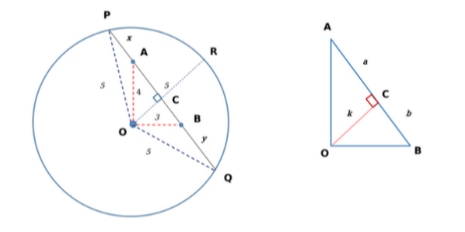
Let
be the foot of the perpendicular from
to the chord. Then
m. Equivalently, in the right triangle
with
, the altitude to
is
.
The perpendicular from the centre bisects the chord, so
m, and
m.
Option B (7.8) is the next closest but is about a metre short. Note that
m is only part of the chord, since
and
lie inside the circle.
Hence, option A (8.8).
Q56MCQTime, Speed & Distance
In a car race, car A beats car B by 45 km. car B beats car C by 50 km. and car A beats car C by 90 km. The distance (in km) over which the race has been
conducted is
- A475
- B450
- C500
- D550
Answer and solution
Answer: (B) 450
Let the race be
km. When A finishes, B has run
and C has run
; when B finishes, C has run
.
So
,
and
. Since
, we get
, so
.
This gives
, so
and
.
Check: over 450 km, B runs 405 while A runs 450, and C runs
, so A beats C by 90. Option C (500) fails: B would run 455 and C
, a gap of 90.5, not 90.
Hence, option B (450).
Q57TITAPermutations & Combinations
How many 4-digit numbers, each greater than 1000 and each having all four digits distinct, are there with 7 coming before 3?
Type in your answer (TITA). No negative mark for a wrong answer.
Answer and solution
Answer: 315
We need to form 4-digit numbers greater than 1000 with all four digits distinct such that 7 appears before 3.
First, we select 4 distinct digits from the 10 available digits (0 to 9). Since 7 and 3 must be among the digits, we need to choose 2 more digits from the remaining 8 digits (which include 0). There are two cases depending on whether 0 is selected or not.
Case 1: 0 is not among the selected digits.
We choose 2 digits from the remaining 7 non-zero digits: ways.
We now have 4 non-zero digits (including 7 and 3).
Total permutations of these 4 digits is .
By symmetry, in exactly half of these permutations, 7 will appear before 3.
So, valid arrangements per selection.
Total numbers for Case 1 = .
Case 2: 0 is one of the selected digits.
We need 1 more digit from the remaining 7 non-zero digits: ways.
We now have 4 digits: 7, 3, 0, and one other non-zero digit.
Total permutations of these 4 digits is .
However, numbers cannot start with 0. We must subtract the cases where 0 is the first digit.
If 0 is the first digit, the remaining 3 digits can be arranged in ways.
Out of these 6 arrangements, 7 appears before 3 in exactly half of them: ways.
Total valid permutations for these 4 digits = (Total where 7 is before 3) - (Those starting with 0 where 7 is before 3)
valid arrangements.
Total numbers for Case 2 = .
Total 4-digit numbers = .
Q58MCQMensuration
The sum of the perimeters of an equilateral triangle and a rectangle is 90cm. The area,
, of the triangle and the area,
, of the rectangle, both in sq cm, satisfying the relationship
. If the sides of the rectangle are in the ratio 1:3, then the length, in cm, of the longer side of the rectangle, is
- A27
- B21
- C24
- D18
Answer and solution
Answer: (A) 27
Let the triangle's side be
and the rectangle's sides be
and
. The perimeters give
.
The areas are
and
. From
:
, so
and
.
Substituting:
, i.e.
, which factorises as
. So
and
.
The rectangle is 9 cm by 27 cm. Check:
,
and
.
Option B (21) would give
and
, but then
, not 7, so
fails.
Hence, option A (27).
Q59TITARatios, Proportions & Partnership
A sum of money is split among Amal, Sunil and Mita so that the ratio of the shares of Amal and Sunil is 3:2, while the ratio of the shares of Sunil and Mita is
4:5. If the difference between the largest and the smallest of these three shares is Rs.400, then Sunil’s share, in rupees, is
Type in your answer (TITA). No negative mark for a wrong answer.
Answer and solution
Answer: 800
The ratio of shares of Amal and Sunil is .
The ratio of shares of Sunil and Mita is .
We can equalize the ratio for Sunil to combine them.
Amal : Sunil =
Sunil : Mita =
Combining the ratios, we get Amal : Sunil : Mita = .
Let their shares be , , and respectively.
The largest share is Amal's () and the smallest share is Sunil's ().
The difference between the largest and smallest shares is Rs 400.
.
Sunil's share is rupees.
Q60MCQLogarithms
The value of
, for
cannot be equal to
- A0
- B-1
- C1
- D-0.5
Answer and solution
Answer: (C) 1
Expand:
, where
.
Since
,
, so by AM-GM
and the expression is at most
.
It equals
when
, and as
grows it takes every negative value:
gives
, and
gives
. So 0,
and
are all possible; option A (0) is attained when
, so it is not excluded.
A positive value such as 1 is impossible.
Hence, option C (1).
Q61MCQSet Theory
Students in a college have to choose at least two subjects from chemistry, mathematics and physics. The number of students choosing all three subjects is
18, choosing mathematics as one of their subjects is 23 and choosing physics as one of their subjects is 25. The smallest possible number of students
who could choose chemistry as one of their subjects is
- A22
- B21
- C20
- D19
Answer and solution
Answer: (C) 20
Every student takes at least two subjects, so each student is in exactly one group: Maths and Physics only (
), Physics and Chemistry only (
), Maths and Chemistry only (
), or all three (18).
Maths gives
, so
. Physics gives
, so
.
Chemistry is
.
To make this as small as possible, make
as large as possible. Since
,
. With
:
,
, and Chemistry is
.
Option D (19) would need
, which is not a whole number and exceeds
; option B (21) would need
, also not a whole number, so it is impossible; option A (22) is possible (with
,
,
) but not the smallest.
Hence, option C (20).
Q62MCQAverages, Mixtures & Alligations
In a group of 10 students, the mean of the lowest 9 scores is 42 while the mean of the highest 9 scores is 47. For the entire group of 10 students, the
maximum possible mean exceeds the minimum possible mean by
- A5
- B4
- C3
- D6
Answer and solution
Answer: (B) 4
Sort the scores
. The lowest nine sum to
and the highest nine to
, so
and the total is
.
Maximum mean: make
, and so
, as large as possible. As
is the smallest of nine scores averaging 42,
. Take
and
; the mean is
.
Minimum mean: make
as small as possible. As
is the largest of nine scores averaging 47,
. Take
and
; the mean is
.
The difference is
. Option A (5) is just
, the gap between the two nine-score means, not between possible means of all ten.
Hence, option B (4).
Q63MCQTime, Speed & Distance
A and B are two points on a straight line. Ram runs from A to B while Rahim runs from B to A. After crossing each other, Ram and Rahim reach their destination in one minute and four minutes, respectively. If they start at the same time, then the ratio of Ram's speed to Rahim's speed is
- A
- B
- C2
- D
Answer and solution
Answer: (C) 2
Let Ram's and Rahim's speeds be
and
, and let them meet after
minutes.
The stretch Ram covers before meeting,
, is what Rahim covers after meeting, in 4 minutes:
. The stretch Rahim covers before meeting,
, is what Ram covers after meeting, in 1 minute:
.
Dividing,
, so
and
. (They meet after
minutes.)
Option A inverts the ratio: Ram is the faster runner, since he needs only 1 minute to finish the remaining distance while Rahim needs 4.
Hence, option C (2).
Q64MCQTime, Speed & Distance
Two circular tracks T1 and T2 of radii 100 m and 20 m, respectively touch at a point A. Starting from A at the same time, Ram and Rahim are walking on
track
and track
at speeds 15 km/hr and 5 km/hr respectively. The number of full rounds that Ram will make before he meets Rahim again for the first
time is
- A5
- B3
- C2
- D4
Answer and solution
Answer: (B) 3
The two tracks touch only at A, so Ram and Rahim can meet only at A. That happens when each has completed a whole number of rounds.
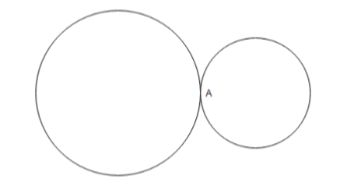
Ram: track length
m, speed
km/hr
m/min, so one round takes
min.
Rahim: track length
m, speed
km/hr
m/min, so one round takes
min.
The round times are in the ratio
. So both are first back at A together after
of Ram's rounds, which take as long as
of Rahim's:
min.
Option A (5) is the number of rounds Rahim makes in that time, not Ram.
Hence, option B (3).
Q65TITAPolygons & Circles
Let C1 and C2 be concentric circles such that the diameter of C1 is 2cm longer than that of C2. If a chord of C1 has length 6cm and is a tangent to C2, then
the diameter, in cm, of C1 is
Type in your answer (TITA). No negative mark for a wrong answer.
Answer and solution
Answer: 10
Let the radius of the smaller circle
be
. The diameter of
is 2 cm more than that of
, so the radius of
is
.
Let
be the common centre and
the 6 cm chord of
, touching
at
. The radius
is perpendicular to the tangent
, so
is the midpoint of
and
cm.
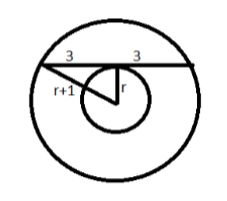
In the right triangle
,
,
and
. By Pythagoras,
, so
, giving
and
cm.
The radius of
is
cm, so its diameter is
cm.
The answer is 10.
Q66MCQProfit, Loss & Discount
Anil buys 12 toys and labels each with the same selling price. He sells 8 toys initially at 20% discount on the labeled price. Then he sells the remaining 4
toys at an additional 25% discount on the discounted price. Thus, he gets a total of Rs 2112, and makes a 10% profit. With no discounts, his percentage of
profit would have been
- A50
- B60
- C54
- D55
Answer and solution
Answer: (A) 50
Let the labelled price be
and the cost be
per toy.
Eight toys sell at
each and four at
each, so the revenue is
, giving
.
A 10% profit means
, so
.
Without discounts, each toy sells for 240, a profit of 80 on a cost of 160, which is
per cent.
Check: all 12 toys at 240 bring 2880 against a cost of 1920, a profit of 960, exactly half the cost, so option D (55) is too high.
Hence, option A (50).
Q67MCQIndices & Surds
The number of integers that satisfy the equality
is
- A3
- B2
- C4
- D5
Answer and solution
Answer: (A) 3
A power
with an integer exponent equals 1 in three ways.
Exponent zero with a non-zero base:
gives
, and the base is
, so
works.
Base equal to 1:
gives
, so
or
.
Base equal to
with an even exponent:
has discriminant
, so there is no real
. In fact
always, so the base is never negative.
The solutions are
,
and
. Option B (2) misses the zero-exponent case
, and option C (4) would wrongly count a base of
.
Hence, option A (3).
Q68TITALinear Equations
The number of pairs of integers
satisfying
and
Type in your answer (TITA). No negative mark for a wrong answer.
Answer and solution
Answer: 17
We are given the equation and the inequality .
We need to find the number of integer pairs that satisfy these conditions.
From the equation, we can express in terms of :
.
Since must be an integer, must be even.
This means must be odd, so must be an odd integer.
We are given :
Since is an integer, .
We are also given .
So the range for is .
Within this range, must be an odd integer.
The odd integers from to are:
.
There are exactly 17 such odd values for .
For each odd value of , there is a corresponding unique integer value for .
Therefore, there are 17 pairs of integers satisfying the conditions.
Q69MCQTriangles & Lines
From an interior point of an equilateral triangle, perpendiculars are drawn on all three sides. The sum of the lengths of the three perpendiculars is
. Then the area of the triangle is
- A
- B
- C
- D
Answer and solution
Answer: (D)
Let the side be
, and let the perpendiculars from the interior point
to the three sides be
, so
.
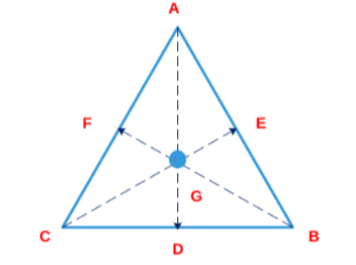
Joining
to the three vertices splits the triangle into three smaller triangles. Each has base
and one of the perpendiculars as its height, so
.
The area is also
. Equating,
, so
. In other words,
equals the altitude of the triangle. The figure puts the point at the centre, but this holds for any interior point.
Then
.
Option B,
, is exactly twice this. It comes from dropping the
in this last step and taking the area as base
altitude.
Hence, option D (
).
Q70MCQSequences & Series
Let the m-th and n-th terms of a geometric progression be
and
, respectively, where
. If the common ratio of the progression is an integer
, then the smallest possible value of
is
- A6
- B2
- C-4
- D-2
Answer and solution
Answer: (D) -2
Let the first term be
. Then
and
. Dividing the second by the first,
.
Since
,
is a positive integer, and
is an integer with
. The possible pairs are
(sum
);
(sum
);
(sum
);
(sum
); and
(sum
).
does not work, since
.
So the smallest value of
is
, from
and
.
Option C,
, cannot be reached. With
it would need
, but the only negative ratios allowed are
and
.
Hence, option D (-2).
Q71MCQPercentages
In May, John bought the same amount of rice and the same amount of wheat as he had bought in April, but spent ₹ 150 more due to price increase of rice
and wheat by 20% and 12%, respectively. If John had spent ₹ 450 on rice in April, then how much did he spend on wheat in May?
- ARs.560
- BRs.570
- CRs.590
- DRs.580
Answer and solution
Answer: (A) Rs.560
Let John's April spending on wheat be
. He bought the same quantities in both months, so each May amount is the April amount raised by that item's price increase.
Rice: April
, May
, an increase of
.
The total increase is
, so the increase on wheat is
.
Wheat's price rose by 12%, so
, which gives
in April.
Wheat in May
.
Option D (Rs.580) fails this check. It would mean April wheat spending of
and a wheat increase of about
, so the total increase would be about
, not
.
Hence, option A (Rs.560).
Q72TITALinear Equations
If
and
are non-negative integers such that
,
and
, then the maximum possible value of
equals
Type in your answer (TITA). No negative mark for a wrong answer.
Answer and solution
Answer: 23
From
and
, we get
and
.
Substitute into
:
.
Since
is an integer,
is an integer, so
. Also
needs
.
Now
, which grows as
grows. So take the largest value,
. This gives
and
, so
.
Check:
and
, so the inequality holds.
The answer is 23.
Q73MCQLinear Equations
Aron bought some pencils and sharpeners. Spending the same amount of money as Aron, Aditya bought twice as many pencils and 10 less sharpeners. If
the cost of one sharpener is ₹ 2 more than the cost of a pencil, then the minimum possible number of pencils bought by Aron and Aditya together is
- A33
- B27
- C30
- D36
Answer and solution
Answer: (A) 33
Let a pencil cost
, so a sharpener costs
. Aron buys
pencils and
sharpeners. Aditya buys
pencils and
sharpeners.
Equal spending gives
.
Cancelling
from both sides,
.
Since
,
, so
. Pencils are counted in whole numbers, so the least possible
is
. That needs
(pencil ₹20, sharpener ₹22), which works for any
.
Together they bought
pencils, so the minimum is
.
Option C (30) would need
, but then
, not
. So Aron must buy more than 10 pencils.
Hence, option A (33).
Q74MCQInequalities & Modulus
For real
, the maximum possible value of
is
- A
- B1
- C
- D
Answer and solution
Answer: (D)
Let
. For
,
, so the maximum occurs at some
.
For
, divide the numerator and the denominator by
:
.
So
is largest when
is smallest. By AM-GM,
, with equality at
.
The maximum is therefore
.
Option A,
, is a value
does take, but it is not the largest, since
. Option B,
, would need
, which is impossible because that sum is at least
.
Hence, option D (
).
Q75MCQInequalities & Modulus
In how many ways can a pair of integers
be chosen such that
?
- A6
- B5
- C4
- D7
Answer and solution
Answer: (D) 7
Since
, complete the square in
:
.
Both terms are non-negative integers, so one of them is
and the other is
.
Case 1:
and
. Then
, and
gives
or
, so
. That is 3 pairs:
,
,
.
Case 2:
and
. Then
and
or
. That is
pairs:
,
,
,
.
Total:
pairs.
Option A (6) is what you get if you miss
in Case 1, that is, if you forget that
also satisfies
.
Hence, option D (7).
Q76TITAInequalities & Modulus
If
and
are positive real numbers satisfying
, then the minimum possible value of
is
Type in your answer (TITA). No negative mark for a wrong answer.
Answer and solution
Answer: 2704
We are given and .
We need to find the minimum value of .
Let's expand the expression in the parentheses:
Substitute :
To minimize , we need to maximize .
Using the AM-GM inequality for positive numbers and :
. So the maximum value of is .
Substitute into the expression for :
Minimum .
The minimum possible value is 2704.