- CATin
- CAT past papers
- CAT 2020 Slot 2
- DILR
CAT 2020 Slot 2 — DILR questions with answers
All 24 questions of the Data Interpretation & Logical Reasoning section (18 MCQs, 6 TITA, 5 sets). Try each one, then open its answer and solution.
CAT 2020 Slot 2, timed like the real exam (120 minutes, 40 a section) and scored the CAT way: +3 right, −1 for a wrong MCQ, 0 for a wrong TITA, with the full post-mock analysis. Older official papers are in CATin Pro, with 80+ mocks and the full planner. The last three years of papers are free.
Sit this paper as a timed mock with CATin ProData Interpretation & Logical Reasoning
CAT 2020 Slot 2 · 40 minutes · +3 for a right answer, −1 for a wrong MCQ, 0 for a wrong TITA
Data set
Set for questions 27–30

A chain of departmental stores has outlets in Delhi, Mumbai, Bengaluru and Kolkata. The sales are categorized by its three departments - ‘Apparel’, ‘Electronics’, and ‘Home Décor’. An Accountant has been asked to prepare a summary of the 2018 and 2019 sales amounts for an internal report. He has collated partial information and prepared the following table.
The following additional information is known.
1. The sales amounts in the Apparel departments were the same for Delhi and Kolkata in 2018.
2. The sales amounts in the Apparel departments were the same for Mumbai and Bengaluru in 2018. This sales amount matched the sales amount in the Apparel department for Delhi in 2019.
3. The sales amounts in the Home Décor departments were the same for Mumbai and Kolkata in 2018.
4. The sum of the sales amounts of four Electronics departments increased by the same amount as the sum of the sales amounts of four Apparel departments from 2018 to 2019.
5. The total sales amounts of the four Home Décor departments increased by Rs 70 Crores from 2018 to 2019.
6. The sales amounts in the Home Décor departments of Delhi and Bengaluru each increased by Rs 20 Crores from 2018 to 2019.
7. The sales amounts in the Apparel departments of Delhi and Bengaluru each increased by the same amount in 2019 from 2018. The sales amounts in the Apparel departments of Mumbai and Kolkata also each increased by the same amount in 2019 from 2018.
8. The sales amounts in the Apparel departments of Delhi, Kolkata and Bengaluru in 2019 followed an Arithmetic Progression.
Q27MCQMissing Value Tables
In Home Décor departments of which cities were the sales amounts the highest in 2018 and 2019, respectively?
- ABengaluru and Delhi
- BMumbai and Mumbai
- CMumbai and Delhi
- DDelhi and Delhi
Answer and solution
Answer: (D) Delhi and Delhi
Only the Home Décor row matters here.
From the table, 2019 Home Décor sales total
crore. Clue 5 says the total rose by 70 crore, so the 2018 total was
.
Clue 6 says Delhi and Bengaluru each rose by 20, so in 2018 Delhi had
and Bengaluru had
. By clue 3, Mumbai and Kolkata were equal in 2018, each
.
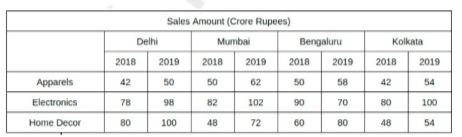
So in 2018 Home Décor sales were Delhi 80, Mumbai 48, Bengaluru 60 and Kolkata 48, and Delhi was highest. In 2019, Delhi's 100 beats Mumbai's 72, Bengaluru's 80 and Kolkata's 54.
Option C (Mumbai and Delhi) fails because Mumbai had only 48 in 2018, well below Delhi's 80. Option A fails for the same reason: Bengaluru had 60 in 2018.
Hence, option D (Delhi and Delhi).
Q28MCQMissing Value Tables
What was the increase in sales amount, in Crore Rupees, in the Apparel department of Mumbai from 2018 to 2019?
- A12
- B8
- C5
- D10
Answer and solution
Answer: (A) 12
From the table, Electronics changed by
(Delhi),
(Mumbai),
(Bengaluru) and
(Kolkata), a net rise of 40. By clue 4, total Apparel sales also rose by 40.
Let 2018 Apparel sales be
for Delhi and Kolkata (clue 1) and
for Mumbai and Bengaluru; Delhi's 2019 figure is also
(clue 2). So Delhi rose by
, and by clue 7 Bengaluru also rose by
, reaching
. Kolkata reached 54, a rise of
, and Mumbai rose by the same
.
Clue 4 gives
, so
.
Clue 8: Delhi
, Kolkata 54 and Bengaluru
are in AP, so
, i.e.
. Substituting,
, so
,
and
.
Mumbai's Apparel sales rose by
crore, from 50 to 62.
Option D (10) would need
, giving
and
, which breaks clue 8.
Hence, option A (12).
Q29MCQMissing Value Tables
Among all the 12 departments (i.e., the 3 departments in each of the 4 cities), what was the maximum percentage increase in sales amount from 2018 to 2019?
- A25
- B28
- C75
- D50
Answer and solution
Answer: (D) 50
Home Décor: the 2019 total is
, so by clue 5 the 2018 total was
. Delhi and Bengaluru each rose by 20 (clue 6), so they had 80 and 60 in 2018; Mumbai and Kolkata had
each (clue 3).
Apparel: Electronics rose by
, so Apparel rose by 40 (clue 4). Let 2018 Apparel be
(Delhi, Kolkata) and
(Mumbai, Bengaluru), with Delhi's 2019 figure
(clues 1 and 2). By clue 7, Delhi and Bengaluru rose by
, Mumbai and Kolkata by
. So
, giving
, and the AP
, 54,
(clue 8) gives
. Hence
and
.
Apparel increases: Delhi
(about 19%), Mumbai
(24%), Bengaluru
(16%), Kolkata
(about 28.6%).
Electronics: at most Delhi's
(about 25.6%); Bengaluru fell.
Home Décor: Delhi
(25%), Mumbai
(50%), Bengaluru
(about 33.3%), Kolkata
(12.5%).
The maximum is 50%, for Mumbai Home Décor. Option B (28) is roughly Kolkata Apparel's 28.6% rise, the largest outside Home Décor, but still well below 50%.
Hence, option D (50).
Q30MCQMissing Value Tables
What was the total sales amount, in Crore Rupees, in 2019 for the chain of departmental stores?
- A600
- B900
- C150
- D750
Answer and solution
Answer: (B) 900
The 2019 Electronics and Home Décor figures are in the table: Electronics
and Home Décor
.
For Apparel: Electronics rose by
, so Apparel also rose by 40 (clue 4). Let 2018 Apparel be
for Delhi and Kolkata and
for Mumbai and Bengaluru, with Delhi's 2019 figure
(clues 1 and 2). By clue 7, Delhi and Bengaluru each rose by
, and Mumbai and Kolkata each by
. So
, giving
. Clue 8 (Delhi
, Kolkata 54, Bengaluru
in AP) gives
. So
and
.
Apparel in 2019: Delhi 50, Mumbai
, Bengaluru
and Kolkata 54, a total of 224.
Total 2019 sales:
crore.
Option D (750) would leave only
for Apparel, yet Delhi and Kolkata alone had
.
Hence, option B (900).
Data set
Set for questions 31–36
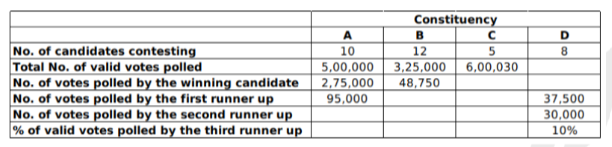
In an election several candidates contested for a constituency. In any constituency, the winning candidate was the one who polled the highest number of votes, the first runner up was the one who polled the second highest number of votes, the second runner up was the one who polled the third highest number of votes, and so on. There were no ties (in terms of number of votes polled by the candidates) in any of the constituencies in this election. In an electoral system, a security deposit is the sum of money that a candidate is required to pay to the election commission before he or she is permitted to contest. Only the defeated candidates (i.e., one who is not the winning candidate) who fail to secure more than one sixth of the valid votes polled in the constituency, lose their security deposits.
The following table provides some incomplete information about votes polled in four constituencies: A, B, C and D, in this election .
The following additional facts are known:
1. The first runner up polled 10,000 more votes than the second runner up in constituency A.
2. None of the candidates who contested in constituency C lost their security deposit. The difference in votes polled by any pair of candidates in this constituency was at least 10,000.
3. The winning candidate in constituency D polled 5% of valid votes more than that of the first runner up. All the candidates who lost their security deposits while contesting for this constituency, put together, polled 35% of the valid votes.
Q31TITAMissing Value Tables
What is the percentage of votes polled in total by all the candidates who lost their security deposits while contesting for constituency A?
Type in your answer (TITA). No negative mark for a wrong answer.
Answer and solution
Answer: 9
In constituency A, the first runner-up polled 95,000, so by fact 1 the second runner-up polled
.
A defeated candidate keeps the deposit only with more than one-sixth of the valid votes:
. The first and second runners-up (95,000 and 85,000) are above this, and the winner never forfeits.
The other seven candidates share
votes, so each has at most 45,000, well below 83,333. All seven lose their deposits.
Their share of the valid votes is
, i.e. 9%.
The answer is 9.
Q32TITAMissing Value Tables
How many candidates who contested in constituency B lost their security deposit?
Type in your answer (TITA). No negative mark for a wrong answer.
Answer and solution
Answer: 11
Constituency B has 12 candidates and 3,25,000 valid votes. A defeated candidate keeps the deposit only by polling more than one-sixth of the valid votes:
.
The winner polled 48,750. Every defeated candidate polled fewer votes than the winner, so each has less than 48,750, which is below 54,167. So every defeated candidate loses the deposit.
The winner keeps the deposit even though 48,750 is below one-sixth, because only defeated candidates can forfeit.
So the number who lost their deposits is
.
The answer is 11.
Q33MCQMissing Value Tables
What BEST can be concluded about the number of votes polled by the winning candidate in constituency C?
- A1,40,010
- Bbetween 1,40,005 and 1,40,010
- Cless than 2,00,010
- D1,40,006
Answer and solution
Answer: (D) 1,40,006
Constituency C has 5 candidates and 6,00,030 valid votes. One-sixth of this is 1,00,005. Since nobody lost the deposit, even the last candidate polled more than 1,00,005, i.e. at least 1,00,006.
Any two candidates differ by at least 10,000, so going up the order the totals are at least 1,00,006, 1,10,006, 1,20,006, 1,30,006 and 1,40,006.
These minimums add up to
, exactly the valid votes. So no candidate can have more than the minimum, and the winner polled exactly 1,40,006.
Option B (between 1,40,005 and 1,40,010) contains this value but is only a range, so it is not the best conclusion; option A (1,40,010) would push the total above 6,00,030.
Hence, option D (1,40,006).
Q34MCQMissing Value Tables
What was the number of valid votes polled in constituency D?
- A1,25,000
- B1,50,000
- C1,75,000
- D62,500
Answer and solution
Answer: (C) 1,75,000
Let the valid votes in D be
. The first and second runners-up polled 37,500 and 30,000, the third runner-up polled
, and by fact 3 the winner polled
.
The third runner-up's 10% is below one-sixth, so he and everyone below him forfeit. They polled 35% in all, so the winner plus any runner-up above
polled 65%.
If both the first and second runners-up keep their deposits:
, so
and
. Check:
, below both 37,500 and 30,000.
If only the first runner-up keeps it:
gives
; but then
and the second runner-up's 30,000 would also keep the deposit, a contradiction. So option A (1,25,000) fails. Option D (62,500) is even smaller than
, the two runners-up alone.
Hence, option C (1,75,000).
Q35MCQMissing Value Tables
The winning margin of a constituency is defined as the difference of votes polled by the winner and that of the first runner up. Which of the following
CANNOT be the list of constituencies, in increasing order of winning margin?
- AD, B, C, A
- BB, D, C, A
- CB, C, D, A
- DD, C, B, A
Answer and solution
Answer: (C) B, C, D, A
Winning margins:
A:
.
C: one-sixth of 6,00,030 is 1,00,005, so all five candidates polled at least 1,00,006; with gaps of at least 10,000, the minimums 1,00,006 to 1,40,006 already add up to 6,00,030. So these are the exact totals, and the margin is 10,000.
D: with valid votes
, the winner has
, so the margin is
. The 10% third runner-up forfeits, and the top three hold 65%:
gives
(keeping only the top two gives
, where 30,000 exceeds
, a contradiction). The margin is 8,750.
B: the winner has 48,750 and the other 11 share 2,76,250, so the runner-up has at least about 25,114; the margin can be anything up to about 23,600.
So A is always last, and D (8,750) always comes before C (10,000). Option C puts C before D, so it is impossible. The others only need B's margin in a suitable range; for example, option D (D, C, B, A) holds if B's margin exceeds 10,000.
Hence, option C (B, C, D, A).
Q36MCQMissing Value Tables
For all the four constituencies taken together, what was the approximate number of votes polled by all the candidates who lost their security deposit
expressed as a percentage of the total valid votes from these four constituencies?
- A38.25%
- B23.54%
- C23.91%
- D32.00%
Answer and solution
Answer: (C) 23.91%
Votes of candidates who forfeited, by constituency:
A: the second runner-up polled
, above one-sixth (about 83,333); the other seven share
, all below it. Forfeited: 45,000.
B: the winner's 48,750 is below one-sixth (about 54,167), so all 11 defeated candidates forfeit:
.
C: nobody forfeits.
D: 35% of the valid votes
. The 10% third runner-up forfeits, so the top three hold 65%:
gives
(keeping only the top two gives
, where 30,000 exceeds
, a contradiction). Forfeited:
.
Total forfeited:
, out of
valid votes, which is about 23.91%.
Every figure is forced, so the nearby 23.54% (option B) cannot occur.
Hence, option C (23.91%).
Data set
Set for questions 37–40
Twenty five coloured beads are to be arranged in a grid comprising of five rows and five columns. Each cell in the grid must contain exactly one bead. Each bead is coloured either Red, Blue or Green. While arranging the beads along any of the five rows or along any of the five columns, the rules given below are to be followed:
1. Two adjacent beads along the same row or column are always of different colours.
2. There is at least one Green bead between any two Blue beads along the same row or column.
3. There is at least one Blue and at least one Green bead between any two Red beads along the same row or column.
Every unique, complete arrangement of twenty five beads is called a configuration.
Q37TITALogical Puzzles
The total number of possible configurations using beads of only two colours is:
Type in your answer (TITA). No negative mark for a wrong answer.
Answer and solution
Answer: 2
Red cannot be one of the two colours. With only Red and Green (or only Red and Blue), rule 1 forces every row to alternate, so a row of five has two Reds with only one bead between them, which breaks rule 3.
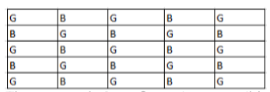
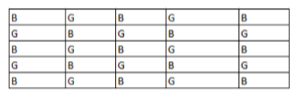
So the colours must be Blue and Green. Rule 1 then forces every row and every column to alternate Blue and Green, which is a checkerboard pattern. Rule 2 holds, because any two Blues in a line have a Green between them.
A checkerboard is fixed completely by the colour of the top-left bead, which can be Green or Blue. These are the only two configurations:
The answer is 2.
Q38TITALogical Puzzles
What is the maximum possible number of Red beads that can appear in any configuration?
Type in your answer (TITA). No negative mark for a wrong answer.
Answer and solution
Answer: 9
Two Reds in the same line need a Blue and a Green between them, so they must be at least three places apart. In a line of five, two Reds can sit only at positions (1, 4), (1, 5) or (2, 5), and three Reds never fit. So each row and each column has at most two Reds, and a Red in the middle position must be the only Red in its line.
Ten Reds would need two in every row, and no allowed pair uses column 3, so all ten would lie in columns 1, 2, 4 and 5. Those columns hold at most
Reds. So there are at most 9 Reds.
Nine is achievable, with the Reds placed as below:
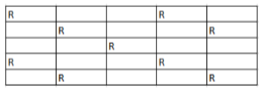
A full configuration with these Reds, rows from top to bottom: RGBRG / GRGBR / BGRGB / RBGRG / GRBGR. Every row and column satisfies all three rules.
The answer is 9.
Q39TITALogical Puzzles
What is the minimum number of Blue beads in any configuration?
Type in your answer (TITA). No negative mark for a wrong answer.
Answer and solution
Answer: 6
Every line of five needs a Blue: with only Red and Green, rule 1 forces alternation, which puts two Reds with only a Green between them and breaks rule 3. So each row and each column has at least one Blue, giving at least 5 Blues.
If a line has exactly one Blue, that Blue cannot be at an end: the other four beads would alternate Red and Green, again putting two Reds with only a Green between them.
With exactly 5 Blues, every row and column would have exactly one Blue. The Blue in column 1 would then be the only Blue in its row and sit at that row's end, which is impossible. So at least 6 Blues are needed.
Six is achievable. Rows from top to bottom: RGBRG / GRGBR / BGRGB / RBGRG / GRBGR.
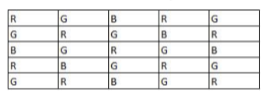
This has six Blues, and every row and column satisfies all three rules.
The answer is 6.
Q40TITALogical Puzzles
Two Red beads have been placed in ‘second row, third column’ and ‘third row, second column’. How many more Red beads can be placed so as to maximise
the number of Red beads used in the configuration?
Type in your answer (TITA). No negative mark for a wrong answer.
Answer and solution
Answer: 6
Two Reds in a line need a Blue and a Green between them, so they must be at least three places apart. A pair of Reds can sit only at positions (1, 4), (1, 5) or (2, 5), and a Red in position 3 is alone in its line.
The Red at row 2, column 3 is in the middle of row 2, so it is the only Red in row 2. The Red at row 3, column 2 is in the middle of column 2, so it is the only Red in that column. Row 3 can add a second Red only at column 5.
Rows 1, 4 and 5 cannot use column 2, so any pair of Reds in them must be (1, 4) or (1, 5), both using column 1. All three rows having a pair would put three Reds in column 1, which is impossible. So rows 1, 4 and 5 hold at most
Reds, and the total is at most
.
Eight is achievable, with the Reds placed as below:
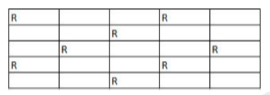
A full configuration, rows from top to bottom: RGBRG / GBRGB / BRGBR / RGBRG / GBRGB. That is 6 Reds added to the two given.
The answer is 6.
Data set
Set for questions 41–46
The Humanities department of a college is planning to organize eight seminars, one for each of the eight doctoral students - A, B, C, D, E, F, G and H. Four of them are from Economics, three from Sociology and one from Anthropology department. Each student is guided by one among P, Q, R, S and T. Two students are guided by each of P, R and T, while one student is guided by each of Q and S. Each student is guided by a guide belonging to their department. Each seminar is to be scheduled in one of four consecutive 30-minute slots starting at 9:00 am, 9:30 am, 10:00 am and 10:30 am on the same day. More than one seminars can be scheduled in a slot, provided the guide is free. Only three rooms are available and hence at the most three seminars can be scheduled in a slot. Students who are guided by the same guide must be scheduled in consecutive slots.
The following additional facts are also known.
1. Seminars by students from Economics are scheduled in each of the four slots.
2. A’s is the only seminar that is scheduled at 10:00 am. A is guided by R.
3. F is an Anthropology student whose seminar is scheduled at 10:30 am.
4. The seminar of a Sociology student is scheduled at 9:00 am.
5. B and G are both Sociology students, whose seminars are scheduled in the same slot. The seminar of an Economics student, who is guided by T, is also scheduled in the same slot.
6. P, who is guiding both B and C, has students scheduled in the first two slots.
7. A and G are scheduled in two consecutive slots.
Q41MCQTeam Selection & Scheduling
Which one of the following statements is true?
- ATwo seminars are scheduled in the first slot.
- BOnly one seminar is scheduled in the second slot.
- CThree seminars are scheduled in the first slot.
- DThree seminars are scheduled in the last slot.
Answer and solution
Answer: (A) Two seminars are scheduled in the first slot.
A is the only seminar at 10:00 (clue 2) and F is at 10:30 (clue 3). By clue 7, G is next to A, so at 9:30 or 10:30. By clue 5, B, G and an Economics student guided by T share a slot; at 10:30 that slot would hold four seminars with F, over the limit of three. So B, G and the T student are at 9:30, which is then full.
P guides B and C and has students in the first two slots (clue 6), so C is at 9:00. T's two students must be in consecutive slots, and 10:00 holds only A, so T's other student is at 9:00. R guides A, and R's second student must be next to A; 9:30 is full, so it is at 10:30.

The schedule is: 9:00 C and a T student; 9:30 B, G and a T student; 10:00 A; 10:30 F and an R student.
So the first slot has two seminars. Option C fails because 9:00 has only two, option B fails because 9:30 has three, and option D fails because 10:30 has two.
Hence, option A (Two seminars are scheduled in the first slot.).
Q42MCQTeam Selection & Scheduling
Who all are NOT guiding any Economics students?
- AQ, R and S
- BP, Q and R
- CP, R and S
- DP, Q and S
Answer and solution
Answer: (D) P, Q and S
P guides B and C (clue 6), and B is a Sociology student (clue 5), so P is a Sociology guide and C is also Sociology. With G (clue 5), the three Sociology students are B, C and G. F is the only Anthropology student, so the four Economics students are A, D, E and H.
R guides A, an Economics student (clue 2), and T guides an Economics student (clue 5). Each student's guide is from the student's department, so R and T are Economics guides. With two students each, they guide exactly the four Economics students.
That leaves G and F for Q and S, one each. So P, Q and S guide no Economics student.
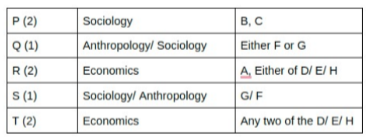
Options A, B and C all include R, and they fail because R guides A, an Economics student.
Hence, option D (P, Q and S).
Q43MCQTeam Selection & Scheduling
Which of the following statements is necessarily true?
- AQ is guiding G.
- BH is an Economics student.
- CS is guiding F.
- DB is scheduled in the first slot.
Answer and solution
Answer: (B) H is an Economics student.
P guides B and C (clue 6), and B is a Sociology student (clue 5), so C is also Sociology. With G (clue 5), the three Sociology students are B, C and G. F is the only Anthropology student (clue 3), so the four Economics students are A, D, E and H. So H is necessarily an Economics student.
R (guiding A) and T are Economics guides with two students each, so they guide all four Economics students. G and F are then guided by Q and S, one each, but nothing fixes which way round.
So options A (Q is guiding G) and C (S is guiding F) are possible but not necessary.
For option D: A is alone at 10:00 and F is at 10:30. By clue 7, G is at 9:30 or 10:30. B, G and a T-guided Economics student share a slot (clue 5); at 10:30 they would make four seminars with F, so they are at 9:30.
B is in the second slot, so option D is false.
Hence, option B (H is an Economics student.).
Q44MCQTeam Selection & Scheduling
If D is scheduled in a slot later than Q's, then which of the following two statement(s) is(are) true?
(i) E and H are guided by T.
(ii) G is guided by Q.
- AOnly (ii)
- BNeither (i) nor (ii)
- COnly (i)
- DBoth (i) and (ii)
Answer and solution
Answer: (D) Both (i) and (ii)
P guides B and C, so B, C and G are Sociology and F is Anthropology; the Economics students are A, D, E and H. R (guiding A) and T are Economics guides, so R's second student and T's two students are D, E and H, and Q and S guide G and F, one each.
A alone is at 10:00 and F at 10:30. By clue 7, G is at 9:30 or 10:30; at 10:30, F, B, G and the T student of clue 5 would make four, so B, G and a T student are at 9:30. T's other student must be in an adjacent slot, and 10:00 holds only A, so it is at 9:00. R's second student must be next to A, and 9:30 is full, so it is at 10:30.
Q's student is G (9:30) or F (10:30). If Q guided F, D would need a slot after 10:30, which is impossible. So Q guides G, and (ii) holds. D is then after 9:30; 10:00 holds only A, so D is at 10:30 as R's second student. So E and H are T's students, and (i) holds.
Both statements hold, so options A and C, which keep only one, fail.
Hence, option D (Both (i) and (ii)).
Q45MCQTeam Selection & Scheduling
If E and Q are both scheduled in the same slot, then which of the following statements BEST describes the relationship between D, H, and T?
- AExactly one of D and H is guided by T.
- BBoth D and H are guided by T.
- CAt least one of D and H is guided by T.
- DNeither D nor H is guided by T.
Answer and solution
Answer: (C) At least one of D and H is guided by T.
P guides B and C, so B, C and G are the Sociology students, F is the Anthropology student, and A, D, E and H are the Economics students, guided by R and T. Q and S guide G and F in some order.
A is alone at 10:00, so G is at 9:30 or 10:30 (clue 7). B shares G's slot and is in the first two slots (clue 6), so B, G and a T-guided Economics student (clue 5) are at 9:30, and C is at 9:00. T's other student must be next to 9:30 but not at 10:00, so it is at 9:00. Clue 1 needs an Economics student at 10:30, so R's second student is there, with F.
If Q guides G, E is T's student at 9:30; D and H are then T's 9:00 student and R's 10:30 student, so exactly one of them is with T. If Q guides F, E is at 10:30 with R, and D and H are both with T.
Either way, at least one of D and H is with T. Option A fails in the second case, option B in the first, and option D in both.
Hence, option C (At least one of D and H is guided by T.).
Q46MCQTeam Selection & Scheduling
If D is scheduled in the slot immediately before Q’s, then which of the following is NOT necessarily true?
- AG is guided by Q.
- BE is guided by R.
- CF is guided by S.
- DD is guided by T.
Answer and solution
Answer: (B) E is guided by R.
P guides B and C, so B, C and G are the Sociology students, F is the Anthropology student, and A, D, E and H are the Economics students, guided by R and T. Q and S guide G and F in some order.
A is alone at 10:00, so G is at 9:30 or 10:30 (clue 7). B shares G's slot and is in the first two slots (clue 6), so B, G and a T-guided Economics student (clue 5) are at 9:30, and C is at 9:00. T's other student must be next to 9:30 but not at 10:00, so it is at 9:00. Clue 1 needs an Economics student at 10:30, so R's second student is there, with F.
Q's student is G (9:30) or F (10:30). The slot just before 10:30 is 10:00, which holds only A, so D cannot precede F. Hence Q guides G, D is at 9:00 as T's student there, and S guides F. E and H are T's 9:30 student and R's 10:30 student, in either order.
So options A, C and D must be true, while E could be guided by T instead of R.
Hence, option B (E is guided by R.).
Data set
Set for questions 47–50
A shopping mall has a large basement parking lot with parking slots painted in it along a single row. These slots are quite narrow; a compact car can fit in a single slot but an SUV requires two slots. When a car arrives, the parking attendant guides the car to the first available slot from the beginning of the row into which the car can fit.
For our purpose, cars are numbered according to the order in which they arrive at the lot. For example, the first car to arrive is given a number 1, the second a number 2, and so on. This numbering does not indicate whether a car is a compact or an SUV. The configuration of a parking lot is a sequence of the car numbers in each slot. Each single vacant slot is represented by letter V.
For instance, suppose cars numbered 1 through 5 arrive and park, where cars 1, 3 and 5 are compact cars and 2 and 4 are SUVs. At this point, the parking lot would be described by the sequence 1, 2, 3, 4, 5. If cars 2 and 5 now vacate their slots, the parking lot would now be described as 1, V, V, 3, 4. If a compact car (numbered 6) arrives subsequently followed by an SUV (numbered 7), the parking lot would be described by the sequence 1, 6, V, 3, 4, 7.
Answer the following questions INDEPENDENTLY of each other.
Q47MCQLogical Puzzles
Initially cars numbered 1, 2, 3, and 4 arrive among which 1 and 4 are SUVs while 2 and 3 are compact cars. Car 1 then leaves, followed by the arrivals of car
5 (a compact car) and car 6 (an SUV). Car 4 then leaves. Then car 7 (an SUV) and car 8 (a compact car) arrive. At this moment, which among the following
numbered car is parked next to car 3?
- A8
- B5
- C6
- D7
Answer and solution
Answer: (D) 7
Track the slots from the start of the row.
Cars 1 (SUV), 2, 3 and 4 (SUV) park: 1, 1, 2, 3, 4, 4. Car 1 leaves: V, V, 2, 3, 4, 4.
Car 5 (compact) takes slot 1. Car 6 (SUV) needs two adjacent free slots; slot 2 is a single gap, so car 6 goes to slots 7 and 8: 5, V, 2, 3, 4, 4, 6, 6.
Car 4 leaves: 5, V, 2, 3, V, V, 6, 6. Car 7 (SUV) cannot use the single slot 2, so it takes slots 5 and 6. Car 8 (compact) then takes slot 2: 5, 8, 2, 3, 7, 7, 6, 6.
Car 3 has car 2 on one side and car 7 on the other. Option A fails because car 8 is in slot 2, next to cars 5 and 2, not car 3.
Hence, option D (7).
Q48MCQLogical Puzzles
Suppose eight cars have arrived, of which two have left. Also suppose that car 4 is a compact and car 7 is an SUV. Which of the following is a POSSIBLE
current configuration of the parking lot?
- A8, 2, 3, V, 6, 5, 7
- BV, 2, 3, 7, 5, 6, 8
- C8, 2, 3, V, 5, 7, 6
- D8, 2, 3, V, 5, 6, 7
Answer and solution
Answer: (D) 8, 2, 3, V, 5, 6, 7
In option D, the cars present are 2, 3, 5, 6, 7 and 8, so cars 1 and 4 left. One possible history: cars 1 to 7 arrive (1 to 6 compact, 7 an SUV) and fill the row in order. Car 1 leaves and car 8, a compact, takes its slot at the front. Car 4, a compact, then leaves a single vacant slot. The row reads 8, 2, 3, V, 5, 6, 7.
Option C (8, 2, 3, V, 5, 7, 6) is the closest trap. Car 7 arrived after 5 and 6, so to sit between them it needs two adjacent slots there that became free after car 6 parked; had they been free earlier, car 6 would have taken them. Only cars 1 and 4 left: car 1 was at the very front, and car 4 is a compact that frees just one slot. So option C is impossible.
Hence, option D (8, 2, 3, V, 5, 6, 7).
Q49MCQLogical Puzzles
Suppose the sequence at some point of time is 4, 5, 6, V, 3. Which of the following is NOT necessarily true?
- ACar 4 is a compact.
- BCar 1 is an SUV.
- CCar 3 is an SUV
- DCar 5 is a compact.
Answer and solution
Answer: (C) Car 3 is an SUV
Cars 1 and 2 are missing, so they have left, and car 3 is still parked.
When car 3 arrived, only cars 1 and 2 had parked, so the row in front of car 3 could be at most four slots long (two each, if both were SUVs); car 3 takes the first slot it can use. Now car 3 has four or more slots before it: cars 4, 5 and 6 take at least one slot each, plus one vacant slot.
So cars 1 and 2 must both be SUVs, filling exactly four slots, and cars 4, 5 and 6 must take one slot each, so they are compacts. Options A, B and D are therefore forced. Nothing fixes car 3's size, so it could be a compact or an SUV.
Hence, option C (Car 3 is an SUV).
Q50MCQLogical Puzzles
Suppose that car 4 is not the first car to leave and that the sequence at a time between the arrival of the car 7 and car 8 is V, 7, 3, 6, 5. Then which of the
following statements MUST be false?
- ACar 2 is a compact.
- BCar 7 is a compact.
- CCar 4 is an SUV.
- DCar 6 is a compact.
Answer and solution
Answer: (D) Car 6 is a compact.
In V, 7, 3, 6, 5, cars 1, 2 and 4 have left. Car 6 arrived after car 5 but sits between cars 3 and 5, so it took the place of car 4, which had parked between them.
Car 4 was not the first to leave, so car 1 or car 2 left earlier, freeing space ahead of car 3. Nothing had filled that space when car 6 arrived: cars 4 and 5 are parked after car 3, and car 7 came later. A compact would have taken that first free slot, so car 6 must be an SUV that did not fit there. 'Car 6 is a compact' must therefore be false.
The other statements are true. Car 4 is an SUV, since car 6 fitted into its place. Car 1 was still parked when car 7 arrived, or car 7 would have taken the first slot, so car 2 left first. Its single slot, too small for car 6, went to car 7, so cars 2 and 7 are compacts.
Hence, option D (Car 6 is a compact).