- CATin
- CAT past papers
- CAT 2019 Slot 1
- QA
CAT 2019 Slot 1 — QA questions with answers
All 34 questions of the Quantitative Ability section (23 MCQs, 11 TITA). Try each one, then open its answer and solution.
CAT 2019 Slot 1, timed like the real exam (180 minutes, 60 a section) and scored the CAT way: +3 right, −1 for a wrong MCQ, 0 for a wrong TITA, with the full post-mock analysis. Older official papers are in CATin Pro, with 80+ mocks and the full planner. The last three years of papers are free.
Sit this paper as a timed mock with CATin ProQuantitative Ability
CAT 2019 Slot 1 · 60 minutes · +3 for a right answer, −1 for a wrong MCQ, 0 for a wrong TITA
Q67MCQTime, Speed & Distance
Two cars travel the same distance starting at 10:00 am and 11:00 am, respectively, on the same day. They reach their common destination at the same
point of time. If the first car travelled for at least 6 hours, then the highest possible value of the percentage by which the speed of the second car could
exceed that of the first car is
- A20
- B30
- C25
- D10
Answer and solution
Answer: (A) 20
Let the distance be
and the first car's travel time be
hours, with
. The second car starts an hour later and arrives at the same time, so it takes
hours.
The ratio of the speeds is
, so the second car is faster by
, that is, by
percent.
This is largest when
is smallest,
, giving
.
A 25% excess would need
, meaning the first car travelled only 5 hours, which breaks the 6-hour condition.
Hence, option A (20).
Q68MCQSequences & Series
If
are in A.P., then,
is equal to
- A
- B
- C
- D
Answer and solution
Answer: (A)
Let the common difference be
(assume
). Rationalise each term:
.
Adding the terms for
to
, the sum telescopes to
.
Multiply the numerator and denominator by
and use
:
.
(If
, every term is
and the same formula holds.)
Check with
: the sum is
, which is what option A gives. Options B and C give 0 for
, and option D has a minus sign where the sum needs a plus.
Hence, option A (
).
Q69MCQPolygons & Circles
AB is a diameter of a circle of radius 5 cm. Let P and Q be two points on the circle so that the length of PB is 6 cm, and the length of AP is twice that of AQ.
Then the length, in cm, of QB is nearest to
- A9.3
- B7.8
- C9.1
- D8.5
Answer and solution
Answer: (C) 9.1
is a diameter of length 10, so the angles
and
are right angles (angles in a semicircle).
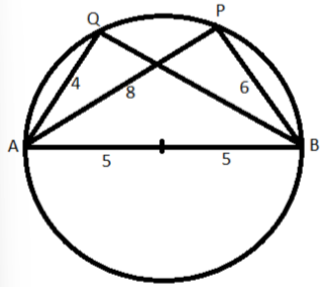
In triangle
:
.
Since
,
.
In triangle
:
.
As
and
,
. This is about 0.07 from 9.1 but about 0.13 from 9.3, so 9.1 is the nearest option.
Hence, option C (9.1).
Q70MCQLogarithms
If
, then the value of
is
- A
- B3
- C1
- D
Answer and solution
Answer: (A)
Take logarithms to base 10.
From
:
, so
.
From
:
, so
.
Since
,
.
Substituting:
, so
and
.
Option B, 3, is the reciprocal; it would need
, not 1.
Hence, option A (
).
Q71MCQPercentages
The income of Amala is 20% more than that of Bimala and 20% less than that of Kamala. If Kamala's income goes down by 4% and Bimala's goes up by
10%, then the percentage by which Kamala's income would exceed Bimala's is nearest to
- A31
- B29
- C28
- D32
Answer and solution
Answer: (A) 31
Take Bimala's income as 100. Amala earns 20% more, that is, 120.
Amala's 120 is 20% less than Kamala's income
, so
and
.
After the changes, Kamala has
and Bimala has
.
Kamala exceeds Bimala by
, which as a percentage of Bimala's income is
.
This is nearest to 31; the neighbouring options, 32 and 29, are more than 1 point away.
Hence, option A (31).
Q72MCQTime, Speed & Distance
The wheels of bicycles A and B have radii 30 cm and 40 cm, respectively. While traveling a certain distance, each wheel of A required 5000 more revolutions
than each wheel of B. If bicycle B traveled this distance in 45 minutes, then its speed, in km per hour, was
- A18π
- B14π
- C16π
- D12π
Answer and solution
Answer: (C) 16π
The circumferences are
cm for A and
cm for B.
Over a distance of
cm, A makes
revolutions and B makes
, and A makes 5000 more:
, so
cm
km, since 1 km
cm.
B covers
km in 45 minutes, which is
of an hour, so its speed is
km per hour.
Option D,
, is the distance in km, not the speed; it ignores that the time is only three-quarters of an hour.
Hence, option C (16π).
Q73MCQInequalities & Modulus
The product of the distinct roots of
is
- A−16
- B-4
- C-24
- D-8
Answer and solution
Answer: (A) −16
Since the left side is an absolute value,
, so
. Factorise:
.
Case 1:
, that is,
or
. The equation becomes
, i.e.
, so
or
. Both fit this case.
Case 2:
, that is,
. The equation becomes
. Dividing by
gives
, so
, which lies in the interval.
The distinct roots are
,
and
, and their product is
.
Stopping after one case gives
(roots
and
) or
(roots
from
); each misses a root.
Hence, option A (−16).
Q74TITATime, Speed & Distance
In a race of three horses, the first beat the second by 11 metres and the third by 90 metres. If the second beat the third by 80 metres, what was the length, in
metres, of the racecourse?
Type in your answer (TITA). No negative mark for a wrong answer.
Answer and solution
Answer: 880
Let the length of the racecourse be meters.
Let the speeds of the three horses be and .
When the first horse finishes the race, it has covered distance .
In the same time, the second horse has covered meters, and the third horse has covered meters.
The ratio of the speeds of the second and third horse is the same as the ratio of the distances they cover in the same time:
--- (1)
When the second horse finishes the race, it has covered distance .
In the same time, the third horse has covered meters.
The ratio of their speeds is:
--- (2)
Equating (1) and (2):
Cross-multiplying:
The length of the racecourse is 880 meters.
Q75MCQSequences & Series
If the population of a town is
in the beginning of any year then it becomes
in the beginning of the next year. If the population in the beginning of 2019 is 1000, then the population in the beginning of 2034 will be
- A
- B
- C
- D
Answer and solution
Answer: (D)
If the population is
at the start of a year, it is
a year later. Adding 3 to both:
. So the population plus 3 doubles every year.
From the beginning of 2019 to the beginning of 2034 there are 15 years. Starting from
, fifteen doublings give
, so the population in 2034 is
.
Check for one year:
, as the rule requires.
Option C has only 14 doublings and 997 in place of 1003, and option A raises 1003, not 2, to the 15th power.
Hence, option D (
).
Q76TITAFunctions & Graphs
Consider a function
satisfying
f(x)
where
are positive integers, and
. If
then
is equal to
Type in your answer (TITA). No negative mark for a wrong answer.
Answer and solution
Answer: 3
Put
:
. With
, this gives
for every positive integer
.
The sum is then
.
The bracket is a geometric series with first term 2, ratio 2 and
terms, so it equals
. Hence the sum is
.
Setting this equal to
and cancelling
(not zero for
) gives
, so
and
.
Check with
:
.
The answer is 3.
Q77MCQRatios, Proportions & Partnership
Amala, Bina, and Gouri invest money in the ratio 3 : 4 : 5 in fixed deposits having respective annual interest rates in the ratio 6 : 5 : 4. What is their total
interest income (in Rs) after a year, if Bina's interest income exceeds Amala's by Rs 250?
- A6350
- B6000
- C7000
- D7250
Answer and solution
Answer: (D) 7250
Let the investments be
,
,
and the rates
,
,
. One year's interest is proportional to principal times rate:
Amala
parts, Bina
parts, Gouri
parts, where one part is
.
Bina's interest exceeds Amala's by
parts, which is Rs 250, so one part is Rs 125.
The total interest is
parts, that is,
rupees.
Option C, 7000, would be only 56 parts; it drops two parts from the total.
Hence, option D (7250).
Q78TITAFunctions & Graphs
For any positive integer
, let
if
is even, and
if
is odd. If
is a positive integer such that
, then
equals
Type in your answer (TITA). No negative mark for a wrong answer.
Answer and solution
Answer: 10
The function is defined as:
if is even
if is odd
We are given where is a positive integer.
We must check two cases based on whether is even or odd.
Case 1: is even
If is even, then .
Since is even, is odd. So .
Substitute into the given equation:
Since is a positive integer, .
We check if is even. Yes, it is. So this is a valid solution.
Case 2: is odd
If is odd, then .
Since is odd, is even. So .
Substitute into the given equation:
The discriminant .
Since is not an integer, will not be an integer. Thus, no valid solution in this case.
The only solution is .
Q79MCQQuadratic & Polynomial Equations
The product of two positive numbers is 616. If the ratio of the difference of their cubes to the cube of their difference is 157:3, then the sum of the two numbers is
- A58
- B85
- C50
- D95
Answer and solution
Answer: (C) 50
Let the numbers be
with
. Use
:
.
So
, giving
.
Then
, so
.
The numbers are 28 and 22 (product 616, difference 6). A sum of 58, the closest-looking option, would need
, but it must be 2500.
Hence, option C (50).
Q80MCQTime, Speed & Distance
One can use three different transports which move at 10, 20, and 30 kmph, respectively to reach from A to B. Amal took each mode of transport for
rd of his total journey time, while Bimal took each mode of transport for
rd of the total distance. The percentage by which Bimal’s travel time exceeds Amal’s travel time is nearest to
- A22
- B20
- C19
- D21
Answer and solution
Answer: (A) 22
Let the three speeds be , , and kmph.
Amal's Journey:
He took each mode for rd of his total journey time.
Let his total time be hours.
He travels at 10 kmph for hours, at 20 kmph for hours, and at 30 kmph for hours.
Total distance covered by Amal km.
Average speed of Amal kmph.
Amal's travel time .
Bimal's Journey:
He took each mode for rd of the total distance.
Let the total distance be . He travels distance at each speed.
Total time taken by Bimal
.
We need to find the percentage by which Bimal's travel time exceeds Amal's travel time.
Amal's travel time = .
Bimal's travel time = .
Excess time = .
Percentage excess =
.
The nearest integer is 22.
Hence, Option A is the correct answer.
Q81MCQPercentages
Meena scores 40% in an examination and after review, even though her score is increased by 50%, she fails by 35 marks. If her post-review score is
increased by 20%, she will have 7 marks more than the passing score. The percentage score needed for passing the examination is
- A60
- B80
- C70
- D75
Answer and solution
Answer: (C) 70
Let the maximum marks be
and the pass mark
.
Meena's first score is
; after a 50% increase it is
, which is 35 short of passing, so
.
A further 20% increase makes it
, which is 7 above the pass mark, so
.
Equating:
, so
and
.
The pass percentage is
.
Option A, 60%, is only her post-review score, which still fails by 35 marks.
Hence, option C (70).
Q82TITASimple & Compound Interest
A person invested a total amount of Rs 15 lakh. A part of it was invested in a fixed deposit earning 6% annual interest, and the remaining amount was
invested in two other deposits in the ratio 2 : 1, earning annual interest at the rates of 4% and 3%, respectively. If the total annual interest income is Rs
76000 then the amount (in Rs lakh) invested in the fixed deposit was
Type in your answer (TITA). No negative mark for a wrong answer.
Answer and solution
Answer: 9
Work in lakh. Let the fixed deposit be
, so the remaining
is split in the ratio
:
at 4% and
at 3%.
Interest from these two parts:
.
The total interest is Rs 76,000, which is 0.76 lakh:
.
Multiplying by 300:
, so
, giving
and
.
Check: 9 lakh at 6% earns Rs 54,000; the other 6 lakh splits into 4 lakh at 4% (Rs 16,000) and 2 lakh at 3% (Rs 6,000), a total of Rs 76,000.
The answer is 9.
Q83MCQSet Theory
A club has 256 members of whom 144 can play football, 123 can play tennis, and 132 can play cricket. Moreover, 58 members can play both football and
tennis, 25 can play both cricket and tennis, while 63 can play both football and cricket. If every member can play at least one game, then the number of
members who can play only tennis is
- A38
- B32
- C45
- D43
Answer and solution
Answer: (D) 43
Let
members play all three games. By inclusion–exclusion:
, so
.
Members who play only tennis are the tennis players minus those who also play football or cricket. The
members in both overlaps are subtracted twice, so they are added back once:
.
Since only-tennis equals
, option C (45) would need
, and options A and B would need a negative
; only
fits the total of 256.
Hence, option D (43).
Q84TITASequences & Series
If
, for every
, then
equals
Type in your answer (TITA). No negative mark for a wrong answer.
Answer and solution
Answer: 6144
Let be the sum of the first terms of the series.
.
We need to find , the 11th term of the series.
The -th term of a sequence can be found using .
So, .
Substitute into the sum formula:
.
Substitute into the sum formula:
.
Now find :
.
Alternatively, algebraically:
.
.
.
Q85MCQFunctions & Graphs
The number of the real roots of the equation
is
- A2
- B1
- Cinfinite
- D0
Answer and solution
Answer: (B) 1
Right side:
and
are positive, so by AM–GM,
, with equality only when
, that is,
.
Left side: cosine never exceeds 1, so
.
The two sides can be equal only when both are 2, which forces
. At
the left side is
and the right side is
, so
is a root.
For every other
the right side exceeds 2, so there are no other roots. The periodic cosine does not create infinitely many solutions, and the count is not 0, because
works.
Hence, option B (1).
Q86MCQTime & Work
At their usual efficiency levels, A and B together finish a task in 12 days. If A had worked half as efficiently as she usually does, and B had worked thrice as efficiently as he usually does, the task would have been completed in 9 days. How many days would A take to finish the task if she works alone at her usual
efficiency?
- A36
- B24
- C18
- D12
Answer and solution
Answer: (C) 18
Let A and B do
and
of the task per day. Together they need 12 days, so
.
At half and triple efficiency they need 9 days, so
.
Multiply the first equation by 3:
. Subtract the second:
, so
and
.
So A alone takes 18 days. Then
: the 36 days of option A is B's time, not A's.
Hence, option C (18).
Q87TITAPercentages
In a class, 60% of the students are girls and the rest are boys. There are 30 more girls than boys. If 68% of the students, including 30 boys, pass an
examination, the percentage of the girls who do not pass is
Type in your answer (TITA). No negative mark for a wrong answer.
Answer and solution
Answer: 20
Let the total number of students in the class be .
Number of girls = 60% of .
Number of boys = 40% of .
We are given that there are 30 more girls than boys:
.
Total number of students = 150.
Number of girls = .
Number of boys = .
Total number of students who pass the examination = 68% of 150.
.
Out of these 102 students who passed, 30 are boys.
So, the number of girls who passed = .
Total number of girls is 90.
Number of girls who do not pass = .
The percentage of girls who do not pass is:
.
Q88MCQPolygons & Circles
In a circle of radius 11 cm, CD is a diameter and AB is a chord of length 20.5 cm. If AB and CD intersect at a point E inside the circle and CE has length 7 cm,
then the difference of the lengths of BE and AE, in cm, is
- A2.5
- B1.5
- C3.5
- D0.5
Answer and solution
Answer: (D) 0.5
is a diameter, so
and
.
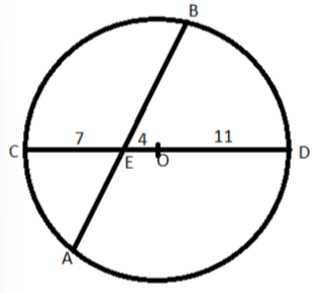
By the intersecting chords theorem,
. Also
.
Then
, so the difference is
.
Indeed,
and
are 10.5 and 10: their sum is 20.5 and their product is 105.
A difference of 1.5, the next option, would need
, which means
, not 105.
Hence, option D (0.5).
Q89MCQProfit, Loss & Discount
On selling a pen at 5% loss and a book at 15% gain, Karim gains Rs. 7. If he sells the pen at 5% gain and the book at 10% gain, he gains Rs. 13. What is the
cost price of the book in Rupees?
- A95
- B85
- C80
- D100
Answer and solution
Answer: (C) 80
Let the cost prices be
for the pen and
for the book.
First sale, a 5% loss on the pen and a 15% gain on the book, nets Rs 7:
.
Second sale, a 5% gain on the pen and a 10% gain on the book, nets Rs 13:
.
Adding the two equations removes
:
, so
.
Then
, so
. Option D, 100, is the pen's cost price, not the book's.
Check:
.
Hence, option C (80).
Q90MCQAverages, Mixtures & Alligations
A chemist mixes two liquids 1 and 2. One litre of liquid 1 weighs 1 kg and one litre of liquid 2 weighs 800 gm. If half litre of the mixture weighs 480 gm, then
the percentage of liquid 1 in the mixture, in terms of volume, is
- A80
- B70
- C85
- D75
Answer and solution
Answer: (A) 80
One litre of liquid 1 weighs 1000 g and one litre of liquid 2 weighs 800 g. Half a litre of the mixture weighs 480 g, so one litre of it weighs 960 g.
Let one litre of the mixture contain
litres of liquid 1 and
litres of liquid 2:
, so
and
.
So liquid 1 is 80% of the mixture by volume.
Option D, 75%, would give
g per litre, that is, 475 g per half litre, not 480 g.
Hence, option A (80).
Q91MCQAverages, Mixtures & Alligations
Ramesh and Gautam are among 22 students who write an examination. Ramesh scores 82.5. The average score of the 21 students other than Gautam is
62. The average score of all the 22 students is one more than the average score of the 21 students other than Ramesh. The score of Gautam is
- A53
- B51
- C48
- D49
Answer and solution
Answer: (B) 51
The 21 students other than Gautam, namely the 20 others and Ramesh, total
.
Let
be the average of the 21 students other than Ramesh, namely the 20 others and Gautam. Adding Ramesh gives all 22, whose average is
:
, so
and this group totals
.
The two groups of 21 differ only in Ramesh and Gautam, so Ramesh's score minus Gautam's is
.
Gautam's score is
. A score of 53, for example, would make that difference 29.5, not 31.5.
Hence, option B (51).
Q92MCQIndices & Surds
If
and
are integers such that
then
is
- A-20
- B-24
- C-12
- D-16
Answer and solution
Answer: (C) -12
Write every base as a power of 2 or 3.
Left side:
,
,
and
, so the left side is
.
Right side:
and
, so the right side is
.
Since 2 and 3 are different primes, the powers of each must match.
Powers of 3:
.
Powers of 2:
, which simplifies to
.
Substituting
:
, so
and
. Then
.
Option A (
) is the value of
, not
, so it answers for the wrong unknown.
Hence, option C (-12).
Q93TITATime & Work
Three men and eight machines can finish a job in half the time taken by three machines and eight men to finish the same job. If two machines can finish the
job in 13 days, then how many men can finish the job in 13 days?
Type in your answer (TITA). No negative mark for a wrong answer.
Answer and solution
Answer: 13
Let the work done by 1 man in 1 day be , and the work done by 1 machine in 1 day be .
We are given that 3 men and 8 machines can finish the job in half the time taken by 3 machines and 8 men.
Since time and efficiency (work done per day) are inversely proportional, this means 3 men and 8 machines are twice as efficient as 3 machines and 8 men.
This means the work done by 2 machines in a day is exactly equal to the work done by 13 men in a day.
We are given that 2 machines can finish the job in 13 days.
Since 2 machines are equivalent to 13 men in terms of work rate, replacing the 2 machines with 13 men would still finish the job in exactly the same time (13 days).
Therefore, 13 men can finish the job in 13 days.
Q94MCQPolygons & Circles
Corners are cut off from an equilateral triangle
to produce a regular hexagon
. Then, the ratio of the area of H to the area of T is
- A2 : 3
- B4 : 5
- C5 : 6
- D3 : 4
Answer and solution
Answer: (A) 2 : 3
Each angle of a regular hexagon is
, so each corner cut from
is a triangle with a
angle at the corner of
and
at both ends of the cut: an equilateral triangle. Its cut edge is a side of the hexagon, so if the hexagon has side
, every corner triangle has side
. Each side of
is then
.
Area of
.
The three corner triangles remove
.
Area of
, so
.
Equivalently,
splits into 9 equilateral triangles of side
, and the hexagon holds 6 of them:
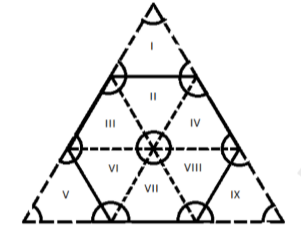
Option D (3 : 4) would mean only a quarter of
is removed. That needs smaller corner triangles, and then the middle part of each side of
is longer than the cut edges, so the hexagon would not be regular.
Hence, option A (2 : 3).
Q95MCQLogarithms
Let
and
be positive real numbers such that
, and
. Then
equals
- A150
- B25
- C100
- D250
Answer and solution
Answer: (A) 150
From the first equation,
, so
.
From the second,
, so
and
.
Substituting:
, so
and
, since
is positive. Then
.
Check:
and
are both positive, so the logarithms are defined, and
.
So
.
No other value is possible, because
is fixed once
. For example, option C (100) would need
, but then
, not 125.
Hence, option A (150).
Q96TITACoordinate Geometry
Let
be the set of all points
in the
plane such that
and
. Then, the area, in square units, of the region represented by
equals
Type in your answer (TITA). No negative mark for a wrong answer.
Answer and solution
Answer: 2
The condition
gives the square with vertices
,
,
and
. The condition
keeps only its parts with
or
.
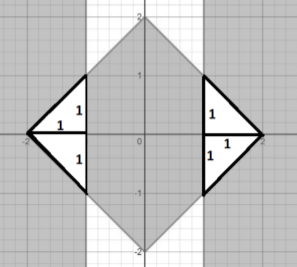
For
, the region is
: the triangle with vertices
,
and
. Its base on the line
runs from
to
, so it has length 2, and its height is
. Its area is
.
By symmetry about the
-axis, the part with
is the triangle with vertices
,
and
, also of area 1.
Total area of
square units.
The answer is 2.
Q97TITAPermutations & Combinations
With rectangular axes of coordinates, the number of paths from
to
via
, where each step from any point
is either to
or to
, is
Type in your answer (TITA). No negative mark for a wrong answer.
Answer and solution
Answer: 3920
A step is either [Right step, R] or [Up step, U].
This is a standard grid path problem.
The number of paths from to is given by where and .
We need to go from to and then from to .
Path from (1, 1) to (4, 6):
Total steps = .
Number of paths = .
Path from (4, 6) to (8, 10):
Total steps = .
Number of paths = .
Since these are sequential and independent choices, we multiply the number of paths:
Total paths = .
Q98MCQMensuration
If the rectangular faces of a brick have their diagonals in the ratio
, then the ratio of the length of the shortest edge of the brick to that of its
longest edge is
- A
- B
- C
- D
Answer and solution
Answer: (B)
Let the edges be
,
and
. The face diagonals are
,
and
, in the ratio
.
Squaring,
,
and
for some
.
Adding the three:
, so
.
Subtracting each equation from this:
,
and
.
So the edges are
,
and
. The shortest to the longest is
.
Option D (
) is the ratio of the middle edge to the longest,
, not of the shortest to the longest.
Hence, option B (
).
Q99TITAInequalities & Modulus
The number of solutions to the equation
is
Type in your answer (TITA). No negative mark for a wrong answer.
Answer and solution
Answer: 5
Consider three cases.
Case 1:
. Both sides are 0, so
is a solution.
Case 2:
. Then
, and dividing by
gives
, that is,
, or
. So
or
; both are positive, giving 2 solutions.
Case 3:
. Then
, and dividing by
gives
, that is,
, or
. So
or
; both are negative, giving 2 more solutions.
This matches the symmetry of the equation: replacing
by
leaves both sides unchanged, so every nonzero solution has a mirror image.
Total:
solutions.
The answer is 5.
Q100TITACoordinate Geometry
Let
be the triangle formed by the straight line
and the coordinate axes. Let the circumcircle of T have radius of length
, measured in the
same unit as the coordinate axes. Then, the integer closest to
is
Type in your answer (TITA). No negative mark for a wrong answer.
Answer and solution
Answer: 9
The line
meets the
-axis where
, at
, and the
-axis where
, at
. With the origin
, these are the vertices of
.
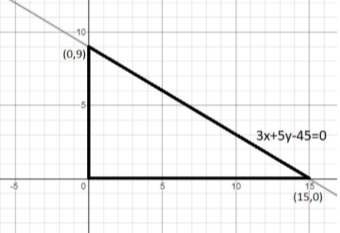
The axes are perpendicular, so
has a right angle at
. The circumcentre of a right-angled triangle is the midpoint of its hypotenuse, so the circumradius is half the hypotenuse
.
, so
and
.
Since
and
,
lies between 8.5 and 9, so the nearest integer is 9. (In fact
, so
.)
The answer is 9.