- CATin
- CAT past papers
- CAT 2017 Slot 1
- QA
CAT 2017 Slot 1 — QA questions with answers
All 34 questions of the Quantitative Ability section (23 MCQs, 11 TITA). Try each one, then open its answer and solution.
CAT 2017 Slot 1, timed like the real exam (180 minutes, 60 a section) and scored the CAT way: +3 right, −1 for a wrong MCQ, 0 for a wrong TITA, with the full post-mock analysis. Older official papers are in CATin Pro, with 80+ mocks and the full planner. The last three years of papers are free.
Sit this paper as a timed mock with CATin ProQuantitative Ability
CAT 2017 Slot 1 · 60 minutes · +3 for a right answer, −1 for a wrong MCQ, 0 for a wrong TITA
Q67TITALinear Equations
Arun's present age in years is 40% of Barun's. In another few years, Arun's age will be half of Barun's. By what percentage will Barun's age increase during this period?
Type in your answer (TITA). No negative mark for a wrong answer.
Answer and solution
Answer: 20
Let Arun's current age be A. Hence, Barun's current age is 2.5A
Let Arun's age be half of Barun's age after X years.
Therefore, 2*(X+A) = 2.5A + X
Or, X = 0.5A
Hence, Barun's age increased by 0.5A/2.5A = 20%
Q68TITATime & Work
A person can complete a job in 120 days. He works alone on Day 1. On Day 2, he is joined by another person who also can complete the job in exactly 120 days. On Day 3, they are joined by another person of equal efficiency. Like this, everyday a new person with the same efficiency joins the work. How many days are required to complete the job?
Type in your answer (TITA). No negative mark for a wrong answer.
Answer and solution
Answer: 15
Let one person do
units of work per day, so the whole job is
units.
On day 1 one person works, on day 2 two people work, on day 3 three, and so on. So the work done on days 1, 2, 3, … is
If the job ends on day
, the total work is
.
Setting this equal to
gives
. Since
,
; the other root of
is
, which is impossible. The job is finished exactly at the end of day 15.
The answer is 15.
Q69TITAInequalities & Modulus
An elevator has a weight limit of 630 kg. It is carrying a group of people of whom the heaviest weighs 57 kg and the lightest weighs 53 kg. What is the maximum possible number of people in the group?
Type in your answer (TITA). No negative mark for a wrong answer.
Answer and solution
Answer: 11
The group has one person of 57 kg and one of 53 kg. To fit the most people, everyone else should be as light as allowed, that is 53 kg each.
Let there be
other people. The total weight must not exceed the limit:
, so
and
.
So there are at most 9 other people, and the group has at most
people.
Check: 11 people can weigh as little as
kg, within 630 kg, while 12 people would weigh at least
kg, over the limit.
The answer is 11.
Q70TITATime, Speed & Distance
A man leaves his home and walks at a speed of 12 km per hour, reaching the railway station 10 minutes after the train had departed. If instead he had walked at a speed of 15 km per hour, he would have reached the station 10 minutes before the train's departure. The distance (in km) from his home to the railway station is
Type in your answer (TITA). No negative mark for a wrong answer.
Answer and solution
Answer: 20
We see that the man saves 20 minutes by changing his speed from 12 km/hr to 15 km/hr.
Let
be the distance. Then:
Q71TITAPercentages
Ravi invests 50% of his monthly savings in fixed deposits. Thirty percent of the rest of his savings is invested in stocks and the rest goes into Ravi's savings bank account. If the total amount deposited by him in the bank (for savings account and fixed deposits) is Rs 59500, then Ravi's total monthly savings (in
Rs) is
Type in your answer (TITA). No negative mark for a wrong answer.
Answer and solution
Answer: 70000
Let Ravi's total monthly savings be
.
He puts 50%, that is
, in fixed deposits. The rest is
; 30% of it,
, goes into stocks, and the remaining
goes into the savings bank account.
Total deposited in the bank (fixed deposits and savings account)
.
Given
, we get
, so the total savings are
.
Check: fixed deposits get 35000; of the other 35000, stocks take 10500 and the savings account gets 24500; and
.
The answer is 70000.
Q72MCQProfit, Loss & Discount
If a seller gives a discount of 15% on retail price, she still makes a profit of 2%. Which of the following ensures that she makes a profit of 20%?
- AGive a discount of 5% on retail price.
- BGive a discount of 2% on retail price.
- CIncrease the retail price by 2%.
- DSell at retail price.
Answer and solution
Answer: (D) Sell at retail price.
Let the retail price be
and the cost price be
.
A 15% discount still gives a 2% profit, so
, which gives
.
A 20% profit means selling at
, which is exactly the retail price
. So she should sell at the retail price, with no discount.
The other options miss 20%. A 2% discount (B) gives
, a 17.6% profit; a 5% discount (A) gives
, a 14% profit; and raising the retail price by 2% (C) gives
, a 22.4% profit.
Hence, option D (Sell at retail price.).
Q73MCQTime, Speed & Distance
A man travels by a motor boat down a river to his office and back. With the speed of the river unchanged, if he doubles the speed of his motor boat, then his total travel time gets reduced by 75%. The ratio of the original speed of the motor boat to the speed of the river is
- A
- B
- C
- D3:2
Answer and solution
Answer: (B)
Let the boat's speed be
, the river's speed
and the one-way distance
.
Original time:
.
Doubling the boat's speed cuts the time by 75%, to
:
.
So
, which gives
, that is
.
Hence
.
The ratio 3:2 (D) does not work: with
and
the time goes from
to
, a cut of only 68.75%, not 75%.
Hence, option B (
).
Q74MCQRatios, Proportions & Partnership
Suppose, C1, C2, C3, C4, and C5 are five companies. The profits made by C1, C2, and C3 are in the ratio 9 : 10 : 8 while the profits made by C2, C4, and C5 are in the ratio 18 : 19 : 20. If C5 has made a profit of Rs 19 crore more than C1, then the total profit (in Rs) made by all five companies is
- A438 crore
- B435 crore
- C348 crore
- D345 crore
Answer and solution
Answer: (A) 438 crore
First make the share of
the same in both ratios.
(multiplying by 9), and
(multiplying by 5).
So
. Let the profits be
and
crore.
exceeds
by 19 crore:
, so
.
Total profit
crore.
The total must be
with
, so 435 crore (B) and the other options cannot occur; 348 crore (C) only swaps the digits of 438.
Hence, option A (438 crore).
Q75MCQPercentages
The number of girls appearing for an admission test is twice the number of boys. If 30% of the girls and 45% of the boys get admission, the percentage of candidates who do not get admission is
- A35
- B50
- C60
- D65
Answer and solution
Answer: (D) 65
Let the number of boys be
, so the number of girls is
and there are
candidates.
Girls admitted: 30% of
is
. Boys admitted: 45% of
is
.
Total admitted
, so the number not admitted is
.
Percentage not admitted
.
Option A (35) is the percentage who do get admission,
; the question asks for those who do not.
Hence, option D (65).
Q76MCQRatios, Proportions & Partnership
A stall sells popcorn and chips in packets of three sizes: large, super, and jumbo. The numbers of large, super, and jumbo packets in its stock are in the ratio 7 : 17 : 16 for popcorn and 6 : 15 : 14 for chips. If the total number of popcorn packets in its stock is the same as that of chips packets, then the numbers of
jumbo popcorn packets and jumbo chips packets are in the ratio
- A1:1
- B8:7
- C4:3
- D6:5
Answer and solution
Answer: (A) 1:1
Popcorn packets (large, super, jumbo) are
, a total of
. Chips packets are
, a total of
.
The totals are equal:
, so
.
Jumbo popcorn
, and jumbo chips
.
So the ratio is
.
Option B (8:7) compares 16 with 14 directly, as if
. That ignores the condition that the two stocks have equal totals, which makes
smaller than
.
Hence, option A (1:1).
Q77MCQProfit, Loss & Discount
In a market, the price of medium quality mangoes is half that of good mangoes. A shopkeeper buys 80 kg good mangoes and 40 kg medium quality mangoes from the market and then sells all these at a common price which is 10% less than the price at which he bought the good ones. His overall profit is
- A6%
- B8%
- C10%
- D12%
Answer and solution
Answer: (B) 8%
Let medium mangoes cost
per kg, so good mangoes cost
per kg.
Cost: good mangoes
and medium mangoes
, a total of
.
All 120 kg are sold at 10% below the good-mango price:
per kg. Revenue
.
Profit
, so the profit percentage is
.
Option C (10%) comes from dividing the profit by the cost of the good mangoes alone,
; the profit must be measured on the whole cost,
.
Hence, option B (8%).
Q78MCQProfit, Loss & Discount
If Fatima sells 60 identical toys at a 40% discount on the printed price, then she makes 20% profit. Ten of these toys are destroyed in fire. While selling the rest, how much discount should be given on the printed price so that she can make the same amount of profit?
- A30%
- B25%
- C24%
- D28%
Answer and solution
Answer: (D) 28%
Let the cost price of a toy be
and the printed price be
.
Selling at a 40% discount gives a 20% profit:
, so
.
All 60 toys were paid for, so the cost is
, and the original profit is 20% of
, that is
. To make the same profit, the revenue must be
.
Only 50 toys are left, each sold at
, where
is the discount:
, so
and
, a 28% discount.
The trap is using the cost of the 50 remaining toys only; the burnt toys were paid for too. A 30% discount (A) would bring in only
, short of
.
Hence, option D (28%).
Q79MCQLinear Equations
If
and
are integers of opposite signs such that
and
, then the ratio
is
- A9:4
- B81:4
- C1:4
- D25:4
Answer and solution
Answer: (D) 25:4
Since the square root can be positive or negative, we get two cases for each equation.
For the first equation:
, so:
-
... (i)
-
... (ii)
For the second equation:
, so:
-
... (iii)
-
... (iv)
Solving (i) and (iii):
and
. Substituting:
. But
and
must have opposite signs. ✗
Solving (i) and (iv):
and
. So
. Not an integer. ✗
Solving (ii) and (iii):
and
. So
. Not an integer. ✗
Solving (ii) and (iv):
and
. So
. Opposite signs ✓
Therefore
Q80MCQAverages, Mixtures & Alligations
A class consists of 20 boys and 30 girls. In the mid-semester examination, the average score of the girls was 5 higher than that of the boys. In the final exam, however, the average score of the girls dropped by 3 while the average score of the entire class increased by 2. The increase in the average score of the boys is
- A9.5
- B10
- C4.5
- D6
Answer and solution
Answer: (A) 9.5
Work with total scores.
The class has 50 students and its average rose by 2, so the class total rose by
.
The 30 girls' average fell by 3, so the girls' total fell by
.
The boys' total must therefore have risen by
, and the average of the 20 boys rose by
. The mid-semester gap of 5 between girls and boys does not affect these changes.
The table below does the same with the boys' mid-term average as
: the girls go from
to
, the class average from
to
, and the boys from
to
.
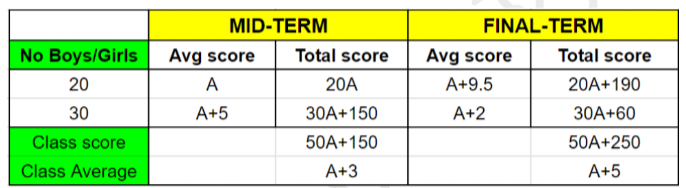
Check option B (10): the boys' total would rise by 200, the class total by
, and the class average by
, not 2.
Hence, option A (9.5).
Q81MCQCoordinate Geometry
The area of the closed region bounded by the equation
in the two-dimensional plane is
- A sq. units
- B sq. units
- C sq. units
- D sq. units
Answer and solution
Answer: (C) sq. units
In the first quadrant,
is the line
, from
to
. By symmetry, the other quadrants give the lines joining
,
,
and back to
.
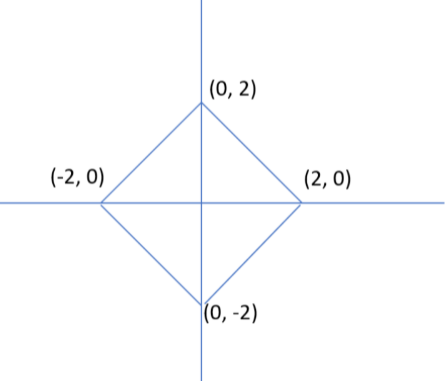
So the region is a square with vertices
,
,
and
. Its diagonals lie along the axes and each is 4 long.
Area
square units. Check: each side is
, and
.
Option B (4) takes the side as 2, the distance from the origin to a vertex; the side is actually
. The options with
would need a circle, but the boundary is made of straight lines.
Hence, option C (
sq. units).
Q82MCQTriangles & Lines
From a triangle ABC with sides of lengths 40 ft, 25 ft and 35 ft, a triangular portion GBC is cut off where G is the centroid of ABC. The area, in sq ft, of the remaining portion of triangle ABC is
- A
- B
- C
- D
Answer and solution
Answer: (B)
The sides are 40, 25 and 35 ft, so the semi-perimeter is
.
By Heron's formula, the area of
is
sq ft.
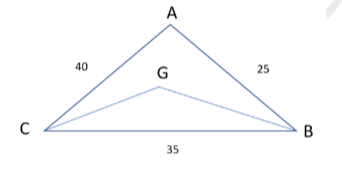
The three medians split a triangle into six small triangles of equal area. Triangle
is made of two of them, so it is one third of
:
.
The remaining portion, triangles
and
together, is two thirds of
:
sq ft.
Option D (
) is the area of the piece
that is cut off, not of what remains.
Hence, option B (
).
Q83MCQPolygons & Circles
Let ABC be a right-angled isosceles triangle with hypotenuse BC. Let BQC be a semi-circle, away from A, with diameter BC. Let BPC be an arc of a circle
centered at A and lying between BC and BQC. If AB has length 6 cm then the area, in sq cm, of the region enclosed by BPC and BQC is
- A
- B
- C
- D
Answer and solution
Answer: (B)
cm and the right angle is at
, so
cm.
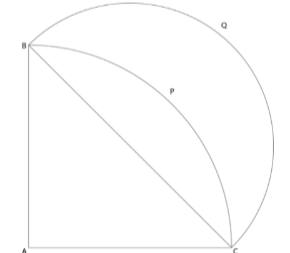
Semicircle
has radius
, so its area is
.
Arc
has centre
and radius 6, and
, so it is a quarter circle. The region between chord
and arc
is the quarter circle minus triangle
:
.
The required region lies between arc
and arc
, so it is the semicircle minus that segment:
sq cm.
Option A (
) is the area of the segment between
and arc
, not the region between the two arcs.
Hence, option B (
).
Q84MCQMensuration
A solid metallic cube is melted to form five solid cubes whose volumes are in the ratio
1 : 1 : 8 : 27 : 27. The percentage by which the sum of the surface areas of these five cubes exceeds the surface area of the original cube is nearest to
- A10
- B50
- C60
- D20
Answer and solution
Answer: (B) 50
Let the five volumes be
. Then the sides are
.
The original cube had volume
, so its side was
and its surface area
.
The five new cubes have total surface area
.
Excess
percent.
The excess is exactly 50%, so 60 (C) is too large: a 60% excess would need a new total of
.
Hence, option B (50).
Q85TITAMensuration
A ball of diameter 4 cm is kept on top of a hollow cylinder standing vertically. The height of the cylinder is 3 cm, while its volume is 9π cubic centimeters.
Then the vertical distance, in cm, of the topmost point of the ball from the base of the cylinder is
Type in your answer (TITA). No negative mark for a wrong answer.
Answer and solution
Answer: 6
The cylinder's volume is
, so
and
cm.
The ball's radius, 2 cm, is more than
cm, so the ball cannot drop inside; it rests on the circular rim at the top of the cylinder, with its centre directly above the centre of the rim.
In a vertical cross-section through the centre, shown below, the line from the ball's centre to a point where it touches the rim is a radius of the ball, 2 cm, and its horizontal part is the rim's radius,
cm. So the ball's centre is
cm above the rim.
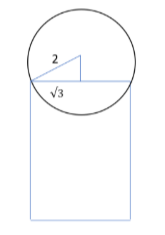
The topmost point of the ball is one radius, 2 cm, above its centre. Its height above the base is therefore
cm.
The answer is 6.
Q86TITATriangles & Lines
Let ABC be a right-angled triangle with BC as the hypotenuse. Lengths of AB and AC are 15 km and 20 km, respectively. The minimum possible time, in
minutes, required to reach the hypotenuse from A at a speed of 30 km per hour is
Type in your answer (TITA). No negative mark for a wrong answer.
Answer and solution
Answer: 24
The shortest path from A to the hypotenuse BC is the altitude from A.
Given:
km,
km (right angle at A).
Hypotenuse:
km
Length of altitude
from A to BC (using area method):
Time taken at 30 km/hr:
minutes
Q87MCQLogarithms
Suppose
, where
are positive numbers. If
is the geometric mean of
and
, then
is equal to
- A
- B
- C
- D
Answer and solution
Answer: (D)
From
and
, we get
and
.
The geometric mean is
.
So
.
Option B (
) is
, the value you get if you forget the square root in the geometric mean. Taking the square root halves the logarithm, which gives
.
Hence, option D (
).
Q88MCQQuadratic & Polynomial Equations
If
and
, then
is
- A
- B
- C
- D
Answer and solution
Answer: (D)
From
we have
.
Then
, so
.
Since
, solving
gives
.
So
.
Option B (
) is just
; it leaves out the
that comes from
.
Hence, option D (
).
Q89MCQLogarithms
The value of
is equal to
- A1/3
- B2/3
- C5/6
- D7/6
Answer and solution
Answer: (C) 5/6
Write each base and argument as a power of a prime.
and
, so
.
and
, so
.
The expression is
.
Option D (
) comes from taking the first logarithm as
. But the base
is less than 1 while
is more than 1, so that logarithm must be negative.
Hence, option C (5/6).
Q90MCQIndices & Surds
If
then x is
- A3
- B9/4
- C4/9
- D1/3
Answer and solution
Answer: (B) 9/4
The equation is
.
Write both terms using
:
and
.
So
, that is
.
Then
.
Since
, we get
and
.
Option C (
) inverts this result, and
(A) would make the left side
, far more than 1944.
Hence, option B (9/4).
Q91MCQPermutations & Combinations
The number of solutions
to the equation
, where
,
, and
are positive integers such that
, and
is
- A101
- B99
- C87
- D105
Answer and solution
Answer: (B) 99
Since
, we have
, and also
. Let
, which runs from 2 to 15. For each
, count the pairs with
and
.
For
to
,
can be
, giving
pairs; together
.
For
,
runs from 2 to 12 (11 pairs); for
,
runs from 3 to 12 (10 pairs).
Total
.
Option D (105) forgets the cap of 12: counting
pairs for every
gives
, which includes pairs such as
.
Hence, option B (99).
Q92TITAInequalities & Modulus
For how many integers n, will the inequality
be satisfied?
Type in your answer (TITA). No negative mark for a wrong answer.
Answer and solution
Answer: 11
=>
=>
=>
=> Thus, n can take values from 4 to 14. Hence, the required number of values are 14 - 4 + 1 = 11.
Q93TITAQuadratic & Polynomial Equations
If
and
, then the largest positive integer
for which the equation
has two distinct real roots is
Type in your answer (TITA). No negative mark for a wrong answer.
Answer and solution
Answer: 24
For two distinct real roots:
The largest positive integer
can take is
.
Q94TITAInequalities & Modulus
If
, and
are integers such that
, then the minimum possible value of
is
Type in your answer (TITA). No negative mark for a wrong answer.
Answer and solution
Answer: 2
Each term is the square of an integer, so the expression is a sum of three non-negative integers.
It cannot be
: that needs
, so
, which has no integer solution.
It cannot be
: the only way to get 1 from three squares is
, so two of
equal
and the third is
. Then
, which again has no integer solution.
A total of
is possible. Take
,
,
,
. The sum is
, and
.
So the minimum value is 2.
The answer is 2.
Q95TITAPermutations & Combinations
Let AB, CD, EF, GH, and JK be five diameters of a circle with center at O. In how many ways can three points be chosen out of A, B, C, D, E, F, G, H, J, K, and O
so as to form a triangle?
Type in your answer (TITA). No negative mark for a wrong answer.
Answer and solution
Answer: 160
There are 11 points: the 10 ends of the diameters, which lie on the circle, and the centre
.
Any 3 of them can be chosen in
ways. A choice fails to form a triangle only if the three points are collinear.
No three points of a circle are collinear, so a collinear choice must include
.
is collinear with two points of the circle only when they are the two ends of the same diameter. That gives exactly 5 bad choices:
,
,
,
and
.
So the number of triangles is
.
The answer is 160.
Q96MCQFunctions & Graphs
The shortest distance of the point
from the curve
is
- A1
- B0
- C
- D
Answer and solution
Answer: (A) 1
Write
piece by piece: for
,
; for
,
; for
,
.
So the curve is a flat segment at height 2 between
and
, with arms rising on both sides. Every point on it has
.
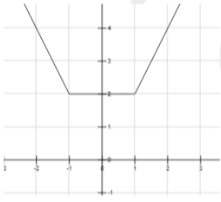
The point
has
, so every point of the curve is at least 1 unit above it, and hence at least 1 unit away. The point
on the flat segment, directly above it, is exactly 1 unit away. So the shortest distance is 1.
Option B (0) fails:
lies on the line
, but that line is part of the curve only for
; at
the curve is at height 2.
Hence, option A (1).
Q97MCQSequences & Series
If the square of the 7th term of an arithmetic progression with positive common difference equals the product of the 3rd and 17th terms, then the ratio of
the first term to the common difference is
- A2:3
- B3:2
- C3:4
- D4:3
Answer and solution
Answer: (A) 2:3
Let the first term be
and the common difference
. The 7th, 3rd and 17th terms are
,
and
.
We are given
.
Expanding:
, so
.
Since
, divide by
:
, so
.
Option B (3:2) is
, the ratio the other way round; the question asks for the first term to the common difference.
Hence, option A (2:3).
Q98MCQPermutations & Combinations
In how many ways can 7 identical erasers be distributed among 4 kids in such a way that each kid gets at least one eraser but nobody gets more than 3
erasers?
- A16
- B20
- C14
- D15
Answer and solution
Answer: (A) 16
Let the kids get
erasers, with
and each at least 1.
The number of such distributions is
.
Now remove those where a kid gets more than 3. The other three kids get at least 1 each, so no kid can get more than
. A kid gets exactly 4 only when the others get 1 each, and this can be any of the 4 kids: 4 cases.
So the number of ways is
.
Option B (20) counts every distribution with at least one eraser each, including the 4 where a kid gets 4 erasers.
Hence, option A (16).
Q99MCQFunctions & Graphs
If
and
, then the value of
is
- A2
- B
- C6
- D
Answer and solution
Answer: (A) 2
First,
.
Next,
.
So
, and
.
A common slip is to stop after one application of
:
, which is not an option. Once
is found, the answer is
, not 6 (C) or a fraction such as
(D).
Hence, option A (2).
Q100MCQSequences & Series
Let
be an arithmetic progression with
and
. If
, then what is the smallest positive integer
such that
?
- A8
- B9
- C10
- D11
Answer and solution
Answer: (B) 9
Here
and
, so the common difference is 4.
Let
. The sum of the first
terms is
.
So
, that is
, which factors as
. Hence
and
.
Sum of the first 10 terms
.
We need
, that is
, so the smallest integer is
:
.
Option A (8) fails because
, which is less than 1830.
Hence, option B (9).