- CATin
- CAT past papers
- CAT 2024 Slot 2
- QA
CAT 2024 Slot 2 — QA questions with answers
All 22 questions of the Quantitative Ability section (14 MCQs, 8 TITA). Try each one, then open its answer and solution.
CAT 2024 Slot 2, timed like the real exam (120 minutes, 40 a section) and scored the CAT way: +3 right, −1 for a wrong MCQ, 0 for a wrong TITA, with the full post-mock analysis. Free — sign in and you come straight back to this paper.
Sit this paper as a timed mock in CATin — freeQuantitative Ability
CAT 2024 Slot 2 · 40 minutes · +3 for a right answer, −1 for a wrong MCQ, 0 for a wrong TITA
Q47TITAProfit, Loss & Discount
Bina incurs 19% loss when she sells a product at Rs. 4860 to Shyam, who in turn sells this product to Hari. If Bina would have sold this product to Shyam at the purchase price of Hari, she would have obtained 17% profit. Then, the profit, in rupees, made by Shyam is
Type in your answer (TITA). No negative mark for a wrong answer.
Answer and solution
Answer: 2160
Let the cost price of the item be C
We are given that Bina sells this at 19% loss or at (1 - 0.19)C = 0.81C at 4860
This gives us the value of C at Rs. 6000
If Bina had sold this at 17% profit, the selling price would have been 1.17× 6000 = 7020
So Shyam bought the product at 4860 and sold it to Hari at 7020
Giving the profit made by Shyam to be 7020−4860 = 2160
Therefore, 2160 is the correct answer.
Q48TITATriangles & Lines
The coordinates of the three vertices of a triangle are:
,
, and
. Then the radius of the incircle of the triangle is
Type in your answer (TITA). No negative mark for a wrong answer.
Answer and solution
Answer: 2
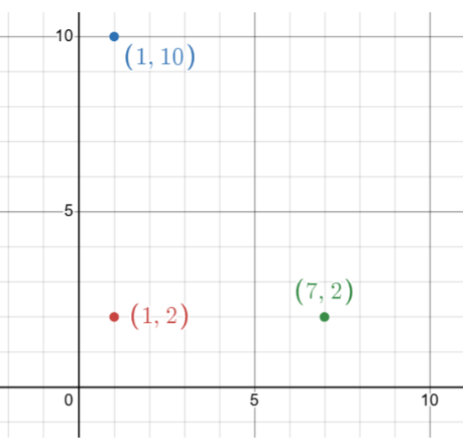
The points
and
lie on a horizontal line, and
and
on a vertical line, so the triangle has a right angle at
.
Legs:
and
. Hypotenuse:
.
Area
.
Semi-perimeter
.
The inradius
of a triangle satisfies
, so
.
The answer is 2.
Q49TITAPercentages
A fruit seller has a stock of mangoes, bananas and apples with at least one fruit of each type. At the beginning of a day, the number of mangoes make up 40% of his stock. That day, he sells half of the mangoes, 96 bananas and 40% of the apples. At the end of the day, he ends up selling 50% of the fruits. The smallest possible total number of fruits in the stock at the beginning of the day is
Type in your answer (TITA). No negative mark for a wrong answer.
Answer and solution
Answer: 340
Let the stock be
fruits, with
apples. Mangoes are 40% of the stock,
.
Fruits sold: half the mangoes,
; 96 bananas; and 40% of the apples,
. This is half the stock:
Multiplying by 10:
, so
.
For
to be a whole number,
must be a multiple of 3. For
apples to be sold,
must be a multiple of 5. So
is a multiple of 15, and the smallest positive value is
.
Then
. Check: 136 mangoes, 15 apples and 189 bananas; sold
, half of 340.
The answer is 340.
Q50TITALogarithms
If
,
and
are positive real numbers such that
and
, then the greatest possible integer value of
is
Type in your answer (TITA). No negative mark for a wrong answer.
Answer and solution
Answer: 14
, and in the same way
.
So
, which gives
, i.e.
.
With
:
, so
.
is possible:
,
satisfies
, and
. The greatest integer value of
is
.
Q51MCQFunctions & Graphs
A function
maps the set of natural numbers to whole numbers, such that
for all
,
and
for every prime number
. Then, the value of
is
- A4095
- B8191
- C2047
- D1023
Answer and solution
Answer: (A) 4095
First,
.
Add 1 to both sides of the rule:
.
So
satisfies
, with
for every prime
.
Hence
; for example
and
.
.
So
.
Option B (
) would need 13 prime factors, but
has
counted with repetition.
Hence, option A (4095).
Q52MCQQuadratic & Polynomial Equations
The roots
,
of the equation
, satisfy
. The value of
is
- A16
- B4
- C1
- D9
Answer and solution
Answer: (B) 4
For
:
and
.
.
Setting this equal to
gives
, so
.
Write
, so
. Then
.
So
, whichever sign
has.
Option D (9) is
and option C (1) is
; neither is the quantity asked for.
Hence, option B (4).
Q53MCQRatios, Proportions & Partnership
When Rajesh's age was same as the present age of Garima, the ratio of their ages was
. When Garima's age becomes the same as the present age of Rajesh, the ratio of the ages of Rajesh and Garima will become
- A
- B
- C
- D
Answer and solution
Answer: (C)
Let Garima's present age be
and Rajesh's
, where
is the age gap.
years ago, Rajesh was
(Garima's present age) and Garima was
:
, so
.
In
years, Garima will be
(Rajesh's present age) and Rajesh will be
.
Ratio
.
Option B (
) is their present ratio, not the future one.
Hence, option C (
).
Q54MCQPolygons & Circles
Three circles of equal radii touch (but not cross) each other externally. Two other circles,
and
, are drawn such that both touch (but not cross) each of the three previous circles. If the radius of
is more than that of
, the ratio of the radii of
and
is
- A
- B
- C
- D
Answer and solution
Answer: (A)
Let each of the three equal circles have radius
. Their centres form an equilateral triangle of side
, and both X and Y are centred at its centre O.
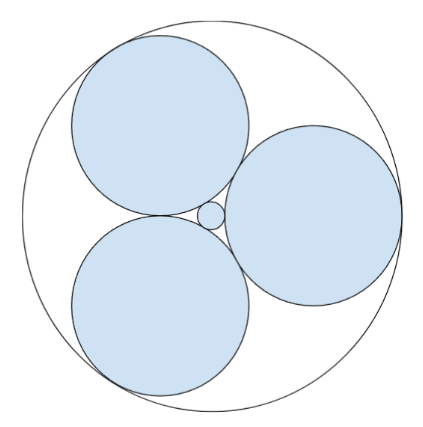
In the right triangle below, the side from a centre to a touching point is
, the hypotenuse to O is
, and the angle at the centre is
. So
, giving
.
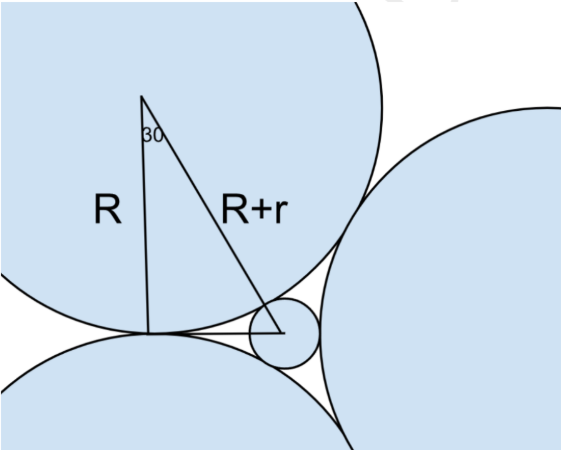
Small circle Y:
.
Large circle X reaches one radius beyond each centre: its radius is
.
Ratio
.
This is about 13.9; options B, C and D give only about 7.5, 5.7 and 3.7.
Hence, option A (
).
Q55MCQTriangles & Lines
is a trapezium in which
is parallel to
. The sides
and
when extended, intersect at point
. If
cm,
cm, and perimeter of
is 6 cm, then the perimeter, in cm, of
is
- A8
- B10
- C9
- D7
Answer and solution
Answer: (A) 8
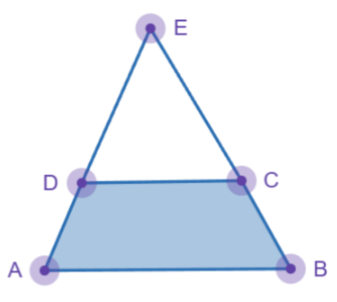
The perimeter of
is 6 cm, with
and
, so
.
Since
, triangles
and
are similar, with ratio
. So
, which makes D the midpoint of
; likewise C is the midpoint of
.
Hence
and
.
Perimeter of
cm.
This holds however the 3 cm is split between
and
, so no other value, such as 7 or 9, is possible.
Hence, option A (8).
Q56MCQAverages, Mixtures & Alligations
A company has 40 employees whose names are listed in a certain order. In the year 2022, the average bonus of the first 30 employees was Rs. 40000, of the last 30 employees was Rs. 60000, and of the first 10 and last 10 employees together was Rs. 50000. Next year, the average bonus of the first 10 employees increased by 100%, of the last 10 employees increased by 200% and of the remaining employees was unchanged. Then, the average bonus, in rupees, of all the 40 employees together in the year 2023 was
- A95000
- B90000
- C80000
- D85000
Answer and solution
Answer: (A) 95000
Split the 40 employees into four groups of 10 with average bonuses
, in order.
First 30:
, so
.
Last 30:
, so
.
First and last 10:
, so
.
Adding the first two:
, so
. Then
and
.
In 2023,
doubles to 40000 and
triples to 240000, while
stays 100000.
Average of all 40
.
Swapping the two increases (tripling
, doubling
) would give 80000, option C.
Hence, option A (95000).
Q57TITATime & Work
Amal and Vimal together can complete a task in 150 days, while Vimal and Sunil together can complete the same task in 100 days. Amal starts working on the task and works for 75 days, then Vimal takes over and works for 135 days. Finally, Sunil takes over and completes the remaining task in 45 days. If Amal had started the task alone and worked on all days, Vimal had worked on every second day, and Sunil had worked on every third day, then the number of days required to complete the task would have been
Type in your answer (TITA). No negative mark for a wrong answer.
Answer and solution
Answer: 139
Let Amal, Vimal and Sunil do
,
and
units of work per day, and let the task be
units.
…(1)
…(2)
…(3)
Adding (1) and (2):
. Doubling (3):
. Subtracting:
, so
.
From (2),
; from (1),
, so
.
New plan: Amal works every day, Vimal every second day and Sunil every third day. In each 6-day block, Amal works 6 days (
), Vimal 3 days (
) and Sunil 2 days (
), a total of
.
23 blocks take
days and complete
. The last
is done by Amal on day 139.
The answer is 139.
Q58MCQInequalities & Modulus
All the values of
satisfying the inequality
are
- A or
- B or
- C or
- D or
Answer and solution
Answer: (A) or
The critical points are
and
, where a denominator is zero.
For
: both denominators are positive, so
becomes
, i.e.
. Valid:
.
For
: the left side is positive and the right side negative, so the inequality never holds.
For
: both denominators are negative, so their product is positive and again
, i.e.
, which every
satisfies.
So
or
.
Option C drops the upper limit 8, but
gives
, which is false.
Hence, option A (
or
).
Q59MCQSimple & Compound Interest
Anil invests Rs 22000 for 6 years in a scheme with 4% interest per annum, compounded half-yearly. Separately, Sunil invests a certain amount in the same scheme for 5 years, and then reinvests the entire amount he receives at the end of 5 years, for one year at 10% simple interest. If the amounts received by both at the end of 6 years are equal, then the initial investment, in rupees, made by Sunil is
- A20860
- B20640
- C20480
- D20808
Answer and solution
Answer: (D) 20808
Anil: 4% a year compounded half-yearly is 2% per half-year, for 12 half-years. He receives
.
Sunil invests
. After 5 years (10 half-years) he has
; one more year at 10% simple interest multiplies this by 1.1.
Equating the two amounts:
The result is exact, so the nearby values 20860 (option A) and 20640 (option B) do not satisfy the equation.
Hence, option D (20808).
Q60MCQTime, Speed & Distance
A bus starts at 9 am and follows a fixed route every day. One day, it traveled at a constant speed of 60 km per hour and reached its destination 3.5 hours later than its scheduled arrival time. Next day, it traveled two-thirds of its route in one-third of its total scheduled travel time, and the remaining part of the route at 40 km per hour to reach just on time. The scheduled arrival time of the bus is
- A7 : 30 pm
- B7 : 00 pm
- C9 : 00 pm
- D10 : 30 pm
Answer and solution
Answer: (A) 7 : 30 pm
Let the scheduled travel time be
hours and the route length
km.
Day 1: at 60 km/h the bus takes
hours, so
.
Day 2: it covers
in
hours, so to arrive on time it covers the remaining
in
hours at 40 km/h. So
, giving
.
Equating:
, so
hours.
Starting at 9 am, the bus is scheduled to arrive 10.5 hours later, at 7:30 pm.
Option B (7 : 00 pm) would mean
, but then
km does not equal
km.
Hence, option A (7 : 30 pm).
Q61MCQIndices & Surds
If
and
are natural numbers such that
, and
, then
equals
- A209932
- B209937
- C209942
- D209947
Answer and solution
Answer: (D) 209947
Since
with
a natural number,
must divide both exponents, 25 and 40. Their only common factor greater than 1 is 5, so
.
Then
, so
.
.
Option C (209942) would need
, but 10 does not divide 25; the other options need values of
that are just as impossible.
Hence, option D (209947).
Q62MCQRemainders
When
is divided by 11, the remainder is
- A5
- B10
- C1
- D6
Answer and solution
Answer: (A) 5
Look for a power of 3 that leaves remainder 1 when divided by 11.
, so
leaves remainder 1.
Write
:
leaves remainder
, and
leaves remainder 5.
So
leaves remainder
.
Option C (1) would be the remainder only if 333 were a multiple of 5; the leftover
changes it to 5.
Hence, option A (5).
Q63TITAQuadratic & Polynomial Equations
If
and
are real numbers such that
, then the value of
is
Type in your answer (TITA). No negative mark for a wrong answer.
Answer and solution
Answer: 7
Complete the squares. The terms
need a
to form
.
Taking that
from
leaves
:
So
. A sum of squares of real numbers is zero only if each square is zero. So
, giving
, and
, giving
.
Then
.
The answer is 7.
Q64TITAIndices & Surds
If
, then
equals
Type in your answer (TITA). No negative mark for a wrong answer.
Answer and solution
Answer: 11
Let
and
, so
.
Then
.
Since
, we get
, so
.
From
and
:
and
, both positive, as square roots must be.
Then
.
Check:
, so
.
The answer is 11.
Q65TITAPermutations & Combinations
,
,
and
are four towns. One can travel between
and
along 3 direct paths, between
and
along 4 direct paths, and between
and
along 4 direct paths. There is no direct path between
and
, while there are few direct paths between
and
, and between
and
. One can travel from
to
either via
, or via
, or via
followed by
, respectively, in exactly 62 possible ways. One can also travel from
to
either directly, or via
, or via
, in exactly 27 possible ways. Then, the number of direct paths between
and
is
Type in your answer (TITA). No negative mark for a wrong answer.
Answer and solution
Answer: 7
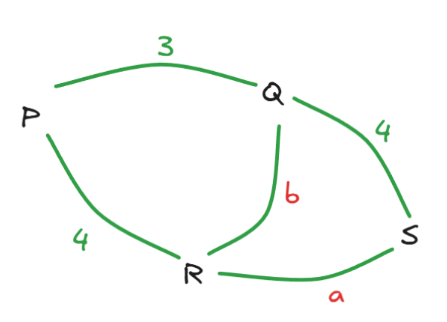
Let
be the number of direct paths between Q and R, and
the number between R and S.
P to S in 62 ways: via Q,
; via R,
; via Q then R,
. So
, or
…(1)
Q to R in 27 ways: directly,
; via P,
; via S,
. So
, or
…(2)
Subtracting (2) from (1):
, so
. So
is a divisor of 35:
:
, but
.
:
, so
is not a whole number.
:
, so
, and
fits (2).
:
, so
is not a whole number.
So there are 7 direct paths between Q and R.
The answer is 7.
Q66MCQInequalities & Modulus
If
and
satisfy the equations
and
, then
equals
- A20
- B15
- C5
- D10
Answer and solution
Answer: (B) 15
Split into cases by the signs of
and
.
,
: the equations become
and
, giving
, which contradicts
.
,
: they become
and
, contradicting
.
,
: the first becomes
, contradicting
.
,
: they become
and
. From the first,
; substituting,
, so
and
, which fits.
So
.
Option C (5) is
and option D (10) is
alone; neither is
.
Hence, option B (15).
Q67MCQAverages, Mixtures & Alligations
A vessel contained a certain amount of a solution of acid and water. When 2 litres of water was added to it, the new solution had 50% acid concentration. When 15 litres of acid was further added to this new solution, the final solution had 80% acid concentration. The ratio of water and acid in the original solution was
- A
- B
- C
- D
Answer and solution
Answer: (B)
After 2 litres of water are added, the solution is 50% acid; let it hold
litres of acid and
litres of water.
Adding 15 litres of acid makes it 80% acid:
, so
.
So after the water was added there were 5 litres of acid and 5 litres of water. Before the 2 litres of water were added, there were 5 litres of acid and 3 litres of water.
Water : acid
.
Option A (
) is the acid-to-water ratio, the reverse of what is asked.
Hence, option B (
).
Q68MCQSequences & Series
The sum of the infinite series
is equal to
- A7/816
- B5/408
- C7/408
- D5/816
Answer and solution
Answer: (B) 5/408
The
-th term is
.
So the series splits into two infinite geometric series:
Sum
.
Option D (
) is half of this value: it comes from halving the numerator
without halving the denominator
.
Hence, option B (5/408).