- CATin
- CAT past papers
- CAT 2022 Slot 1
- QA
CAT 2022 Slot 1 — QA questions with answers
All 22 questions of the Quantitative Ability section (14 MCQs, 8 TITA). Try each one, then open its answer and solution.
CAT 2022 Slot 1, timed like the real exam (120 minutes, 40 a section) and scored the CAT way: +3 right, −1 for a wrong MCQ, 0 for a wrong TITA, with the full post-mock analysis. Older official papers are in CATin Pro, with 80+ mocks and the full planner. The last three years of papers are free.
Sit this paper as a timed mock with CATin ProQuantitative Ability
CAT 2022 Slot 1 · 40 minutes · +3 for a right answer, −1 for a wrong MCQ, 0 for a wrong TITA
Q45TITARatios, Proportions & Partnership
In a village, the ratio of number of males to females is 5 : 4. The ratio of number of literate males to literate females is 2 : 3. The ratio of the number of illiterate males to illiterate females is 4 : 3. If 3600 males in the village are literate, then the total number of females in the village is
Type in your answer (TITA). No negative mark for a wrong answer.
Answer and solution
Answer: 43200
Literate males : literate females
, so literate females
.
Now write the illiterate counts in terms of the totals and use their ratio. Let there be
males and
females. Then illiterate males
and illiterate females
, and
, so
.
Females
.
Check: males
, so illiterate males
and illiterate females
, in the ratio
.
The answer is 43200.
Q46MCQAverages, Mixtures & Alligations
The average weight of students in a class increases by 600 gm when some new students join the class. If the average weight of the new students is 3 kg more than the average weight of the original students, then the ratio of the number of original students to the number of new students is
- A1 : 4
- B1 : 2
- C4 : 1
- D3 : 1
Answer and solution
Answer: (C) 4 : 1
Let there be
original students with average weight
kg, and
new students with average
kg. The new average is
kg (600 g):
, so
.
So
. Option A (1 : 4) reverses this: the new students are 3 kg heavier yet raise the average by only 0.6 kg, so they must be few. Hence, option C (4 : 1).
Q47MCQSequences & Series
For any natural number
, suppose the sum of the first
terms of an arithmetic progression is
. If the
term of the progression is divisible by 9, then the smallest possible value of
is
- A9
- B4
- C7
- D8
Answer and solution
Answer: (C) 7
It is given,
The terms are 3, 7, 11, 15, 19, 23, 27,......
27 is the first term in the series divisible by 9.
27 is the 7th term.
Therefore, the least possible value of n is 7.
Q48MCQFunctions & Graphs
Let
and
. Then the maximum value of
becomes 100 when
is equal to
- A25
- B100
- C50
- D0
Answer and solution
Answer: (C) 50
For
:
and
. These add to
, so
.
As
runs over
,
runs from
to
. Its largest absolute value is
, which is
because
keeps
. It is reached at
.
So the maximum of
is
. Setting
gives
.
Check: with
,
, and no
in
gives more.
The other options give a different maximum:
gives
and
gives
. With
,
can only be
, and
.
Hence, option C (50).
Q49MCQTime, Speed & Distance
Trains A and B start traveling at the same time towards each other with constant speeds from stations X and Y, respectively. Train A reaches station Y in 10 minutes while train B takes 9 minutes to reach station X after meeting train A. Then the total time taken, in minutes, by train B to travel from station Y to station X is
- A6
- B15
- C10
- D12
Answer and solution
Answer: (B) 15
Let the trains meet at M, a distance
from X, on a track XY of length
. Let the speeds of A and B be
and
.

Train A takes 10 minutes for the whole trip:
. After meeting, B covers
in 9 minutes:
.
Up to the meeting both run for the same time:
. Substituting,
, so
, i.e.
, i.e.
.
Speeds are positive, so
and
.
So B takes
minutes from Y to X. Option C (10) is train A's time, not B's. Hence, option B (15).
Q50TITAMensuration
A trapezium
has side
parallel to
,
,
cm and
cm. If the perimeter of this trapezium is 36 cm, then its area, in sq. cm, is
Type in your answer (TITA). No negative mark for a wrong answer.
Answer and solution
Answer: 66
Since
and
,
is the height; call it
. Drop
:
, so
and
.
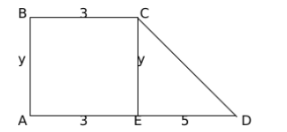
In right triangle
, the legs are
and 5, so
. The perimeter is 36:
, so
.
Squaring,
, so
and
(then
, and
).
Area of the trapezium
.
The answer is 66.
Q51MCQProfit, Loss & Discount
Ankita buys 4 kg cashews, 14 kg peanuts and 6 kg almonds when the cost of 7 kg cashews is the same as that of 30 kg peanuts or 9 kg almonds. She mixes all the three nuts and marks a price for the mixture in order to make a profit of ₹1752. She sells 4 kg of the mixture at this marked price and the remaining at a 20% discount on the marked price, thus making a total profit of ₹744. Then the amount, in rupees, that she had spent in buying almonds is
- A1680
- B1176
- C2520
- D1440
Answer and solution
Answer: (A) 1680
Let
, where
,
,
are the costs per kg of cashews, peanuts and almonds. Then
,
,
.
Cost of 4 kg cashews, 14 kg peanuts and 6 kg almonds
.
The 24 kg mixture is marked to give ₹1752 profit, so its full marked price is
. She sells 4 kg at the marked price and 20 kg at 80% of it:
.
Profit is ₹744:
, so
and
.
Almonds cost
rupees. Options D (1440) and B (1176) are the amounts spent on cashews (
) and peanuts (
). Hence, option A (1680).
Q52TITAProperties of Numbers
Let
be the largest positive integer that divides all the numbers of the form
, and
be the largest positive integer that divides all the numbers of the form
, where
is any positive integer. Then
equals
Type in your answer (TITA). No negative mark for a wrong answer.
Answer and solution
Answer: 82
A number that divides every value must divide the first few values, so start there.
: at
,
; at
,
. So
divides
. Also
and
are odd and
is even, so every value is even. Hence
.
:
.
At
this is 80, and for every
,
is a multiple of 80. So
.
.
The answer is 82.
Q53MCQQuadratic & Polynomial Equations
Let
,
,
be non-zero real numbers such that
, and
. If the set
consists of all integers
such that
, then the set
must necessarily be
- Athe set of all positive integers
- Bthe set of all integers
- Ceither the empty set or the set of all integers
- Dthe empty set
Answer and solution
Answer: (C) either the empty set or the set of all integers
Since
, the discriminant
is negative, so
has no real root and never changes sign.
If
,
for every
, so no integer
has
and
is empty.
If
,
for every
, so every integer is in
.
The sign of
is not given, and both cases fit
(for example
with
, or with
). So
is either empty or all integers. Option D (the empty set) covers only the case
. Hence, option C (either the empty set or the set of all integers).
Q54TITAPermutations & Combinations
The number of ways of distributing 20 identical balloons among 4 children such that each child gets some balloons but no child gets an odd number of balloons, is
Type in your answer (TITA). No negative mark for a wrong answer.
Answer and solution
Answer: 84
No child gets an odd number and each gets some, so each child gets an even number, at least 2. Let the children get
,
,
and
balloons, with
:
, so
.
The balloons are identical but the children are not, so we count ordered solutions. The number of ways to write 10 as an ordered sum of 4 positive integers is
.
The answer is 84.
Q55MCQQuadratic & Polynomial Equations
Let
and
be natural numbers. If
and
, then
equals
- A8
- B7
- C10
- D9
Answer and solution
Answer: (A) 8
Take out the common factor in each equation:
and
.
Both share the factor
, which is positive, so dividing the equations gives
, i.e.
.
Substituting in the first:
, i.e.
, i.e.
.
is a natural number, so
and
. Check:
and
.
. Option B (7) is
, not
. Hence, option A (8).
Q56TITAProfit, Loss & Discount
Amal buys 110 kg of syrup and 120 kg of juice, syrup being 20% less costly than juice, per kg. He sells 10 kg of syrup at 10% profit and 20 kg of juice at 20% profit. Mixing the remaining juice and syrup, Amal sells the mixture at ₹308.32 per kg and makes an overall profit of 64%. Then, Amal's cost price for syrup, in rupees per kg, is
Type in your answer (TITA). No negative mark for a wrong answer.
Answer and solution
Answer: 160
Let juice cost
per kg; syrup is 20% cheaper, so
per kg.
Total cost
.
10 kg syrup at 10% profit sells for
; 20 kg juice at 20% profit sells for
.
The remaining 100 kg syrup and 100 kg juice, 200 kg, sell at ₹308.32 per kg:
.
Overall profit is 64%:
, so
and
.
Syrup costs
rupees per kg.
The answer is 160.
Q57MCQPolygons & Circles
All the vertices of a rectangle lie on a circle of radius
. If the perimeter of the rectangle is
, then the area of the rectangle is
- A
- B
- C
- D
Answer and solution
Answer: (B)
Let the sides be
and
. All four vertices lie on the circle, so each diagonal is a diameter (the figure labels the radius
):
.
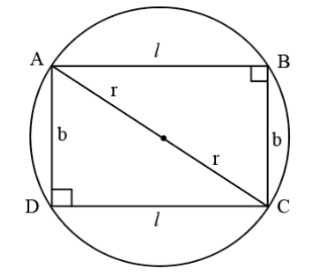
The perimeter gives
, so
. Squaring:
.
This is the area of the rectangle. Option A (
) is exactly half of it, so it fails. Hence, option B (
).
Q58MCQAverages, Mixtures & Alligations
The average of three integers is 13. When a natural number
is included, the average of these four integers remains an odd integer. The minimum possible value of
is
- A3
- B4
- C5
- D1
Answer and solution
Answer: (C) 5
The three integers add to
. With
included, the average is
, which must be an odd integer.
So
with
odd. Since
,
, so
; the smallest odd such
is 11.
, so
.
Option D (
) gives an average of
, which is even; options A and B give
and
, which are not integers. Hence, option C (5).
Q59MCQAverages, Mixtures & Alligations
A mixture contains lemon juice and sugar syrup in equal proportion. If a new mixture is created by adding this mixture and sugar syrup in the ratio 1 : 3, then the ratio of lemon juice and sugar syrup in the new mixture is
- A1 : 4
- B1 : 5
- C1 : 6
- D1 : 7
Answer and solution
Answer: (D) 1 : 7
Take 1 part of the original mixture: it holds
part lemon juice and
part sugar syrup. Add 3 parts of sugar syrup.
Lemon juice
part.
Sugar syrup
parts.
Ratio
, so lemon juice is
of the new mixture.
Option C (1 : 6) counts only the added syrup and forgets the half part already in the mixture. Hence, option D (1 : 7).
Q60MCQInequalities & Modulus
The largest real value of
for which the equation
has an infinite number of solutions for
is
- A-1
- B0
- C1
- D2
Answer and solution
Answer: (C) 1
is the sum of the distances from
to
and to
on the number line. This sum is at least the distance between
and
, which is
, and equals it for every
between them.
If
, every
between
and
is a solution: infinitely many. If
there are exactly two solutions, and if
there are none.
So
, giving
or
. The largest is
, when every
from
to
works.
Option D (
) puts
and
a distance 3 apart, so the sum is never 2. Hence, option C (1).
Q61MCQSet Theory
In a class of 100 students, 73 like coffee, 80 like tea and 52 like lemonade. It may be possible that some students do not like any of these three drinks. Then the difference between the maximum and minimum possible number of students who like all the three drinks is
- A47
- B53
- C52
- D48
Answer and solution
Answer: (A) 47
Let
,
,
,
be the numbers liking none, exactly one, exactly two and all three drinks.
and
. Subtracting,
.
Maximum:
, as only 52 like lemonade.
works with
,
,
(20 coffee only, 27 tea only, 1 coffee and tea).
Minimum:
, so
, giving
.
works with
and
(48 coffee and tea, 20 coffee and lemonade, 27 tea and lemonade).
Difference
. Option C (52) is the maximum alone, not the difference. Hence, option A (47).
Q62MCQCoordinate Geometry
Let
be a parallelogram such that the coordinates of its three vertices
,
,
are
,
and
, respectively. Then, the coordinates of the vertex
are
- A
- B
- C
- D
Answer and solution
Answer: (D)
In a parallelogram the diagonals bisect each other, so diagonals AC and BD have the same midpoint.
Midpoint of AC
.
Let
. Midpoint of BD
.
Equating:
, so
; and
, so
.
So
, which is the same as
. The trap
comes from treating BC as a diagonal, but in ABCD the diagonals are AC and BD.
Hence, option D (
).
Q63TITAProperties of Numbers
For natural numbers
,
, and
, if
and
, then the minimum possible value of
is
Type in your answer (TITA). No negative mark for a wrong answer.
Answer and solution
Answer: 34
It is given, y(x + z) = 19
y cannot be 19.
If y = 19, x + z = 1 which is not possible when both x and z are natural numbers.
Therefore, y = 1 and x + z = 19
It is given, z(x + y) = 51
z can take values 3 and 17
Case 1:
If z = 3, y = 1 and x = 16
xyz = 3*1*16 = 48
Case 2:
If z = 17, y = 1 and x = 2
xyz = 17*1*2 = 34
Minimum value xyz can take is 34.
Q64MCQSimple & Compound Interest
Alex invested his savings in two parts. The simple interest earned on the first part at 15% per annum for 4 years is the same as the simple interest earned on the second part at 12% per annum for 3 years. Then, the percentage of his savings invested in the first part is
- A37.5%
- B62.5%
- C60%
- D40%
Answer and solution
Answer: (A) 37.5%
Let the two parts be
and
. The simple interest is equal:
, so
and
.
So the savings split into 8 equal shares, 3 in the first part. First part
.
This makes sense: the first part earns at a higher rate for longer, so it must be the smaller part. Option B (62.5%) is the second part's share. Hence, option A (37.5%).
Q65TITARatios, Proportions & Partnership
Pinky is standing in a queue at a ticket counter. Suppose the ratio of the number of persons standing ahead of Pinky to the number of persons standing behind her in the queue is 3 : 5. If the total number of persons in the queue is less than 300, then the maximum possible number of persons standing ahead of Pinky is
Type in your answer (TITA). No negative mark for a wrong answer.
Answer and solution
Answer: 111
The ratio
means the counts are
ahead of Pinky and
behind her, for some whole number
. Including Pinky, the queue has
people.
The queue has fewer than 300 people, so
, giving
and
. The largest whole value is
.
Then
people stand ahead of her (with 185 behind, 297 in all).
The answer is 111.
Q66TITAProperties of Numbers
For any real number
, let
be the largest integer less than or equal to
. If
, then
is
Type in your answer (TITA). No negative mark for a wrong answer.
Answer and solution
Answer: 44
.
For
to
,
runs from 6 to 24, so each term is 0.
For
to
,
runs from 25 to 49, so each term is 1.
At
,
and the term becomes 2.
So for
the sum counts the terms from
to
, which is
. Setting
gives
. Going on to
would make the sum 27.
The answer is 44.