- CATin
- CAT past papers
- CAT 2020 Slot 1
- QA
CAT 2020 Slot 1 — QA questions with answers
All 26 questions of the Quantitative Ability section (18 MCQs, 8 TITA). Try each one, then open its answer and solution.
CAT 2020 Slot 1, timed like the real exam (120 minutes, 40 a section) and scored the CAT way: +3 right, −1 for a wrong MCQ, 0 for a wrong TITA, with the full post-mock analysis. Older official papers are in CATin Pro, with 80+ mocks and the full planner. The last three years of papers are free.
Sit this paper as a timed mock with CATin ProQuantitative Ability
CAT 2020 Slot 1 · 40 minutes · +3 for a right answer, −1 for a wrong MCQ, 0 for a wrong TITA
Q51MCQLogarithms
If
is a negative number such that
, then
equals to:
- A
- B
- C
- D
Answer and solution
Answer: (B)
Use
on the left side:
.
So
. Equating the powers of 5 gives
.
Since
, this becomes
, so
.
is negative, so
.
Option D,
, equals
, which is positive and so is ruled out. Options A and C involve
, which does not satisfy the equation.
Hence, option B (
).
Q52TITALinear Equations
A gentleman decided to treat a few children in the following manner. He gives half of his total stock of toffees and one extra to the first child, and then the
half of the remaining stock along with one extra to the second and continues giving away in this fashion. His total stock exhausts after he takes care of 5
children. How many toffees were there in his stock initially?
Type in your answer (TITA). No negative mark for a wrong answer.
Answer and solution
Answer: 62
Work backwards. If he has
toffees before a child, the child gets
and
remain. So if
remain after a child, there were
before that child.
After the 5th child, 0 remain.
Before the 5th child:
.
Before the 4th:
.
Before the 3rd:
.
Before the 2nd:
.
Before the 1st:
.
Check forwards: from 62 the first child gets 32, leaving 30; then 16, leaving 14; then 8, leaving 6; then 4, leaving 2; then 2, leaving 0.
The answer is 62.
Q53TITADigits & Base Systems
How many 3-digit numbers are there, for which the product of their digits is more than 2 but less than 7?
Type in your answer (TITA). No negative mark for a wrong answer.
Answer and solution
Answer: 21
The product of the digits must be 3, 4, 5 or 6. No digit can be 0, or the product would be 0.
Product 3: digits 1, 1, 3, which can be arranged in
ways.
Product 5: digits 1, 1, 5, in 3 ways.
Product 4: digits 1, 1, 4 (3 ways) or 1, 2, 2 (3 ways), giving 6 numbers.
Product 6: digits 1, 1, 6 (3 ways) or 1, 2, 3 (
ways), giving 9 numbers.
Total
.
The answer is 21.
Q54MCQInequalities & Modulus
The number of real-valued solutions of the equation
is:
- A1
- B2
- Cinfinite
- D0
Answer and solution
Answer: (D) 0
By AM–GM, since
and
are positive,
, with equality only at
.
Since
, the right side satisfies
, with equality only at
.
So the left side is always at least 2 and the right side at most 2. They can be equal only if both equal 2 at the same
. But the left side needs
and the right side needs
, so no real
works.
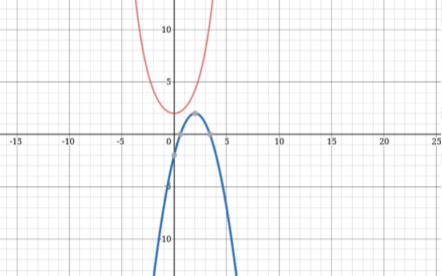
The graph shows this: the upper curve
has its lowest point at
, the downward parabola
has its highest point at
, and the two never meet.
Option A (1) would need a common point, but at
the right side is
, not 2.
Hence, option D (0).
Q55MCQIndices & Surds
How many distinct positive integer-valued solutions exist to the equation
?
- A8
- B4
- C2
- D6
Answer and solution
Answer: (D) 6
in three cases.
Exponent 0 with a non-zero base:
gives
. The base there is 5 and 11, both non-zero.
Base 1:
gives
, so
.
Base
with an even exponent:
gives
. The exponent is
at
and
at
. Both are even, so both work.
The solutions are 2, 3, 4, 5, 6 and 7, which is six values. Option B (4) is what you get if you miss the base
case.
Hence, option D (6).
Q56MCQMensuration
A solid right circular cone of height 27 cm is cut into two pieces along a plane parallel to its base at a height of 18 cm from the base. If the difference in
volume of the two pieces is 225 cc, the volume, in cc, of the original cone is
- A243
- B232
- C256
- D264
Answer and solution
Answer: (A) 243
The top piece is a small cone of height
cm, which is
of the full height. It is similar to the original cone, so its radius is also
of the base radius:
against
.
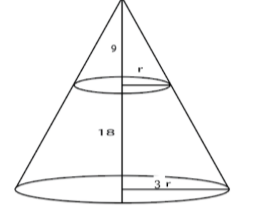
Volumes of similar cones are in the ratio of the cubes of their heights, so the small cone is
of the original volume
.
Small cone
and the lower piece (the frustum)
.
Difference
, so
cc.
Option C (256) would give a difference of
, not 225.
Hence, option A (243).
Q57TITACoordinate Geometry
The area of the region satisfying the inequalities
and
is
Type in your answer (TITA). No negative mark for a wrong answer.
Answer and solution
Answer: 3
The inequality
means
, that is,
. Together with
, the region lies in the band between
and
, between the lines
and
.
At
:
, so
, a width of 2.
At
:
, so
, a width of 4.
The width grows steadily with
, so the region is a trapezium with vertices
,
,
and
. It is the white region in the figure.
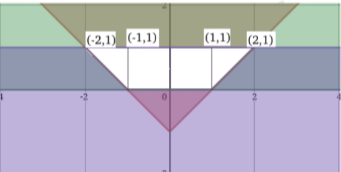
Its parallel sides are 2 and 4, and its height is 1.
Area
.
The answer is 3.
Q58MCQMensuration
On a rectangular metal sheet of area 135 sq in, a circle is painted such that the circle touches two opposite sides. If the area of the sheet left unpainted is two-thirds of the painted area then the perimeter of the rectangle in inches is
- A
- B
- C
- D
Answer and solution
Answer: (A)
The circle touches two opposite sides, so its diameter equals the distance between them. That must be the shorter side, since the circle could not fit across the longer one. Let the radius be
, so the shorter side is
.
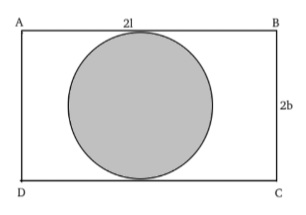
Unpainted
of painted, so the sheet is
of the circle:
. Then
and
.
Shorter side
. Longer side
.
Perimeter
.
Option C,
, is exactly half of this. It is the semi-perimeter, not the perimeter.
Hence, option A (
).
Q59MCQPolygons & Circles
A circle is inscribed in a rhombus with diagonals 12 cm and 16 cm. The ratio of the area of circle to the area of rhombus is
- A
- B
- C
- D
Answer and solution
Answer: (A)
The diagonals bisect each other at right angles at O, giving four right triangles with legs 6 and 8. So each side of the rhombus is
cm.
The inscribed circle is centred at O and touches side AD at T, so its radius
is OT, the perpendicular from O to AD.
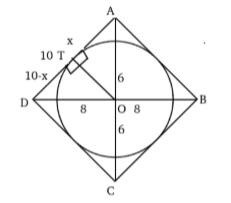
In right triangle AOD, twice the area is both
and
, so
, giving
cm.
Area of the rhombus
sq cm.
Circle area
.
Ratio
.
Option C,
, is half the correct ratio. It comes from dividing by the full product of the diagonals, 192, instead of half of it.
Hence, option A (
).
Q60MCQAverages, Mixtures & Alligations
Among 100 students,
have birthdays in January,
have birthdays in February, and so on. If
, then the smallest possible value of
is
- A8
- B9
- C10
- D12
Answer and solution
Answer: (B) 9
The 12 monthly counts add to 100. If every month had at most 8 students, the total would be at most
. So some month has at least 9, and
.
9 can be achieved: put 9 students in four months and 8 in the other eight. This gives
, with a maximum of 9.
Option A (8) fails because 12 months of at most 8 students hold only 96 people.
Hence, option B (9).
Q61MCQTime, Speed & Distance
A straight road connects points A and B. Car 1 travels from A to B and Car 2 travels from B to A, both leaving at the same time. After meeting each other,
they take 45 minutes and 20 minutes, respectively, to complete their journeys. If Car 1 travels at the speed of 60 km/hr, then the speed of Car 2, in km/hr, is
- A100
- B90
- C80
- D70
Answer and solution
Answer: (B) 90
Let the cars meet
minutes after starting, with speeds
(Car 1) and
(Car 2).
After meeting, Car 1 covers the stretch Car 2 had covered, in 45 minutes:
.
After meeting, Car 2 covers the stretch Car 1 had covered, in 20 minutes:
.
Multiplying the two equations:
, so
and
minutes.
Then
, and with
km/hr,
km/hr.
Check: in 30 minutes Car 1 covers
km, which Car 2 covers in 20 minutes at
km/hr.
With option A (100 km/hr) the two equations disagree:
gives
minutes, but
gives
minutes.
Hence, option B (90).
Q62TITAProfit, Loss & Discount
A person spent Rs 50000 to purchase a desktop computer and a laptop computer. He sold the desktop at 20% profit and the laptop at 10% loss. If overall he
made a 2% profit then the purchase price, in rupees, of the desktop is
Type in your answer (TITA). No negative mark for a wrong answer.
Answer and solution
Answer: 20000
Let the purchase price of the desktop computer be and the laptop computer be .
Total cost price (CP): .
He sold the desktop at a 20% profit, so its selling price is .
He sold the laptop at a 10% loss, so its selling price is .
Overall, he made a 2% profit on the total investment of 50000, so the total selling price (SP) is .
We have the equation:
Multiply the first equation by 0.9:
Subtract this from the second equation:
.
The purchase price of the desktop is Rs. 20000.
Q63TITAAverages, Mixtures & Alligations
A solution, of volume 40 litres, has dye and water in the proportion 2 : 3. Water is added to the solution to change this proportion to 2 : 5. If one fourths of
this diluted solution is taken out, how many litres of dye must be added to the remaining solution to bring the proportion back to 2 : 3?
Type in your answer (TITA). No negative mark for a wrong answer.
Answer and solution
Answer: 8
Initially, the 40-litre solution has dye and water in the ratio .
Amount of Dye = litres.
Amount of Water = litres.
Water is added to change the proportion to .
Since the amount of dye remains the same (16 litres), let the new amount of water be .
litres.
(This means 16 litres of water was added, making the total volume litres).
One-fourth () of this diluted solution is taken out.
Dye removed = litres. Dye remaining = litres.
Water removed = litres. Water remaining = litres.
We need to bring the proportion back to by adding dye.
Let the amount of dye to be added be .
.
Hence, 8 litres of dye must be added.
Q64MCQIndices & Surds
If
, then which of the following equals to 64?
- A
- B
- C
- D
Answer and solution
Answer: (C)
Given .
Note that . So, .
Let's check the options to see which equals .
We can evaluate the expression (Option D):
Substitute :
Using the identity :
.
Thus, . This is not 64.
Now check Option C:
From above, we know .
So, .
Hence, Option C is the correct answer.
Q65MCQRatios, Proportions & Partnership
An alloy is prepared by mixing three metals A, B and C in the proportion 3 : 4 : 7 by volume. Weights of the same volume of the metals A. B and C are in the
ratio 5 : 2 : 6. In 130 kg of the alloy, the weight, in kg. of the metal C is
- A48
- B84
- C70
- D96
Answer and solution
Answer: (B) 84
The weight of each metal is its volume times its weight per unit volume.
Take volumes
and unit weights
. The weights are then A:
, B:
and C:
, a total of
.
So C makes up
of the alloy by weight:
kg.
Using the volume ratio alone would give
kg, which ignores the different unit weights. Option C (70) would make C only
of the weight, less than its true share of
.
Hence, option B (84).
Q66TITAQuadratic & Polynomial Equations
The number of distinct real roots of the equation
equals
Type in your answer (TITA). No negative mark for a wrong answer.
Answer and solution
Answer: 1
Let
. Then
, so
, and
or
.
If
, then
. Its discriminant is
, so there is no real root.
If
, then
, that is
, so
. This is a repeated root, counted once.
So the equation has exactly one distinct real root,
.
The answer is 1.
Q67TITALogarithms
If
, then
equals
Type in your answer (TITA). No negative mark for a wrong answer.
Answer and solution
Answer: 36
Given:
We can rewrite the equation by converting all logarithms using the change of base formula to natural logs:
Cancelling from both sides (since it is non-zero):
.
Q68MCQTime, Speed & Distance
Leaving home at the same time, Amal reaches the office at 10:15 am if he travels at 8 km/hr, and at 9:40 am if he travels at 15 km/hr. Leaving home at 9.10
am, at what speed, in km/hr, must he travel so as to reach office exactly at 10 am?
- A13
- B12
- C14
- D11
Answer and solution
Answer: (B) 12
Let the distance be
km. At 8 km/h he arrives 35 minutes later than at 15 km/h (9:40 to 10:15), so
.
Then
, so
km.
Leaving at 9:10 and arriving at 10:00 gives 50 minutes, which is
hour.
Speed
km/h.
Option C (14) takes
hour, about 43 minutes, so he would arrive about 9:53, too early. Option D (11) takes about 55 minutes, so he would arrive late.
Hence, option B (12).
Q69MCQTime, Speed & Distance
A train travelled at one-third of its usual speed, and hence reached the destination 30 minutes after the scheduled time. On its return journey, the train
initially travelled at its usual speed for 5 minutes but then stopped for 4 minutes for an emergency. The percentage by which the train must now increase its
usual speed so as to reach the destination at the scheduled time, is nearest to
- A50
- B58
- C67
- D61
Answer and solution
Answer: (C) 67
At one-third speed the trip takes 3 times as long. It arrives 30 minutes late, so
, giving the usual time
minutes.
On the return trip, the train runs 5 minutes at its usual speed
, covering
of the route. It then stops for 4 minutes, so 9 of the 15 minutes are used and 6 minutes remain for the other
of the route.
At usual speed,
of the route takes 10 minutes. To do it in 6 minutes, the speed must be
times
.
The increase is
of
, about
, which is nearest to 67.
Option D (61) is too small: at
the remaining part takes about
minutes, so the train would be late.
Hence, option C (67).
Q70MCQDigits & Base Systems
The mean of all 4-digit even natural numbers of the form 'aabb', where
, is
- A4466
- B5050
- C4864
- D5544
Answer and solution
Answer: (D) 5544
The number
, where
runs over 1 to 9 and
over the even digits 0, 2, 4, 6, 8. Every pair gives one number, so there are
numbers.
Every value of
is paired with every value of
, so the mean of
is
.
The mean of
is 5, and the mean of
is
.
Mean
.
Option A (4466) equals
, which would need a mean of 4 for
and 6 for
, but the means are 5 and 4.
Hence, option D (5544).
Q71MCQTime, Speed & Distance
Two persons are walking beside a railway track at respective speeds of 2 and 4 km per hour in the same direction. A train came from behind them and
crossed them in 90 and 100 seconds, respectively. The time, in seconds, taken by the train to cross an electric post is nearest to
- A87
- B82
- C78
- D75
Answer and solution
Answer: (B) 82
Let the train's speed be
km/h and its length
m. When passing a walker, the train covers its own length at its speed minus the walker's speed.
Equating:
, so
km/h and
m.
To pass a post, the train covers 500 m at
m/s. This takes
s.
81.8 s is much nearer 82 than option C (78) or option A (87).
Hence, option B (82).
Q72MCQProperties of Numbers
If
and
are positive integers such that
,
and
, then the smallest possible value of
is
- A49
- B56
- C59
- D46
Answer and solution
Answer: (D) 46
must divide 96 and be less than 9, so
is 1, 2, 3, 4, 6 or 8. Then
, and
must be a whole number.
:
,
, sum 56.
:
,
, sum 49.
:
,
, sum 46.
:
,
, not allowed.
:
,
, sum 59.
:
,
, not allowed.
The smallest sum is 46, with
,
,
. Option A (49), from
, is the next smallest but is larger.
Hence, option D (46).
Q73MCQPercentages
In a group of people, 28% of the members are young while the rest are old. If 65% of the members are literates, and 25% of the literates are young, then the
percentage of old people among the illiterates is nearest to
- A62
- B55
- C59
- D66
Answer and solution
Answer: (D) 66
Take 100 people: 28 young and 72 old; 65 literate and 35 illiterate.
Young literates
of
.
Young illiterates
.
Old illiterates
.
Share of old people among the illiterates
, which is nearest to 66.
The next closest option, A (62), is more than 4 points away from 66.4.
Hence, option D (66).
Q74TITASimple & Compound Interest
Veeru invested Rs 10000 at 5% simple annual interest, and exactly after two years, Joy invested Rs 8000 at 10% simple annual interest. How many years
after Veeru’s investment, will their balances, i.e., principal plus accumulated interest, be equal?
Type in your answer (TITA). No negative mark for a wrong answer.
Answer and solution
Answer: 12
Let be the number of years after Veeru's investment when their balances become equal.
Veeru invested Rs 10000 at 5% simple interest.
Amount for Veeru after years = .
Joy invested Rs 8000 at 10% simple interest exactly 2 years after Veeru.
So, the time period for Joy's investment is years.
Amount for Joy after years = .
Equating their balances:
.
Hence, their balances will be equal 12 years after Veeru's investment.
Q75MCQFunctions & Graphs
If
for every real
, and
has four distinct real roots, then the sum of these roots is
- A0
- B40
- C10
- D20
Answer and solution
Answer: (D) 20
means the graph of
is symmetric about
. If
is a root, put
: then
, so
is also a root.
So the roots pair up as
and
, and each pair sums to 10. Only
would pair with itself. If 5 were a root, the other three roots would have to pair up among themselves, which is impossible. So the four roots form two pairs.
Sum
.
Option C (10) counts only one pair.
Hence, option D (20).
Q76MCQLinear Equations
Let
and
be three positive integers such that the sum of
and the mean of
and
is 5. In addition, the sum of
and the mean of
and
is 7. Then
the sum of
and
is
- A5
- B4
- C6
- D7
Answer and solution
Answer: (C) 6
gives
.
gives
.
Subtracting:
. Putting
into the first equation gives
, so
.
must be a positive integer, so
, which gives
and
.
So
.
Option D (7) cannot work: since
,
is always even.
Hence, option C (6).